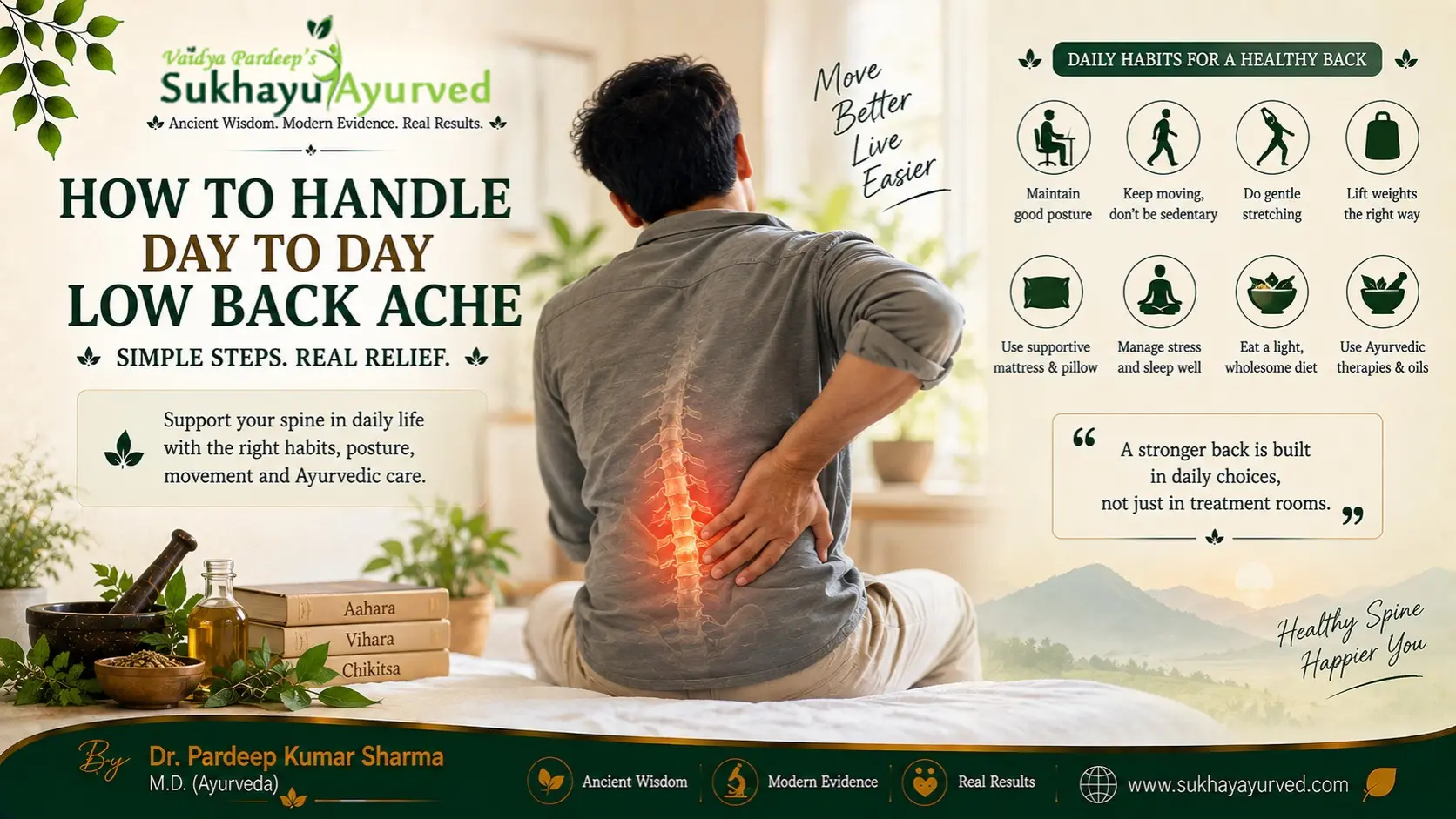
The back that has been held still too long does not ache. It seizes.
Understanding ordinary back pain
Most back pain that walks into an OPD is not a disc, not a nerve, and not a disease. It is a back that has been asked to hold one position for too long — a desk, a long drive, a counter, a shop floor, an eight-hour shift standing at a corporate event — and has stiffened in protest.
This is the pain that arrives after the flight, not during it. It builds through the working week and eases on Sunday. It is worse for the first few minutes of standing up and better once you have walked around the room. It is muscular in character: a band of tightness across the low back, a reluctance to bend, an ache that follows the shape of the muscle rather than the shape of a nerve.
That last distinction is the whole of this page. Ordinary back pain stays in the back. When pain leaves the back and travels down the leg — when it brings numbness, heaviness, weakness, or a leg that gives way — it is no longer the condition described here, and it needs examination rather than self-care. That line is drawn precisely further down, and it is worth reading before you try any of the measures on this page.
What Ayurveda calls it
The classical name for this presentation is kaṭi-graha — kaṭi, the lumbar region; graha, seizing, gripping, being held. Not śūla, which is pain. Graha, which is stiffness.
That naming is not a technicality. It tells you what the disorder actually is. The pain is a consequence; the loss of free movement is the disorder itself. This is why rest alone so rarely resolves it — rest is more of the same stillness that produced it — and why appropriate movement so often does.
The doṣa involved is Vāta. Charaka lists the causes of Vāta aggravation directly, and two of them are precisely the two histories that produce this pain:
लङ्घनप्लवनात्यध्वव्यायामातिविचेष्टितैः | धातूनां सङ्क्षयाच्चिन्ताशोकरोगातिकर्षणात् ||१६|| दुःखशय्यासनात् क्रोधाद्दिवास्वप्नाद्भयादपि | वेगसन्धारणादामादभिघातादभोजनात् ||१७||
Charaka Saṃhitā, Chikitsā Sthāna, Chapter 28, verses 16–17
Among the causes named there are atyadhva — excessive or prolonged travel — and duḥkha-śayyā-āsana — sitting and lying in a manner that is unsound. Long journeys and bad seating. The text is describing office chairs and highway hours two thousand years before either existed, because the mechanism has not changed: sustained immobility dries and hardens tissue that was built to move.
The causes may differ — one patient sat, one stood, one travelled — but they converge on a single condition. That convergence is itself a Vāta characteristic.
Which tissues are involved
In this presentation the disturbance is held at the level of māṃsa (muscle), snāyu (ligament and tendon), and asthi — specifically the sandhi, the joints of the lumbar spine.
There is no penetration to majjā.
That single clinical fact is the reason ordinary back pain behaves the way it does, and it is the reason it is separable from serious spinal disease. Majjā dhātu carries the nervous tissue. When a spinal problem reaches majjā — as it does in a significant disc herniation or in gṛdhrasī — the presentation changes character entirely. Pain radiates. Sensation alters. Strength fails. Those are majjā-level signs, and they do not belong to kaṭi-graha.
So the honest summary is this: if your pain has stayed in your back, is worse for stillness, and is better for movement, you are most likely dealing with māṃsa–snāyu–sandhi stiffness. If it has left your back, you are not, and the rest of this page is not written for you.
Two patterns, two different corrections
The most common mistake in self-managing back pain is treating it as one problem. It is not. The long-sitting back and the long-standing back have failed in opposite directions, and the advice that helps one will often aggravate the other.
The long-sitting patient
People who sit for hours generally develop flexion intolerance. Prolonged slouching flattens the natural lordotic curve of the lower back, and the pain is triggered by that sustained rounding.
The correction is extension and interruption:
- Stand up at least once every hour. The interval matters more than what you do in it. An hour is the threshold, not a target to negotiate down.
- Take a standing extension micro-break. Stand, reach both arms gently toward the ceiling, and take a deep breath. The movement reverses the seated slouch and restores the curve the chair has been flattening.
The long-standing patient
People who stand for hours develop the opposite problem: extension intolerance, or static muscular fatigue. The lower back muscles clamp down and over-activate, holding a contraction they were never designed to hold for a full shift.
The correction is decompression and dynamic loading:
- Walk, don't just stand. Brisk walking breaks are more useful than static standing. Walking creates an alternating, dynamic load across the pelvis and spine, clearing metabolic waste and restoring circulation through tissue that has been held in one gear.
- Use the catcher's stance. Lean the hips back, slide the hands down to rest just above the knees, and let the arms carry the weight of the torso. This takes the load off the lower back muscles completely and lets them stop working for a moment.
If you sit all day, extension helps you. If you stand all day, it is the thing you have been doing too much of. Match the correction to the history.
At home: oil and heat
There is a measure that helps this presentation, and it is important to name it accurately.
This is not snehana and svedana. Classical snehana and svedana are formal Pañcakarma procedures, prescribed to a specific patient after assessment, in sequence, under supervision, with defined preparation and end-points. What is described below is a simple domestic measure that borrows their logic. Calling it Pañcakarma would be dishonest, and doing real Pañcakarma from a webpage would be unsafe.
What can be done at home:
- Apply medicated oil over the lower back. Mix equal quantities of the Mahanarayan and Mahavishgarbha Oil. ›
- Leave the oil on for about thirty minutes. This step is routinely skipped and it is the step that matters. Oil applied and immediately wiped away has not had time to do anything.
- Then apply moist heat — a warm, wet towel over the area. Not a dry heating pad; the moisture carries the heat into the tissue.
The order is not decorative. Oil first, time, then heat. The principles behind therapeutic oil application are worth understanding if you intend to do this regularly rather than occasionally.
Āhāra: what to eat, and what dries you out
Vāta is dry, light, and cold. Food that shares those qualities adds to the problem.
Favour food that is warm and unctuous — freshly cooked, served hot, with adequate fat in it. Ghee and oil in cooking are not the enemy here; they are the correction.
Reduce or avoid the dry foods that quietly aggravate Vāta while carrying a reputation for being healthy:
- Oats
- Raw salads
- Sprouts
These are the standard recommendations of contemporary diet advice, and in a patient whose problem is dryness and stiffness, they work against the correction. This is not a claim that they are bad food. It is a claim that they are the wrong food for this particular state — which is the whole of Ayurvedic dietary reasoning, and which is covered more fully in the ritual of eating.
Instead of reaching for a painkiller
The previous version of this page recommended over-the-counter analgesics by brand name. That advice has been removed. Whether you take an analgesic, and which one, is a decision for the physician who prescribes for you — not for a website, and not for a pharmacy counter.
What can be offered instead, as a household measure for this presentation:
Til taila (sesame oil), 2–3 teaspoons, taken with warm milk.
Take this in early morning, empty stomach for a week only. If you are cardiac patient or suffering with Dyslipidaemia - avoid or consult with your Ayurveda doctor.
This is a nutritive measure appropriate to a dry, Vāta-predominant state. It is not an analgesic and should not be expected to behave like one.
A word on yoga
The old version of this page ended with "add yoga to your daily life." That is not advice; it is a slogan.
Movement helps kaṭi-graha, and specific postures help specific patterns. But postures chosen blindly can aggravate — a flexion-based sequence given to a flexion-intolerant desk worker will make things worse, and in the presence of nerve involvement, some very common poses are actively harmful. We have written separately on why yoga can make sciatica worse. Read it before you build a routine around your back.
When this is not ordinary back pain
Everything above assumes māṃsa–snāyu–sandhi involvement without majjā. The following signs suggest otherwise. If any of them are present, stop self-managing and seek examination.
Seek emergency care immediately for:
- Loss of bladder or bowel control, or difficulty passing urine
- Numbness in the saddle area — the inner thighs, groin, or buttocks
- Rapidly progressing weakness in one or both legs
These are cauda equina warning signs. They are a surgical emergency and they are time-critical. They do not wait for an appointment.
Seek prompt medical assessment for:
- Pain radiating down one or both legs, below the knee
- Numbness, tingling, or a sensation of heaviness in the leg
- A leg that feels weak, drags, or gives way
- Jerky or uncontrolled movement in the legs
- Back pain accompanied by fever, unexplained weight loss, or a history of cancer
- Pain that is worse at night or at rest, rather than better
- Pain following a fall or injury
- Pain that has not improved at all after two weeks of sensible self-care
Back pain that is ignored does not always stay ordinary. We have written on how low back pain progresses when it is left alone, and on when sciatica becomes a surgical emergency. Both are worth knowing.
One further caution: an MRI finding does not automatically explain your pain, and pain without an MRI finding is not imaginary. What your scan says and what your back is doing are frequently two different stories.
Who this page is for
This page is written for you if: your back pain is recent or recurrent, follows periods of sitting, standing, or travel, stays in the back, is worse for stillness and better for movement, and comes with no neurological signs.
This page is not written for you if: you have any of the red flags listed above, a diagnosed structural spinal condition, an inflammatory or autoimmune spinal disease, a history of spinal surgery, osteoporosis, or back pain in pregnancy. Those need individual assessment, not a general page.
When self-care is not enough
If sensible correction of posture, movement, oil, heat, and diet has not changed anything in two weeks, the problem is probably not simple kaṭi-graha, and continuing to self-manage costs you time.
At that point the question is not "which remedy" but "what is actually happening" — which requires examination, history, and where indicated, imaging. Our approach to low back ache begins with establishing which tissues are involved and how deep the disturbance runs, because the treatment for māṃsa-level stiffness and the treatment for majjā-level disease are not the same treatment.
We do not sell packages. We treat diagnoses.
Ayurvedic care here is offered alongside your existing medical care, not as a replacement for it. Any change to medication you have been prescribed is a decision for your prescribing physician alone.
Cure is divine. Treatment is possible.
Reviewed by Dr. Pardeep Sharma, M.D. (Ayurveda), Medical Director, Sukhayu Ayurved — NABH accredited, CGHS and RGHS empanelled, Jaipur.
This page is educational and is not a substitute for individual medical assessment.