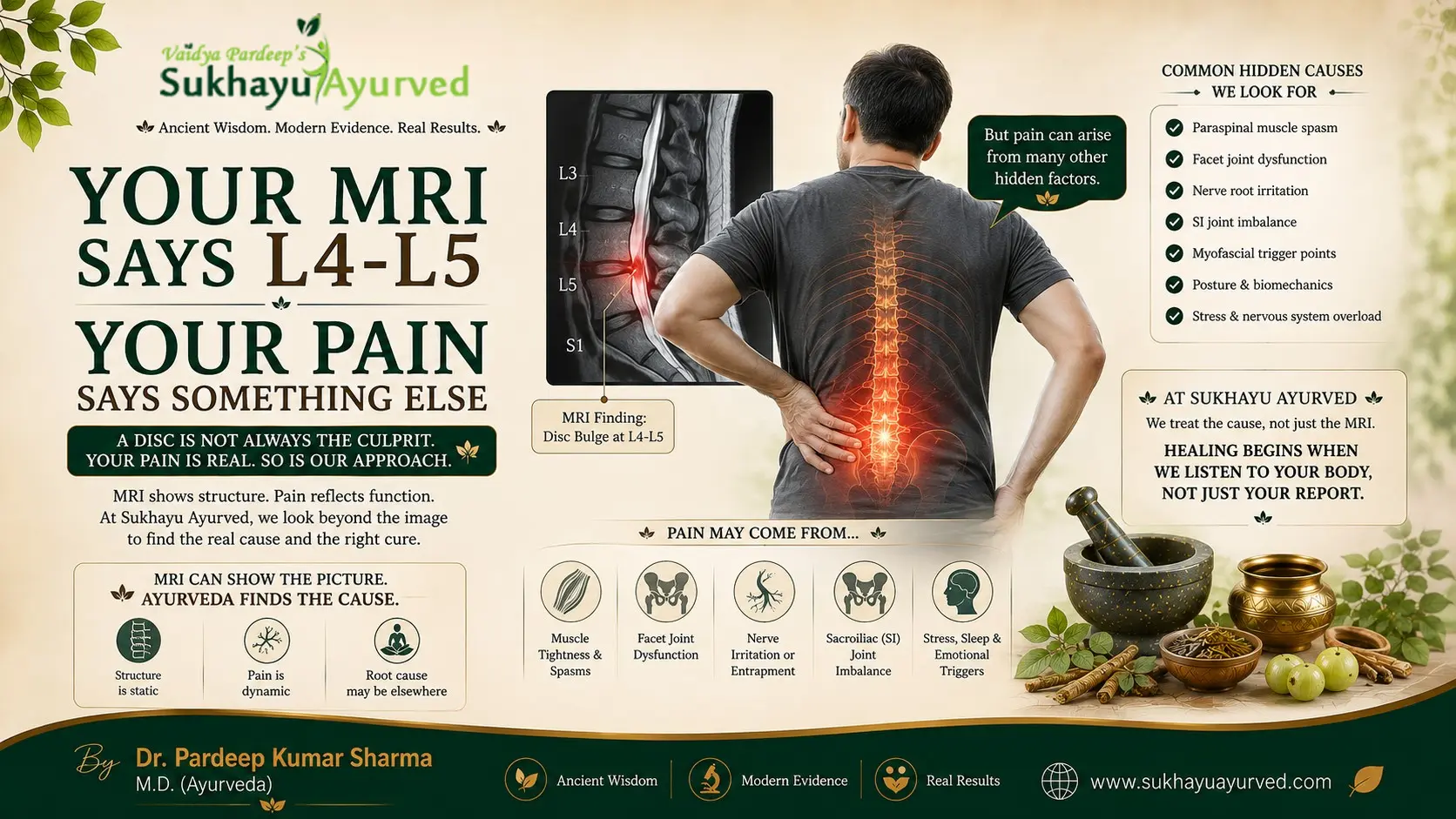
Part of our series on sciatica and the mechanical cause behind it.
Two patients come to my OPD in the same week.
The first hands me an MRI that looks alarming — a substantial disc herniation at L5-S1, clear compression of the nerve root. Then he sits down comfortably, crosses his legs, and tells me the pain is "manageable, doctor, it comes and goes." He has driven himself here. He is smiling.
The second brings a film that is, by comparison, unremarkable. A modest bulge. And she cannot sit through the consultation. She has not slept properly in weeks. Her husband helps her onto the examination table.
Somewhere between these two consultations, most patients lose confidence in something — either in their imaging, or in their doctor, or in themselves. I have heard all three versions. The MRI must be wrong. The doctor is not taking me seriously. Maybe I am imagining it.
None of those is true. And Ayurveda described exactly this problem, with precision, roughly two thousand years ago.
What the film can and cannot tell you
Let me be clear at the outset, because a great deal of writing on this subject is quietly dishonest about it.
The MRI is not unreliable. It is an excellent instrument. It shows you, with real accuracy, what is happening structurally at a given level of the spine. When it reports a herniation at L4-L5, there is a herniation at L4-L5. I do not treat patients by disregarding their imaging, and you should be wary of any practitioner who suggests you should.
The MRI is not unreliable. It is partial.
It photographs the spine. It does not photograph the person carrying it.
And that gap — between the structure and the person — is not a flaw in the technology. It is a known clinical variable, and knowing it is the difference between treating a patient correctly and treating them by their appearance.
Guru Vyadhita and Laghu Vyadhita
In the Charaka Samhita, Vimana Sthana, Chapter 7 — the chapter titled Vyadhita Rupiya Vimana, on the types of patients — Charaka opens with a deceptively simple observation.
There are, he says, two kinds of diseased persons.
The guru vyadhita is the patient with serious illness who, because of strong mental constitution (sattva bala) and physical constitution (sharira sampat), appears to be suffering from a mild disease.
The laghu vyadhita is the patient with a mild disorder who, because of a weaker constitution, appears to be suffering from a severe one.
Read that again with my two patients in mind.
The man with the severe herniation and the easy smile is a guru vyadhita. He is not exaggerating; he is not stoic in some heroic sense. His constitution simply absorbs the disease without displaying it. The woman whose film looks mild and whose distress is total is a laghu vyadhita — and she is not exaggerating either. Her constitution transmits the disease outward with full force.
Neither patient is misrepresenting anything. Both are reporting their experience accurately. It is the relationship between the disease and its outward expression that differs — and that relationship is a property of the patient, not a defect in the imaging.
Charaka is unsparing about what happens next. Physicians who lack skill in this, he writes, judge by observation alone and fail to correctly assess the severity of the disease.
Why this is not an academic point
Here is what makes this passage clinically serious rather than merely interesting. Charaka does not stop at the classification. He states the consequence — and the consequence is a treatment error in both directions.
When a physician mistakes a guru vyadhita for a laghu vyadhita, he assumes the dosha involvement is small and administers mild shodhana. The treatment is too weak for the disease. The dosha is not expelled. The patient is left, in Charaka's account, worse than before.
When a physician mistakes a laghu vyadhita for a guru vyadhita, he assumes major dosha involvement and administers strong shodhana. The treatment is too aggressive for the disease. The doshas are over-evacuated and the body is weakened.
Both are errors of proportion, not of naming.
This is precisely the trap in spinal disc disease. The diagnosis of sciatica, as I have written elsewhere, is rarely the difficult part — a straight leg raise settles it in under a minute. What goes wrong is the calibration of the treatment to the patient in front of you.
Treat the confident man with the severe herniation as though he has a mild problem — because that is how he presents — and you will under-treat a spine that genuinely needs the full protocol. Treat the distressed woman as though her spine matches her distress, and you risk imposing intensity that her tissue does not need and her constitution cannot absorb.
Same diagnosis. Same segment. Two completely different treatment plans.
The second reason the picture drifts: accommodation
There is a further mechanism, and this one is not classical — it is simply what patients tell me, year after year.
Chronic patients accommodate. They gradually learn to live with pain.
The man who has had back pain for six years does not experience it the way he did in year one. He has rebuilt his life around it: how he sits, how he lifts, how far he walks before he needs to stop, which chair at home he uses. The adaptation is so gradual that he never notices it happening. By the time he reaches my consulting room, his answer to "how bad is the pain?" is calibrated against six years of the same pain — not against how he felt before it started.
This matters more than it sounds. When compression is overlooked and pain management simply continues, chronicity does its own damage — in the cervical spine, this is how a compression problem becomes myelopathy, where the changes are no longer fully reversible. Accommodation is comfortable. It is not safe.
Ask him for a VAS score and he will say four. He is being honest. But he is scoring against a baseline that has quietly moved.
This is why I ask chronic patients different questions. Not "how much does it hurt?" but: What have you stopped doing? When did you last sit through a full meal with your family? How far can you walk before you look for somewhere to sit? Function does not accommodate the way sensation does. The answers to those questions are far more revealing than a number.
And it is why, in the group of patients I see most often — those who have carried a disc problem for years — the film frequently looks worse than the person sounds. Not because the film is exaggerating. Because the person has stopped noticing.
So which one do I treat?
Neither. I treat the patient, and I use both.
Charaka's answer to this problem is not to distrust one source of evidence in favour of another. It is the opposite. Verse 4 of that chapter opens with a line that ought to be carved above the door of every consulting room: partial knowledge of a subject does not produce understanding of the whole. The physicians who succeed, he says, are those who examine by every available means before deciding.
That is a two-thousand-year-old argument for more evidence, not less. It is the reason I find the modern content-marketing claim — that MRIs are unreliable because bulges appear in people without pain — so unhelpful. That argument asks you to discard information. Charaka asks you to add to it.
In practice, at Sukhayu, the assessment combines classical diagnostic method — Nadi Pariksha, Agni Pariksha, and constitutional analysis — with modern imaging and laboratory investigation. It includes:
- The imaging, read carefully — level, extent, whether the material is contained or sequestered, whether the canal is compromised
- The clinical examination — straight leg raise, neurological findings, reflexes, and any motor weakness
- Functional history — what has been lost, not merely what is felt
- The constitution — prakriti, sattva bala, and how this particular person expresses illness
- The chronicity — how long, and how much accommodation has occurred
The film tells me what is compressing the nerve. The examination tells me how the nerve is responding. The constitution tells me how to read what the patient is telling me. The chronicity tells me how much of their calm to trust.
Only the combination produces a treatment plan of the right intensity — and intensity is exactly what Charaka warns us to get right.
The findings where appearance stops mattering
One important exception, and I place it here rather than at the end.
There is a category of finding where none of the above applies — where a patient's composure, constitution, or high pain threshold is irrelevant, and where a calm presentation is actively dangerous because it delays action.
Go to a hospital immediately if you have:
- Loss of bladder or bowel control, or difficulty passing urine
- Numbness in the saddle region — the inner thighs, the genitals, around the anus
- Rapidly progressing weakness in one or both legs
- A foot that drags or slaps when you walk
These can indicate cauda equina syndrome and time changes the outcome permanently. A guru vyadhita — the patient whose constitution masks severity — is at particular risk here, because he is exactly the person likely to say "it is manageable, I will see someone next week."
With these findings, do not wait, and do not let your own composure reassure you.
We do not accept these cases for treatment at Sukhayu. Nor do we accept complete cut-off in the spinal canal, or severe sequestration compressing the nerve roots or cord. Those are decided at the level of the disc and the cord — never at the level of how the patient looks.
What this means for you, practically
If you are the patient whose film looks worse than you feel: your composure is a real asset, and it is also a risk. Please do not use it as a reason to postpone assessment. The compression on that nerve root is doing what compression does, whether or not you are troubled by it. Strong constitutions delay presentation, and delayed presentation is how a manageable disc problem becomes a difficult one.
If you are the patient whose pain seems out of proportion to your film: you are not imagining it, and you are not weak. Charaka named your presentation two millennia ago and instructed physicians to account for it rather than dismiss it. A modest bulge in the wrong position, in a patient whose constitution registers it fully, produces genuine and severe suffering. Anyone who tells you the pain is "in your head" because the MRI looks unimpressive has stopped short of a complete examination.
And if you have been carrying this for years: I would ask you to consider how much you have already surrendered without registering it. Not the pain score. The chair you have stopped using. The walk you no longer take. That is the honest measure of what the disease has cost you.
The point of all this
The mismatch between your imaging and your experience is not a mystery, and it is not a reason to doubt either one.
It is a documented feature of how different people carry disease — described in the Charaka Samhita with enough clinical precision to specify how the treatment goes wrong in each direction. Your MRI is telling the truth about your spine. Your body is telling the truth about you. A physician's job is to read both, and to calibrate the treatment to the whole picture rather than to whichever half is louder.
Cure is divine. Treatment is possible. But treatment of the right intensity requires being seen completely — and that has never been something a film alone can accomplish.
Related reading
- Gridhrasi: why sciatica is easy to diagnose and hard to treat — the mechanical cause behind sciatica, and the 3P Program
- Tired of trying Kati Basti for your L4-L5 and L5-S1 disc problem — why one therapy alone cannot complete the sequence
- Ayurvedic treatment for slip disc — the disc condition underlying most sciatica
- Case study: chronic lower back pain with sciatica — a documented individual case
- Prakriti: your Ayurvedic constitution — why two patients with the same diagnosis need different treatment
- Cervical myelopathy — what happens when compression is managed as pain for too long
Reference
Charaka Samhita, Vimana Sthana, Chapter 7 (Vyadhita Rupiya Vimana), verses 3–7. Translated and commented by Baghel M.S. and Mandal S.K.; Charak Samhita New Edition, Charak Samhita Research, Training and Skill Development Centre, 2020. doi:10.47468/CSNE.2020.e01.s03.008