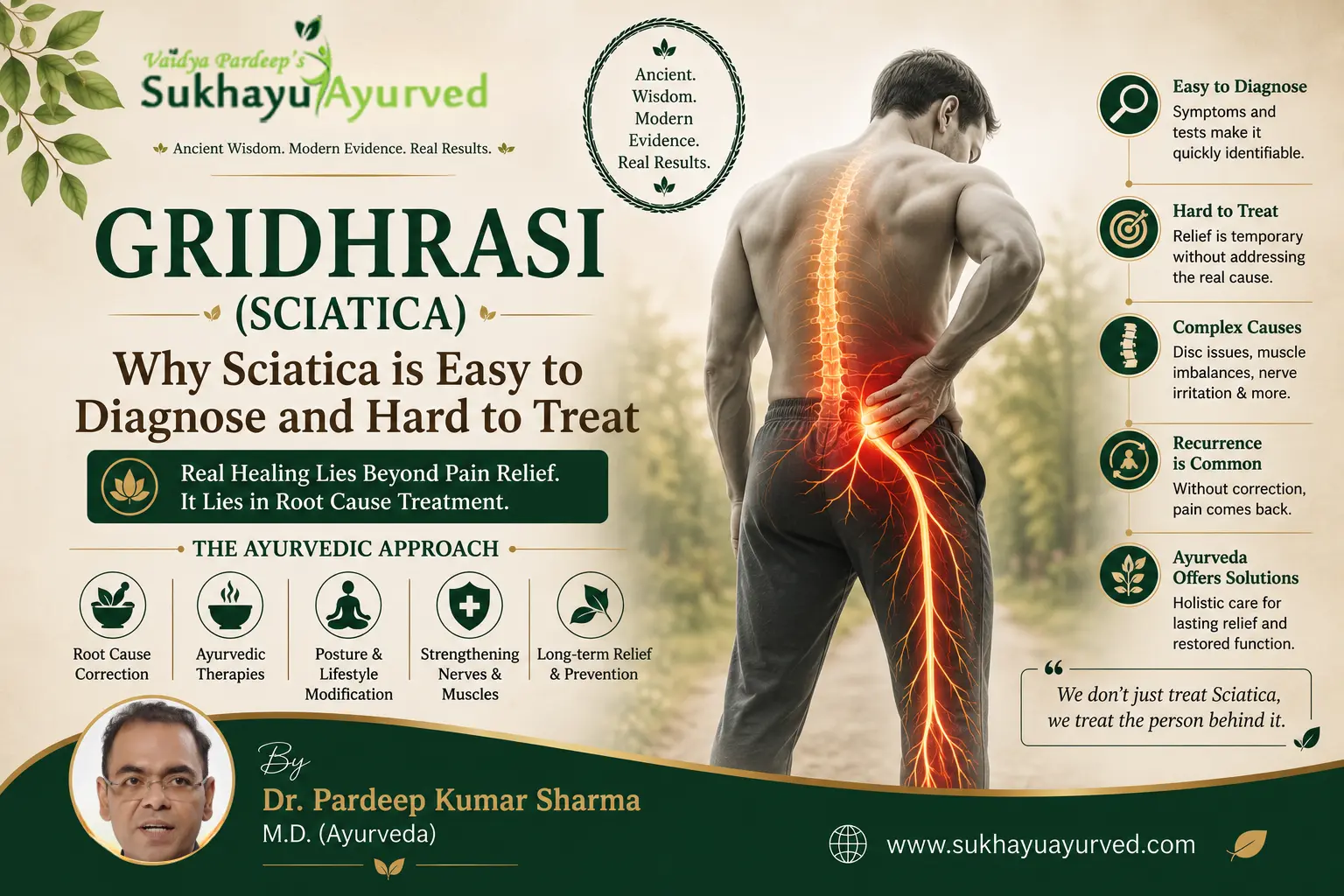
There is a peculiar cruelty in sciatica.
It is one of the easiest conditions in all of spinal medicine to name. A straight leg raise test, performed in under a minute in any consulting room in the country, will tell an examining physician most of what he needs to know. There is no great diagnostic mystery here, no long list of conditions that convincingly imitate it. In my clinic I see patients who have carried a diagnosis of sciatica for years, and the diagnosis is almost always correct.
And yet these same patients arrive after two years, five years, seven years, with the same leg pain they started with. They have taken neuropathic painkillers. They have taken guggulu preparations. Someone told them about parijaat leaves and they took those too. They have had Kati Basti — sometimes several courses of it. They have been told, eventually, that surgery is what remains.
How does a condition that is so simple to identify become so difficult to resolve?
The answer is the subject of this article, and I want to state it plainly at the outset, because everything else follows from it.
The diagnosis is not the problem. The target is the problem.
The only finding a patient has is pain
Put yourself in the position of the person suffering.
You have one symptom you can feel and describe: pain running down the back of your leg. You cannot feel your disc. You cannot feel the nerve root, or the space it passes through, or the pressure on it. Pain is the only piece of information your body has given you.
So pain becomes the thing you try to fix. It is entirely rational. It is also the reason so many patients never recover.
Every treatment such a patient reaches for is aimed at the sensation rather than at what is producing the sensation. The neuropathic medicine acts on how the nerve signals. The herb acts on inflammation. The oil is applied where it hurts. Each of these does something. None of them touches the actual cause.
Here is the distinction I want you to hold on to, because it decides everything about whether you will get better:
In nerve root compression, the cause is mechanical, not physiological.
Physiological problems respond very well to medicines. That is what medicines are for. If the disturbance is in the chemistry of the tissue, in the inflammation, in the way the dosha is behaving, an appropriately selected medicine can genuinely correct it.
But a mechanical problem is a problem of structure. Something is physically pressing on something else. There is no medicine, Ayurvedic or otherwise, that can be swallowed to create space inside a spinal segment. The nerve root does not care what you have taken. It cares that it is being compressed.
This is why the patient who has been taking medicines for eight months is not better. Not because the medicines were fraudulent, and not because Ayurveda failed. Because the treatment was addressed to a layer of the problem that was never the one causing the pain.
What sciatica actually is
Gridhrasi is the classical Ayurvedic name for this condition. The word derives from the gait of the affected person — the stiff, guarded, dragging walk that resembles the movement of a vulture. Even in the naming, the ancients were describing something mechanical: a disturbance of how the body moves through space.
The straight leg raise test used to confirm it is standardised and well described{:target="_blank" rel="noopener"} in the clinical literature, which is precisely why the diagnosis so rarely goes wrong.
In modern terms, sciatica is pain arising from compression or irritation of a nerve root — most commonly at the L4-L5 or L5-S1 level, where a disc has bulged or herniated into the space the nerve needs.
The pain travels because the nerve travels. It begins in the lower back or the buttock and follows the course of the sciatic nerve down the back of the thigh, into the calf, sometimes into the foot. This is why the leg hurts when the problem is in the spine, and why treating the leg achieves nothing.
It rarely begins as leg pain
This is worth knowing, and almost nobody writes about it.
When I take a careful history, most patients tell me the same thing about how it started — and it was not radiating pain. It was stiffness in the calves.
A tightness after sitting. A heaviness in the lower leg at the end of the day. Something that seemed like it belonged to fatigue or to a long commute or to age. It went on for weeks or months. And then, at some point, it changed character and became the radiating pain that finally sent them to a doctor.
If you are reading this with calf stiffness and no leg pain, you are earlier in this process than most of my patients were when they first sought help. That is a considerable advantage, and it is worth acting on.
Before anything else: the findings that are not ours to treat
I want to place this here, high on the page, rather than at the bottom where such things are usually put.
Some presentations are surgical emergencies. If you have any of the following, this article is not your next step — a hospital is.
- Loss of bladder or bowel control, or difficulty passing urine
- Numbness in the region that would contact a saddle — the inner thighs, the genitals, around the anus
- Rapidly progressing weakness in one or both legs
- Weakness of the foot, such that it drags or slaps when you walk
These can indicate cauda equina syndrome, and it is a condition where time changes the outcome permanently. Do not wait for a convenient appointment. Do not try a course of anything first.
We do not accept these patients for treatment, and I want to be equally clear about the others we do not accept.
Sukhayu does not take every case. The cases we decline are decided at the level of the disc and the spinal cord — not at the level of the sciatica. A patient is refused because of what is happening structurally, never because their leg pain is severe. Specifically, we do not treat:
- Cauda equina syndrome
- Complete cut-off in the spinal canal
- Severe sequestration causing compression of the nerve roots or cord
In these situations, the mechanical obstruction is beyond what any conservative treatment can reverse, and the honest thing to do is say so and refer the patient onward.
I state these criteria publicly because a physician who claims to treat everything is telling you something about his marketing, not about his medicine.
The question of surgery
Outside those criteria, I hold a different position, and I hold it firmly.
Surgery cannot be a golden rule applied to every disease.
And there is a question I ask patients that they are rarely asked elsewhere: if it is not a disc, what is the point of surgery? Operations are structural solutions. They exist to correct a structural problem. Where the structural problem is not the kind an operation can correct — or where it is one that can be resolved without opening the spine — the operation is a large intervention in search of a justification.
Sciatica, in my clinical experience, responds well to Ayurvedic treatment. Not always, not in every case, and not in the cases listed above. But well enough that surgery presented as the only remaining option deserves a second opinion before you consent to it.
Ayurvedic treatment here works alongside your existing medical care, not in defiance of it. Your orthopaedic surgeon's imaging and your neurologist's assessment remain relevant. What changes is the target of the treatment.
What actually treats a mechanical problem
If the cause is mechanical, then the treatment must produce a mechanical change. This is the whole logic of what we do.
At Sukhayu, treatment for spinal disc disease is organised as the 3P Program — Purification, Pacification, and Posture Correction.
The most important thing to understand about it is usually the thing that is misunderstood: these are not phases. They are three parallel dimensions of a single treatment, running together, each one supporting the others. Purification without pacification leaves the doshas unaddressed. Pacification without posture correction leaves the mechanical cause exactly where it was. Posture correction without the first two is exercise imposed on inflamed, rigid tissue.
The first P — Purification
This addresses the environment around the spine: the toxin-laden, stiffened, inflamed musculature that is gripping and compressing the column.
The tools are classical panchakarma therapies, selected for the individual case — Kati Basti, a reservoir of warm medicated oil held over the affected region; Sarvangadhara (Pizhichil), a continuous stream of warm medicated oil releasing muscular guarding; Patrapinda Sweda, heated herbal boluses combining warmth and medicine; and Basti therapy, which in Ayurveda is the principal treatment of aggravated Vata — the dosha behind nerve compression and disc dehydration itself.
The second P — Pacification (Shamana)
Where purification works on the environment, pacification works on the dosha imbalance and on the tissue.
Tiktaksheera Basti — a medicated milk enema — is central here, directed at disc rehydration and the healing of neural tissue. Kashaya Dhara supports blood flow and tissue regeneration in the affected region. Beneath all of it run the internal medicines, selected for the individual diagnosis.
The third P — Posture Correction
The disc bulged inside an architecture. If the architecture is not corrected, recovery will not hold.
This dimension restores it: a customised programme of yogasanas working on spinal alignment and segmental decompression; postural and ergonomic training addressing how you sit, lift and move for the rest of your life; and Marma therapy on specific vital points to support nerve function and circulation.
The mechanism, stated plainly
Here is the sequence by which a mechanical problem is mechanically resolved. I set it out step by step because you are entitled to understand what is being claimed.
One. Panchakarma relaxes the musculature through detoxification. The muscles that have been gripping the spine — guarding it, compressing it — let go.
Two. Yoga restores what was lost structurally: the lordotic curvature of the lumbar spine, and the intervertebral spaces that had reduced. The architecture opens.
Three. With that, pressure on the disc falls. This is not incidental — mechanical loading is itself one of the governing factors in how nutrients move into a disc and how metabolites move out.1
Four. A disc has no blood supply of its own — it is the largest avascular structure in the body. It feeds by imbibition, drawing nutrition by diffusion through the cartilaginous endplates of the adjacent vertebral bodies. The capillaries arising from the vertebral bodies reach only as far as the subchondral region of the endplate; from there, nutrients and gases must diffuse through the extracellular matrix{:target="_blank" rel="noopener"} to reach the disc cells.2 Under sustained pressure this exchange is impaired. When the pressure reduces, nutrition to the disc improves.
Five. With nutrition restored, the disc rehydrates. This matters because a degenerated disc holds less water and therefore has a reduced capacity to sustain pressure— which is precisely why it bulges and loses height in the first place.3
Six. A rehydrated disc under reduced pressure retracts — and in retracting, releases the compression on the nerve root.
The pain stops because the nerve is no longer being compressed.
Notice what is absent from that chain. No medicine pushed the disc back. Nothing was applied to the leg. The treatment changed every condition that was preventing the disc from recovering, and the disc did the rest.
The disc did the healing. The treatment made the healing possible.
This is also, precisely, why the guggulu and the neuropathic tablet could not have worked. Look at the six steps and find the point at which either of them enters. There isn't one.
A warning about yoga
There is one deliberate exception to the parallel principle, and because it is a safety rule I will state it directly.
The yoga component begins only when we are satisfied that the musculature has regained enough flexibility. Typically this is a few days into treatment — day five or day seven — later in complex cases, and always on the physician's judgment, never on a schedule.
Asanas imposed on rigid, inflamed muscle do not treat a disc problem. They aggravate it.
Please hear the warning inside that sentence. If you have an acute disc problem and you are following yoga videos at home without an examination, you are performing the third P without the first two, on tissue that may not be ready for it. This is one of the more common ways I see patients arrive in worse condition than they needed to be in.
Why Kati Basti alone disappoints so many patients
I have heard the same sentence more times than I can count: I had Kati Basti done, but it didn't solve my problem.
The sentence carries frustration and disappointment together — frustration at not finding a solution, and disappointment in Ayurveda itself. Very often, the fear of eventually being operated on sits underneath both.
Kati Basti is a genuine and valuable therapy. But look again at where it sits: it is one tool inside the first P. It addresses the muscular environment. On its own, it does not restore lordotic curvature, it does not open the intervertebral space, and it does not complete the chain that ends in the disc retracting.
Performed alone, it is a part being asked to do the work of a whole. When it disappoints, that is not the failure of the science. It is the failure of an incomplete plan.
(A fuller discussion of what goes wrong with Kati Basti — oil selection, temperature, and duration by dhatu involvement is set out separately.)
What treatment actually looks like
There is no standard package. Panchakarma treatment runs 15 to 21 days, and where a given patient falls in that range is determined by their condition, not by a price list. We do not sell packages. We treat diagnoses.
Yoga begins within that period — day five or day seven, on the physician's assessment — not after it.
And treatment does not end at discharge. The yogasanas continue at home, along with medicines for dosha pacification. The mechanical correction has to be maintained by the body that lives in it.
What the first week feels like
Patients want to know when something will change. The honest answer is that pain begins responding in the first week. The VAS score starts sliding downward.
But it does not slide smoothly, and I want you to expect that rather than be alarmed by it. The pain will fluctuate. It will come and go. You should not expect a flat line.
The reason is deliberate.
We do not manage pain
No pain management is done during treatment.
This surprises people, so let me explain the reasoning. Pain is telling us that things are still not correct deep inside. It is information — the most useful information the patient's body produces. A medicine that suppresses it does not make the patient better; it makes the physician blind. We would lose our clearest signal of whether the mechanical correction is actually progressing.
So the fluctuation you feel in week one is not a treatment failing. It is what recovery looks like when nothing is chemically flattening the signal.
If you arrive on ongoing pain medication, we do not stop it forcefully. That is not our approach and it would not be safe. What we encourage is a change in how it is used: not on a schedule, but only when pain requires it — because these medicines have no physiological importance in the disease itself. Any decision to reduce or discontinue a prescribed medicine remains between you and your prescribing physician.
When sciatica belongs to a larger disease
Not every sciatica is a straightforward disc.
Some patients present with sciatic pain that arises within ankylosing spondylitis, or within a spine where degeneration rather than frank herniation is the dominant process. Here the mechanical logic still holds, but the mechanical problem is a different one — and so the treatment changes.
In ankylosing spondylitis, the treatment must work on the degeneration side. Tikta Ksheer Basti moves into a central position, and the internal medicines change accordingly. We are no longer only restoring space around a compressed root; we are working against a degenerative and inflammatory process, with the sciatica downstream of it.
This is the practical meaning of a phrase that is otherwise easy to dismiss as a slogan. Gridhrasi is a presentation. What treats it is decided by what is producing it. Two patients with identical leg pain and identical straight leg raise findings may need substantially different treatment, and the examination is what tells us which.
It is also why no honest protocol can be printed in advance of meeting the patient. A documented case of sciatica arising within ankylosing spondylitis is set out in detail separately.
Where this leaves you
If you have been treating your sciatica for months or years without lasting change, I would ask you to consider that the failure may not have been in the effort or in the medicines, but in the target.
Pain was the only finding you had, so pain became the thing you fought. Meanwhile the mechanical cause — the pressure, the lost curvature, the dehydrated disc — went on being exactly what it was.
Cure is divine. Treatment is possible. What is possible in sciatica, in the great majority of cases that are not in the exclusion list above, is a genuine mechanical correction that lets the disc recover and the nerve be released.
That begins with an examination, not with a therapy.
Related reading
- Tired of trying Kati Basti for your L4-L5 and L5-S1 disc problem — why one therapy, done alone, cannot complete the sequence
- Ayurvedic treatment for slip disc — the disc condition underlying most sciatica
- Panchakarma treatment for slip disc — what the inpatient phase involves
- Case study: chronic lower back pain with sciatica — a documented individual case
- Case study: sciatica with ankylosing spondylitis — when sciatica sits inside a larger disease
(This section is updated as further articles in this series are published.)
References
Footnotes
- De Geer CM. Intervertebral Disk Nutrients and Transport Mechanisms in Relation to Disk Degeneration: A Narrative Literature Review. Journal of Chiropractic Medicine. 2018;17(2):97–105. doi:10.1016/j.jcm.2017.11.006 (PMID: 30166966; PMCID: PMC6112070) ↩
- Velnar T, Gradisnik L. Endplate role in the degenerative disc disease: A brief review. World Journal of Clinical Cases. 2023;11(1):17–29. doi:10.12998/wjcc.v11.i1.17 ↩
- Velnar T, Gradisnik L, as above. See also: Ma Z, Liu X, Zhang M, et al. Research Progress on the Role of Cartilage Endplate in Intervertebral Disc Degeneration. Cell Biochemistry and Function. 2024;42(7):e4118. doi:10.1002/cbf.4118 ↩