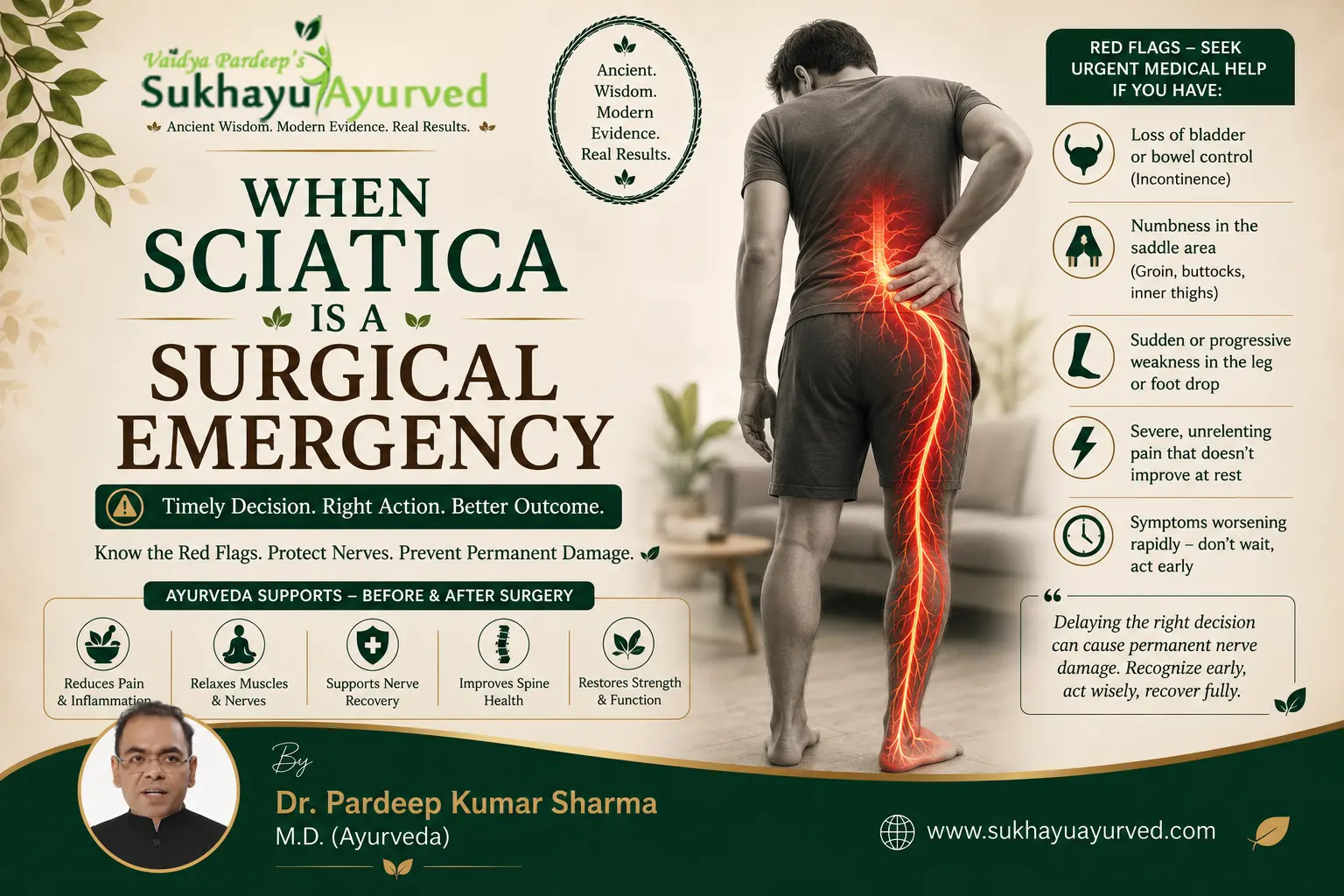
Part of our series on sciatica and the mechanical cause behind it.
If you have lost control of your bladder or bowel, cannot pass urine normally, have numbness around your genitals or inner thighs, or have rapidly worsening weakness in your legs — stop reading and go to a hospital emergency department now.
Not tomorrow. Not after this article. Not after one more course of anything.
I have opened with that because everything else in this piece is written for people who have time, and a small number of readers do not. If you are one of them, the rest of this can wait until you are safe.
Why an Ayurvedic physician writes this article
I treat sciatica. I have spent twenty years treating spinal disc disease, and I have written at length about why most sciatica does not need an operation and how the mechanical cause can be corrected without one.
So it would be easy — and commercially convenient — for me to write only that.
But a physician who tells you he can treat everything is telling you something about his marketing, not his medicine. Our published position on this is not new: we follow the guidance of Charaka and Sushruta, who instructed physicians not to claim treatment for conditions that are beyond it. Knowing how to say no is part of the discipline.
There is a narrow set of findings in sciatica where conservative treatment of any kind — Ayurvedic, physiotherapeutic, or pharmacological — is the wrong answer, and where delay causes permanent loss. I would rather you learned to recognise them from me than discovered them too late.
The red flags, in plain language
These are the findings that change everything. If any of them is present, the question is not which treatment but how fast can you reach a hospital.
1. Bladder or bowel changes
The single most important sign. Specifically:
- Difficulty starting to pass urine, or a weak stream
- Not being able to feel when your bladder is full
- Not being able to feel urine passing
- Loss of control of urine or stool
- Retention — being unable to pass urine at all
Patients often explain these away. It is the medicine. It is the anxiety. It is because I have been lying down so much. Please do not explain them away.
2. Saddle numbness
Loss of sensation in the area that would touch a saddle if you sat on one: the inner thighs, the genitals, the perineum, around the anus. Some patients notice it first while wiping after using the toilet, or when the sensation of water in the shower changes.
3. Weakness that is getting worse
Not pain — weakness. A foot that drags or slaps when you walk. Difficulty lifting the front of the foot. Difficulty standing from a chair, or climbing stairs, because the leg gives way. What matters most is the direction of travel: weakness that is progressing over hours or days is entirely different from weakness that has been stable for months.
4. Numbness or weakness in both legs
Sciatica from a single compressed nerve root is usually one-sided. Symptoms appearing in both legs suggest something is compressing the nerve bundle rather than a single root, and that raises the level of concern considerably.
Together, these can indicate cauda equina syndrome — compression of the bundle of nerve roots at the base of the spinal cord. It is uncommon. It is also the one presentation in this whole field where hours genuinely matter, because the loss of bladder, bowel, and sexual function can become permanent.
Do not wait for an outpatient appointment. Do not attempt a therapy first. Go to an emergency department.
One practical note that patients rarely think about: do not drive yourself. Ask someone to take you, or call an ambulance. And bring whatever medicines you are currently taking with you.
The three findings we do not accept
Beyond the emergency presentation above, there are structural findings where we decline to take the case at Sukhayu. I want to state them publicly, because a clinic's exclusion criteria tell you more about its honesty than its success stories do.
We do not accept:
- Cauda equina syndrome — as described above
- Complete cut-off in the spinal canal — where the canal is fully obstructed
- Severe sequestration compressing the nerve roots or cord — where disc material has broken free from the disc and is pressing on neural structures
Note carefully what these three have in common, and what they do not.
They are all decided at the level of the disc and the cord — never at the level of the sciatica. We do not refuse a patient because their leg pain is severe. Severe pain is not an exclusion; some of our most straightforward cases arrive in extreme pain. We refuse when the structural situation is beyond what conservative treatment can reverse.
This is a point I have made in the main article on sciatica and it bears repeating here, because patients frequently get it backwards. They assume that if the pain is unbearable, surgery must be indicated. Pain is not the criterion. Structure is.
Why these three are different
Everything Ayurvedic treatment achieves in disc disease works through a mechanical sequence I have described in detail elsewhere: the musculature is relaxed and detoxified, the lordotic curvature and intervertebral space are restored, pressure on the disc falls, nutrition reaches the disc through the endplates, the disc rehydrates and retracts, and the nerve root is released.
Look at that sequence and ask what each exclusion does to it.
In severe sequestration, the disc material has separated. A fragment has broken away from the parent disc. It is no longer part of the structure that can rehydrate and retract, because it is no longer connected to it. You cannot draw back something that has come loose. The mechanism has nothing to act on.
In complete canal cut-off, there is no space left to restore. The sequence depends on creating room; where the canal is entirely obstructed, the treatment is being asked to work in a space that does not exist.
In cauda equina, the issue is not mechanism but time. Even if a conservative approach could eventually help, "eventually" is the wrong timescale. Function lost in this window does not reliably return.
This is why I can be confident about the criteria: they are not arbitrary limits, and they are not commercial caution. They follow directly from how the treatment actually works. Where the mechanism cannot reach, we should not pretend otherwise.
What surgery does, and what it does not do
I want to be even-handed here, because this article recommends surgery to a specific group of readers and I should be honest about what they are getting.
Surgery in these situations is decompression. It removes what is pressing on the nerve — the fragment, the obstruction — and it does this quickly and reliably. That is exactly what an emergency requires, and it is why an operation is the right answer for cauda equina.
What surgery does not do is correct the disc. It removes the offending material. The degeneration, the lost curvature, the mechanical loading pattern that produced the problem — these are unaddressed by the procedure itself. This is why some patients return with recurrence at the same or adjacent level.
Both things are true at once. Where decompression is urgently needed, surgery is the correct and often the only answer. Where it is not needed, an operation is a large intervention that leaves the underlying mechanics untouched. The skill is in telling the two situations apart, and that is a matter of examination and imaging, not of preference.
The far more common problem: waiting too long with no emergency at all
Having spent this article on urgent findings, let me put them in proportion.
Most sciatica is not an emergency. The findings above are uncommon. If you have leg pain, even severe leg pain, and no bladder or bowel changes, no saddle numbness, and no progressive weakness, you are almost certainly not in this category.
But there is a quieter danger that I see far more often, and it is the opposite failure — not rushing to surgery, but drifting for years without proper assessment.
The patient takes neuropathic medication. Then something herbal that a relative recommended. Then a course of Kati Basti somewhere, which helps briefly. The pain becomes part of life. And in the meantime, nothing has addressed the mechanical cause, and the structure continues to change.
In the cervical spine, I have watched exactly this pattern produce myelopathy — where compression, managed as pain for long enough, eventually inflames the cord itself and produces changes that surgery can no longer fully reverse. The same logic applies lower down.
There is also a specific trap for the composed patient. As I wrote in the previous article in this series, some people carry serious disease without displaying it — what Charaka called guru vyadhita. That constitution is exactly what delays presentation. If you are the sort of person who tolerates things, please be aware that your tolerance is not a clinical assessment.
What to do, and in what order
If you have any red flag above: emergency department, now. Not an appointment. Not a phone call to us. A hospital — and one with a spinal team, if you have the choice. Cauda equina is assessed and managed by an emergency specialist spinal service, so a facility with MRI access and spinal surgery on site saves hours that matter.
If you do not: you have time to be assessed properly, and you should use it rather than continue guessing.
That assessment should include imaging read carefully — level, extent, whether the disc material is contained or has sequestered, whether the canal is compromised — alongside clinical examination and neurological testing. At Sukhayu, our evaluation reviews MRI, nerve conduction studies, and blood work alongside classical Ayurvedic assessment, because the structural question and the constitutional question are both real questions.
And then, honestly: sometimes the answer is that we take the case, and sometimes it is that we do not. Patients occasionally travel to Jaipur and are told, after examination, that we are not the right people. That is frustrating, and I understand why. But we would rather say so than take a case we cannot help.
We do not sell packages. We treat diagnoses — and part of treating diagnoses is naming the ones that belong to someone else.
The point of all this
Cure is divine. Treatment is possible. But treatment means the right intervention for the actual situation, and there is a small category of sciatica where the right intervention is a surgeon and a hospital, immediately.
Knowing that category is not a weakness in Ayurvedic practice. It is what makes the rest of the practice trustworthy. A physician who would treat cauda equina with Panchakarma has told you everything you need to know about how he assesses every other case as well.
If you are reading this at two in the morning because something feels wrong with your bladder and you were hoping to find a reason to wait until morning — this article is not that reason. Please go.
Related reading
- Gridhrasi: why sciatica is easy to diagnose and hard to treat — the mechanical cause, and the 3P Program
- Your MRI says L4-L5, your pain says something else — why presentation and imaging often disagree
- Ayurvedic treatment for slip disc — the disc condition underlying most sciatica
- Cervical myelopathy — what happens when compression is treated as pain for too long
- Facilities and services at Sukhayu — how we assess, and why we decline some cases
- NHS: cauda equina syndrome — independent guidance on the emergency presentation
This article describes general warning signs and is not a substitute for examination. If you have any of the findings described above, seek emergency medical care immediately. Ayurvedic treatment at Sukhayu works alongside conventional medical care, not in place of it.