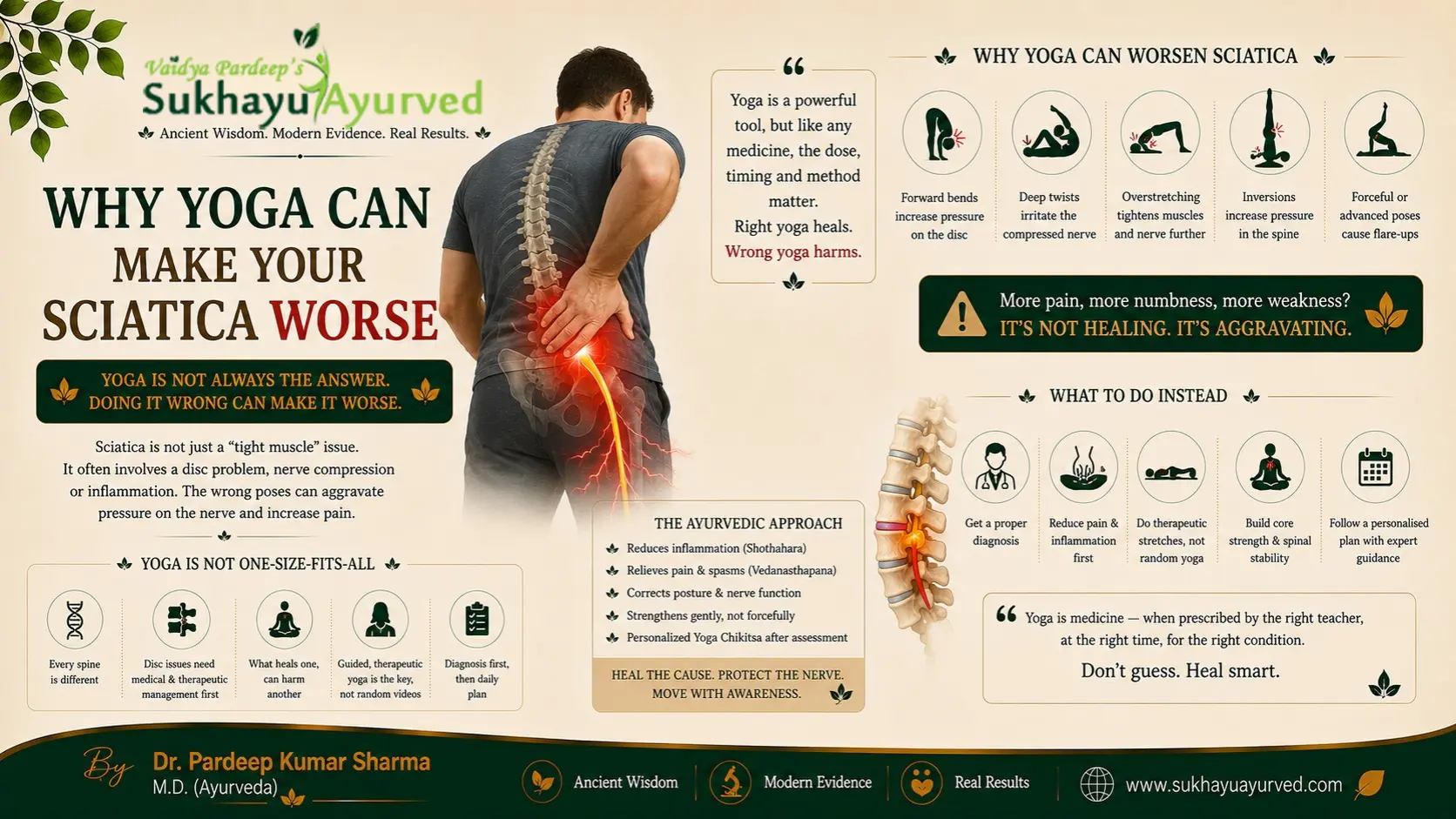
Part of our series on sciatica and the mechanical cause behind it.
There is a piece of advice so common that almost nobody questions it: yoga is good for your back.
It is repeated by well-meaning relatives, by fitness accounts, by the algorithm that serves you a "10 stretches for sciatica relief" video the moment you search for your symptoms. And it contains a real truth, which is exactly what makes it dangerous. Yoga is part of how we correct a spinal disc problem. But the version of that truth circulating online has been stripped of the one thing that makes it safe — and in an acute disc problem, following it can leave you worse than when you started.
I see the results of this often enough that I want to explain, carefully, why the advice is incomplete and when it turns harmful.
Yoga is the third P — and the order is not decorative
Regular readers of this series will know that we treat a spinal disc problem across three parallel dimensions, the 3P Program: Purification, Pacification, and Posture Correction.
Posture Correction is where yoga lives. It is the dimension that restores the spine's lost curvature and the intervertebral space, so that pressure on the disc falls and it can recover. It is genuine, and it is essential. Without it, the mechanical correction never completes.
But here is what the "yoga for your back" advice leaves out entirely: the yoga only begins once the first two dimensions have done their work.
In a disc problem, the muscles around the spine are not neutral. They are toxin-laden, stiffened, gripping the column in protective spasm. That is what Purification addresses first — relaxing and detoxifying that musculature. Only when the muscle has regained enough flexibility does the yoga component begin. In our treatment that is typically a few days in, sometimes later in complex cases, and always on the physician's judgment — never on a schedule, and never before the tissue is ready.
The reason is simple and physical. Asanas imposed on rigid, inflamed muscle do not treat a disc problem. They aggravate it.
What actually happens when you skip the first two P's
Picture what a "sciatica stretch" video asks of you.
You have an acutely inflamed disc problem. The muscles around your lumbar spine are in spasm — that spasm is your body's own splint, holding a damaged segment still. And now you are asked to fold forward, to twist, to load that segment through a range of motion it is actively guarding against.
The muscle was not ready. Nothing prepared the tissue. There was no Purification, no Pacification — just the third P, applied cold, to a spine that was protecting itself for a reason.
This is what I mean when I tell patients: you are doing the third P without the first two. You have taken the final, most delicate step of a three-part treatment and performed it first, alone, without the groundwork that makes it safe. It is the single most common way I see patients arrive in worse condition than they needed to be in.
And it is worth naming plainly, because your own instinct will mislead you here: a stretch that hurts feels like it is working. It is not. In an acutely guarded spine, that pain is the opposite of progress.
Ahimsa: the classical text already warned you
This is not a modern caution retrofitted onto an old practice. The warning is built into the foundation of yoga itself.
Patanjali, defining what an asana even is, gives it two required qualities: sthira and sukha — steadiness and the ability to remain comfortable. And the practice is governed by ahimsa, non-violence, which our note on asana states in the clearest possible terms: never work to the point of pain, because that is doing violence to your body.
Read that against a "push through it" stretching video and the contradiction is total. The tradition the videos borrow their authority from explicitly forbids what the videos ask you to do. An asana practised through pain, on an inflamed spine, is not yoga in any sense Patanjali would recognise. It is the posture without the principle.
This is also why, at Sukhayu, we have never believed in making forceful, unnatural movements of the spine that can endanger a patient. Yoga for the spine is delicate and specific. It is not a set of aggressive stretches, and it is not one-size-fits-all.
"But which stretches should I do?" — the wrong question
When patients grasp this, their next question is almost always: fine, then which asanas are safe?
I understand the instinct, but the question itself is the problem. It assumes there is a universal list — a set of movements that is correct for anyone with a bad back. There is not.
The asanas that will help you depend on your specific presentation: which level is involved, what your posture has done to compensate, how much flexibility the muscle has recovered, and where you are in treatment. The same forward fold that helps one patient in week three is exactly wrong for another in week one. This is a customised programme built from examination, sequenced to the individual — not a playlist.
A video cannot know which level is involved. It cannot feel whether your muscle is ready. It cannot see that you are compensating by shifting your trunk to one side. It offers the same movements to a triathlete and to a seventy-year-old with an acute prolapse, and it calls that accessibility. In a disc problem, it is not accessibility. It is risk.
When yoga is not even the question
One more thing, and it sits above all of the above.
There is a set of findings where yoga, stretching, and every other self-directed measure are simply the wrong universe of response — where the correct action is to reach a hospital. If you have loss of bladder or bowel control, numbness in the saddle area (inner thighs, genitals, around the anus), or rapidly worsening weakness in a leg, stop and seek emergency care. No asana has any place in that situation.
Short of that, most disc problems are treatable — but treatable does not mean "treatable by whatever you found online." It means treatable by the right sequence, in the right order, at the right time.
So what should you actually do?
If you have an acute disc problem or active sciatica, here is the honest guidance:
Do not start a home yoga or stretching programme on your own. Not because movement is bad — it is central to recovery — but because the movement has to come after the tissue is prepared, and it has to be chosen for your spine specifically. The sequence is what makes it work, and the sequence is exactly what a video cannot give you.
Get examined, so that the origin and the state of your problem are actually known. From there, the Purification and Pacification that must precede the yoga can be done, and the Posture Correction can be introduced at the point where it helps rather than harms — as I've described in the main article of this series.
And if you are already deep into a stretching routine and hurting more — that is information, not failure. It usually means the third P is being asked to work without the first two. The answer is not a better video. It is to stop, and to be assessed.
The point of all this
"Yoga is good for your back" is not a lie. It is a truth with its safety instructions removed.
Yoga corrects the spine — third, after the muscle has been prepared, sequenced to the individual, and never worked to the point of pain. Take that same yoga and apply it first, alone, off a screen, to an inflamed and guarding spine, and you have kept the shape of the treatment while discarding everything that made it treatment.
You would not take the last step of a staircase and call it the whole climb. A disc problem deserves the same respect for order. Do the first two P's first — or rather, let someone qualified do them with you — and let the third do its work when the spine is finally ready to receive it.
Related reading
- Gridhrasi: why sciatica is easy to diagnose and hard to treat — the mechanical cause, and the full 3P Program
- Your MRI says L4-L5, your pain says something else — why imaging and symptoms often disagree
- When sciatica is a surgical emergency — the findings that mean hospital now, not stretching
- Sciatica, piriformis syndrome and spinal stenosis — why these are distinct, and why self-diagnosis fails
- Tired of trying Kati Basti for your L4-L5 and L5-S1 disc problem — the first-P therapy done alone, and why it disappoints
This article is educational and not a substitute for examination. Ayurvedic treatment at Sukhayu works alongside conventional medical care, not in place of it. If you have loss of bladder or bowel control, saddle numbness, or progressive weakness, seek emergency care immediately.