How we eat is quietly deciding what we become.
Ask what eating is, and most answers fall into four quiet grooves:
- to taste something
- to fill the stomach
- to take in some nutrition
- to keep life going
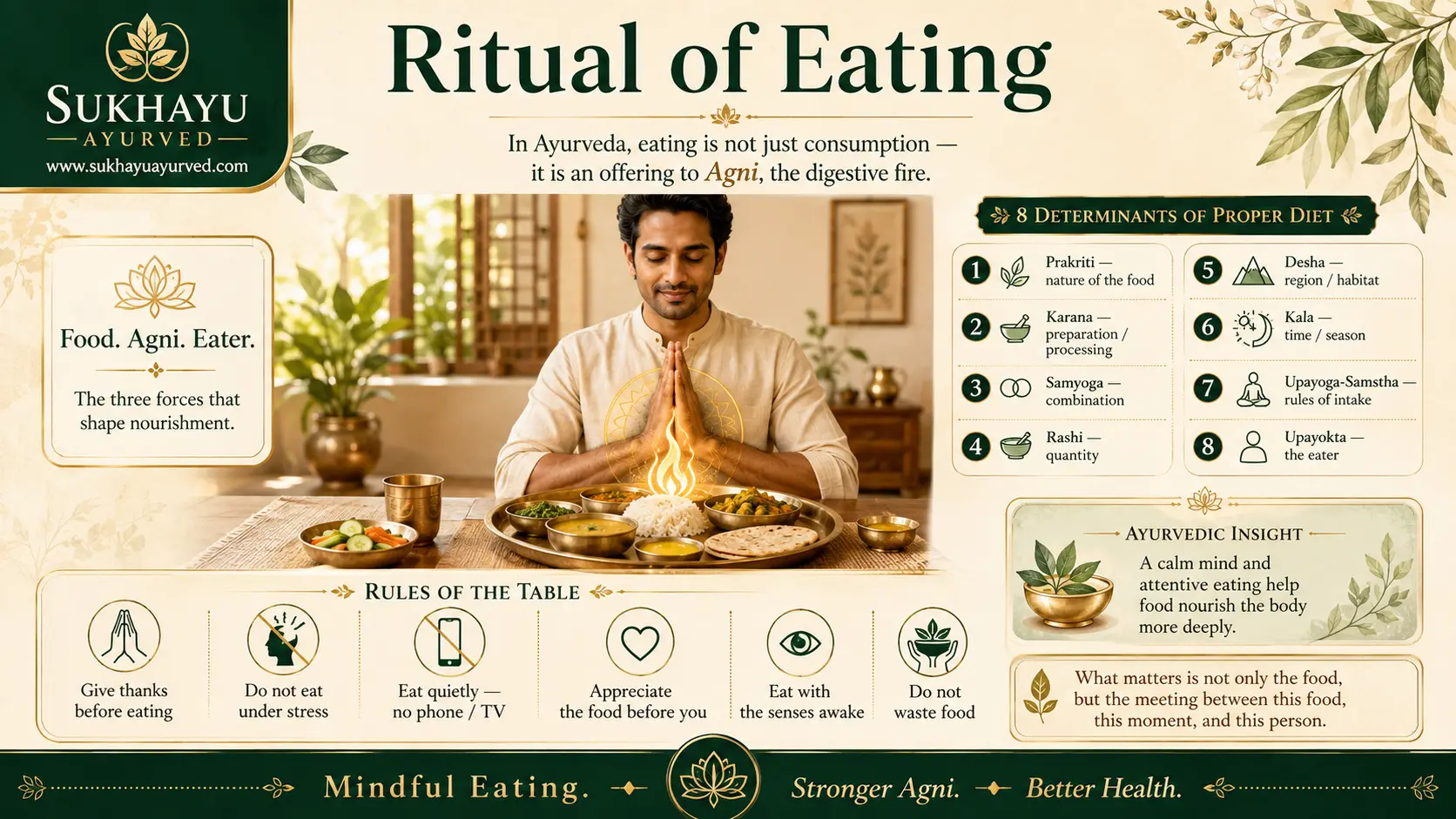
Each is true, and each is small. In the Indian philosophical tradition, eating is none of these alone — it is a ritual. Whatever we are, and however we find ourselves here in this world, is in some measure the result of what we have eaten. That is not a slogan; it is a claim about how a body is built, meal by meal, over a lifetime. Seen this way, the act of eating opens into three paradigms: the food itself, the fire that receives it, and the person who sits down to eat.
Understanding the Ritual: Food as an Offering
Every food carries its own qualities, and when we eat, those qualities pass into us. The chief thing that transfers is life itself — the livingness of a fruit, a grain, a pulse, a vegetable. Something surrendered its life so that ours could continue. Ayurveda asks us to hold that fact with regard rather than indifference: this living thing is offering itself to your digestion so that you may be nourished.
The oldest mirror for this is the Yajña — the fire ritual, where herbs, ghee and other offerings are given to Agni, the sacred fire. It is a holy process: the environment is nourished by the aromatic qualities of what is offered, and the prayer is for the wellbeing of every creature. The intent is not consumption. The intent is nourishment given back.
Eating is the same ritual, turned inward. You offer the food to your own Agni — the digestive fire. In Ayurveda, Agni is far more than heat; it is the principle of transformation, the faculty that disintegrates food and decides, with its own discretion, what will become part of you and what will not. This is why Agni is treated as the most vital thing in the body. When you eat, you are not filling a container. You are making an offering to a fire, and trusting that fire to do its work.
From that fire, the vitality of the food is drawn out and carried through the body's many channels, each taking its share of the food-sap as it passes. When the sap reaches its final refinement, it becomes Ojas — which you might call the nectar of food, or simply the body's capacity to stay well and resist illness. The whole ritual, then, has one purpose: to draw the vitality out of what we eat and let it become strength.
The Classical Framework: Charaka's Eight Determinants
What every culture has ritualized by instinct, Ayurveda also set down with precision. In Charaka, Vimana Sthana, Chapter 1, the same wisdom that the fire ritual expresses devotionally is laid out as a working framework — the eight determinants of proper diet (aṣṭau āhāra-vidhi-viśeṣāyatana). These are the eight things that decide whether a meal nourishes or harms, and no single one of them is the food's calories or contents alone:
- Prakṛti — the inherent nature of the food; what it is by its own quality, heavy or light, heating or cooling.
- Karaṇa — how it has been processed and prepared; the same grain cooked one way and another is not the same food.
- Saṃyoga — combination; how foods sit together, since some pairings serve the body and some quietly work against it.
- Rāśi — quantity; both the total on the plate and the proportion of each thing within it.
- Deśa — the region and habitat the food and the eater belong to; what suits one land and climate may not suit another.
- Kāla — time; the season, and the state of the body at the moment of eating.
- Upayoga-saṃsthā — the rules of intake; the how of eating, which the ritual itself is chiefly concerned with.
- Upayoktā — the eater; the one person no framework can leave out, because the same meal meets a different fate in a different body and a different state of mind.
Read the list slowly and something becomes clear: only a little of it is about the food. Most of it is about the meeting — between this food, this moment, this place, and this person. The ritual of eating is the care we bring to that meeting.=
How to Eat: The Rules of the Table
Under Upayoga-saṃsthā, the how of eating, Ayurveda becomes specific. You may be eating food of the finest quality, but if you are unhappy with the food or your surroundings, that quality is lost. It is like praying in the most beautiful temple, church or mosque with too much noise inside — prayer is a way of connecting with an energy, and once the connection is disturbed, the results do not come. Food is a prayer of the same kind. You have to be settled for the prayer to be heard.
If we take food carrying bad thoughts, the food returns those same energies to us and the life within is diminished rather than fed. So the tradition set down rules for the table — not etiquette, but the conditions under which an offering can actually nourish:
- Do not disregard the food.
- Give thanks before eating, for the life and the food that sustains life.
- Hold in mind that food is for life — not life for food.
- The food has given its life for you; be thankful for the sacrifice.
- Do not eat under stress. Food taken in a stressed state serves the body poorly.
- Eat quietly — no television, no phone, no newspaper before you.
- Bring the taste from your own side, not only from the food's.
- Never waste food; wasting it is a disregard for what was given.
- Appreciate what is in front of you.
- Eat with the senses awake — the eye to colour and presentation, the nose to aroma, the ear to the words spoken of the food, the tongue to taste, the skin to touch.
These are only some of the principles the tradition offers, but follow them and much of what we blame on food — the heaviness after a meal, the vague unease, the sense that eating did not sit right — begins to loosen. Often the trouble was never in the food. It was in the meeting.
A Closing Thought: The Eater's State of Mind
Patients often arrive describing their relationship with food as a kind of betrayal — whatever I eat seems to turn against me and float in my blood as something harmful. It is worth hearing that as what it is: not a diagnosis, but a felt experience, the way a disordered relationship with food feels from the inside. The body, in that description, has become an adversary.
But consider how you greet a person you have decided you dislike, even when they arrive meaning you well. Your response is already set before they speak. The body answers food the same way. When we have decided in advance that something is bad for us — when the meal is met with suspicion, guilt or dread — the bhāva, the inner state of the eater, colours the whole ritual before digestion begins. This is exactly the Upayoktā principle: the eater is one of the eight things that decide a meal's fate.
So before giving up on foods, it is worth giving up the bad thoughts about them. This does not mean every food serves every body, or that genuine dietary and medical guidance should be set aside — it means the ritual begins in the mind that sits down to eat. Settle that, and much of the rest follows.
Related Reading: The Diet Pages
The ritual is the frame; the specifics live condition by condition. Where the general principles above meet a particular diagnosis, the pathya (what suits) and apathya (what works against) become precise. These pages carry that detail:
Diet by Condition
| Condition | Page |
|---|---|
| Avascular Necrosis | Diet for Avascular Necrosis: The Real Don'ts |
| Rheumatoid Arthritis | Foods That Are Bad for Rheumatoid Arthritis |
| Gout | Diet for Gout |
| Cardiac Diseases | Diet for Cardiac Diseases |
| Cirrhosis of Liver | Diet for Cirrhosis of Liver |
| Jaundice | Diet for Jaundice |
| Hyperacidity | The Foods Which Help with Hyperacidity |
| IBS | The Diet Which Helps in IBS: Do's and Don'ts |
| Ulcerative Colitis | 9 Steps for Ulcerative Colitis Relief via Ayurveda |
| Asthma | Foods That Complicate Asthma |
| Acne | Healthy Diet for Acne-Free Skin |
Diet by Principle
| Focus | Page |
|---|---|
| The foundational approach | Ayurvedic Diet for Self-healing |
| Pacifying Pitta | How to Reduce Pitta Naturally with Ayurveda |
| Cholesterol | Lowering Cholesterol: The Ayurvedic Way |
| Gastric health | Gastric Diseases: The Ayurvedic Viewpoint |
At Sukhayu Ayurved, the way you eat is treated as part of the treatment, not an afterthought to it.