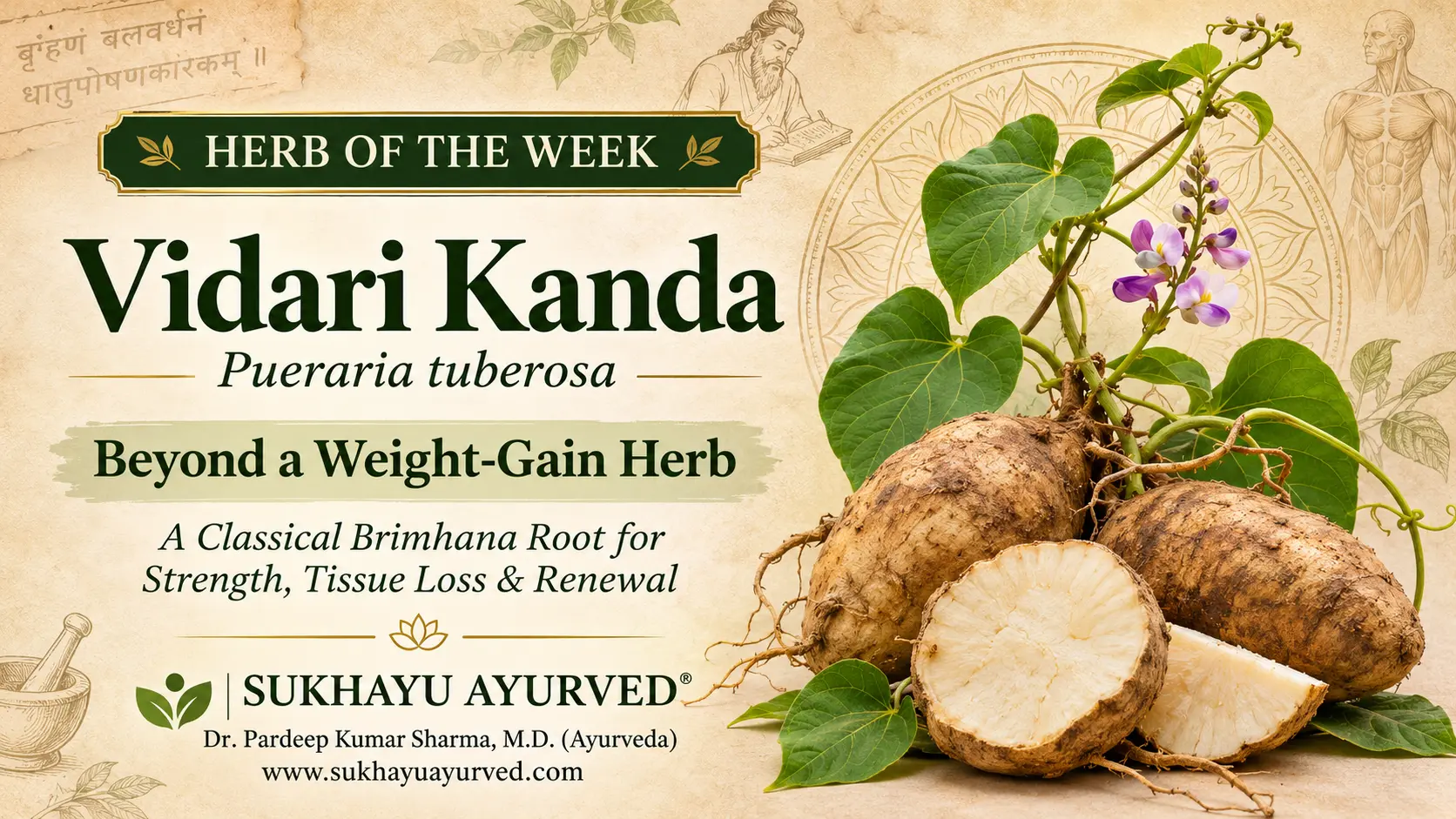
You typed Vidari Kanda into a search bar, and the results were not shy. A weight-gain powder. A natural testosterone booster. A stamina root, with a dose in grams and a thread of strangers reporting what it did for them in a fortnight. Not one of those pages asked what is actually wasting in you.
That is the question I ask first, and it decides whether this herb belongs in your hands at all. Muscle wasting is not one condition. Wasting from Vata and Pitta together, wasting from Pitta alone, and wasting where Ama has jammed a weak Agni ask for three different kinds of treatment. Vidari Kanda suits the first, and only when the digestive fire can carry it.
What the herb is, in its classical profile
Vidari Kanda is the tuber (kanda) of Pueraria tuberosa, called Vidari in the classical literature. Its profile is short and precise:
- Rasa (taste): Madhura, sweet
- Vipaka (post-digestive effect): Madhura, sweet
- Virya (potency): Sheeta, cooling
- Guna (qualities): Guru (heavy) and Snigdha (unctuous, oily)
- Karma (recorded actions): Rasayana (rejuvenating), Balya (strength-giving), Brimhana (nourishing, restoring depleted tissue) and Vrishya
Read that as a physician reads it. Vata is dry, light and mobile. Pitta is hot. A herb that is sweet, cooling, heavy and unctuous carries the opposite of both, which is why it is considered where Vata and Pitta have together burned and dried a tissue down. Brimhana means exactly that: treatment that gives something back to what has been depleted.
One more point about the plant itself. The Vidari of the classics and the Vidarikand of the market are not guaranteed to be the same root. A 2025 quality-control study compared authentic Pueraria tuberosa with marketed samples from twelve Indian herbal markets and found most of the marketed samples chemically thinner than the authentic root, with one classed as an Ipomoea species. I cite that as a parallel observation, not as the reason the herb is used. It is a fair warning to anyone buying a powder online.
The question before the herb: cause, Dosha, Dhatu
Muscle is a Dhatu, a tissue, and the classics call it Mamsa. But a wasting Dhatu is the end of a chain, not the start of one. Mamsa can fail because Vata is drying it, because Pitta is consuming it, or because nourishment never reached it. And a Dhatu is never a standalone entity. Its state depends on the Doshas and on Agni. So "which Dhatu is it?" is the right question, and its honest answer is seldom only the tissue you can see wasting.
If the cause is Vata and Pitta together, depleting the tissue, the condition is Kshaya, and what the patient needs is Madhura and Sheeta: sweet and cooling, given back. If Pitta alone is the story, the reasoning changes and so does the medicine. No forum can tell you which of these you have. A physician takes the history, the digestion, the pulse and the pattern of loss, and only then reaches for a herb.
Brimhana needs Agni
There are two directions of treatment. Santarpana, the nourishing direction (Brimhana is its tissue-building form), gives back. Apatarpana, the lightening direction, takes away. The axis between them governs every choice I make, and the first thing I ask is: does this patient need something taken away, or given back?
Brimhana treatment is indicated where Agni is good, because a heavy, unctuous herb must be digested to become tissue. Where there is Ama, the sticky, undigested residue of a failing digestion, and Agni is low, the treatment is Apatarpana. A Guru, Snigdha, Sheeta herb poured into that picture does not rebuild anything. It adds load. A patient who looks like they need building up may need to be made lighter first, and a man who has been taking a "tonic" and has grown heavier and more sluggish has often learned this the hard way.
Vrishya, and for whom
Vrishya means what the dictionary says it means: provocative of sexual vigour, aphrodisiac. The marketplace reads that word and stops. The classics do not stop there, because they ask the question the marketplace skips: for whom?
वाजीकरणमन्विच्छेत् पुरुषो नित्यमात्मवान्। तदायत्तौ हि धर्मार्थौ प्रीतिश्च यश एव च॥ पुत्रस्यायतनं ह्येतद्गुणाश्चैते सुताश्रयाः।
vājīkaraṇam anvicchet puruṣo nityam ātmavān | tadāyattau hi dharmārthau prītiś ca yaśa eva ca || putrasyāyatanaṃ hy etad guṇāś caite sutāśrayāḥ ||
Meaning: The man of self-command (ātmavān) should seek Vajikarana, for dharma and artha, affection and renown depend upon it. It is the seat of progeny, and these qualities rest on offspring.
Charaka Samhita, Chikitsa Sthana, Vajikarana chapter.
The first condition is placed on the man, not on the herb: he must be ātmavān, a person of self-command, one who is jitendriya, with his senses under control. The stated purpose is dharma, artha, affection, renown and progeny. It is not performance, and it is not a number on a blood test. A reader who sees "Vrishya" on a label and thinks "performance supplement" has read the word and skipped the sentence.
Where I use it in the OPD
Vidari Kanda enters my plans in a few specific pictures:
- Kshaya from Vata and Pitta, with muscular wasting and weakness, where Madhura and Sheeta are what is required. Where Rakta is involved, it is especially relevant.
- Progressive muscle and nerve conditions, such as muscular dystrophy and motor neurone disease, where it is balanced with Ghrita (medicated ghee) inside a physician's composition.
- Autoimmune conditions that lead to loss of tissue.
I say "enters my plans," not "treats," and I mean it. No herb halts a progressive disease, and I will not write that one does. In these conditions the aim is strength, function and the patient's ease, and the outcome belongs to the whole protocol: diet, lifestyle, oral medicines and local procedures such as Pinda Swedana, never to one root. For the condition pages, see our pages on motor neurone disease and ALS. For how we frame the question of progression, see our article on MND and its progression.
Why a supplement is not the same thing
I hold one line without exception: a food supplement is not food, and a herb is not a supplement. Aahar nourishes. Aushadha is given for a reason, in a form, for a duration, and under observation. Whether Vidari Kanda helps or harms depends on the cause, the Dosha, the Dhatu and the state of Agni, and a dose from a forum knows none of them.
The same reasoning applies to extracts. Isolating a fraction of a root removes the regulating constituents of the whole matrix, which is what makes the whole herb safe to use. And a classical medicine is a received, verified composition, not something to assemble at home from a product page. This is the same argument I made about taking any herb blindly, and our clinical guides to Ashwagandha and Shatavari ask the same question of those herbs.
How it is prescribed
At Sukhayu, Vidari Kanda is prescribed by a physician, inside a composition and a wider plan, often with Ghrita. I do not publish a dose, an Anupana (the vehicle it is taken with) or a named formulation, and this is deliberate. Publishing a number would turn this article into the very thing it argues against. Whether it is started, delayed or set aside is a matter of physician timing, judged across consultations: where Ama or low Agni is present, it waits.
If you are weak and losing tissue and have been searching online for an answer, the useful step is not a purchase. It is a consultation, with someone who will ask what is wasting and why. You can contact Sukhayu Ayurved or message us on WhatsApp at 9050802060.
Closing philosophy
A herb has a pharmacodynamic profile. A patient has a cause. This article has described the first, Madhura, Sheeta, Guru, Snigdha, and it never meant that the profile will help you gain weight or virility. The profile is only a tool in the hand of a physician who has already answered the other question: what is the cause behind the condition? If it is Vata and Pitta together, that is one treatment. If it is Pitta alone, it is entirely different. And in either case: which Dhatu is it, and what is it depending on?
Taking everything and anything is not the same as taking the right herb, in the right manner, for the right person.
Cure is divine. Treatment is possible.
Dr. Pardeep Sharma, M.D. (Ayurveda) is the founder of Sukhayu Ayurved, Jaipur. With over 20 years of clinical experience in Ayurvedic management of orthopedic, neurological and autoimmune conditions.
Medical Disclaimer: This article is for education and reflects classical Ayurvedic understanding and clinical experience. It is not a substitute for individualised medical diagnosis or treatment. Muscle wasting, muscular dystrophy, motor neurone disease and autoimmune conditions need ongoing monitoring by qualified physicians, and outcomes vary between patients. Do not start, stop or replace any prescribed medicine, including immunosuppressants, steroids or neurological treatment, without your treating doctor's advice. Consult a registered Ayurvedic physician before using Vidari Kanda or any herbal medicine.
Herb Profile: Vidari Kanda (Pueraria tuberosa): Quick Clinical Reference
Classical description: the tuber of Pueraria tuberosa, known as Vidari; classed as Rasayana, Balya, Brimhana and Vrishya.
| Rasa (taste) | Madhura |
| Vipaka (post-digestive effect) | Madhura |
| Virya (potency) | Sheeta |
| Guna (qualities) | Guru, Snigdha |
| Karma (action) | Rasayana, Balya, Brimhana, Vrishya |
Clinical indications (physician-assessed): Kshaya from Vata and Pitta with muscular wasting and weakness; considered, inside a physician's composition and with Ghrita, in progressive muscle and nerve conditions such as muscular dystrophy and MND (no outcome is claimed); and in autoimmune conditions that lead to loss of tissue.
How it is prescribed: by the physician, inside a composition and a wider plan. Dose, Anupana and named formulations are deliberately not published.
Timing and cautions: Brimhana treatment is indicated where Agni is good. Where Ama and low Agni are present, the treatment is Apatarpana and Vidari Kanda is held back. Judged by the physician, never self-applied.
Combinations: not published as a recipe. Companions and sequence are the physician's decision.
Related reading on this site: Rasayana · Dhatu · Vata Dosha · Agni · From Agni to Ama · Motor Neurone Disease · Motor Neurone Disease (treatment page) · ALS · MND and Progression · Autoimmune Diseases · Why Autoimmune Diseases Keep Flaring · Pinda Swedana · Manjistha · Shatavari · Ashwagandha · Why No Herb Should Be Taken Blindly
External references (parallel observations, not validation): Chemical fingerprinting and quantification of bioactive metabolites in Pueraria tuberosa and its marketed samples, Indian Journal of Traditional Knowledge (2025) · Pueraria tuberosa: A Review on Traditional Uses, Pharmacology, and Phytochemistry, Frontiers in Pharmacology (2020)