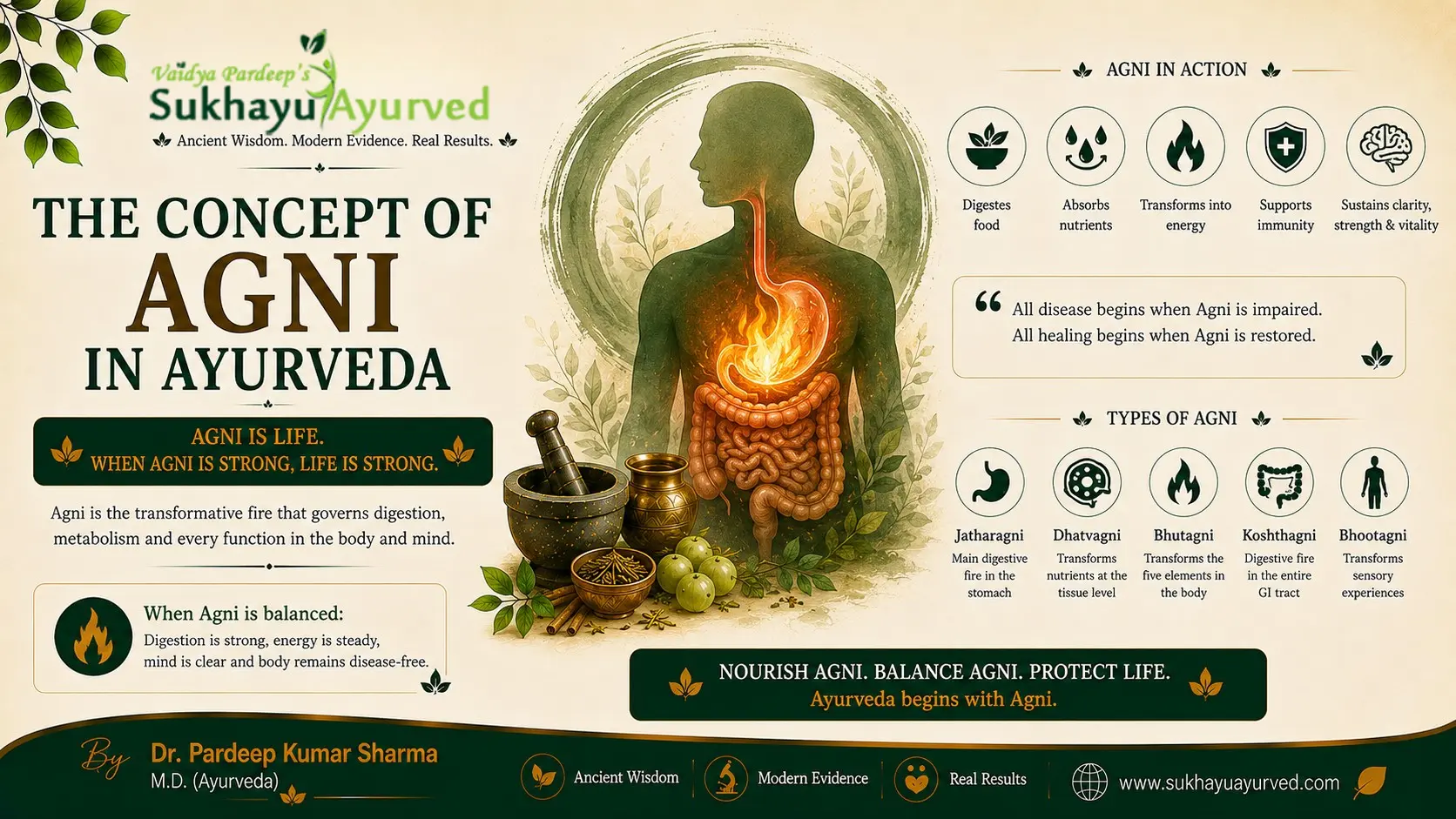
The discovery of fire was one of the great turning points in human history. It gave us warmth, protection, light — and cooking. Cooked food was easier to break down, easier to absorb, and easier for the body to turn into flesh and strength. Somewhere in watching food soften and transform over a flame, the ancient physicians of India recognised something profound: the same thing happens inside us. Digestion, they realised, is nothing but cooking — the body converting complex substances into simpler ones it can actually use.
They gave this inner fire a name: Agni.
Agni is one of the most important ideas in all of Ayurveda. It is not a metaphor decorating a textbook; it is the working principle behind how you extract nourishment, how you fight off illness, how clearly you think, and how well you age. Classical texts state it plainly — when Agni is balanced, a person is healthy and long-lived; when Agni fails, disease takes root; and when Agni is extinguished, life ends. Everything downstream of digestion depends on it.
This article walks through what Agni actually is, the thirteen forms it takes in the body, how the three doshas govern its strength, the four functional states it moves between, and — most importantly for anyone living with a chronic gut or autoimmune problem — what happens when it breaks down.
Agni Is Not Just "Digestion in the Stomach"
The first thing to unlearn is that digestion begins and ends in the gut. According to Ayurveda, digestion is a continuous, body-wide process. That is why Ayurveda speaks not of one fire but of many.
The closest modern parallel is metabolism. In metabolism, complex structures are broken down into simpler ones — catabolism — and those simpler, body-compatible units are then rebuilt into living tissue — anabolism. Agni is the intelligence that runs both directions of that exchange, at every level of the body, from the food on your plate to the individual tissue cell.
When we talk about healthy digestion in Ayurveda, we are really talking about the strength and steadiness of Agni. A person can eat the finest diet in the world, but if the fire that processes it is weak, that food becomes a liability rather than nourishment.
The Thirteen Agnis of the Body
There are thirteen Agnis in the human body:
- Jatharagni — one, the central digestive fire
- Dhatvagni — seven, one for each body tissue
- Bhutagni — five, one for each of the five great elements
Jatharagni — the Central Fire
Jathara means the digestive system; Agni is the fire. So Jatharagni is the fire seated in the digestive tract, and it is the master of all the others. It performs the first and most decisive stage of digestion, breaking food down into a form the rest of the body can work with. Crucially, Jatharagni also governs the strength of every other Agni beneath it. If the central fire is strong, the tissue and elemental fires tend to be strong. If it falters, the whole cascade suffers. This is why Ayurveda places so much emphasis on protecting the digestive fire first, before anything else.
Dhatvagni — the Seven Tissue Fires
What Jatharagni does to food, the Dhatvagnis do to the tissues — the dhatus. The body has seven dhatus, and each has its own dedicated fire, named after the tissue it produces: Rasagni for the plasma/lymph tissue (Rasa), Raktagni for blood (Rakta), Mamsagni for muscle (Mamsa), and so on through fat, bone, marrow, and reproductive tissue. Each Dhatvagni takes the nourishment passed to it and refines it into that specific tissue. A weak tissue fire means that tissue is poorly formed and poorly nourished, however much raw material arrives.
Bhutagni — the Five Elemental Fires
Digestion does not even stop at the tissues. It continues down to the Panchamahabhutas — the five great elements (space, air, fire, water, earth) — because ultimately health rests on the harmony of these elements within us. Each element has its corresponding fire: Akashagni for space, Vayvagni for air, and so on. The Bhutagnis act on the elemental components of food so that each element in what we eat is made compatible with the same element in the body.
Read together, the thirteen Agnis describe a single, elegant idea: nourishment is refined in stages, and at every stage there is a fire responsible for getting it right. A failure at any level echoes through all the levels below it.
How the Doshas Govern Agni
In Ayurveda, everything in the body is regulated by the three doshas — the biological governing principles. Agni is no exception. The state of your digestive fire at any given moment is largely a reflection of which dosha is influencing it.
Pitta shares its very nature with fire, so when Pitta runs high, Agni becomes sharp and aggressive. Appetite spikes; food is burned through quickly. But an over-strong fire is not a healthy one — at the tissue level it can begin to consume the dhatus themselves, and at the elemental level it burns through the mahabhutas. The person feels intense hunger, heat, acidity, and a body that is being used up faster than it is being built.
Kapha is cool, heavy, and dense — the opposite of fire — so when Kapha dominates, Agni goes dim. Digestion slows, food sits undigested, and harmful residue accumulates in the body. Weak Jatharagni means indigestion; weak Dhatvagnis mean the tissues are starved even when the person is eating enough. This dim, sluggish fire is at the heart of a great many chronic complaints.
Vata is mobile and irregular, so when Vata is involved, Agni becomes erratic — strong one moment, feeble the next. Digestion is unpredictable: bloating after one meal, ravenous hunger before the next, bowel habits that swing between extremes.
The Four States of Agni
These dosha influences give rise to the four classical states of Agni. Recognising which state you are in is the practical heart of the whole concept — it is how an Ayurvedic physician decides what to correct.
Samagni — the balanced fire. This is the goal. Agni is neither too sharp nor too dull. Food is digested completely and on time, the tissues are properly nourished, elimination is regular, and the mind is clear. Samagni is possible when the three doshas are themselves in balance.
Vishamagni — the irregular fire (Vata). Digestion is inconsistent. The same meal may be handled well today and cause bloating, gas, cramping, or irregular stools tomorrow. Appetite comes and goes without pattern. This is the fire of an anxious, over-stretched, irregularly-fed modern life.
Tikshnagni — the sharp fire (Pitta). Digestion is too fast and too hot. There is excessive hunger, heartburn, acidity, burning sensations, and sometimes loose stools. The person may feel they "digest anything" — but they are often quietly burning through their own reserves.
Mandagni — the dull fire (Kapha). The most clinically important of the four. Digestion is weak and slow. There is heaviness after eating, poor appetite, a coated tongue, lethargy, and a feeling that food simply "sits." Mandagni is where most chronic disease begins, because a dull fire produces something Ayurveda regards as the root of illness: Ama.
Agni, Ama, and the Birth of Disease
When Agni — especially Mandagni — is too weak to fully digest food, that food is not properly processed. Instead of becoming clean nourishment, it becomes a sticky, toxic, incompletely-digested residue called Ama.
Ama is the pivotal concept that connects a "weak stomach" to serious, systemic illness. This residue does not stay politely in the gut. It clogs channels, mixes with the doshas, and travels through the body, settling in weak or vulnerable tissues and joints. Wherever it lodges, it obstructs normal function and provokes disease. The chain is direct and unforgiving: weak Agni → undigested Ama → obstruction and reaction → disease. Ayurveda has understood this cascade — from a failing digestive fire to what modern medicine would recognise as chronic inflammation — for well over two thousand years.
In Everyday Gut Health
Long before any diagnosed disease, weak Agni and early Ama show up as the ordinary, dismissed complaints so many people live with: bloating, heaviness after meals, a white-coated tongue in the morning, foul breath, sluggish or irregular bowels, low energy after eating, and that vague sense of being "not quite digested." These are not trivial. In Ayurvedic terms they are the smoke that signals a struggling fire — and the earliest, most treatable stage of the whole cascade. When the gut lining itself becomes compromised and starts leaking incompletely-digested material into the system, the picture Ayurveda has always described as Ama overlaps closely with what is now studied as leaky gut.
In Chronic and Autoimmune Disease
Follow the Ama cascade to its end and you arrive at the autoimmune diseases. When Ama circulates and settles into the tissues and joints, the body mounts a reaction against its own obstructed, "foreign-seeming" tissue — the terrain in which conditions like rheumatoid arthritis develop. This is why classical Ayurveda locates the origin of such a joint disease not in the joint at all, but in the digestive fire. The joint is where the fire's failure finally becomes visible. Treat the joint alone and you chase the smoke; correct the Agni and clear the Ama, and you address the actual source.
This is the reasoning behind Sukhayu's clinical approach to chronic and autoimmune conditions: before building the body up, you must first restore the fire that was supposed to be building it in the first place.
Restoring Agni
Because Agni sits upstream of nearly everything, correcting it is the first move in Ayurvedic treatment, not an afterthought. Broadly, the work proceeds along a few lines.
Kindling the fire (Deepana) and digesting the residue (Pachana). Specific herbs and formulations are used to rekindle a dull Jatharagni and to "cook" existing Ama so it can be cleared rather than left to circulate. This is why an Ayurvedic physician so often begins with the digestion even when the patient came in about a joint or the skin.
Clearing accumulated Ama and doshas (Shodhana). Where residue and disturbed doshas have built up over years, gentle, properly-supervised Panchakarma procedures are used to remove them, so the restored fire is not immediately re-buried under old accumulation. You can read more in our guide to Panchakarma.
Protecting the fire day to day. Much of Agni's health is decided by ordinary habits: eating at regular times, eating to roughly three-quarters full, favouring warm and freshly-cooked food, not drowning the fire in cold or heavy meals, and giving the previous meal time to digest before the next. These are not quaint suggestions — they are how you keep Samagni once you have it.
The Bottom Line
Agni is the single thread that ties together digestion, immunity, energy, clarity, and the slow work of building and maintaining a body. Ayurveda's insight — arrived at by watching food transform over fire and recognising the same process within — is that health is not primarily about what you eat, but about the strength of the fire that processes it. A strong, steady Agni turns food into vitality. A weak or erratic one turns the very same food into Ama, and Ama, over time, into disease.
If you recognise your own digestion in the irregular, sharp, or dull states described above — or you are living with a chronic or autoimmune condition that no one has traced back to the gut — the concept of Agni is not ancient trivia. It is very likely the first place your treatment should begin.