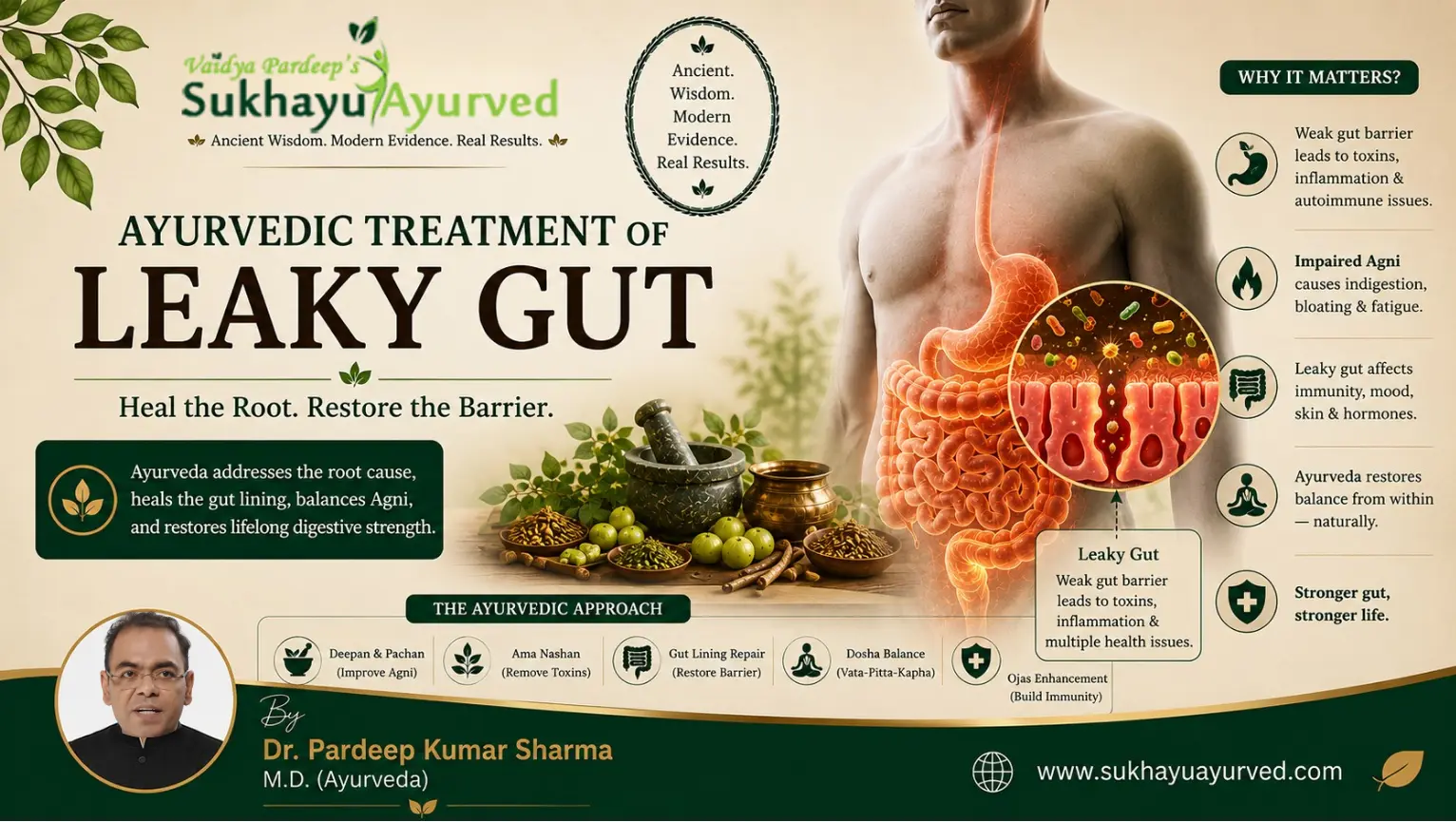
If you've been told your gut is "leaky," you've probably also been told there's no real treatment for it — just supplements, elimination diets, and a lot of waiting. That answer never satisfied you, and it shouldn't.
Ayurveda looked at this exact problem more than two thousand years ago, long before anyone had a microscope to see a tight junction. It called it Grahani — a disorder of the organ that holds, digests, and absorbs. And unlike the modern conversation, which is still arguing about whether leaky gut is "real," Ayurveda never treated the gut lining as the problem to begin with. It treated the fire behind it.
That distinction is the whole difference between managing symptoms and actually healing.
What is leaky gut, really?
Your intestinal wall is not a passive pipe. It's a highly selective barrier, one cell thick in places, that decides what enters your bloodstream and what stays out. The cells in that wall are stitched together by structures called tight junctions. When they're working, they let nutrients through and keep everything else — undigested food particles, bacterial fragments, toxins — safely inside the gut where they belong.
In leaky gut, those junctions loosen. The gate that's meant to open for the right molecules starts letting the wrong ones slip into the bloodstream. Your immune system, finding food proteins and bacterial debris where they were never supposed to be, does the only thing it knows how to do: it reacts. Inflammation. Antibodies. Over time, a body that's fighting its own dinner.
This is why leaky gut rarely stays a "gut problem." It shows up as skin flares, joint pain, brain fog, fatigue, and — most importantly — as the quiet groundwork beneath many autoimmune conditions.
Is leaky gut a real condition, or a myth?
Here's the honest answer, because you deserve one.
The phrase "leaky gut syndrome" is not yet a formal diagnosis in conventional medicine, and some clinicians dismiss it for that reason. But increased intestinal permeability — the actual mechanism — is well documented and studied. Dr. Alessio Fasano, who identified the protein zonulin that loosens these tight junctions, has argued that gut permeability plays a pathogenic role across a range of chronic inflammatory and autoimmune diseases (Fasano, F1000Research, 2020 — NIH/PMC). It's an established feature of celiac disease, Crohn's, ulcerative colitis, IBS, and several autoimmune conditions.
So the mechanism is real. The debate is only about the label.
Ayurveda sidesteps this argument entirely. It never needed the term "leaky gut," because it was never describing a leak in the first place. It was describing a failure of Agni — your digestive fire — and the trail of consequences that follow when that fire goes weak. That framework is over two millennia old, and it maps onto the modern findings with unsettling precision.
What Ayurveda calls leaky gut: Agni, Ama, and Grahani
To understand the Ayurvedic view, you only need three ideas.
Agni is your digestive fire. It's what breaks food down into nourishment your body can actually use. Strong Agni means clean, complete digestion. Weak Agni — Agnimandya — means food is left half-processed.
Ama is what half-processed food becomes. When Agni is too weak to finish the job, food ferments and turns into a sticky, toxic residue Ayurveda calls Ama. This is the real villain of the story. Ama clogs channels, feeds inflammation, and irritates the very gut lining that's supposed to protect you.
Grahani is the organ that holds and absorbs — closely corresponding to the small intestine and duodenum, the classical seat of Agni. When Agni weakens and Ama accumulates, the Grahani loses its grip. It can no longer hold, digest, and selectively absorb the way it should. What modern medicine sees as loosened tight junctions, Ayurveda has always understood as a Grahani that has lost its integrity because the fire beneath it went cold.
Put simply: leaky gut is not a leak. It's a fire problem that became a barrier problem.
And that's why supplementing the lining alone rarely works for long. You're patching a wall while the fire that damaged it still burns low.
Symptoms of leaky gut
Leaky gut is a great imitator — its symptoms rarely point straight at the gut. Watch for clusters like these:
- Bloating, gas, and irregular bowel movements that never fully settle
- Food sensitivities that seem to multiply over time
- Skin conditions — eczema, acne, unexplained rashes
- Joint aches and stiffness without clear injury
- Persistent fatigue and brain fog
- Mood changes, disturbed sleep, low resilience to stress
- A history of, or tendency toward, autoimmune flares
If several of these travel together and no single specialist has been able to connect them, the gut is often the missing thread. This overlap is why leaky gut is so closely tied to conditions like irritable bowel syndrome (IBS) and ulcerative colitis.
How leaky gut connects to autoimmune disease
This is the part that matters most, and it's why so many of the patients who come to Sukhayu for autoimmune conditions turn out to have a gut story underneath.
When the barrier loosens and foreign particles reach the bloodstream, the immune system is forced into a constant state of alarm. In people already prone to it, that chronic alarm can tip into autoimmunity — the immune system, overtrained and overreactive, begins mistaking the body's own tissue for a threat. This link is best documented in celiac disease, where our own clinical work found the root lay not in the wheat but in weakened Agni and compromised tissue formation.
Heal the gut, and you're not just treating digestion. You're removing one of the biggest triggers keeping the immune system inflamed. This is why gut restoration sits at the foundation of autoimmune care in Ayurveda, not off to the side as an afterthought.
Ayurvedic treatment of leaky gut at Sukhayu
Because the root is a fire problem, the treatment doesn't chase symptoms — it rebuilds the system from Agni outward. At Sukhayu, that follows a clear sequence, personalised to each patient's constitution and the state of their Grahani.
1. Clear the Ama first. You cannot rekindle a fire in a clogged hearth. The first phase focuses on gentle detoxification — using deepana (fire-kindling) and pachana (Ama-digesting) herbs and protocols to burn off accumulated toxins before anything else. Rushing past this step is the most common reason gut treatments fail.
2. Rekindle Agni. Once the channels are clearer, treatment turns to restoring the digestive fire itself — so that food is fully digested and no new Ama is created. This is the difference between a lasting result and a temporary one. A strong Agni stops the problem at its source.
3. Restore and strengthen the Grahani. With Ama cleared and Agni rebuilt, targeted therapies repair and tone the gut lining — the Grahani — so it can once again hold and selectively absorb. Classical formulations chosen for gut-wall integrity do here what "gut repair supplements" attempt, but as part of a system rather than in isolation.
4. Panchakarma, where indicated. For deeper or long-standing cases — especially those with autoimmune involvement — measured Panchakarma therapies remove entrenched toxins and reset the digestive system at a level diet alone cannot reach. This is done under supervision, calibrated to your strength, never as a one-size protocol.
5. Diet and rhythm that keep the fire strong. None of the above holds without the daily foundation: eating in a way and at a rhythm that protects Agni. Warm, well-cooked, easily digestible food. Regular mealtimes. Removing the specific triggers that keep your gut inflamed. This isn't a punishing elimination diet — it's a way of eating that keeps the fire you rebuilt from going out again.
The result patients notice isn't just less bloating. It's the skin clearing, the joints easing, the fog lifting — the whole scattered set of symptoms resolving together, because they always had a single root.
Why this approach works when others stall
Most leaky gut protocols treat the wall. Ayurveda treats the fire that damages the wall. That's the entire reason results last — you're not sealing a barrier while the cause runs on underneath it. You're removing the cause, then letting the barrier heal because it finally can.
For anyone whose gut symptoms are tangled up with an autoimmune condition, that difference is not academic. It's the difference between a lifetime of management and a genuine path toward healing.
Frequently asked questions
Is leaky gut curable with Ayurveda? In most cases, yes — because Ayurveda treats the cause (weak Agni and accumulated Ama), not just the loosened lining. When the fire is rebuilt and the Grahani restored, the barrier heals and stays healed, provided the daily diet and rhythm are maintained.
How long does Ayurvedic treatment for leaky gut take? It depends on how long the condition has existed and whether autoimmune disease is involved. Early cases often respond within weeks; deep-seated cases with autoimmune involvement need a longer, staged course. Your Agni and Grahani are assessed at the outset to set a realistic timeline.
Do I have to follow a strict elimination diet? No. Ayurveda focuses on eating in a way that supports your digestive fire — warm, well-cooked, easily digestible food at regular times — and on removing your specific triggers, rather than blanket-eliminating entire food groups indefinitely.
Can leaky gut cause autoimmune disease? It's one of the recognised contributing factors. A loosened gut barrier keeps the immune system chronically activated, which in susceptible people can push it toward autoimmunity. This is why gut restoration is central to autoimmune care at Sukhayu.
This article is for education and does not replace an individual consultation. Leaky gut, and especially its autoimmune connections, is best assessed and treated under a qualified Ayurvedic physician. To discuss your case with the team at Sukhayu Ayurved, book a consultation.