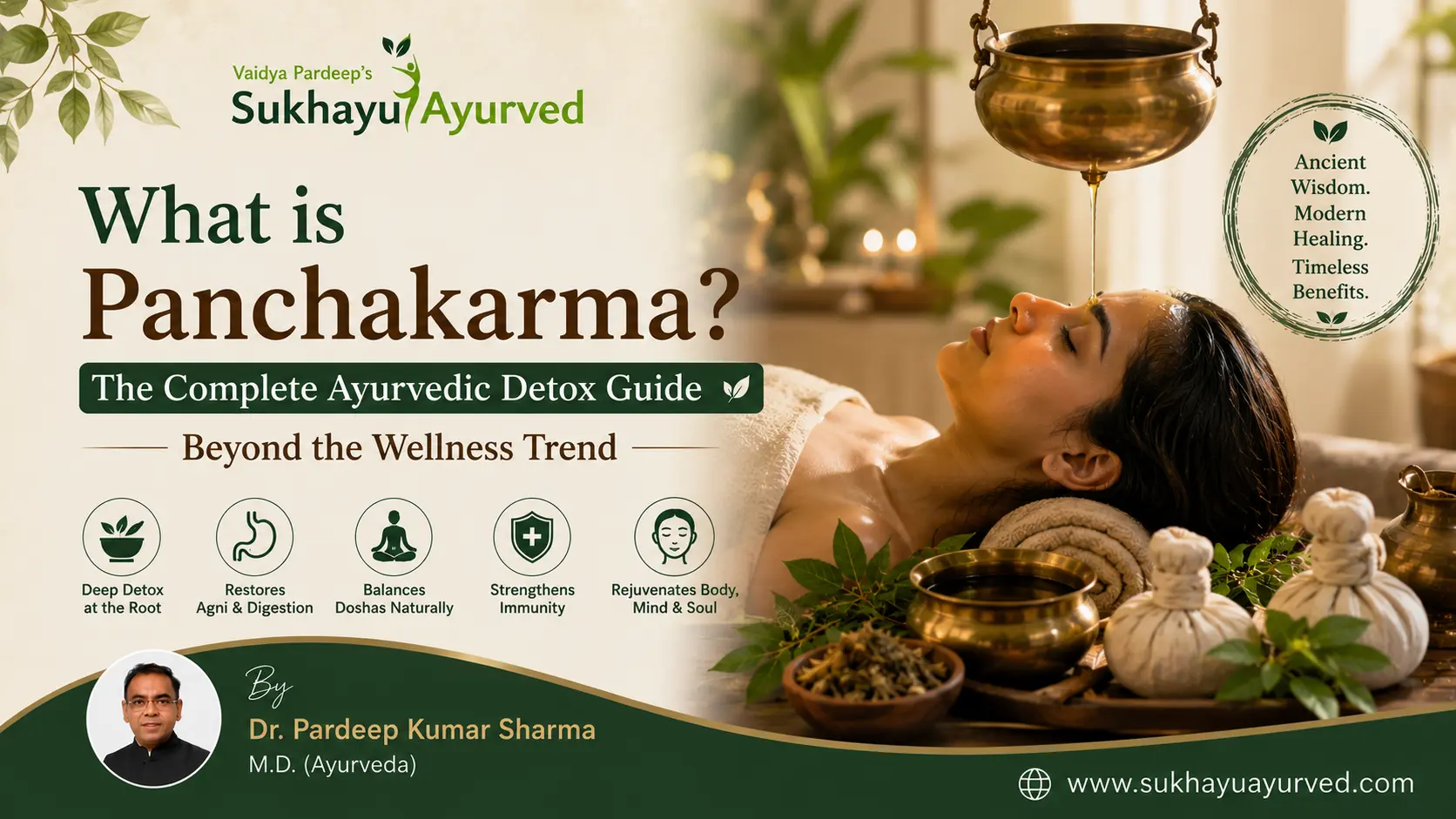
A patient asked me something recently that I still think about: "If my blood work is normal, why do I still feel like something inside me is stuck?" I didn't have a quick answer for her that day. But it's the question that Panchakarma exists to answer.
Most people who ask me about Panchakarma have already read about it online — usually as a five-star wellness package involving oil, steam, and a very relaxing week. That version isn't wrong, exactly. It's just incomplete. What I practice in the clinic is a clinical protocol, not a retreat experience, and the difference matters more than most people realize until they've tried both.
The deeper principle
Panchakarma is not one treatment. It is a category of five classical procedures — Vamana (therapeutic emesis), Virechana (therapeutic purgation), Basti (medicated enema), Nasya (nasal administration), and Raktamokshana (bloodletting) — each designed to remove vitiated Doshas through the body's own natural exit routes. Each has its own indication; none of them are interchangeable, and none of them are meant to be self-selected.
Acharya Charaka, in the Charaka Samhita, describes the logic behind this with a phrase I return to constantly: shodhanam bhuyo doshanam apunarbhava karanam — purification is what prevents the recurrence of the disease-causing factors. Not suppression. Not masking. Removal.
This is the line I want every patient to sit with before we go further: Ayurveda does not treat disease by masking a symptom. It treats disease by locating where the Dosha (pathological activities) has accumulated, and giving it a path out. That is a fundamentally different clinical philosophy from most of what patients have already tried before they reach me.
And underneath all of it sits the belief my entire practice is built on: Ayurveda is about adding value in life, not years in life. Panchakarma is not a promise of cure/longevity. It is a complete and sophisticated tool Ayurveda gives us to make the conditions for healing possible.
Clinical reality — what this looks like in the OPD
The patients who actually end up asking about Panchakarma are rarely who people expect.
It's the engineer with ankylosing spondylitis whose medication has plateaued and whose inflammatory markers won't budge below a certain threshold no matter how consistent he is. It's the woman with over a decade of knee osteoarthritis who's been told "there's nothing more to do besides replacement." It's the new mother with postpartum Vata derangement — disrupted sleep, anxiety, joint stiffness — months after delivery, when every scan comes back "normal" and every specialist has run out of things to check.
None of them are looking for a detox holiday. They're looking for an explanation of why their body keeps returning to the same dysfunction despite doing everything they were told to do. Panchakarma, done correctly, answers that specific question: the channels carrying nutrition and waste — what Ayurveda calls the srotas — have become obstructed by vitiated Dosha, and no amount of symptomatic management clears an obstructed channel.
I've seen this distinction play out again and again: patients who do a single superficial oil-massage session at a wellness resort with no clinical assessment behind it, and see nothing change. And patients who go through it as a properly sequenced protocol — Dosha assessment first, procedure selection second — and see functional markers move in ways their previous treatment plan never achieved. The difference is never the procedure itself. It's the diagnosis behind it.
The mechanism — why this actually works
Here's where I want to bridge the classical language into something a physiologically-minded patient can hold onto.
Panchakarma runs on three phases, and each has a distinct mechanistic job:
Purva Karma (pre-procedure) — Snehana (internal and external oleation) and Swedana (sudation/heat therapy) come first. Physiologically, this loosens Ama — metabolic toxins and undigested material — that has adhered to deeper tissue, and mobilizes it back into the gastrointestinal tract, where it can be eliminated. This isn't a metaphor. Oleation genuinely increases the solubility of fat-soluble toxins and metabolic byproducts, making them mobile again.
Pradhana Karma (main procedure) — this is the actual elimination, and each of the five procedures targets a different exit route: Vamana clears Kapha through the upper GI tract, Virechana clears Pitta through the lower GI tract, Basti clears Vata through the colon (Vata's primary seat in Ayurvedic physiology), Nasya clears accumulated Dosha from the head and sinus region, and Raktamokshana addresses vitiated blood directly — relevant in chronic inflammatory and dermatological presentations.
Paschat Karma (post-procedure) — a structured, sequential return to normal diet (Samsarjana Krama) that rebuilds Agni, or digestive fire, carefully rather than shocking a purified system with heavy food immediately. This is where most self-administered or poorly supervised Panchakarma fails: patients treat the procedure as the endpoint, when clinically it's only the midpoint.
Practical application — what to actually expect
- Duration: A properly sequenced protocol typically runs 7 to 21 days, depending on the procedure selected, the patient's constitution (Prakriti), strength (Bala), and how chronic the condition is. A single-day "detox" is not Panchakarma — at best, it's a partial Purva Karma.
- Who it is for: Chronic joint disease, autoimmune conditions, neurological conditions involving Vata derangement, chronic skin conditions, and metabolic disorders where conventional management has plateaued.
- Who it is NOT for: Pregnant women, patients in acute infection, patients with significant cardiac compromise, extremely debilitated patients without a prior strength assessment, and patients with active bleeding disorders (for most procedures). Every one of these is a clinical judgment call — which is exactly why Panchakarma should never be self-administered or done without a physician's assessment first.
- During the procedure: Mild fatigue, transient appetite changes, and occasional emotional release are common and expected — I tell every patient this in advance so it's never mistaken for something going wrong.
- After the procedure: Most patients notice their first real functional change — sleep quality, morning joint stiffness, digestive regularity — during the Paschat Karma window, not during the procedure itself.
Closing philosophy
Patients often ask why Ayurveda insists on removing something instead of simply adding a herb to counter a symptom. My answer is always the same: you can't pour clean water into a clogged vessel and expect it to run clear. Panchakarma is Ayurveda's admission that the body sometimes needs to be emptied before it can be rebuilt.
If you've been managing a chronic condition and feel like your current treatment has plateaued, this is worth a proper conversation — not a self-diagnosis from an article. WhatsApp us at [+91-9050802060] and we'll help you understand whether Panchakarma is the right next step for your specific case.
-------------------------------------------------------------------------------------------------------------------------------------------------
Dr. Pardeep Sharma, M.D. (Ayurveda) is the founder of Sukhayu Ayurved, Jaipur, where his OPD practice focuses on the Ayurvedic management of orthopedic, neurological and autoimmune conditions.
Medical Disclaimer: This article is for educational purposes only and does not constitute medical advice. Panchakarma procedures should only be undertaken under the direct supervision of a qualified Ayurvedic physician after proper clinical assessment. Individual results vary and no outcome is guaranteed.