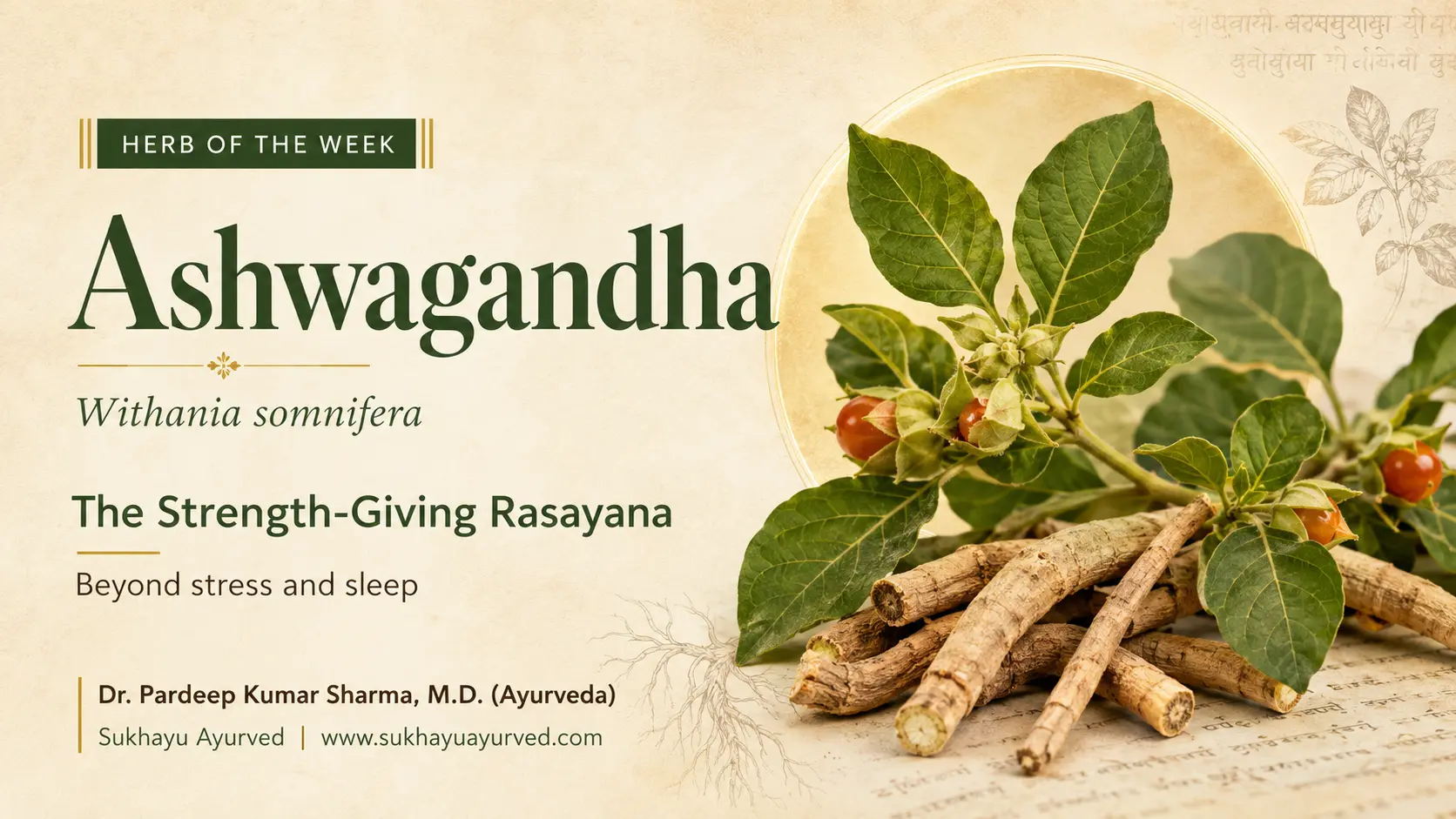
With every seasonal change, my OPD fills with a very specific complaint. Not pain. Not a skin eruption. Just exhaustion - the kind that doesn't lift with sleep. Executives who cannot switch off their mobiles and brains. Mothers who feel their body has stopped listening to them. In more than two decades of practice, I have learned to recognise this pattern before the patient finishes describing it. And in nearly all of these cases, one herb enters the treatment plan within the first week: Ashwagandha.
What Charaka Actually Wrote
Ashwagandha - Withania somnifera - is classified in classical Ayurveda as a Balya and Rasayana dravya. Charaka Samhita places it among the Balya Dashemani, the ten strength-promoting herbs (Charaka Samhita, Sutrasthana 4). The Sanskrit name itself is clinical: ashva (horse) + gandha (smell), referring to the root's distinct odour and, traditionally, to the strength it was believed to confer — "the vitality of a horse."
Its pharmacological profile in classical terms:
- Rasa (taste): Katu, Tikta, Kashaya (pungent, bitter, astringent)
- Guna (qualities): Laghu, Snigdha (light, unctuous)
- Veerya (potency): Ushna (heating)
- Vipaka (post-digestive effect): Madhura (sweet)
This combination is precisely why it works where it works. A Vata-pacifying, tissue-nourishing herb with a heating potency counteracts the cold, dry, depleting qualities that define chronic stress states in Ayurvedic physiology — what we call Vata prakopa.
What I See in the OPD
The textbook description is one thing. What happens across a consulting table is another.
Three patterns repeat, year after year:
The corporate burnout pattern — professionals, usually 28 to 45, presenting with disturbed sleep, morning fatigue despite eight hours in bed, and a resting heart rate that's crept up over months. Cortisol dysregulation shows on their labs before they ever say the word "stress."
The post-viral fatigue pattern — patients who recovered from a viral illness weeks ago but never regained baseline energy. Their agni (digestive fire) has weakened, and Ashwagandha's tissue-building action becomes central to recovery, not incidental.
The autoimmune-adjacent fatigue pattern — this is where I am most careful. In autoimmune conditions with a hyperactive immune response (certain presentations of rheumatoid arthritis, for instance), Ashwagandha's immunomodulatory action needs calibration, not blanket prescription. I do not give it reflexively here. This is a clinical judgment call, made case by case, and it is one reason self-prescription of Ashwagandha in autoimmune disease worries me.
The Mechanism — Why, Not Just That
Modern research on withanolides — the steroidal lactones responsible for Ashwagandha's activity — maps onto classical observation with unusual precision. Withanolides appear to modulate the HPA axis (hypothalamic-pituitary-adrenal), which governs the body's cortisol response. This is the biochemical face of what Ayurveda described, without that vocabulary, as an ojo-vardhaka (Ojas-building) action — the restoration of the body's core reserve capacity.
Ojas, in classical understanding, is not a poetic abstraction. It is the physiological reserve that determines resilience — how well a person withstands stress, infection, and fatigue without breaking down. Chronic Vata aggravation depletes Ojas. Ashwagandha's Rasayana action rebuilds it. That is the mechanism, in both languages.
Practical Application
In my practice, Ashwagandha is prescribed with attention to three variables: form, dose, and anupana (the vehicle it's taken with) — because these determine how it acts, not just whether it acts.
- Form: Root powder (churna) for classical Rasayana use; standardised root extract when precise withanolide dosing matters, particularly in stress and sleep protocols
- Typical dose: 3–6 grams of churna, or 300–600 mg of standardised extract, once or twice daily — individualised to constitution and condition
- Anupana: With warm milk at night for sleep and tissue-building (classical combination); with honey for daytime energy support in Vata-dominant fatigue
- Timing: Night dosing for sleep and HPA-axis support; morning dosing when the goal is sustained daytime energy
Contraindications I take seriously: pregnancy, active hyperthyroidism (Ashwagandha can influence thyroid hormone levels), and — as noted above — certain hyperactive autoimmune presentations without proper monitoring. It is also combined thoughtfully: with Shatavari in cases needing both Vata-pacification and reproductive tissue support, with Brahmi when the fatigue pattern includes cognitive fog.
The Larger Truth
Patients often ask me if Ashwagandha will "fix" their stress. I tell them what I tell everyone who asks a version of this question: any medicine is a just a part of the treatment, larger picture needs larger working. Ashwagandha does not remove the source of a person's exhaustion — the job, the grief, the unresolved thing sitting under the fatigue. What it does is rebuild the physiological floor a person stands on while they do that harder work themselves. That distinction matters more than any dose I write on a prescription pad.
________________________________________________________________________________________________________________
Dr. Pardeep Sharma, M.D. (Ayurveda) is the founder of Sukhayu Ayurved, Jaipur. With over 20 years of clinical experience in Ayurvedic management of orthopedic, neurological and autoimmune conditions.
This article is for educational purposes and does not replace individualised medical consultation. Ashwagandha, like any therapeutic agent, has contraindications and interactions. Please consult a qualified Ayurvedic physician before starting any herb, especially if pregnant, on thyroid medication, or managing an autoimmune condition.