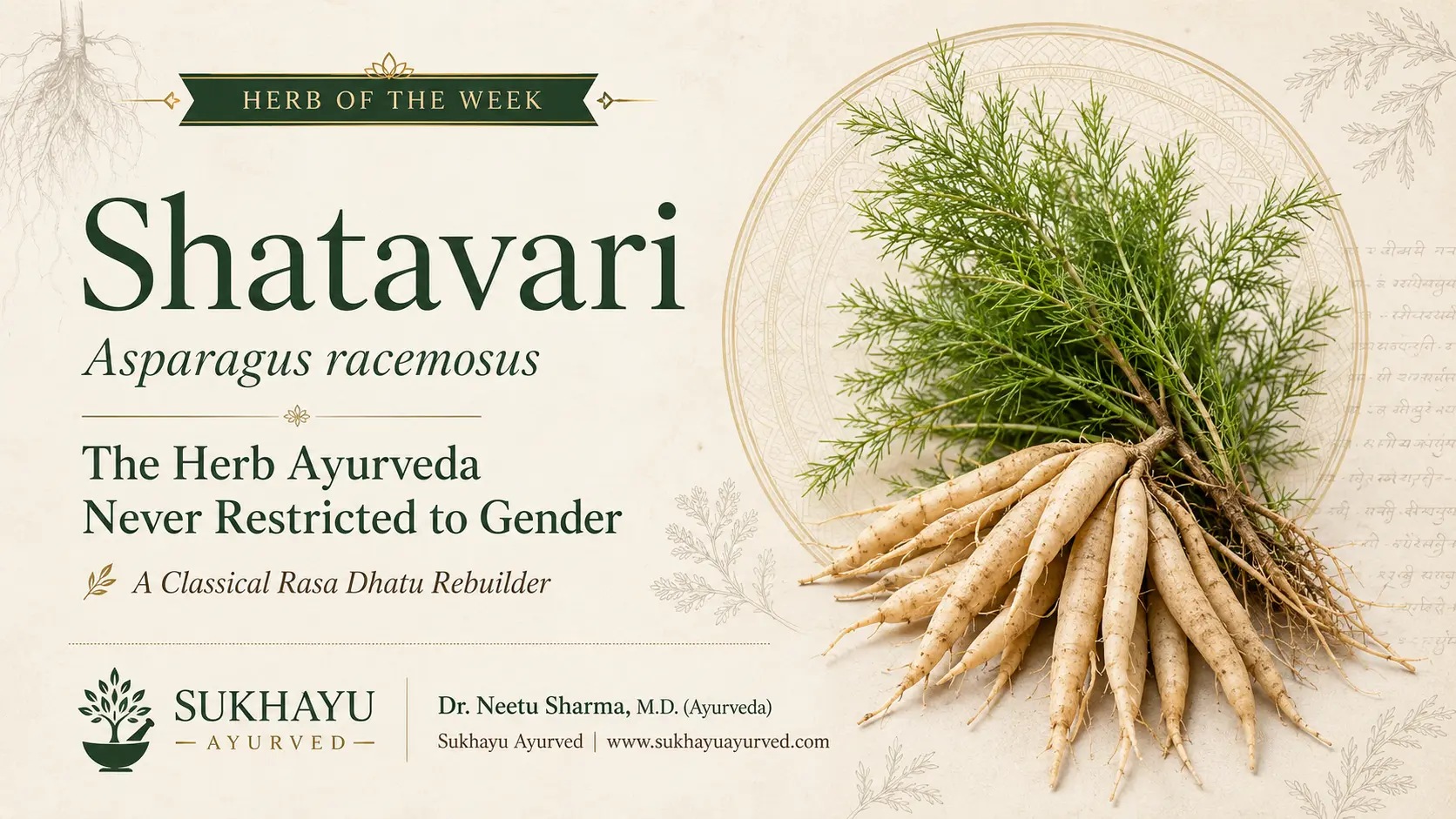
A name that became a misdiagnosis
The Sanskrit word Shatavari has a feminine grammatical form. Its root system climbs and spreads — a hundred roots, some translate it. Others say a hundred husbands, pointing to its association with female vitality. The name stuck. The association calcified. And somewhere between the classical texts and the modern supplement shelf, a herb that Charaka classified as a strength-builder and anti-ageing medicine became — in popular understanding — a women's supplement.
This is a problem. Not because the name is wrong. But because a label applied to a herb without clinical reasoning is not Ayurveda. It is marketing wearing Ayurveda's clothes.
Charaka places Shatavari in two groups: Balya — herbs that build strength and immunity — and Vayasthapana — herbs that delay ageing. He places it in the Madhura Skandha, the category of sweet-tasting herbs with deep nourishing action. Sushruta includes it in Vidarigandhadi and Pitta Shamaka groups. Neither classification restricts it to women. Neither classical authority frames it as a reproductive herb first.
The herb's primary action is on the Rasa Dhatu. Understanding that changes everything.
Rasa Dhatu — the tissue that everything else depends on
Ayurveda describes seven Dhatus — the body's structural and functional tissues, each formed from the one before it. Rasa Dhatu is the first. It is plasma, lymph and the most refined nutritive essence the body produces from food. It nourishes all six tissues downstream. It governs Prinana — the satisfaction and fullness that flows through a body that is genuinely well-nourished.
Rasa Kshaya — depletion of Rasa Dhatu — has a recognisable clinical picture. Dryness. Fatigue that sleep does not resolve. Palpitations. Skin that has lost its quality. A quality of emptiness that runs deeper than tiredness. In classical terms: the body is receiving food but cannot extract nourishment from it at the level that matters.
Shatavari's pharmacological profile maps directly onto this deficiency state.
Rasa: Madhura and Tikta — sweet and bitter. The sweet taste builds and nourishes. The bitter purifies without depleting. Together they nourish without aggravating heat.
Guna: Guru and Snigdha — heavy and unctuous. The properties most opposite to the dryness and lightness of depleted Rasa Dhatu.
Veerya: Sheeta — cold potency. Directly pacifies the Pitta that flares when tissue reserves are low.
Vipaka: Madhura — sweet post-digestive effect. The herb continues to nourish after digestion is complete, supporting deep tissue rebuilding over time.
Effect on Doshas: balances Vata and Pitta. Does not balance Kapha. This last point matters enormously — and is what the market consistently ignores.
Pandu and the classical indications that get no marketing budget
Among Shatavari's classical indications is Pandu — the Ayurvedic category encompassing anaemia, pallor and inadequate nourishment of tissues. Pandu is, at its root, a condition of deficient Rasa Dhatu. The blood and the tissues downstream are not receiving what they need.
Kshaya — depletion of body tissues in the context of chronic respiratory conditions, prolonged illness or sustained overwork — is another primary indication. Here Shatavari functions as a rebuilder: it replenishes the Rasa that has been consumed by illness, and from that foundation allows the downstream Dhatus to reconstitute themselves.
These are not niche applications. In a clinical population dealing with chronic disease, post-illness recovery, sustained metabolic depletion and the tissue-level damage of long-term inflammation — Rasa Kshaya is ubiquitous. And Shatavari, correctly indicated, is one of the most direct tools for addressing it.
Neither Pandu nor Kshaya have a marketing category. They do not trend. They do not appear in Instagram posts about hormonal balance. But they represent the classical core of this herb's clinical application — available to any patient, of any gender, whose Rasa Dhatu has been depleted.
Why menopause is where this herb genuinely excels — the clinical logic
This is the application that twenty years of clinical practice has confirmed most consistently. And the reasoning is classical, not intuitive.
In Ayurveda, Artava — the menstrual essence and the hormonal regulatory function associated with it — is an Upadhatu of Rasa Dhatu. Not a primary Dhatu but a specialised output of the first tissue. When the menstrual cycle ceases and the hormonal landscape of the body undergoes its most significant shift, what is also happening in Ayurvedic terms is a fundamental change in how Rasa Dhatu expresses itself and what it produces.
The symptoms of perimenopausal transition — dryness of skin and mucous membranes, heat flushes, disturbed sleep, emotional variability, a quality of internal restlessness — are, in classical terms, manifestations of Rasa Kshaya combined with the withdrawal of Artava's moderating influence on Vata and Pitta. The body loses a regulatory rhythm it has maintained for decades. Vata, which depends on the cyclical movement of the menstrual process for grounding, becomes unsettled. Pitta, which the body previously channelled and released monthly, accumulates without its usual outlet.
Shatavari addresses this transition at its physiological root. It rebuilds Rasa Dhatu. It pacifies the Pitta that flares without the moderating influence of the cycle. And its Snigdha, heavy, nourishing properties counter the dryness and lightness that characterise aggravated Vata in the perimenopausal body.
Prescribed correctly — often in combination with Ashwagandha for the Vata component and Yashtimadhu where Pitta involvement is pronounced — the effect on the quality of the menopausal transition is clinically consistent. Not a suppression of symptoms. A steadying of the physiological process itself.
This is the application Charaka's pharmacological profile points toward. It happens to be most relevant to women at a specific life stage. That is not the same as being a women's herb.
Shatavari and PCOS: the clinical argument the market will not make
PCOS has become one of the most aggressively marketed conditions in the Ayurvedic wellness space. Shatavari is consistently placed at its centre.
The classical logic does not support this placement.
PCOS, from an Ayurvedic standpoint, is primarily a metabolic disorder. Its root is Agnimandya — impaired digestive fire. The accumulation of Ama from impaired Agni, the resulting disruption of Rasa and Rakta Dhatu metabolism, the secondary involvement of Kapha and the obstruction of Srotas — this is the pathological sequence that produces what ultrasound shows as cysts and what bloodwork shows as hormonal dysregulation.
Shatavari's properties are precisely contraindicated in this pathology. Heavy, sweet and cooling qualities do not help a sluggish Agni. They slow it further. They increase Kapha where Kapha obstruction is already part of the problem. They nourish Rasa Dhatu in conditions where the issue is not depletion but accumulation and obstruction.
The confusion is understandable. PCOS involves hormonal disruption. Shatavari is associated with hormonal balance. The surface-level connection is legible. But Ayurveda does not work at the surface. It works at the level of Dosha, Agni and Dhatu — and at that level, the PCOS-Shatavari pairing is not clinically sound for most patients.
PCOS requires Deepana-Pachana — stimulation of Agni and clearance of Ama. It needs herbs and protocols that address the metabolic root, not the symptomatic surface. For most PCOS presentations, that means herbs like Trikatu, Vidanga, Guggulu and Triphala — not a sweet, heavy, Kapha-increasing Rasayana.
If you have PCOS and have been taking Shatavari based on market advice, the correct step is a full clinical assessment of your Dosha state, Agni condition and Ama burden. What you need may be entirely different from what you have been told you need.
How Shatavari is prescribed — the classical method versus the capsule
The most effective preparation is the classical one: Shatavari processed with milk — root powder simmered in warm milk, filtered and consumed warm. This is not ceremonial. Milk is itself a Rasa Dhatu nourisher. The combination works at a depth the capsule form does not replicate.
Dose: 3–6 grams of root powder twice daily, 30 minutes before food.
Anupana: warm milk. Where Agni also needs support, a pinch of Pippali in the preparation activates the digestive component without counteracting the nourishing action.
Duration: minimum two to three months for meaningful Rasa Dhatu rebuilding. Rasayana protocols extend to six months or longer where the depletion is deep.
Combinations:
With Ashwagandha — for combined Vata-Pitta depletion and for perimenopausal transition involving both dryness and fatigue.
With Yashtimadhu — where Pitta involvement is pronounced and the gastric lining also needs support.
With Vidari Kanda — where strength and stamina rebuilding is the primary goal alongside Rasa nourishment.
Contraindications: active Kapha aggravation, high Ama burden, Agnimandya, diagnosed oestrogen-sensitive conditions (fibroids, certain hormone-sensitive tumours), elevated prolactin. In these cases the same presentation that elsewhere calls for Shatavari requires a different clinical approach entirely.
Shatavari, placed correctly
Charaka lists it among the greatest of Rasayanas. Sushruta includes it in his Pitta-pacifying group. The Ashtanga Hridayam confirms its place as a premier Rasa Dhatu rebuilder. Two thousand years of classical scholarship is consistent on this herb's nature and application.
It nourishes the depleted. It cools the inflamed. It steadies the body through transitions — menopause being the most significant of them. It supports recovery from prolonged illness, chronic disease and the sustained depletion that overwork produces in tissue at the level most laboratory tests will not measure.
This is a herb for Rasa Kshaya. Anyone — man or woman, young or ageing — whose first tissue is depleted has a clinical case for Shatavari. The gender association is a cultural inheritance, not a classical prescription.
Ayurveda's herbs are precise instruments. Their properties define their application more reliably than any category label ever can. Shatavari is not a women's herb. It is a Rasa Dhatu herb. And Rasa Dhatu belongs to everyone.
Dr. Neetu Sharma, M.D. (Ayurveda) is the fco-ounder of Sukhayu Ayurved, Jaipur — a NABH-certified Ayurvedic hospital empanelled under RGHS and CGHS. With over 18 years of clinical experience in the Ayurvedic management of Skin, gastro and gynaecological diseases, she writes on classical Ayurveda, clinical Panchakarma and seasonal health.
Medical disclaimer: This article is for educational purposes only and does not constitute medical advice. All Ayurvedic herbs should be prescribed by a qualified physician following a full clinical assessment.