
Reviewed by Vaidya Dr. Pardeep Sharma, M.D. (Ayurveda) — 20+ years in chronic neurological care | Sukhayu Ayurved, Jaipur
Motor Neurone Disease (MND) takes away movement, strength, speech, and — hardest of all — hope. Conventional medicine offers symptom control but no way to slow the underlying decay. Ayurveda works from a different starting point: instead of only managing symptoms, it aims to nourish the nervous system, slow the degeneration of nerve tissue, and preserve the function a patient still has through classical Panchakarma and Rasayana therapy.
This page explains what MND is, how Ayurveda understands and treats it, what our protocol at Sukhayu Ayurved actually involves, and — honestly — what it can and cannot do.
A clear, honest starting point: There is no known cure for MND in any system of medicine, including Ayurveda. What careful Ayurvedic treatment aims to do is slow the progression, protect remaining nerve and muscle function, and improve quality of life. We tell every patient this before treatment begins.
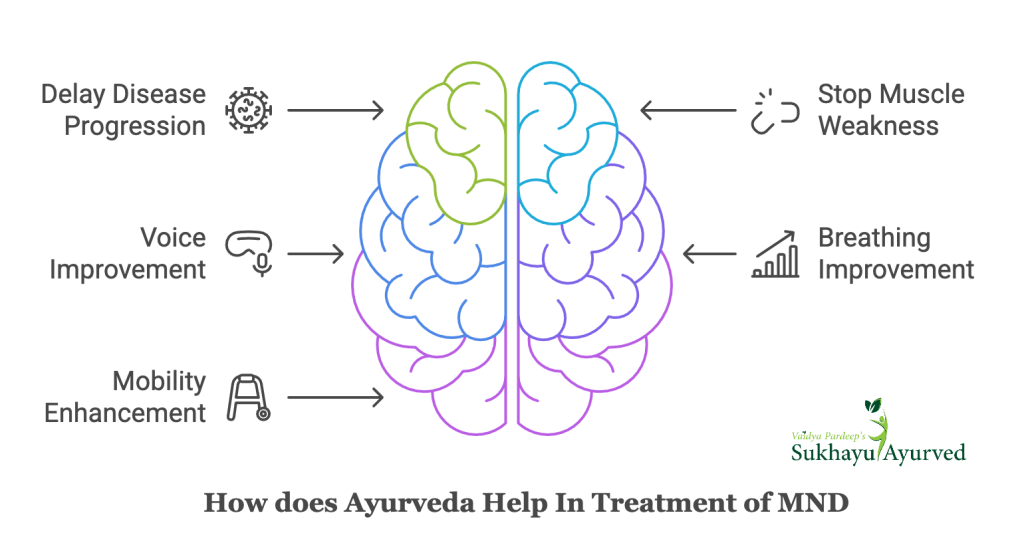
How Ayurveda Understands Motor Neurone Disease
In Ayurveda, the nervous system is governed by Vata dosha — not as an anatomical structure, but as the physiology of movement, signalling, and coordination. Because of this, disorders of the nervous system are broadly classified as Vata Vyadhi.
Charaka describes the core functions of Vata in a way that maps almost directly onto what MND destroys:
प्रवर्तकश्चेष्टानामुच्चावचानां सर्वेन्द्रियाणामुद्योजकः। सर्वेन्द्रियार्थानामभिवोढा सर्वशरीरधातुव्यूहकरः॥ सन्धानकरः शरीरस्य प्रवर्तको वाचः।
In plain terms, Vata is responsible for:
- Initiating every physical activity — including the motor commands that start movement
- Driving and coordinating all the senses and organs
- Binding the body's tissues together and keeping the structure intact
- Enabling speech
In MND, each of these functions steadily diminishes — which is exactly the clinical picture of the disease. But the more precise Ayurvedic understanding is Kaphavritta Vata: a state where sticky, obstructive Kapha blocks the normal free movement of Vata. This obstruction produces the sluggish nerve responses, stiffness, and progressive loss of motor control that define MND. This distinction matters, because it shapes the entire treatment approach — you cannot simply "increase" Vata; you have to clear the obstruction and nourish the channels at the same time.
The Approach of Motor Neurone Disease: Ayurvedic Treatment
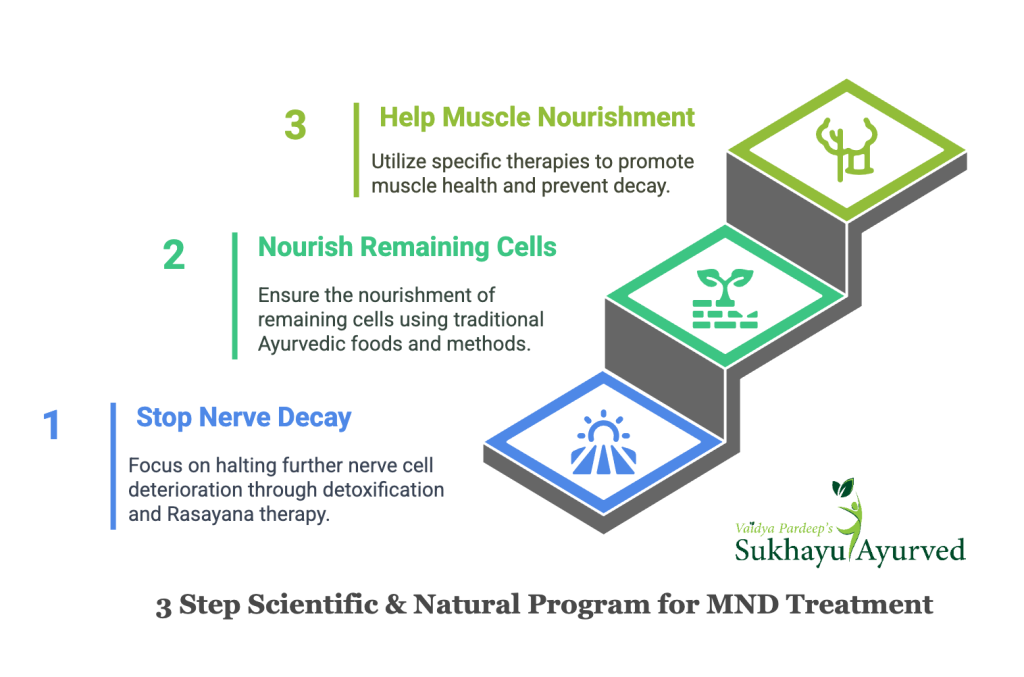
Our treatment under Vaidya Dr. Pardeep Sharma follows Ayurveda as the classical texts describe it, adapted carefully for the fragility of an MND patient. The goal is threefold:
1. Stop further decay of nerve cells
Gentle detoxification. Deep-seated toxins — whether environmental or arising from the body's own genetic tendency — obstruct the channels (srotas) that carry nourishment to nerve tissue. Panchakarma clears these. Crucially, in MND we never perform aggressive cleansing: the body is already in a state of significant decline, so only mild, carefully supervised detoxification is used.
2. Nourish the nerve cells that remain
Rasayana therapy. Rasayana is the medicine of deep nourishment. This ranges from single herbs like Ashwagandha, Brahmi, Amalaki, and Yashtimadhu to complex classical formulations such as Brahma Rasayana and Chyawanprash. The right choice depends entirely on the individual patient's strength and stage — which is why every plan is physician-selected, not standardized.
Charaka's guidance for Vata Vyadhi shapes this stage directly:
सर्पिस्तैलवसामज्जसेकाभ्यञ्जनबस्तयः। स्निग्धाः स्वेदा निवातं च स्थानं प्रावरणानि च॥ रसाः पयांसि भोज्यानि स्वाद्वम्ललवणानि च। बृंहणं यच्च तत् सर्वं प्रशस्तं वातरोगिणाम्॥
He prescribes ghee, medicated oils, animal fats, and bone marrow to nourish the body — applied to the skin, given orally, and administered through Basti. The patient is kept warm and sheltered from wind, and given sweet, sour, and salty nourishing foods. This is Bruhmana (nourishing) therapy, and it is the heart of MND management.
3. Support and rebuild muscle
- As nerves are protected and nourished, the wasting muscles must be supported too. Alongside internal medicines, Panchakarma procedures such as Navara Kizhi (Shashtika Shali Pinda Sweda) help slow muscle wasting and support neuromuscular coordination.
How does the Motor Neurone Disease: Ayurvedic Treatment at Sukhayu
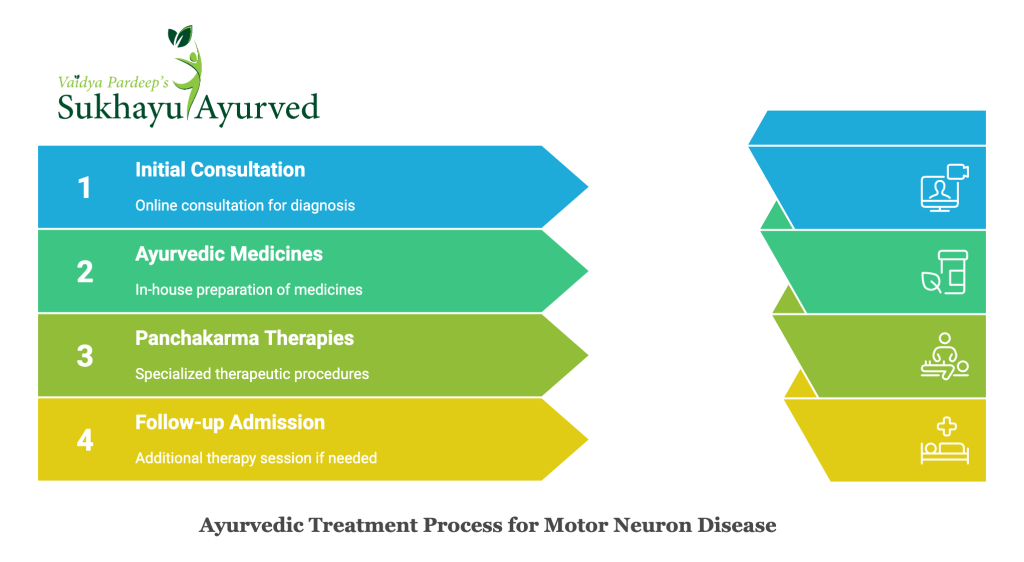
MND treatment at Sukhayu Ayurved is primarily an in-patient (IPD) programme, because Panchakarma in such a delicate condition requires continuous supervision.
How it works:
- Initial consultation — preferably online. Vaidya Dr. Pardeep and Dr. Neetu review your medical documents before the consultation, so please share reports when you book.
- Assessment. We evaluate your symptoms, stage, and overall strength.
- An honest decision. We tell you clearly whether we believe we can help — and how much.
- A personalised plan built around your specific condition and strength.
- IPD admission of 3–4 weeks for the Panchakarma phase, with periodic shorter follow-up admissions (around 8 days) at intervals thereafter.
- Ongoing Ayurvedic medicines — mostly prepared in-house under our Vaidyas' supervision, safe for long-term use, continued between admissions.
Key therapies used
- Basti — Kashaya (decoction) and Anuvasana (oil) enemas, the primary treatment for Vata disorders
- Bruhmana Nasya — nourishing nasal therapy
- Pizhichil — warm medicated oil bathing
- Navara Kizhi — medicated rice bolus fomentation for muscle support
- Choorna Pinda Swedana — herbal powder bolus fomentation
- Abhyanga — full-body therapeutic oil massage
What Ayurvedic Treatment Can Realistically Offer
With consistent treatment, appropriate medication, rehabilitation, and dietary discipline, patients may experience:
- Slower progression of the disease
- A stop or slowing of muscle weakness
- Improvement in voice and speech clarity
- Easier, steadier breathing
- Better mobility — improvements in walking and grip in earlier-stage patients
The degree of benefit depends heavily on the stage at which treatment begins. Early-stage patients have far more to preserve than late-stage patients — which is why beginning treatment sooner, not later, matters so much.
Understanding Motor Neurone Disease
MND is a group of progressive neurodegenerative conditions in which the motor neurons — the nerve cells that carry commands from the brain to the muscles that move, breathe, speak, and swallow — gradually die. As they degenerate, the muscles they control weaken and waste, leading to progressive disability.
There are two types of motor neurons, both of which MND can affect:
- Upper motor neurons connect the brain to the spinal cord.
- Lower motor neurons carry the message from the spinal cord to the muscles.
Key facts about MND
- Lifetime risk is roughly 1 in 300.
- It can appear at any age, but symptoms most often begin between 50 and 70.
- In about 90% of cases there is no family history; only around 10% are inherited.
- Amyotrophic Lateral Sclerosis (ALS) is the most common form.
- The rate of progression varies widely from person to person.
- Around 15% of patients develop signs of frontotemporal dementia.
- As of today, conventional medicine has no cure.
Types of Motor Neurone Disease
Amyotrophic Lateral Sclerosis (ALS)
Also called Lou Gehrig's disease, ALS is the most common form and affects both upper and lower motor neurons — in the brain and spinal cord. It involves the limbs, mouth, and respiratory muscles.
Primary Lateral Sclerosis (PLS)
Affects the upper motor neurons of the brain and progresses more slowly than ALS. It is not typically fatal but significantly affects quality of life. A childhood form is called juvenile PLS.
Progressive Muscular Atrophy (PMA)
Affects the lower motor neurons in the spinal cord, causing slow, gradual wasting of the muscles of the arms, legs, and mouth.
Progressive Bulbar Palsy (PBP)
Involves the brain stem and often overlaps with ALS. It causes choking spells and progressive difficulty speaking, swallowing, and eating.
Spinal Muscular Atrophy (SMA)
An inherited condition affecting children, linked to changes in the SMN1 gene, ranging from severe infant-onset forms (Werdnig-Hoffmann) to milder adult-onset types.
MND is sometimes confused with other progressive neurological conditions that Ayurveda also treats. If you are still working toward a firm diagnosis, it may help to read about Parkinson's disease, Multiple Sclerosis, Cerebellar Atrophy, and Myasthenia Gravis — each of which can present with overlapping weakness or coordination symptoms but follows a very different treatment path.
Symptoms of MND, by Stage
MND generally progresses through three stages — early, middle, and advanced.
Early stage:
- Weakening grip; difficulty holding or picking up things
- Muscle cramps, twitches, and pain
- Fatigue and slurred speech
- Weakness in the limbs, stumbling, clumsiness
- Early difficulty swallowing or breathing
- Inappropriate emotional responses (laughing or crying)
Middle stage:
- Early symptoms intensify
- Visible muscle shrinkage and difficulty moving
- Joint pain; swallowing difficulty leading to drooling
- Changes in personality and emotional state
- Increasing breathing difficulty
Advanced stage:
- Severe loss of movement, breathing, and the ability to eat
- The condition becomes life-threatening, most often through respiratory difficulty
What Causes MND?
In about 90% of cases, MND occurs sporadically and the exact cause is unknown. Around 10% is believed to be hereditary. Research suggests that a combination of genetic, environmental, and other factors may contribute — the most common mechanism being sudden damage to the DNA of motor neurons, which in some cases runs in families.
Why Patients Choose Sukhayu Ayurved for MND
- 20+ years of specialised experience in chronic neurological conditions
- Treatment planned and supervised by M.D. (Ayurveda) physicians — Vaidya Dr. Pardeep Sharma and Dr. Neetu Sharma
- Classical, text-based Ayurveda — protocols drawn directly from Charaka, adapted for patient safety
- In-house prepared medicines under our Vaidyas' supervision
- A NABH-certified hospital in Jaipur with dedicated IPD Panchakarma care
- Honest counselling — we tell you what is realistic before you commit
We also welcome co-management with conventional care. The single MND medication typically prescribed in modern medicine, along with multivitamins, can safely continue alongside Ayurvedic treatment. We plan every case for the patient's overall benefit, without conflict between the two systems.
"HOPE is the main ingredient of any medicine." — the principle we begin every MND consultation with.
Frequently Asked Questions
Can Ayurveda cure MND or ALS? No. There is no known cure for MND in any system of medicine. Ayurveda aims to slow progression, preserve function, and improve quality of life by nourishing and supporting the nervous system. For a deeper look at the evidence, see Can Ayurveda Slow the Progression of Motor Neuron Disease (MND)?
How soon might benefits be felt? Some patients notice better breathing, improved voice, or mild stabilisation within 3–4 weeks of careful therapy. Lasting results depend on consistent treatment, correct medication, rehabilitation, and following dietary guidance.
Is Panchakarma safe in such a fragile condition? Yes — when applied gently, individualised to the patient's strength, and closely supervised. We avoid aggressive cleansing entirely, using only mild detoxification and nourishing (Bruhmana) therapies.
Can Ayurvedic treatment run alongside conventional medicine? Yes. These therapies are complementary. Physiotherapy, conventional medication, and multivitamins can continue under the supervision of our M.D. Ayurveda Vaidyas.
Is hospital admission necessary? For the Panchakarma phase, yes — admission of 3–4 weeks is recommended so treatment can be delivered safely and monitored continuously. Some follow-up therapy can be done as an outpatient.
How do I begin? The first assessment is done through an online video consultation. Share your medical documents when booking so Vaidya Dr. Pardeep and Dr. Neetu can review them beforehand and make an accurate initial assessment.
Begin Your Treatment
If you or a family member is living with Motor Neurone Disease, the most valuable thing you can do is begin an honest assessment early — while there is more function to preserve.
Book an Online Video Consultation with our neurology team at Sukhayu Ayurved, Jaipur.
Related reading
- Can Ayurveda Slow the Progression of Motor Neuron Disease (MND)?
- All Neurological Conditions We Treat
- Ayurveda Treatment for Neuropathy
- Parkinson's Disease: Ayurvedic Treatment
- Basti: The Primary Ayurvedic Treatment for Neural Diseases
- What is Panchakarma? The Complete Guide
- About Vaidya Pardeep Sharma