Take a skin biopsy of a psoriatic plaque and the pathologist will describe the scale, the thickened epidermis, the inflammatory cells. Then, in the histology, a feature that patients rarely hear about: elongated, dilated, tortuous capillary loops in the papillary dermis. New vessels growing where they should not. Nailfold capillaroscopy shows the same thing in a different place: capillaries that are enlarged, coiled and branched, in people whose complaint was the skin.
A disease that rearranges the body's smallest blood channels is not a skin disease with some blood in the background. The skin is where it can be seen. I have never been able to treat it as anything less than a disease of the blood and the channels that carry it, and the classical physicians, without any microscope, wrote it down as exactly that.
This is the clinical frame inside which I use Manjistha, and it is why I will not discuss the herb the way most pages do, as a cosmetic root for glowing skin.
What the classics actually place Manjistha in
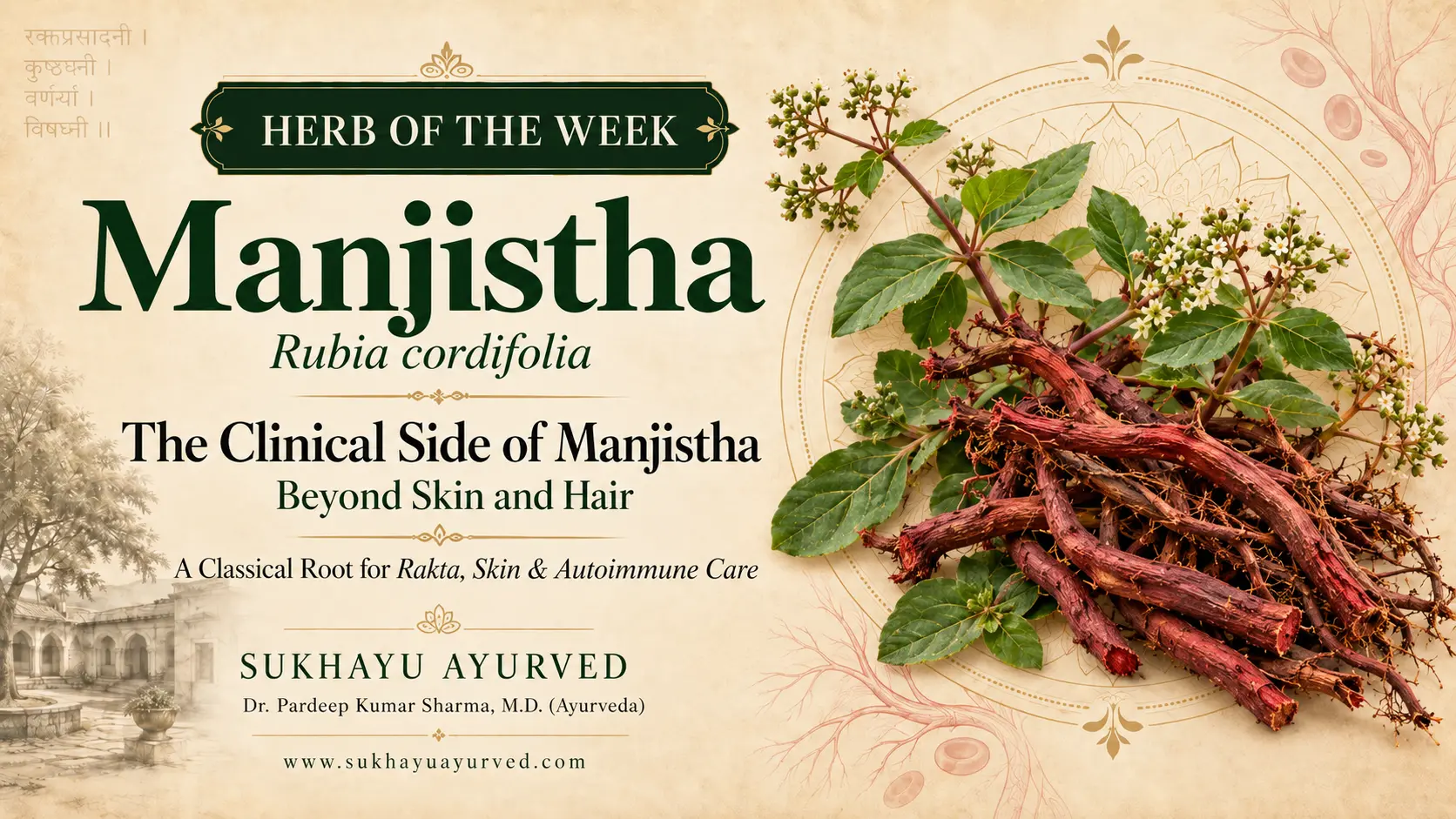
Manjistha (Rubia cordifolia, the Indian madder) is classified, across the classical texts, as Raktashodhaka: a substance that acts on Rakta, the blood tissue. All the texts agree on this. They enter it through different doors. Charaka Samhita places it among the Jvarahara herbs, the group that settles fever, which in classical language means heat of the Pitta kind running through the system. Sushruta Samhita places it among the Pittashamaka herbs, those that pacify Pitta. The two texts approach from different directions and arrive at the same drug: a herb for Pitta-driven, heat-laden pathology of the blood.
The pharmacology the texts give is specific. Manjistha is Madhura-Tikta in Rasa (sweet and bitter in taste), Ushna in Virya (hot in potency) and Katu in Vipaka (pungent after digestion). Its Karma, its recorded action, is Vishaghna (counteracting Visha, the toxic quality that disturbs the tissues), and it reduces Kapha and Pitta.
That combination looks contradictory until you read it as a physician. Bitter taste (Tikta) usually aggravates Vata, and a hot-potency herb in a Pitta-surge condition sounds like fuel on a fire. But the sweetness (Madhura) and the Ushna Virya together keep Vata from rising, and the Pitta-quieting does not depend on cold potency at all. It comes from the Rasa and from its recognised Karma. The result is a herb that can lower Kapha and Pitta without provoking Vata. That is rare, and it is precisely what a Tridoshaja condition with a Pitta surge and heavy inflammation demands: a disease where all three Doshas are in the picture and Pitta is leading, and a single-direction herb would fix one problem by creating another.
Why colour is the clinical signature
The classics also place Manjistha in the Varnya group: herbs that restore Varna, natural colour. Read that as a clinician, not as a cosmetic promise.
Colour is how Rakta announces itself. When Rakta is vitiated, the skin changes: redness, patches, discolouration, pigmentation that will not behave. Psoriasis, vitiligo, the rashes of SLE, urticaria and many other skin and autoimmune presentations differ in name and in Western classification. But they share a clinical picture I recognise quickly: a Tridoshaja disease, Pitta in surge, Rakta vitiated, and a change of Varna as the visible sign. That is where Manjistha is considered. Not because the skin is the problem, but because the skin is where the problem has surfaced.
The mechanism: correction upstream, not filtration downstream
The popular idea is that a "blood purifier" scrubs circulating blood like a filter. That is not the classical mechanism, and I do not teach it.
Raktaprasadana, the clearing of Rakta, works at the source. Rakta Dhatu is built upstream, and its quality is set at the marrow. A herb that corrects Rakta does so there, by correcting what is being produced, not by cleaning what has already entered the circulation. This is also why the herb that restores the colour of the skin is understood to do it by correcting what lies beneath, not by working on the surface.
This is also why the capillary findings in psoriasis do not trouble the classical position. They reinforce it as a parallel observation: a disease that the texts located in Rakta and its channels turns out, under the microscope, to be centred on vessels. The vascular changes are reported to appear early in the lesion, before the epidermis thickens. Modern pharmacology adds that Rubia cordifolia contains anthraquinones and naphthoquinones (mollugin among them) with anti-inflammatory activity in laboratory studies. I cite these as parallel observations only. The classical framing does not need them to stand, and I would not want a patient to think a molecule is the reason the herb is used.
What this looks like in the OPD
Autoimmune and chronic skin diseases are not physical problems alone. This is the thing I would most like families to understand. Every relapse irritates the patient's mind as well as the skin. The condition subsides, and then it returns, again and again, and with each return the irritation accumulates in the patient's memory. By the time someone reaches a clinic they are not only carrying a disease. They are carrying every earlier flare.
I see that pattern constantly, and it shapes how I speak to patients more than any pharmacology does. A person whose psoriasis has "cleared" and relapsed more than once does not trust clear skin any more. They are right not to. Clear skin and a settled disease are different things.
In that picture, Manjistha is one element of a larger plan. I say this plainly: no single herb carries the outcome. These are multi-factorial, multidimensional conditions, and what helps is a combination of measures: diet, lifestyle, oral medicines, and local or Shodhana procedures where they are indicated, chosen by the physician for that patient. "Absolute" is not a word Ayurveda uses for diseases like these, and I would not trust anyone who does.
Beyond the skin: why it is in my AVN protocols
If Manjistha were only a skin herb, it would not appear in my plans for avascular necrosis. I use it there regularly, and for the same reason it appears in psoriasis.
Avascular necrosis is, at root, a disease of a blocked channel. The classical picture is Sanga, obstruction, within Raktavaha Srotas, the channels that carry Rakta to the tissues. In the causes we see in the OPD (steroid exposure, alcohol, sickle cell disease, a surgical implant disturbing local vessels) the path is obstructed, Vata is aggravated behind the blockage, and the bone beyond it is cut off from nourishing blood. Asthi Kshaya, decay of bone, follows downstream. The bone is the late casualty. The channel is the disease. Charaka's guidance for a path obstructed by Medas or Kapha, with Vata aggravated as a result, is Snehana and Brimhana, not harsh detoxification, which tells you how the classics read the problem.
A herb that acts on Rakta and the channels it travels in has a logical place in such a plan, and Manjistha, a Raktaprasadana and Vishaghna drug, is one I rely on. It does not work alone. The plan is built around the stage, the cause and the Dosha involvement, with Panchakarma and local procedures where they are indicated, and the internal medicines are individual to the patient.
Stage decides everything, and I say so to every AVN patient. Before the femoral head collapses, there is a real window in which Ayurvedic and conservative management can achieve something meaningful. After collapse, no herb restores bone architecture, and Manjistha does not change that. A patient at that stage needs an honest conversation with an orthopaedic surgeon alongside ours. I would rather they hear this from me than discover it from their MRI. See our pages on avascular necrosis and the staging and recovery guide for AVN of the hip and knee. For how we think about the word reversal, read can avascular necrosis be reversed with Ayurveda, and for anonymised patient records see an early-stage AVN case study and a Grade III to Grade II AVN case study.
Where I hold it back
Right picture, wrong moment: this happens. In a patient with IBS and loose motions, Manjistha can provoke cramping and heavier stools. I avoid it at the start of treatment in such patients and bring the gut to order first. The skin can wait a little. This is a matter of physician timing, not a list that a patient can apply to themselves, and I say so because that is exactly how it goes wrong. Whether a particular patient should take Manjistha, when, and in what form is a judgment made across several consultations, not read from a page.
The capsule problem
I am firmly against single-herb Manjistha capsules sold online. There are three reasons, and none of them is snobbery.
First, food and medicine are different categories. Aahar nourishes; Aushadha is given for a purpose, in a dose, for a duration, under observation. A "daily blood purifier" is a category error that sounds like wellness.
Second, an extract is not the herb. In Ayurveda, the whole matrix of the root contains regulating constituents, and isolating a fraction removes the very thing that makes the herb safe to use. The pharmacology of a purified compound tells you nothing reliable about the pharmacology of the root.
Third, a classical medicine is a composition that has been received, verified and handed down. It is not something to be assembled at home from a product page. The same reasoning is behind our piece on why no herb should be taken blindly.
How it is prescribed
At Sukhayu, Manjistha is prescribed by a physician, within a composition and a plan. I do not publish doses, vehicles (Anupana) or timing for it, and this is deliberate, not an omission. Publishing a dose table for an autoimmune condition turns an article into a self-treatment manual, and these are conditions that are made worse by it. The form, the dose, the companions it is paired with and the order in which a plan unfolds all depend on which Dosha leads, how the digestive fire is behaving and what else is wrong. Where a plan calls for Shodhana, what Virechana actually is is a better place to begin than a herb label.
For the other conditions where I most often consider it, see our pages on psoriasis (and the longer psoriasis skin-disease page and guide to healing psoriasis), psoriatic arthritis and SLE and lupus nephritis. The full classical profile is in our Manjistha herb library entry.
Closing philosophy
I am sometimes asked what Ayurveda understands about the mind that dermatology does not. I think the question is slightly wrong. Empathy cannot be entitled to a science. It lives in the clinician who is sitting across from the patient, and it is present or absent in that room whatever school of medicine the clinician was trained in. Nor can the concept of Manas be applied mechanically in every consultation.
What can be said is narrower and more honest. A disease that returns, and that leaves a record of irritation in the patient each time, has to be treated by a physician who keeps the patient's ease as the goal and not the appearance of the skin. Manjistha can help correct what lies beneath the colour. It cannot undo what is already structurally changed, and it cannot do any of this alone.
Cure is divine. Treatment is possible.
Dr. Pardeep Sharma, M.D. (Ayurveda) is the founder of Sukhayu Ayurved, Jaipur. With over 20 years of clinical experience in Ayurvedic management of orthopedic, neurological and autoimmune conditions.
Medical Disclaimer: This article is for education and reflects classical Ayurvedic understanding and clinical experience. It is not a substitute for individualised medical diagnosis or treatment. Psoriasis, SLE and other autoimmune conditions need ongoing monitoring by qualified physicians, and outcomes vary between patients. Do not start, stop or replace any prescribed medicine, including immunosuppressants, biologics or steroids, without your treating doctor's advice. In avascular necrosis, the stage of the disease matters, and an orthopaedic opinion should not be delayed. Consult a registered Ayurvedic physician before using Manjistha or any herbal medicine.
Herb Profile: Manjistha (Rubia cordifolia): Quick Clinical Reference
Classical description: Indian madder, whose red root is the medicine; grouped by the classics as Raktashodhaka. Charaka: Jvarahara. Sushruta: Pittashamaka.
| Rasa (taste) | Madhura, Tikta |
| Virya (potency) | Ushna |
| Vipaka (post-digestive effect) | Katu |
| Karma (action) | Raktashodhaka, Varnya, Vishaghna; Kapha-Pitta hara |
| Dosha action | Reduces Kapha and Pitta without aggravating Vata |
Clinical indications (physician-assessed): Pitta-surge, Tridoshaja skin and autoimmune presentations with vitiated Rakta and change of Varna, including psoriasis, vitiligo, SLE and urticaria; and avascular necrosis (AVN), where the obstruction is in the Rakta channels feeding the bone.
How it is prescribed: by the physician, within a composition and a wider plan. Dose, Anupana and timing are deliberately not published.
Timing and cautions: judged by the physician, not self-applied. Held back at the start in patients with IBS and loose motions, where it can provoke cramping and heavier stools. In AVN, stage decides what is realistic: it does not restore a collapsed femoral head.
Combinations: not published as a recipe. Companions and sequence are the physician's decision and vary with the patient's Dosha leadership, digestive fire and associated conditions.
Related reading on this site: Psoriasis · Psoriasis (skin-disease page) · Healing Psoriasis · Psoriatic Arthritis · SLE and Lupus Nephritis · Avascular Necrosis (AVN) · AVN of the Hip & Knee: Staging and Recovery · Can AVN Be Reversed? · Early-Stage AVN Case Study · AVN Grade III to II Case Study · IBS · Manjishtha in the Herb Library · What Virechana Actually Is · Why No Herb Should Be Taken Blindly
External references (parallel observations, not validation): Nailfold videocapillaroscopy identifies microvascular pathologies in psoriasis vulgaris, JDDG (2021) · A comprehensive review of Rubia cordifolia L.: traditional uses, phytochemistry, pharmacological activities and clinical applications, Frontiers in Pharmacology (2022)
To discuss your own case: contact Sukhayu Ayurved or WhatsApp 9050802060.