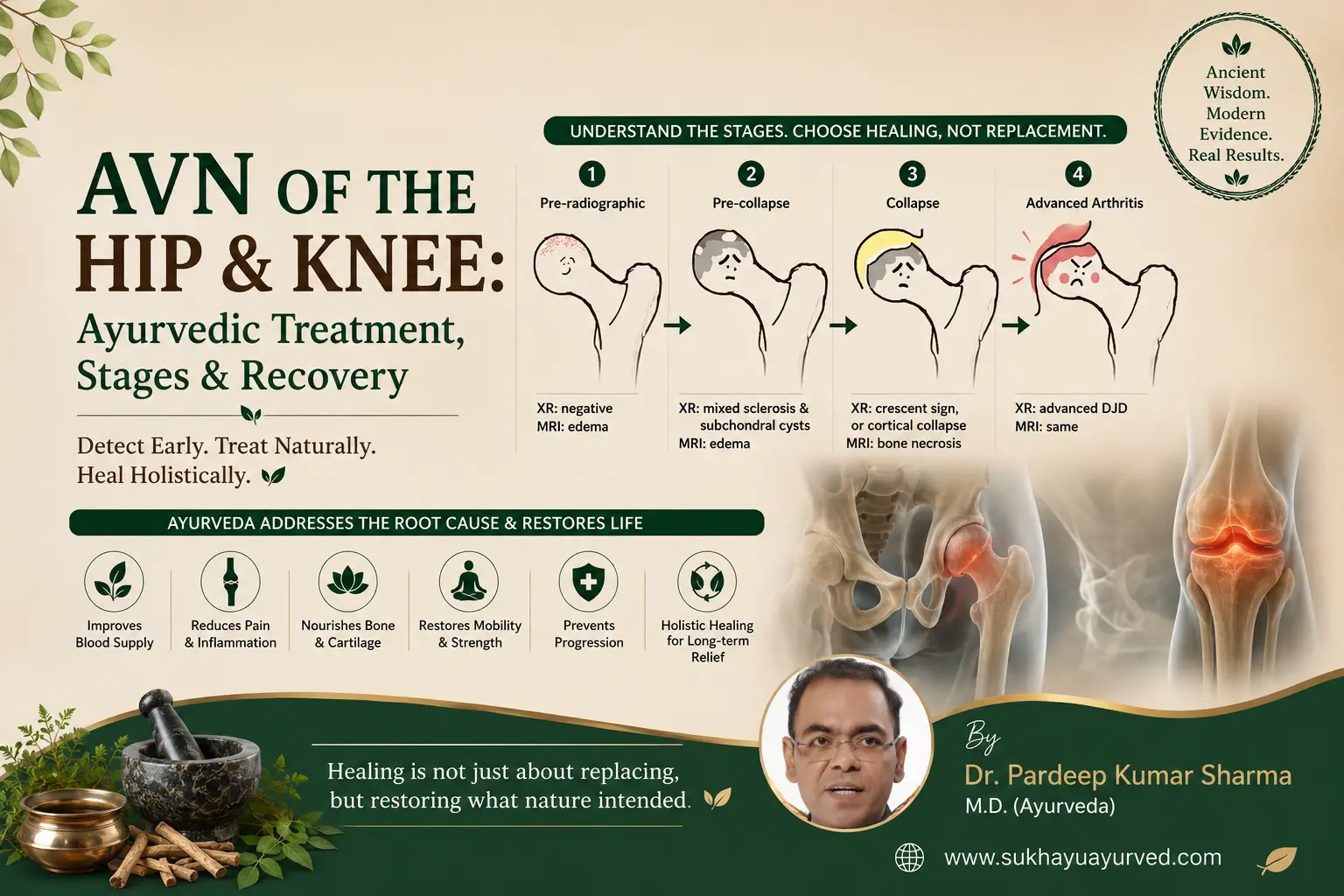
A diagnosis of avascular necrosis (AVN) usually arrives with a question attached: how far has it progressed, and what can still be done? The honest answer depends almost entirely on stage. Caught early, AVN responds to conservative and Ayurvedic management far better than most patients are led to believe. Caught late — after the femoral head has already collapsed — the conversation changes, and pretending otherwise does nobody any favors.
This guide walks through how AVN is staged, how Ayurveda understands and treats it, and what a realistic recovery timeline looks like at each stage — so you can have an informed conversation with your physician, whichever path you choose.
What Is Avascular Necrosis?
Avascular necrosis (also called osteonecrosis) happens when the blood supply to a section of bone is disrupted, causing the bone tissue to die. It most commonly affects the femoral head (hip) and, less often, the knee, shoulder, or ankle. Without blood supply, the affected bone weakens, and in advanced cases it can collapse — leading to joint damage and secondary osteoarthritis.
Common causes include:
- Prolonged corticosteroid use — one of the most frequent triggers
- Chronic alcohol use
- Trauma or fracture near the joint
- Sickle cell disease and other clotting disorders
- Idiopathic — in a significant number of cases, no clear cause is ever identified
AVN is often silent in its earliest phase, which is precisely why staging matters — by the time pain becomes constant, the disease may already be several stages in.
The Stages of AVN
Orthopedic medicine most commonly stages AVN using the Ficat-Arlet classification, based on X-ray, MRI, and clinical findings [ a radiology or orthopedic reference explaining the Ficat-Arlet staging system in detail].
| Stage | What's Happening | Typical Presentation |
|---|---|---|
| 0 | Pre-clinical, pre-radiographic | No symptoms; only detectable on biopsy |
| I | Early bone marrow changes | Vague joint pain; normal X-ray, MRI shows edema |
| IIA | Sclerosis / subchondral cysts | Mild-moderate pain; changes visible on X-ray, no collapse |
| IIB | Subchondral fracture ("crescent sign") | Increasing pain; early structural weakening |
| III | Segmental collapse | Joint surface flattens; pain with weight-bearing |
| IV | Secondary osteoarthritis | Joint space loss, stiffness, and arthritis in the surrounding joint |
This distinction — pre-collapse (Stages 0–IIB) versus post-collapse (Stages III–IV) — is the single most important factor in deciding what treatment, Ayurvedic or otherwise, can realistically achieve.
How Ayurveda Understands Avascular Necrosis
Ayurveda frames AVN not as a metabolic or dhatu-nutrition disorder, but as a disease of obstruction — Sanga (blockage) within the Raktavaha Srotas, the channels that carry Rakta (blood) to the tissues. Charaka Samhita addresses this mechanism directly:
कुपिते मार्गसंरोधान्मेदसो वा कफस्य वा | अतिवृद्ध्याऽनिले नादौ शस्तं स्नेहनबृंहणम् ||१५६||
"When the marga (channel/path) is obstructed by aggravated Medas (fat) or Kapha, and Vata becomes excessively aggravated as a result, Snehana (oleation) and Brimhana (nourishing, bulking therapy) are indicated."
This maps directly onto the modern mechanism of AVN: Medas — corresponding to fat emboli released by corticosteroid or alcohol use — obstructs the marga, the vascular channel (Sira/Dhamani) within Raktavaha Srotas. The same principle of marga-avarodha extends to occlusion by abnormal Rakta (as in sickle cell disease) and to purely physical obstruction from surgical implants disrupting local vasculature, such as a nail in the hip.
Once the channel is blocked, Vata — which governs gati (movement) — becomes locally aggravated precisely because it can no longer move freely through the obstructed path. This vitiated, trapped Vata, combined with the tissue beyond the blockage being cut off from poshaka rakta (nourishing blood), leads to Asthi Kshaya — decay of bone tissue. The bone damage is downstream of the vascular obstruction and resulting Vata prakopa, not a primary disorder of Asthi-Majja nourishment. It is also why the classical text specifies Snehana-Brimhana, not detoxification, as the indicated response.
Ayurvedic Treatment Protocol for AVN
Treatment targets the mechanism directly — clearing the srotorodha (channel obstruction) and addressing the resulting Vata prakopa, rather than generic joint therapy.
Panchakarma Therapies
- Tikta Ksheera Basti — a bitter milk-based medicated enema, addressing the Vata aggravation that follows marga-avarodha while working at the Rakta-Asthi level rather than superficial joint tissue
- Pinda Swedana — bolus fomentation to support local circulation around the affected joint
- Lepana — medicated paste application directly over the affected region
- Parisheka — a continuous pouring of medicated liquid prepared with Rakta Prasadana Dravyas, chosen specifically to act on the vascular obstruction itself
A typical course runs several weeks, with the specific sequence and duration set by the treating physician based on stage and cause, followed by reassessment.
Formulations
Internal medicines for AVN are highly individualized — the choice of Rakta Prasadana and supporting dravyas depends on the patient's specific dosha involvement, underlying cause (steroid-induced, alcohol-related, sickle cell, or post-implant), and stage. These are prescribed and adjusted only after direct physician evaluation; there is no fixed formulation that applies across patients, and self-medicating based on a general article is not advisable.
Diet & Lifestyle
- Warm, unctuous, easily digestible foods — milk, ghee, and sesame — to counter Vata's inherent dryness
- Avoid leafy vegetables, salads, sprouts, and moong dal
- Avoid cold, dry, and processed foods that aggravate Vata
- Gentle, non-weight-bearing movement — swimming, and specific yoga postures such as Vajrasana and Makarasana, done under guidance rather than self-directed
- Strict avoidance of continued corticosteroid or alcohol exposure where these are the underlying cause
[INTERNAL LINK: /orthopedic "See our full Ayurvedic orthopedic treatment approach"]
What Recovery Actually Looks Like, Stage by Stage
This is the part most patients don't get told plainly:
- Stages 0–IIA (pre-collapse): This is where Ayurvedic and conservative management has the strongest evidence base. With a consistent Panchakarma and herbal protocol over roughly 2–4 months, many patients see meaningful reduction in pain and improved joint function, since the bone structure itself is still largely intact.
- Stage IIB: Still pre-collapse, but the window is narrowing. Treatment at this stage aims to prevent progression to collapse as much as to relieve symptoms — recovery timelines extend to 4–6 months, with closer monitoring.
- Stages III–IVa (post-collapse): Once the femoral head has collapsed, no treatment — Ayurvedic or allopathic — can restore the original bone architecture. Ayurvedic therapy at this stage is best understood as supportive: managing pain, improving surrounding muscle function, and supporting quality of life, often alongside a surgical opinion rather than instead of one.
- Stages IV onwards (post-collapse): Once the femoral head has collapsed, no treatment — Ayurvedic or allopathic — can restore the original bone architecture. Ayurvedic therapy at this stage is best understood as supportive: managing pain, improving surrounding muscle function, and supporting quality of life, often alongside a surgical opinion rather than instead of one.
An honest Ayurvedic physician will tell you which category your MRI puts you in before promising an outcome.
Is Ayurveda a Real Alternative to Surgery?
For early-stage AVN, yes — a growing number of documented cases show meaningful symptom improvement and delayed or avoided progression with sustained Ayurvedic care. For collapsed, advanced-stage AVN, Ayurveda is better positioned as a complement to surgical options like core decompression or joint replacement, not a replacement for the conversation with your orthopedic surgeon. We cover this trade-off in detail, stage by stage, in our companion article on - Avascular Necrosis: Do you really need Surgery