"So it's basically a strong purge, right?"
The young man sitting across my desk was nineteen, a medical undergraduate, and he had lived with psoriasis for five years. He had read about Virechana the night before — enough to arrive with a diagnosis of the treatment already formed in his head. He wanted me to confirm it. A laxative with a Sanskrit name. Take something in the morning, empty the bowel, walk out lighter.
I told him no. And then I spent the next twenty minutes doing what I will do here: taking that single sentence apart.
Because the sentence is not just wrong. It is wrong in a way that leads people to do dangerous things to themselves at home, in the name of a procedure they have not understood. If you take away only one idea from this article, let it be this: the medicines used in Virechana are laxatives, but that shared ingredient does not make the two things the same procedure. A scalpel is a blade. So is a kitchen knife. You would not confuse the surgery for the chopping.
What the word actually says
Start with the word itself, because it carries the whole misunderstanding.
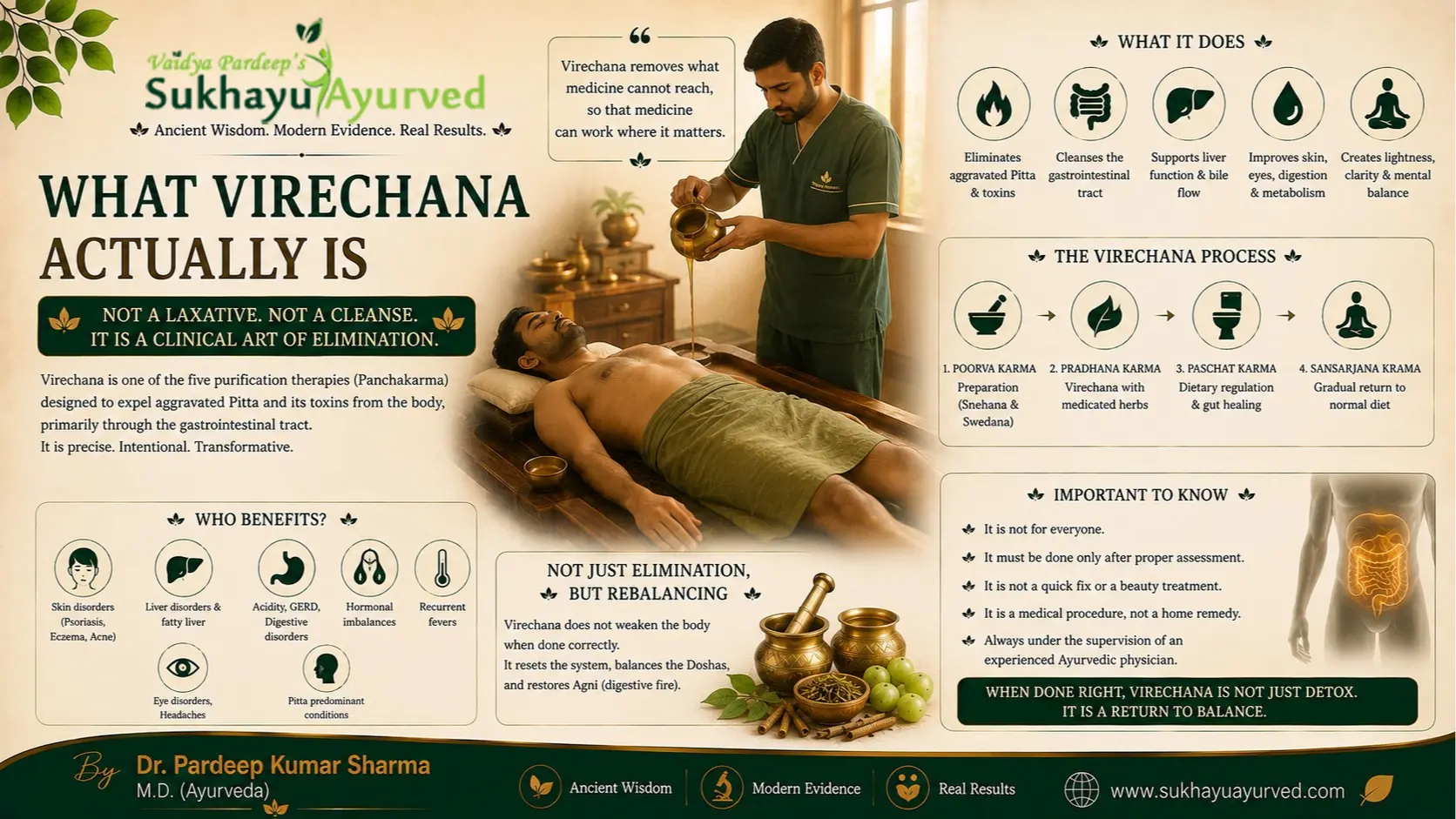
Rechana in Sanskrit means removal. But the procedure is not called Rechana. It is called Vi-rechana — and that prefix Vi is the entire point. It tells you this is a specific, planned, directed method of removal, not a general emptying.
Removal of what? Not "toxins" in the vague way the internet uses that word. Virechana is Pitta Rechana — the removal of Pitta. Loosely, and only loosely, you can associate this with the removal of the body's bile and liver juices, drawn out in abundance in a deliberately planned way. Not all at once. Not by force. Under a schedule the physician sets.
And here is the part patients almost never grasp: it is not about the bowel at all. The bowel is the exit. The procedure concerns every organ associated with the gut — the liver, the gall bladder, the pancreas, the small intestine. A laxative empties a pipe. Virechana works on the whole system that feeds the pipe.
For the full step-by-step mechanics of the procedure — the classical stages, indications, contraindications and subtypes — I have written a separate, detailed page: the complete Virechana procedure at Sukhayu. This article is about something the procedure page cannot carry — why a physician chooses it, what it does in a real patient, and where the popular idea of it goes wrong.
Why psoriasis, and why not a single dosha
Let me correct a second thing before it takes root, because I hear it constantly: psoriasis is a Pitta disease.
It is not. Like any autoimmune condition, psoriasis is Pitta-dominant, but it involves Vata and Kapha as well. It is a tridoshic problem with Pitta leading. Anyone who tells you psoriasis is purely a Pitta disorder has flattened something complex into something marketable. In twenty years of managing autoimmune skin disease, I have never seen it behave as a single-dosha problem.
Why does this matter for Virechana? Because if the disease were simply "too much Pitta," then "remove the Pitta" would be a complete treatment, and the whole thing would collapse into exactly the laxative-cleanse fantasy I am arguing against. It is more careful than that. Virechana is one planned intervention inside a longer protocol — it opens a door. It does not, by itself, walk the patient through it.
And one principle I want to state plainly, because it governs everything I do clinically: the natural movement of dosha is physiology. Its disturbance is pathology. Virechana does not "flush" the body. It restores a physiological direction of movement that disease has disturbed. That is a very different claim from detox, and a much more honest one.
The days before the purgation are the treatment
Here is where the popular version falls apart completely.
People imagine Virechana as a morning event. It is not. The purgation morning is almost the last and smallest act in a sequence that has already been running for a week.
The real work begins with Snehapana — internal oleation, taking medicated ghee, for three, five, or seven days. Not a spoonful. A measured, escalating internal dose, watched closely. And crucially, in a skin patient, the ghee is not neutral lubricant. It is medicine in its own right.
For my psoriasis patients I reach for medicated ghritas like Mahatikta Ghrita, Guggulutikta Ghrita, or Kalyanaka Ghrita. These do double duty: they serve as the sneha that prepares the body for Virechana, and they are simultaneously therapeutic — they are already treating the skin condition during those days. The preparation is not preparation. It is already treatment.
This is why, with my young medical student, the itching began to settle within the first two days of snehapana. Most people assume the plaques and the itch are the same thing. They are not. In psoriasis, the itching is driven largely by the dryness of the skin — and medicated ghee, working from the inside, addressed that dryness before we had done any purgation at all. The itch quieted first. The lesions came later.
We do not proceed on a calendar. We proceed when the body shows Samyak Snigdha Lakshana — the signs of proper oleation, that tell the physician the ghee has done its work and the body is ready. These signs are precise, and there is a long list of them, and I am deliberately not reproducing that list here. Reading them correctly is the physician's job, in person. It is not something a patient can self-assess from a blog — and if a piece of content ever hands you that checklist and tells you to judge for yourself, it is handing you a way to hurt yourself.
Only after that do we move to two days of dietary preparation, external Snehana — note, external oleation, not direct Abhyanga — and Swedana, therapeutic sweating.
And then, on the day itself, the purgative medicines are given — after the bowel is naturally empty, in Pitta Kala, between 8 and 11 in the morning. There is a reason for that window. Virechana is a physiologically-scheduled procedure keyed to the body's own rhythm and to its readiness signs. It is the exact opposite of "take something and purge."
What actually happened, honestly
So — the medical student who could not fix his own skin from inside the system he was training in.
Snehapana for five days. Virechana on the seventh. The main procedure done once — and done properly, once is enough. This is another place the "cleanse culture" gets it backwards: Virechana is not something you repeat every few weeks to "stay clean." A single, correctly executed Virechana did the work. After the procedure, I began his internal medicines — the Virechana had opened the door, and the medicines were what held it open.
By three weeks after the procedure, his rashes were negligible.
Now the honest part, because this is the part that makes the difference between a testimonial and the truth.
He did not take his medicines regularly. He abandoned the treatment partway through. He did not care much for the dietary guidelines. And at around ten months, a few rashes returned. He came back, and he restarted his medicines.
I tell you this deliberately. Virechana did not fail. His follow-through did. The relapse was not a failure of the procedure — it was a failure of the second half of the treatment, the part nobody wants to hear about. Which brings me to the thing I most want to leave you with.
Removal without replenishment is worse than nothing
There is a rule at the heart of Panchakarma — of Vamana and Virechana especially — and it is this: a removal without replenishment is always incomplete, and it creates more complex problems than it solves.
This is why the days after Virechana matter as much as the days before. After the procedure comes Samsarjana Krama — a graded, stepwise return to normal food. You do not walk out and eat a full meal that evening. You rebuild the digestive fire in stages, letting the body recover its acumen gradually, so the state you have created can actually hold.
My young patient took the removal and walked away from the replenishment. He got the emptying without the rebuilding. That is not half a treatment — it is worse than an untreated state, because you have opened the body up and then left it unsupported.
This is the whole worldview I practise inside: cure is divine, treatment is possible. Virechana is not a cure for psoriasis, and I will never tell you it is. Autoimmune disease relapses; that is its nature. What Virechana offers is a genuine, physiological reset — and what decides whether that reset lasts is not the drama of the purgation morning, but the quiet discipline of the weeks that follow it. The procedure is an event. Holding the result is a practice.
Who should not walk in asking for this
I will end where the young man began — wanting a procedure he had diagnosed himself.
There are people for whom Virechana is wrong: Vata-dominant presentations, the depleted and emaciated, and anyone in the middle of an active flare. But I do not want you leaving with a checklist to run against yourself, because that would be repeating the exact mistake this whole article is written against.
No Panchakarma is a grab-it-from-the-shelf procedure. Whether to do Virechana, and when to avoid it, is a physician's judgment, made in person, on your body — not a decision you make from an article at midnight. That single principle answers every question in this piece at once. Is it a laxative? No. Can I read my own readiness signs? No. Am I a candidate? That is not yours to decide alone.
That is not me guarding a gate. It is me telling you the truth about what this is.
Talk to us before you decide
If you live with psoriasis or another autoimmune skin condition and you are wondering whether Virechana has a place in your care, the honest first step is not to book a procedure — it is a consultation. Let a physician assess your prakriti, your stage, and your history, and tell you whether this is right for you at all.
Book a consultation with Sukhayu Ayurved → sukhayuayurved.com/book-appointment
Dr. Pardeep Sharma, M.D. (Ayurveda) is the founder of Sukhayu Ayurved, Jaipur. With over 20 years of clinical experience in Ayurvedic management of orthopedic, neurological and autoimmune conditions.
Medical disclaimer: This article is for educational purposes and does not constitute medical advice, diagnosis, or a prescription. Virechana and all Panchakarma procedures must be assessed and supervised by a qualified Ayurvedic physician. Do not attempt any purgation protocol on your own. Outcomes vary between individuals, and no cure is implied or promised.
Related reading at Sukhayu:
- The complete Virechana procedure — stages, indications and subtypes
- Ayurvedic treatment for Psoriasis
- Autoimmune disease: the Ayurvedic view
External reference (parallel observation): the role of skin lipids and barrier function in psoriatic skin — Journal of Investigative Dermatology.