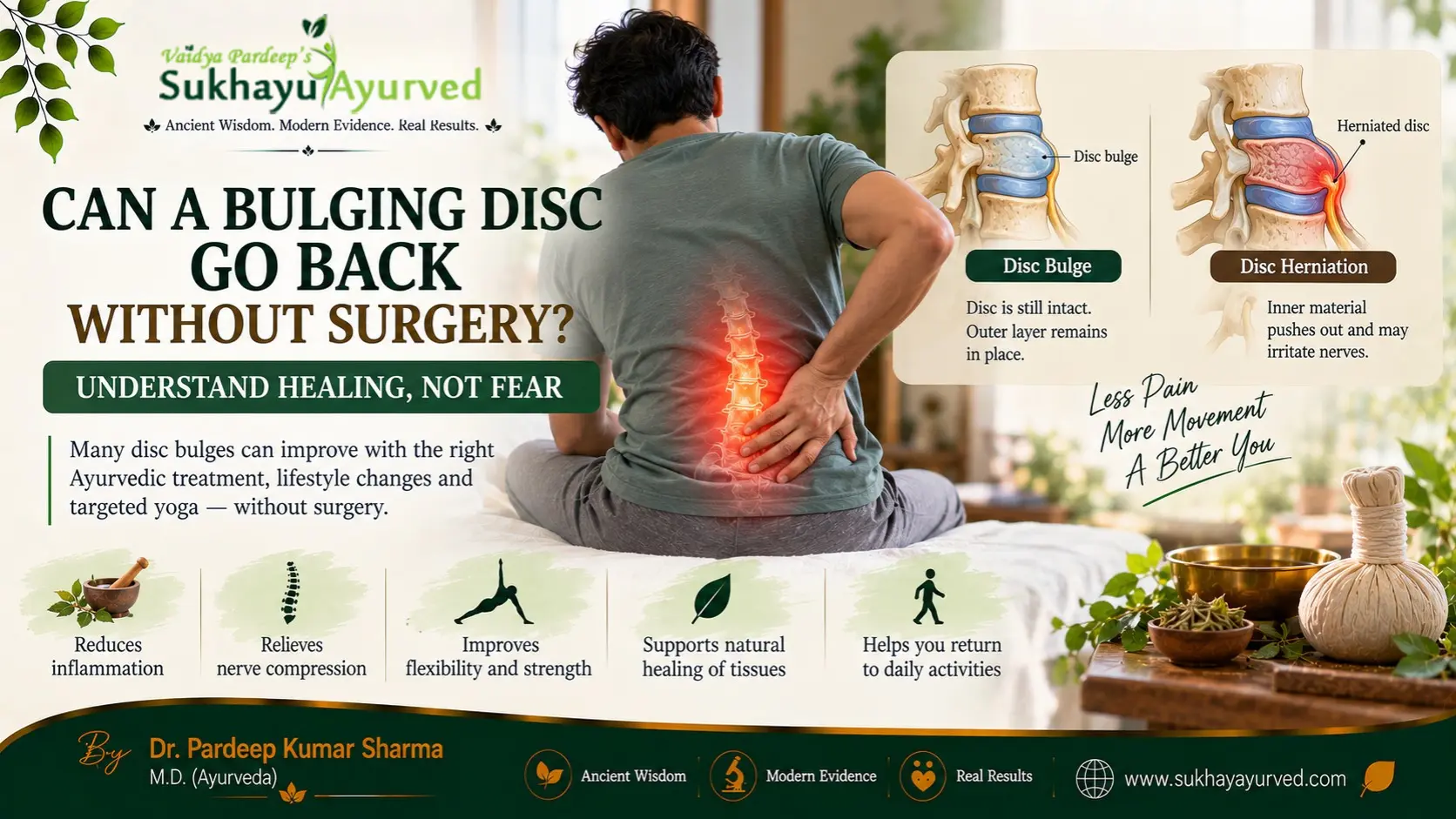
Almost every patient with a disc problem asks the same question, and almost every one of them uses the same word: back. Will the disc go back? Disc wapas jayegi?
The word carries a whole theory inside it. It assumes the disc is an object that has moved out of place and now needs to be pushed back in, by a medicine, a massage, a belt, or a surgeon's hand. Even the name patients use, "slip disc," tells the same story. Nothing slipped. The disc is still exactly where it was. Part of its inner material has pressed outward against its own walls, and that outward pressure is what touches the nerve.
So the honest answer to "will it go back?" is this: no medicine pushes a disc back. But a disc can retract, and in the cases we accept, that is exactly what treatment is designed to make possible. The disc does the healing. The treatment makes the healing possible.
This page is part of our work on Ayurvedic treatment for sciatica. It explains what retraction means, where it applies, where it does not, and what decides the outcome.
There are two ways a disc heals, and we rely on only one
Medical literature describes two different routes by which a herniated disc can stop pressing on a nerve.
The first is resorption. The body treats disc material that has escaped as foreign tissue, and inflammatory cells gradually break it down and clear it away. This happens mainly in sequestration, where a fragment of the disc has broken free. It is real, and it is documented. It is also slow, and no patient living with radiating leg pain can reasonably be asked to wait out its timeline. We do not accept cases of sequestration, so resorption is rarely part of our conversation with patients.
The second is retraction. Here the disc itself recovers: it rehydrates, regains its internal balance, and draws back from the nerve root it was pressing on. This is the route our treatment works on, and it is what the rest of this page is about.
A disc retracts when its conditions change, not because of a medicine
An intervertebral disc has almost no direct blood supply. It is nourished largely by diffusion through the cartilaginous endplates that sit between the disc and the vertebrae above and below it (Velnar & Gradisnik, 2023; Ma et al., 2024). How well that nutrition flows depends heavily on how the disc is loaded (De Geer, 2018).
That gives us a chain of cause and effect:
When pressure on the disc is reduced, nutrition through the endplates improves. When nutrition improves, the disc rehydrates. When the disc rehydrates, it retracts. When it retracts, the pressure on the nerve root is released.
Nothing in that chain is a painkiller. Nothing in it is a medicine that "dissolves" a bulge. Every step depends on changing the conditions around the disc, and that is what our 3P Program is built to do. Its three dimensions run in parallel, not one after the other, because the result comes from their combination, never from one part alone:
- Purification addresses the toxin-laden, stiffened, inflamed musculature gripping the spinal column. It uses therapies such as Kati Basti, Sarvangadhara (Pizhichil), Patrapinda Sweda and Basti, the principal treatment of aggravated Vata.
- Pacification (Shamana) works on dosha imbalance and on the tissue itself. Tikta Ksheera Basti is central here, directed at disc rehydration and the healing of neural tissue. It is supported by Kashaya Dhara and by internal medicines chosen for the individual patient.
- Posture Correction uses customised yogasanas to restore lost spinal curvature and reduced intervertebral spaces, so that pressure on the disc falls. It also includes postural and ergonomic training and Marma therapy.
There is one exception to "parallel." Yoga begins only once the muscles have regained enough flexibility. That is typically around the fifth or seventh day, later in complex cases, and always on the physician's judgment rather than a fixed schedule. Asanas performed on rigid, inflamed muscle aggravate a disc problem. We have written about this separately in why yoga can make your sciatica worse.
Bulge, protrusion, extrusion, and the one finding where we stop
We accept bulges, protrusions and extrusions with retraction as the goal of treatment. If you are unsure what these terms on your report mean, our guide to what your MRI report is actually telling you explains them.
Our line is simple. A large herniation that causes complete cut-off of the spinal canal and disturbs bowel or bladder control is not a case for Ayurvedic treatment. It is a surgical emergency. Our exclusions are set by what is happening structurally in the disc and spinal canal, not by how severe the leg pain feels.
Seek emergency care immediately if you notice any loss of control over your bladder or bowels, or any new difficulty passing urine, alongside back or leg pain. Do not wait for an appointment. Read more on when sciatica is a surgical emergency.
Everything else is assessed individually. We do not sell packages. We treat diagnoses.
We measure the patient, not the scan, and the scans have confirmed it anyway
Repeat MRI scans are expensive. Most patients cannot afford one every few weeks, and in private practice, without government funding, routine follow-up imaging is not realistic. We say this plainly because it is true, and because it shapes how progress is judged.
Our routine measures are clinical: the Straight Leg Raise (SLR) test, pain, and function. When these improve together, the picture is consistent with the disc moving off the nerve, even without an image to show it.
Some patients do have follow-up MRIs. In many documented cases, those scans show a measurable change in spinal canal diameter: the canal has opened up. One such case, with MRI-confirmed structural improvement and a four-year follow-up, is documented on this site. These are individual documented cases, not a promise for every patient, but they show directly what the clinical measures suggest indirectly.
Imaging and symptoms do not always move together, and that is not because either is wrong. We explain why in your MRI says L4-L5, your pain says something else.
The first week is quiet, and day 21 is not
Pain usually starts responding within the first week, and the pain score begins to slide downward. It will not be a smooth line. Because we use no painkillers, pain comes and goes along the way, and mild fluctuation is expected, not a sign of failure. We treat pain as information: it tells us that something deep inside is still not right.
The SLR changes more quietly. In the first week the improvement is subtle. By day 21, we have seen improvements of 5 to 10 degrees.
That number can sound small, so it is worth explaining. In the SLR test you lie on your back and your straight leg is raised until pain starts radiating down it. The angle at which that happens reflects how much tension the irritated nerve root can tolerate. A gain of 5 to 10 degrees means the leg can be raised noticeably further before the nerve protests. That is a meaningful sign that the pressure on the nerve is easing.
Patients who arrive on pain medicines are not forced to stop them; that is not our approach. They are encouraged to use them only when needed. Any change to a prescribed medicine remains a decision for the doctor who prescribed it.
Bed rest weakens the muscles your spine depends on
Many patients are still told to lie flat for weeks and wait. We do not encourage bed rest at all. Prolonged bed rest weakens the very muscles that support the spine, and a weaker support system is the opposite of what a recovering disc needs.
Day 22 means back at your desk, not the end of treatment
In most of our cases, patients resume office work on the 22nd day.
That is a return to work, not a finish line. Panchakarma treatment itself runs 15 to 21 days. The yoga that began during that period continues at home after discharge, along with medicines for dosha pacification. The conditions that allow a disc to retract have to be maintained after you leave the hospital.
After 70, the goal changes
For patients beyond 70 years of age, our position is clear: we do not promise retraction. The goal shifts to relief, meaning a life free of daily pain without dependence on painkillers. We reach it through the same treatment principles, not by suppressing the pain.
The patient who wants it faster usually gets it slower
Some patients are, understandably, impatient. They are in pain, and they try whatever they come across on the internet in the hope of quicker relief: neuropathic painkillers, parijaat leaves, guggulu preparations, home yoga videos. In our observation, patients who move from one quick fix to the next tend not to achieve proper results, in disc problems and in other health conditions alike.
This is not a judgement of anyone in pain. It follows from the nature of the problem. When a nerve root is compressed, the cause is mechanical, not only physiological, and a remedy aimed at the pain alone leaves the cause in place. We have explored this at length in Gridhrasi: why sciatica is easy to diagnose and hard to treat.
A reminder that bears repeating: any loss of bladder or bowel control with back or leg pain needs emergency medical care, not home remedies. See when sciatica is a surgical emergency.
We treat a dynamic system, not a stationary object
In medicine we deal with a dynamic system, not a stationary object. The body changes; the treatment changes it; the body responds in its own way. No one can predict that every patient's disc will behave identically under identical treatment, and anyone who promises you that is promising something no physician can know.
What we can tell you is what the treatment is designed to do, which cases it suits, which it does not, and what we have documented in the patients we have treated. Ayurvedic treatment of this kind works alongside conventional care, not in place of it.
Cure is divine. Treatment is possible.
For a complete overview of how we approach sciatica, see our Ayurvedic treatment for sciatica page.
References
- Velnar T, Gradisnik L. World J Clin Cases. 2023;11(1):17–29.
- Ma Z, et al. Cell Biochem Funct. 2024;42(7):e4118.
- De Geer CM. J Chiropr Med. 2018;17(2):97–105.