Almost every week, someone sits across from me holding an MRI report they have already read forty times. They have underlined one phrase. Sometimes it says disc bulge. Sometimes it says disc herniation. And they have already decided, based on that single phrase, how frightened they should be.
I understand the instinct. But I want to say something at the start that will sound strange coming from a doctor: that phrase, on its own, tells me very little about how much trouble you are in.
I have seen patients with a "simple bulge" who could not sit through a fifteen-minute consultation. I have seen patients with a documented herniation who came in for something else entirely and had no back complaint at all. The label on the report and the severity of the problem are two separate things — and confusing them is one of the most common sources of unnecessary panic I encounter.
So let me explain what the two words actually mean, and then what I actually do with that information.
First: the anatomy, not the terminology
Before I explain the difference, I explain the disc. Without the anatomy, the words are just vocabulary.
Picture a doughnut — the jam-filled kind.
The outer ring of the doughnut is dough: layered, fibrous, tough. In your spine, that is the annulus fibrosus — concentric rings of tough fibre that form the outer wall of the disc.
Inside, there is jelly. In your spine, that is the nucleus pulposus — a soft, gel-like core that absorbs load and lets the spine move.
The dough's entire job is to keep the jelly where it belongs.
Now:
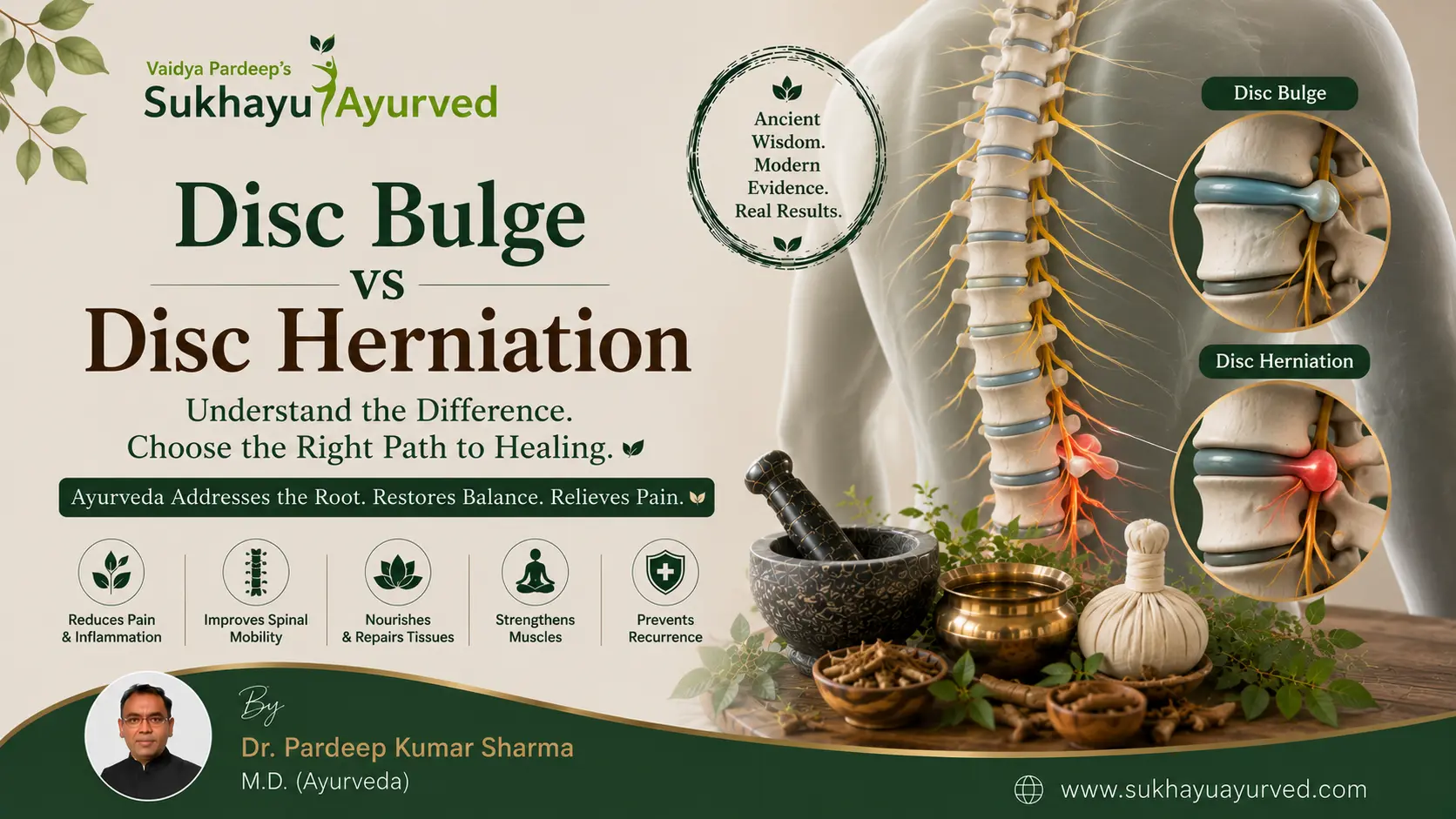
- A disc bulge is when the jelly shifts and pushes the outer wall outward — but the wall holds. The dough is stretched, distorted, pushed out of its normal shape. Nothing has escaped. The containment is intact.
- A disc herniation is when the outer wall tears. The annular fibres give way, and the jelly peeps out through the tear.
That is the whole structural distinction. Wall intact, wall torn. Everything else is commentary.
Why the label doesn't predict the pain
Here is what patients find hardest to accept: a bulge can cause immense pain, and a herniation can be completely silent.
That is not a comforting platitude. It is a mechanical fact, and once you understand the anatomy above, it follows logically. The pain does not come from the category of the lesion. It comes from what the lesion is doing — and to whom.
A bulge sitting in exactly the wrong place, pressing exactly where a nerve root exits, in a spine that has lost its curve and is locked in muscular spasm, will hurt far more than a herniation that has escaped into open space and is touching nothing at all.
So when a patient asks me, "Doctor, is a bulge better than a herniation?" — the honest answer is: that is not the right question. The right question is where, how many, and what else.
What I am actually reading on the film
I am never certain whether I am looking at a bulge or a herniation until I have seen the MRI. But I do not open the report at the disc description and stop there. That single line is one item on a much longer list.
What I read the film for:
- Loss of lordosis — has the lumbar curve flattened?
- Muscular spasm — is the surrounding musculature locked?
- Scoliosis — has the spine deviated to offload the painful side?
- Degeneration of the disc or discs — is this one event, or a spine that has been changing for years?
- How severe the bulge or herniation actually is — not just that it exists
- How much compression there is on the nerve roots
- Canal stenosis — is the passage itself narrowed?
Any one of these can matter more to a patient's day-to-day suffering than whether the annulus is technically torn. A spine with a modest bulge, a flattened lordosis, and a scoliotic shift is a spine in genuine mechanical distress. A spine with a herniation and none of the above is often a spine that is coping.
This is why I take the history before I read the film. The symptoms, and the story of how they started, come first. The MRI confirms — it does not announce.
Where Ayurveda actually enters — and where it doesn't
I want to be precise here, because this is where a great deal of Ayurvedic writing on the internet goes wrong.
The disc lesion itself is not a doshic event. A torn annular fibre is a mechanical change. A displaced nucleus is a mechanical change. Assigning a dosha to the tear itself would be dishonest, and I do not do it.
Classical Ayurveda already accounts for this. Dosha aggravation happens in two ways:
- Nija — primary. The dosha is disturbed at the physiological level and itself produces the disease.
- Agantuja — secondary. The dosha is disturbed because of an external cause. The event comes first; the aggravation follows.
A disc lesion is agantuja. The mechanical insult happens, and dosha aggravation follows as a consequence. The order matters, and getting the order right is what keeps the reasoning honest.
(Where there is a syrinx or another underlying pathology, the picture is different and must be assessed on its own terms.)
Where the doshic reading does change everything
So if the lesion isn't classified doshically, what is?
The presentation. And this is where two patients with identical MRIs part company completely.
I do not classify the disc. I classify what the patient is experiencing:
- Pure pain, without other features — this is Vataja.
- Pain with burning, or other Pittaja features — this is Vata-Pittaja.
- Paraesthesia, tingling, numbness — Kapha symptoms — this is Vata-Kaphaja.
Two patients, same herniation at the same level, same size on film. One describes burning that radiates. One describes a numb, heavy, tingling leg. Their MRIs are near-identical. Their treatment is not similar — it is different in composition, because the doshic picture they present is different.
This is precisely the information the MRI cannot give me, and precisely why the report is a confirmation and not a diagnosis. The film tells me the mechanics. The patient tells me the physiology.
When it is not my case
Honesty about limits matters more than enthusiasm about scope.
Cases before sequestration — where the nuclear material, even if herniated, has not separated and become a free fragment — can reasonably be managed through Ayurvedic treatment. That covers the large majority of what walks through my door, and it covers bulges and herniations alike. Again: the label is not the deciding factor.
But there is a line, and I do not negotiate it:
If bladder or bowel control is affected, that patient goes to a surgeon. Not after a trial. Not after a course of therapy. Immediately. Loss of bladder or bowel control in the presence of disc pathology is not a symptom to manage conservatively — it is a reason to refer, and delay in that situation carries consequences that no amount of Ayurvedic care can undo afterwards.
Sequestration, similarly, changes the conversation.
I would rather send you to the right person on day one than be the doctor who kept you.
What I want you to take from your report
If you are holding an MRI right now with one of those two phrases underlined, here is what I would tell you across the desk:
The word is not your prognosis. A bulge does not mean you are fine. A herniation does not mean you need surgery. The word describes whether one wall of one structure has torn — nothing more.
What matters is where the lesion sits, how many levels are involved, what your curve and your muscles are doing around it, whether a nerve root is being compressed and how much, and — most of all — what you are actually experiencing. Whether your pain burns, or is numb and heavy, or is simply pain, changes my treatment more than the difference between those two words on your report ever will.
Bring me the report. But bring me the whole story first.
This article is for educational purposes and reflects clinical experience in Ayurvedic practice. It is not a substitute for individualized medical evaluation. Ayurvedic management is intended to complement, not replace, conventional diagnosis and care — particularly for spinal conditions, where signs such as loss of bladder or bowel control require immediate conventional assessment. Please consult a qualified physician for assessment specific to your case.
Dr. Pardeep Sharma, M.D. (Ayurveda) — Sukhayu Ayurved, Jaipur