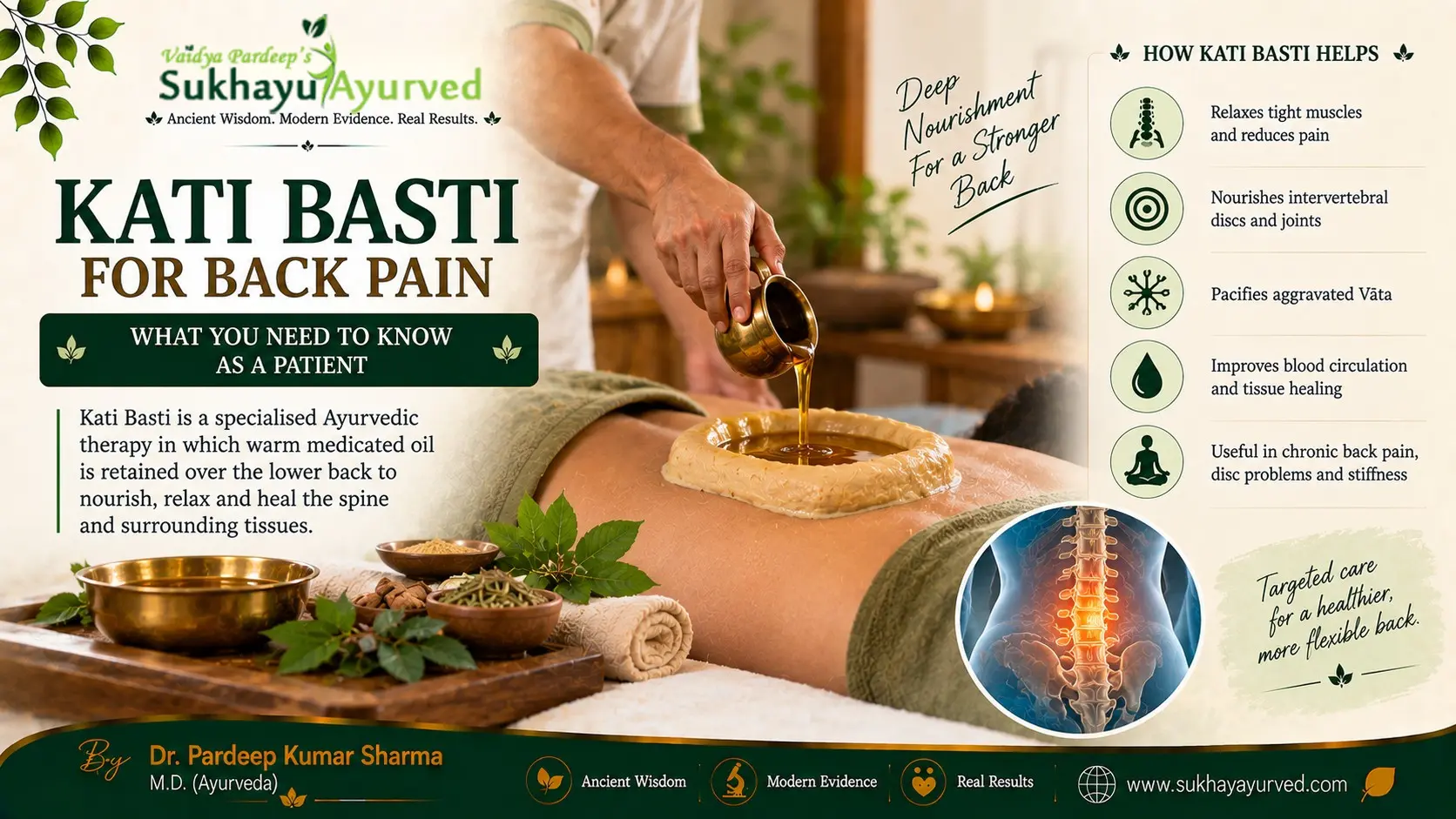
Twenty minutes of warm oil on the lower back. By the time most spine patients reach my clinic in Jaipur, they have already had it — at a spa, at a wellness centre, at home from a kit that arrived with a ring of dough and a bottle of oil. They tell me, almost apologetically, that "Kati Basti didn't work for me."
I ask them how long the oil stayed on their back. Fifteen minutes. Twenty. Occasionally thirty.
Then I tell them something a commentator named Dalhana wrote roughly nine hundred years ago: at twenty minutes, the oil has barely reached the blood. The muscle was never touched. The bone was never touched. The disc — the thing their MRI report is actually about — was never touched at all.
Kati Basti did not fail them. Kati Basti was never done.
The deeper principle: oil moves through the body on a timetable
Kati Basti (Kaṭi — the lumbar and sacral region; Basti — a container or retaining vessel) is the external Basti in which a ring of black gram dough is built on the lower back and warm medicated oil is held within it. No pressure. No massage. The oil simply sits.
That stillness is what makes people underestimate it. "Oil sitting on your back" sounds like comfort, not treatment. But the classical texts did not treat oleation as vague. In his commentary on the Sushruta Samhita, Chikitsa Sthana 24 — the chapter on the daily regimen that prevents disease — Dalhana records precisely how long applied oil takes to travel through each tissue layer:
रोमान्तेष्वनु देहस्य स्थित्वा मात्राशतत्रयम्। ततः प्रविशति स्नेहश्चतुर्भिर्गच्छति त्वचम्॥ रक्तं गच्छति मात्राणां शतैः पञ्चभिरेव तु। षड्भिर्मांसं प्रपद्येत मेदः सप्तभिरेव च॥ शतैरष्टाभिरस्थीनि मज्जानं नवभिर्व्रजेत्। तत्रस्थाञ्छमयेद्रोगान् वातपित्तकफात्मकान्॥
romānteṣv anu dehasya sthitvā mātrāśatatrayam | tataḥ praviśati snehaś caturbhir gacchati tvacam || raktaṃ gacchati mātrāṇāṃ śataiḥ pañcabhir eva tu | ṣaḍbhir māṃsaṃ prapadyeta medaḥ saptabhir eva ca || śatair aṣṭābhir asthīni majjānaṃ navabhir vrajet | tatrasthāñ chamayed rogān vātapittakaphātmakān || — Dalhana on Sushruta Samhita, Chikitsa Sthana 24.30
In plain language: the oil (Sneha) rests at the hair roots for 300 Mātrā (units of time). At 400 it reaches the skin (Tvak). At 500, the blood (Rakta). At 600, the muscle (Māṁsa). At 700, the fat tissue (Meda). At 800, the bone (Asthi). At 900, the marrow (Majjā). And once it arrives at a tissue, it settles the Vata, Pitta and Kapha disorders located there.
This is the verse my clinic's external Basti practice is built on. Sukhayu follows Sushruta's Chikitsa 24 completely — and the consequence is simple: the duration of Kati Basti is not a preference. It is chosen by which tissue (Dhatu) is diseased.
Why the duration is the dose
In practice we work with Majjā — the deepest layer, at 900 Mātrā — at about one hour, and calculate the other layers proportionally. That places roughly:
- Muscular stiffness and spasm (Māṁsa level) at around 40 minutes
- Osteophytes and bony degeneration (Asthi level) at around 53 minutes
- Degenerative disc disease (Majjā level) at around 60 minutes
Why is the disc a Majjā problem? Because Majjā is not only the marrow within bone — classically it is also what lies between bones. The intervertebral disc sits exactly there. A patient with a degenerated L4-L5 or L5-S1 disc (the MRI findings I discuss in what your MRI report is actually telling you) needs the oil to reach the deepest layer the verse describes.
A twenty-minute session is therefore not a lighter dose of the same treatment. By Dalhana's arithmetic it stops somewhere between the skin and the blood. It is a different, shallower intervention — and it cannot be expected to act on a tissue it never reaches.
Why no pressure changes everything
The second thing patients do not expect is who Kati Basti is for.
Most people assume that a severely tender, inflamed lower back — the kind that flinches at a finger's touch — should be left alone until it "settles." For every treatment that works through pressure, that caution is right. Manipulation, deep massage and traction all ask the inflamed spine to bear force.
Kati Basti asks nothing of the spine except to receive. Because there is no pressure at all, it can be given across almost every lower back presentation I see — acute and chronic, degenerative and inflamed, even when tenderness is severe. The oil does its work by staying, not by pushing.
There is one presentation where it does not work: pathological fusion of the vertebral bodies. When a disease such as advanced ankylosing spondylitis has fused vertebrae into bone, there is no joint space left for the oil to act upon. I say this plainly to every patient who arrives hoping otherwise.
Surgical fusion is a different matter, and I want to be equally plain about that. A pathological fusion and a surgical fusion are not the same thing. We treat many patients with failed back surgery syndrome — people who had a discectomy, a laminectomy or a fixation and are still in pain — and their backs remain within reach of the protocol.
Choosing the oil is a diagnosis, not a product
There is no single "Kati Basti oil." The Ghrita and Taila (medicated ghee and oil) preparations of Ayurveda are chosen by the Dosha picture and the pathology in front of the physician. To show the reasoning — not to offer a list anyone should apply to themselves:
A back that is inflamed, injured or traumatised calls for a preparation such as Murivenna, classically indicated for injury and inflammation. A purely Vata back — dry, degenerative, without swelling — calls for something in the family of Dhanvantaram Taila. A Kapha-Vata back, heavy, stiff and congested, needs a Kapha-clearing combination such as Mahanarayan Taila with Mahavishgarbha Taila. Severe degeneration asks for deep nourishment with penetration — Ksheerabala with Karpuradi, for example.
The same patient can need a different oil in week three than in week one, because the picture shifts as the inflammation settles. That judgment — reading the back, not the label on the bottle — is the treatment.
What we see in the clinic
The spine patients whose stories we have documented over the years (Sukhayu success stories) cover almost the entire range of lumbar disease: single-level and multi-level disc herniations from L3 to S1, disc extrusions with spinal canal stenosis, posterior annular tears, Grade II spondylolisthesis, Grade III retrolisthesis.
Many of them had already been through the circuit. Some had been operated on. Some had done Kati Basti at home. Some had spent months with manual manipulation of the spine. When I took their histories, the home and kit-based Kati Basti had failed in every aspect — wrong duration, wrong oil for their Dosha picture, and no treatment around it. No treatment can be done as a kit. A kit supplies the dough and the oil. It cannot supply the diagnosis.
I will not publish their individual protocols here, deliberately. A protocol that was right for one spine can harm the next, and a reader with an MRI report in hand deserves better than a recipe. What I can say is this: in none of these cases was Kati Basti working alone. Depending on the case it sat alongside internal Basti chikitsa — the medicated enema Charaka calls half of all treatment — Pinda Swedana where muscle needed it, Lepana (medicated paste) where local inflammation demanded it, oral medicines, diet and rest. Whatever improvement came, it came from the whole protocol.
Clinical research on Kati Basti tends to arrive at the same shape. A randomised controlled trial published in 2024 studied Kati Basti with Ksheerabala Taila as an add-on within a one-week residential programme for chronic low back pain (PMC, CTRI-registered RCT), and a clinical study at the All India Institute of Ayurveda gave Kati Basti together with Panchatikta Ksheera Basti for lumbar disc degeneration (Kaalia, Bhatted & Acharya, 2021). Neither study tested the oil in isolation. That is a parallel observation, not a validation: the classical position stands on its own.
What to expect — honestly
What happens in a session. You lie face down. A ring of black gram dough is built and sealed over the affected lumbar segment. Warm medicated oil is poured inside and kept at a steady temperature, replaced as it cools, for the duration the diseased tissue requires. The dough is removed, the area is gently cleaned, and you rest. The session mechanics are described in detail on our external Basti procedure page.
What you will feel. Warmth. Relaxation. That is usually all. Your pain will not ease in the first one or two sittings, and I would rather you knew that before you arrive than be disappointed on day two. A few patients do report complete relief early; in my experience that is most often a placebo effect, and it does not last.
How long it takes. A course runs between 7 and 21 days, decided by the case. Within that, I cannot promise you a neat curve. Treatment done naturally, without strong medicines, never gives a predictable line of results. The tissue responds on its own timeline — and the honest thing is to say so.
Where I draw the line
For a treatment article, this may be the most important section.
I have personally referred thousands of spine patients to surgeons over the years, because I know how delicate the spine is and how little room it leaves for pride. Some presentations are not mine to treat conservatively, and they go straight to a surgeon without a trial of anything:
- Signs of cauda equina compression — new changes in bladder or bowel control, numbness in the saddle area
- Progressive foot drop or worsening motor weakness
- A massive sequestrated disc fragment
- Suspected infection or malignancy in the spine
If any of these apply, please do not wait for an Ayurvedic appointment — go to an emergency department. I have written about this in more detail in when sciatica is a surgical emergency, and about the harder middle ground in L4-L5 disc bulge: when to choose Ayurveda over surgery.
For every other lower back — the inflamed one, the degenerated one, the one that has already been operated on — Kati Basti has a place, as part of a protocol designed by a physician who has read the whole spine, not just the MRI.
If you are weighing whether your back is one of them, write to us or book a consultation, or message us on WhatsApp at +91 90508 02060. Bring your reports.
Closing philosophy
There is a particular modern habit of judging a treatment by how it feels in the first hour. Kati Basti will disappoint anyone who does that. It asks for time — first the hour the oil needs to reach the tissue that is actually sick, and then the weeks the tissue needs to respond. What Dalhana understood nine centuries ago is something we keep relearning: the body is not a surface, and healing does not happen at the surface. The oil has to arrive. So does the patience. Cure is divine. Treatment is possible.
Dr. Pardeep Kumar Sharma, M.D. (Ayurveda) is the founder of Sukhayu Ayurved, Jaipur. With over 20 years of clinical experience in Ayurvedic management of orthopedic, neurological and autoimmune conditions.
Medical Disclaimer: This article is for educational purposes and reflects classical Ayurvedic understanding and clinical experience. It is not a substitute for individual diagnosis or treatment, and it does not describe a protocol for any individual patient. Kati Basti should only be given under the supervision of a qualified Ayurvedic physician. Bladder or bowel changes, saddle numbness, progressive leg weakness or foot drop are medical emergencies — seek immediate care at a hospital.