A man in his early forties sat across from me last month, one leg not quite bearing its share of his weight even as he sat. Avascular necrosis of the femoral head, left side. He had the surgeon's letter in his hand and a single question he'd clearly rehearsed on the drive over.
"So you're going to give me an enema?"
I hear a version of this question almost every week, and I never rush past it, because the misunderstanding folded inside it is the exact thing standing between most people and the treatment that could help them most. He had read the word "Basti" somewhere online, found it translated as medicated enema, seen it filed under "Ayurvedic detox," and arrived expecting a spa procedure — pleasant, perhaps, but not the sort of thing that touches a dying hip.
Almost none of that is right. And correcting it is not pedantry. It changes what a patient like him can reasonably hope for.
So let me tell you what Basti actually is, why Charaka staked half of all medicine on it, and why — after twenty years of prescribing it several times a day — I still consider it the most sophisticated instrument in Ayurvedic practice.
Basti is a route, not an enema
Start with the word. An enema is defined by its purpose: to evacuate the bowel. That is the whole of it. Basti borrows the same anatomical door, and there the resemblance ends.
Basti is a route of administration. The rectum and colon are the doorway; what we send through that doorway — and what we intend it to do once inside — is determined entirely by the patient in front of us. Sometimes the medicine is a decoction. Sometimes it is oil or ghee. Sometimes the aim is to draw accumulated Dosha down and out; just as often the aim is to nourish — to feed tissue that oral medicine can no longer reach efficiently.
That last point undoes the whole "detox" framing, so let me be precise about it. Basti has an entire nourishing class — Brimhana Basti — described plainly in the classical texts. A procedure whose stated purpose is to build tissue, strengthen the body and enrich Shukra cannot, by definition, be a "cleanse." You cannot scrape and nourish with the same hand.
And here is the logical knot that the detox industry never untangles: Basti's principal target is Vata. Vata is Ruksha, Khara, Laghu — dry, rough, light. If you set out to pacify a dry, rough, light Dosha, the last thing you would do is subject the body to a scraping, depleting purge, because scraping is the aggravating action. A treatment built to calm Vata that worked by "flushing you out" would be self-defeating on its own terms. The moment you understand which Dosha Basti governs, the detox story collapses under its own logic.
This matters because of what "Shodhana" actually means. Panchakarma is Shodhana Chikitsa, yes — but Shodhana does not mean expulsion. It means correction. Restoration of the body's homeostasis through procedure. "Detox" is a fashionable word that sells quickly because it comes with a villain — the toxin — and a satisfying purge. Give people a devil to blame and a ritual to cast it out, and the idea sells itself. But that is marketing physiology, not the physiology in the texts.
Why "half of all medicine"
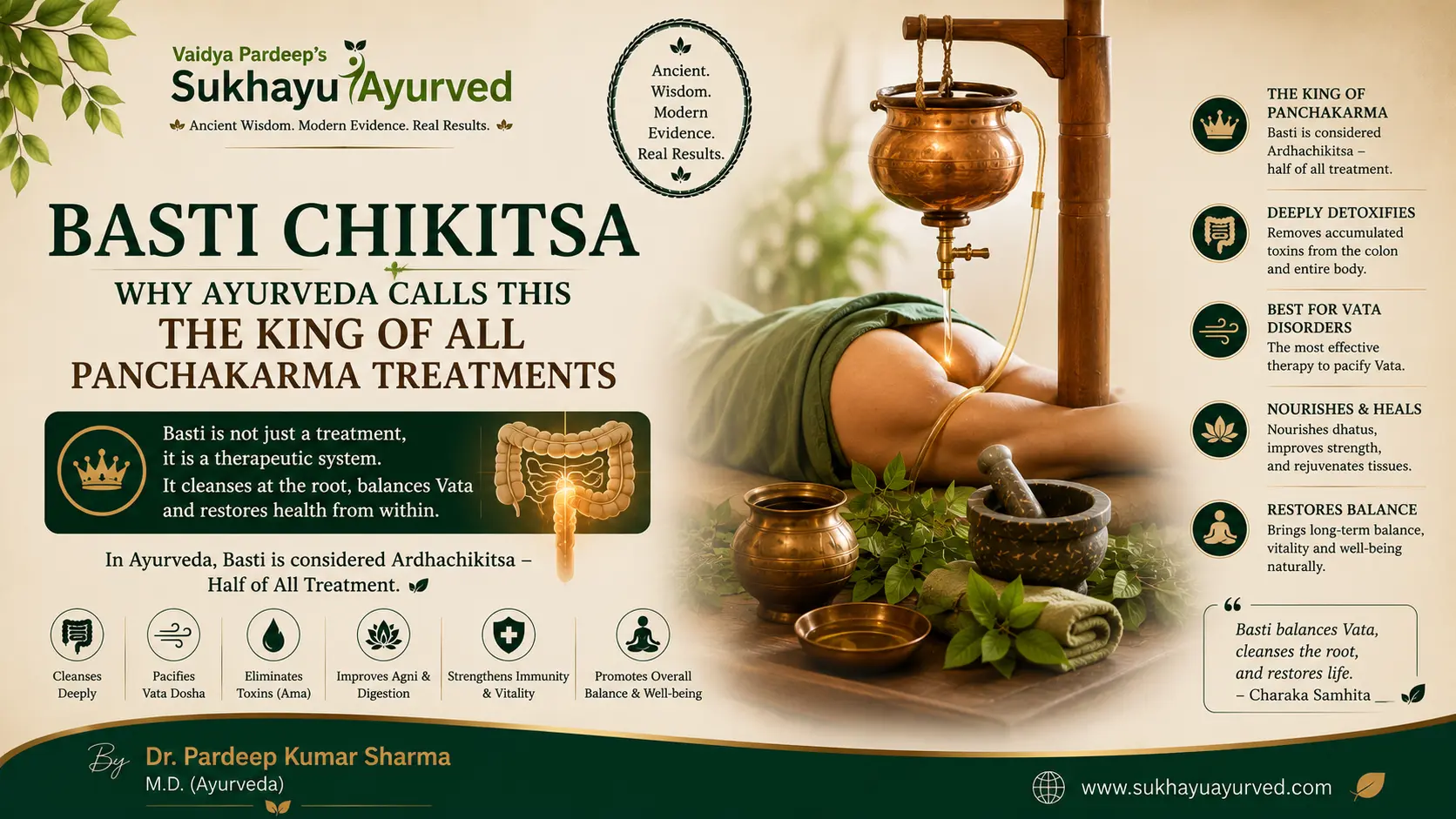
In the Siddhi Sthana of the Charaka Samhita, Basti is given a status no other single procedure receives — Ardha Chikitsa, half of all treatment. When a text that catalogues hundreds of therapies places one of them on a scale against all the others combined, it is worth asking why. There are two reasons, and they are worth understanding rather than memorising.
The first reason is Vata. Among the three Doshas, Vata alone possesses the quality of movement. It is the mover — and crucially, it is the mover of everything else. Pitta does not travel on its own; Kapha does not travel on its own; the Dhatus (tissues) and Malas (wastes) do not relocate themselves. Vata carries all of them. It is the dynamic principle, and in a living body, movement is not one function among many — movement is life. Where things sit, when they are released, how one organ signals another: this is the domain of Vata.
Modern physiology has arrived at a strikingly similar conclusion by its own road. Health is not only a matter of the body's chemical composition — of what substances are present — but of where those substances are located, how they move, when they are released, and how organs communicate with one another. The regulatory, positional, temporal layer of physiology is exactly the territory Ayurveda assigned to Vata. And Basti is our most direct instrument for governing Vata. Master the mover, and you have leverage over everything it moves.
The second reason is versatility. Basti is not a Vata-only tool. There is Basti for Vata, Basti tuned to Pitta, Basti directed at particular Dhatus, nourishing Basti and cleansing Basti. It reaches conditions across the whole classical spectrum, which is why the same procedure serves a patient with Ankylosing Spondylitis, another with AVN, and a third with ulcerative colitis — with different compositions and different intent each time. A single procedure that adapts to nearly every clinical situation earns its place as half of medicine.
The classical description is worth quoting, because it makes my earlier point for me. Charaka, Siddhi Sthana, verses 27–28:
बस्तिर्वयःस्थापयिता सुखायुर्बलाग्निमेधास्वरवर्णकृच्च ।
सर्वार्थकारी शिशुवृद्धयूनां निरत्ययः सर्वगदापहश्च ॥
विट्श्लेष्मपित्तानिलमूत्रकर्षी दार्ढ्यावहः शुक्रबलप्रदश्च ।
विश्वक्स्थितं दोषचयं निरस्य सर्वान् विकारान् शमयेन्निरूहः ॥
Basti prevents ageing; it promotes longevity, strength, digestive power, intellect, voice and complexion. It serves every purpose, is safe for children, the elderly and the young alike, and relieves all diseases. It evacuates stool, Kapha, Pitta, Vata and urine, brings sturdiness to the body, and enriches Shukra and strength. Removing the accumulated Dosha from the entire body, it pacifies all disorders.
Read that list of effects again — prevents ageing, promotes strength, enriches semen, brings sturdiness. This is the profile of a builder, not a cleaner. The text itself refuses to let Basti be reduced to a purge. (And I will note, without labouring it, that the verse describes Basti as giving the patient sukha-ayu — a life of ease and wellbeing. Our clinic did not choose its name idly.)
Basti for Neurological Diseases
How we actually run it
A single Basti is almost meaningless in isolation. Basti is prescribed as a series — a Kaala or Karma Basti — and the sequence has an architecture.
For our broader Vata and joint cases, the rhythm at Sukhayu runs like this: the first two and the last three Bastis of the course are Anuvasana — the oil-based, nourishing Basti that prepares and then seals the sequence. In the middle band, the day is split: Niruha (the decoction Basti that draws Dosha down and out) on an empty stomach in the morning, and Anuvasana again in the evening. This alternation — cleanse in the morning, nourish at night — is a daily clinical routine here, and it sits entirely within classical reference. It is not improvised.
For the heavier, more entrenched conditions — AVN, Ankylosing Spondylitis, colitis — we run a full Basti Kalpa: a committed set of sixteen or thirty Bastis carried through in one go. These conditions do not yield to a light touch, and the protocol reflects that. Our case series in HLA-B27-positive Ankylosing Spondylitis — where patients moved through multiple Panchakarma sittings with documented BASDAI and ESR changes — was built on exactly this structure.
What goes into a Basti — and why
This is where clinical work separates itself from content. The composition of a Basti is never a fixed recipe; it is chosen along two axes at once.
The first axis is the disease. In AVN, for instance, part of the objective is Rakta Prasadana — the correction of blood — because the necrosis is downstream of a blood-supply failure. That objective pulls a particular Ghrita into the formulation, chosen for that action. (This is the same reasoning that governs why the diet in AVN targets circulation rather than calcium — the whole protocol points at the blood supply, not the bone in isolation.)
The second axis runs in parallel: the Dosha, the Dhatu and the person. In AVN the afflicted tissue is Majja (the marrow/deep-tissue level), and Majja calls for Tikta Rasa — the bitter taste — so that enters the reasoning too. This is precisely why Tikta Ksheer Basti is central to our Panchakarma protocol in Ankylosing Spondylitis as well, where bone and marrow are directly involved. Contrast this with, say, azoospermia, where the requirement is different in kind: there we need Ushna Guna paired with Madhura Rasa — heat to open the channel and sweetness to nourish what flows through it, simultaneously.
So the medicine sits at the intersection of what the disease demands and what the tissue and the person can actually receive. The oil or decoction that enters a Basti for AS is not the one that enters it for AVN, and neither is the one for sciatica — not because we like variety, but because the pathology, the Dhatu and the constitution are asking for different things. This is the un-fakeable part of the work.
The honest part: Basti is half, not all
Here I have to be careful, because it would be easy — and dishonest — to let you walk away thinking Basti is a switch that fixes things. It is half of the treatment. The word Charaka chose was deliberate. The other half — diet, lifestyle, oral medicines, and local procedures — is real, and no amount of Basti substitutes for it.
Take the AVN patient I opened with. His pain does not actually come from the bone. It comes from the altered femur-neck angle, which strains the inner-thigh muscles; those muscles grow sore, and the soreness is what produces the limp. Basti works at the Majja level, correcting the deeper terrain — but it is Patra Pinda Sweda or Churna Pinda Sweda, applied locally, that releases the muscular tension and lets him walk with ease again. Two levels of the same problem, two different tools, one protocol. This is the whole logic behind our protocol-based orthopedic care — the deep correction and the local relief are prescribed together, never in isolation. Attribute his walking to Basti alone and you have made exactly the error I refuse to make with single herbs: crediting the outcome to one instrument when it belonged to the whole.
Nothing here is absolute. Everything is relative. There is no magic — only physiology, applied with precision.
Who Basti is not for
Trust is built at the boundaries of a treatment, not at its centre. There are patients who come in wanting Basti whom I turn away, and the reasons are plain. Terminally ill patients. Patients with incontinence of stool — because retention, which the procedure depends on, is not possible. And patients with deep, open fistulas — because the route itself is compromised. These are not judgment calls I agonise over; they are firm exclusions, and I would rather tell you so honestly than pretend Basti is for everyone.
I will add one reassurance for the nervous first-timer, and I can say it because of volume rather than faith: we perform close to a dozen Bastis a day at this clinic, and have done so for two decades. That repetition has let us refine the process — the Snehana and Swedana that must precede it, the case selection, the timing — to the point where the complications the texts warn about, Ayoga and Atiyoga, have simply not appeared in my practice in twenty-odd years. The safety is upstream, in the preparation, not improvised at the table.
A closing thought
The man with the surgeon's letter did not need me to promise him a miracle. He needed to understand that the "enema" he was bracing himself for was actually the most precise, most adaptable instrument I own — one that Charaka rated against the entire rest of medicine and found equal to half of it. Not because it flushes anything out, but because it corrects the mover of all things, and because it can be tuned, patient by patient, to nourish exactly what needs nourishing.
Cure is divine. Treatment is possible. Basti is not a shortcut to either — it is simply the finest half of the work.
Dr. Pardeep Sharma, M.D. (Ayurveda) is the founder of Sukhayu Ayurved, Jaipur. With over 20 years of clinical experience in Ayurvedic management of orthopedic, neurological and autoimmune conditions.
Medical disclaimer: This article is for educational purposes and does not constitute medical advice. Basti Chikitsa is a clinical procedure that requires individual assessment, formal contraindication screening and trained supervision. Do not attempt it without qualified guidance. Outcomes vary by individual, stage of disease and adherence to the complete protocol.
Considering Basti for a chronic condition? Whether it's right for you depends entirely on your diagnosis, stage and constitution — some patients we take on, some we don't. To ask whether Basti is appropriate for your specific condition, message us on WhatsApp at 9050802060, email [email protected], or book a consultation.