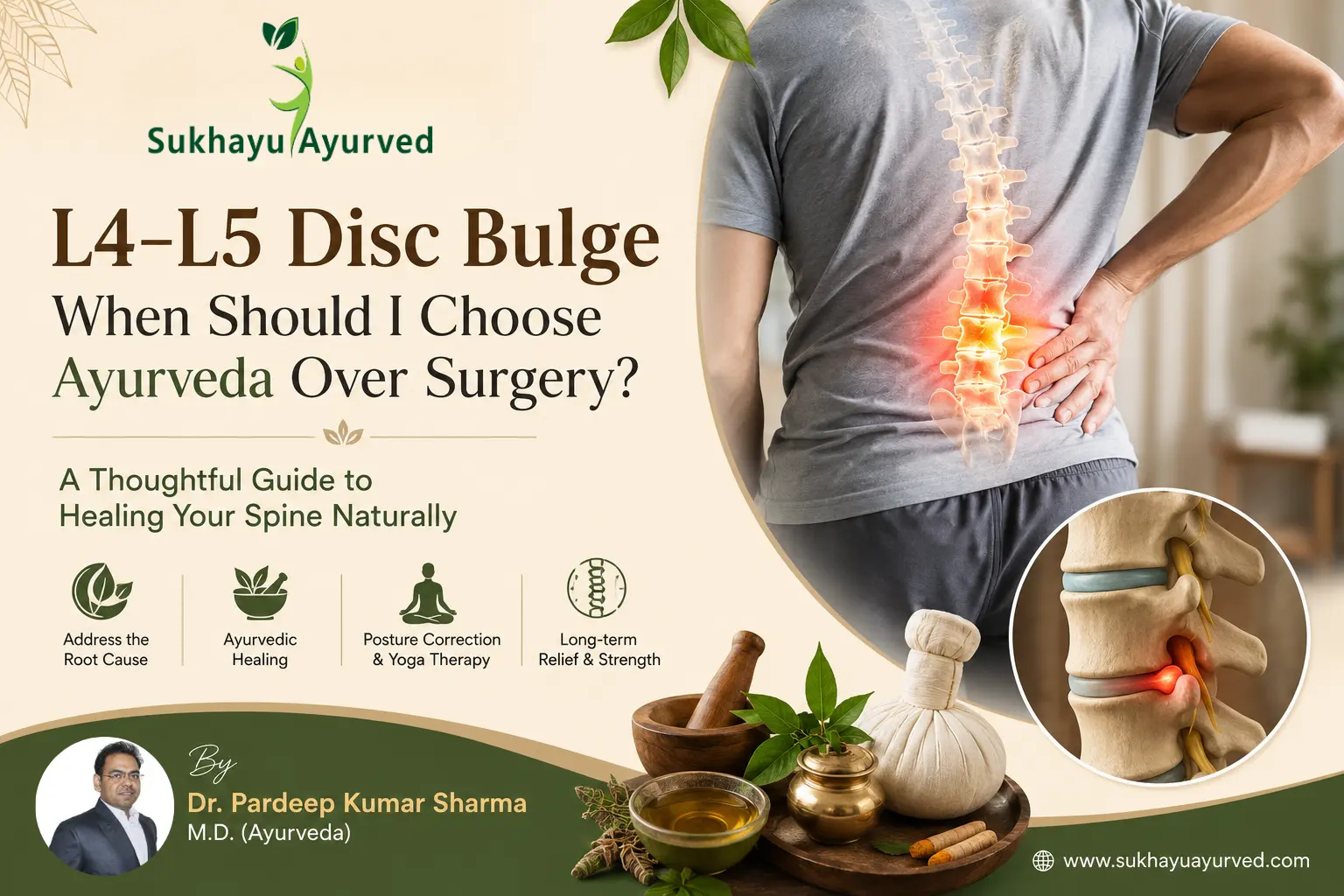
If you've been told you have an L4-L5 disc bulge, you've probably already collected a few conflicting opinions. One doctor says surgery is the only real fix. A relative swears by Ayurveda. A forum post terrifies you with someone's post-surgery complications. Somewhere in between is the actual answer for your spine — and it depends on details that a five-minute search can't give you.
At Sukhayu Ayurved, we've spent over 20 years treating spinal conditions, including a large number of L4-L5 cases — statistically the most commonly affected disc level in the lower back. This post is our honest, clinical take on when Ayurveda makes sense, when it doesn't, and what actually happens during treatment.
First, the One Red Flag That Overrides Everything Else
Before any discussion of Ayurveda versus surgery can happen, there's a non-negotiable line we draw immediately: loss of bladder or bowel control.
This is a sign of cauda equina syndrome, a surgical emergency. If you're experiencing this, no amount of Panchakarma or herbal medicine should delay a visit to a spine surgeon. We say this clearly and upfront because we are not anti-surgery, and we are not anti-science. We understand our limitations, and this is one of them.
The same applies to certain MRI findings — particularly sequestration (where a fragment of the disc breaks off and migrates) and caudal migration of disc material. In these cases, nothing applied "over the skin" can fix what's happening internally. A scalpel becomes hard to avoid, and we'll tell a patient this directly rather than promise something Ayurveda can't deliver.
If none of that applies to you, the conversation about Ayurveda becomes genuinely worth having.
A Mismatch in Expectations That Trips Up Most Patients
Here's something we see constantly, and it's worth naming directly: most patients expect their surgeon to be the one who tells them whether non-surgical treatment is an option. That's usually a mistake.
A surgeon's training, mindset, and entire frame of reference is surgery. That's not a criticism — it's simply what they are trained to do, and it's why they're indispensable for the cases that genuinely need a scalpel. But it also means that when a patient sits across from a surgeon, the default lens through which their case gets viewed is "does this need an operation," not "what are all the paths available here." Asking a surgeon to advocate for a non-surgical route is a bit like asking a tailor whether you really need that suit altered — it's simply not the question their expertise is built to answer.
This isn't said to discourage seeing a surgeon. It's said so you walk in with the right expectation: get their opinion on whether surgery is indicated, but don't expect them to be the one weighing Ayurveda, physiotherapy, or other conservative options against it. That comparison needs to happen with someone whose practice actually spans those options.
How We Actually Decide: It's Never Just the MRI
A lot of people arrive at our clinic holding only their MRI report, expecting a yes-or-no answer based on the image alone. We don't work that way.
Our diagnostic process combines three things together, not in isolation:
- A detailed history and physical examination — how you move, where exactly the pain travels, what aggravates and relieves it, your daily posture and occupation.
- A careful review of the MRI — not just "is there a bulge," but what type, what direction, and how it correlates with your actual symptoms (imaging and symptoms don't always match, and that mismatch matters).
- Prakriti and dosha assessment — your individual constitutional pattern, which shapes how we approach treatment, diet, and lifestyle correction.
It's this comprehensive picture — not the scan in isolation — that tells us whether someone is a good candidate.
A Surprising Factor: Age Isn't What You'd Expect
Most people assume younger patients recover faster and older patients are harder cases. In our clinical experience with L4-L5, that assumption doesn't hold.
We've seen a 70-year-old patient recover completely, while a 17-year-old was not a suitable candidate for our treatment at all. Age on its own tells us very little. What matters is the comprehensive clinical picture — the type of bulge, the person's overall constitution, lifestyle, and how their body is actually responding, not a number on a form.
This is exactly why we don't give blanket answers over the phone before seeing a full case history.
What Treatment Actually Looks Like: The Three-Dimensional Approach
If you are a suitable candidate, here's what the process involves — not vague "herbal remedies," but a structured, three-pronged protocol:
1. Ayurvedic medicines — internal formulations aimed at balancing the doshas, particularly addressing the Vata imbalance that underlies most disc degeneration.
2. Panchakarma — therapies like Basti and other detoxification procedures designed to clear deep-seated toxins from the muscular and connective tissue around the spine and improve blood supply to the affected region.
3. Yoga therapy — targeted practice aimed not at general fitness, but specifically at correcting spinal alignment.
That third point connects to the core philosophy that shapes everything we do.
The Disc Is the Victim, Not the Villain
Here's the part of our approach that tends to surprise people, and honestly, it's the part we think patients deserve to hear plainly: we don't treat L4-L5 disc bulge as a pain-management problem.
In our clinical view, the disc bulge itself isn't really the root cause — it's a consequence. The deeper issue is usually an attenuation of the natural curvature of the lumbar spine, or loss of lordosis. When that curvature is compromised over years of poor posture and habits, the disc takes on stress it was never meant to bear, and it bulges. The disc, in that sense, is the victim of a structural problem upstream of it.
So our treatment doesn't chase the pain. It works on correcting the spinal curvature itself. When that's addressed properly and scientifically, the disc bulge resolves as a downstream effect — and the pain fades slowly, but completely, rather than being masked.
This is a slower process than a painkiller or an injection. We won't pretend otherwise. But it's aimed at the actual mechanism, not the symptom.
How We Track Progress (Without Overusing Expensive Imaging)
We don't repeat MRIs every few weeks during treatment — they're an expensive tool, and not every patient is ready or able to keep paying for repeat scans. Instead, during treatment we track patients through:
- Pain and mobility assessments at regular intervals
- Functional milestones — can they walk normally, bend, sit, stand for longer periods, reduce or stop painkillers
A confirmatory MRI is typically done after the course of treatment is completed, to objectively verify the structural change, rather than as a recurring check-in expense.
One Thing Most People Overlook: Diet
When patients ask what they can do right now, before deciding on a treatment path, the conversation usually goes straight to posture — sit better, avoid heavy lifting, don't bend at the waist. Fair enough, and important. But there's a piece almost everyone misses.
Diet.
A diet that aggravates Vata dosha — dry, cold, processed, irregular eating patterns — contributes directly to dryness and stiffness in the body, restricted spinal movement, and over time, accelerates degenerative changes in the spine. It's not the first thing people associate with a "slipped disc," but in our clinical experience, it's one of the most consistently overlooked contributors.
So if you're still deciding on a treatment path, two things you can safely start today: correct your posture, and look honestly at whether your diet is Vata-aggravating.
Who We Are
This approach comes from Dr. Pardeep at Sukhayu Ayurved, with over 20 years of clinical experience specifically in orthopedic and spinal conditions, working at the intersection of traditional Ayurvedic training and modern diagnostic tools like MRI correlation. The qualification isn't just years in practice or formal training in isolation — it's the combination of clinical experience, training, and a track record across a meaningful volume of L4-L5 cases that informs how we make these calls.
So, Should You Choose Ayurveda Over Surgery?
There's no universal answer, and anyone who gives you one without seeing your case in full isn't being honest with you. What we can tell you:
- If you have bladder/bowel involvement, sequestration, or caudal migration — see a surgeon, don't delay.
- If you don't, your case deserves a comprehensive look — history, imaging, and constitutional assessment together — before any recommendation is made.
- If Ayurveda is appropriate for your case, it's a slower, root-cause-oriented process (curvature correction, not pain masking), not a quick fix.
If you'd like that comprehensive look at your own case, you can reach out for a consultation, send over your MRI report for an initial review, or visit us in person — whichever is most convenient for you.
This post reflects clinical experience and opinion from Sukhayu Ayurved. It isn't a substitute for an in-person medical evaluation of your specific case.