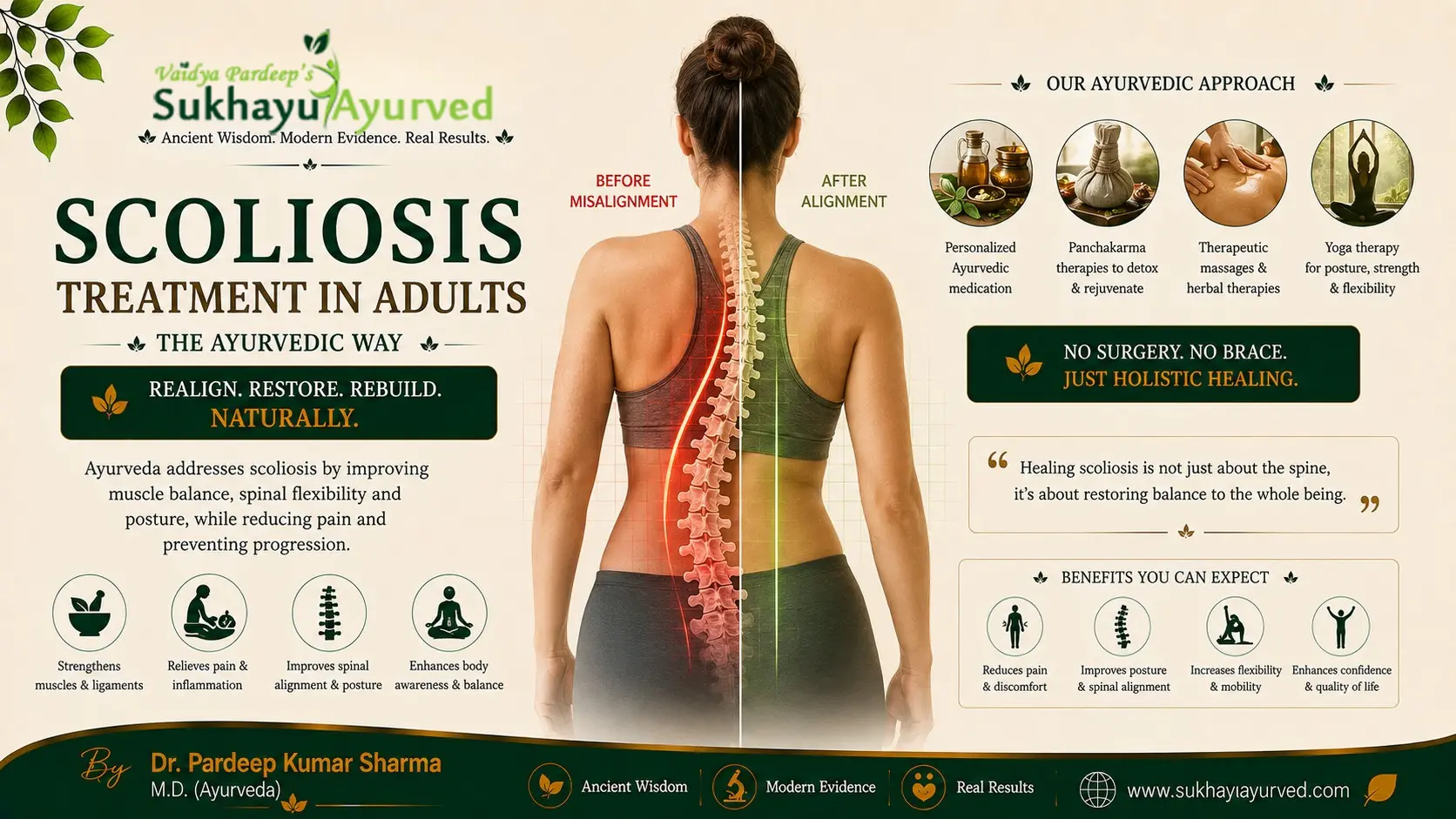
When an adult comes to me with a scoliosis diagnosis, the first question I am silently answering is not "how do we treat this curve" — it is "what kind of curve is this in the first place." Because in adults, that distinction decides almost everything about what treatment can honestly offer.
Most people arrive assuming scoliosis is a single condition. It is not. In the age group I see most often — thirties through fifties — the curve rarely comes from a true bony deformity. Unless there has been a serious accident, the sideways pull on the spine is usually driven by something more correctable: muscular stiffness and poor posture holding the spine off its centre. That is a very different problem from a spine whose bones have themselves grown or set into a curve, and it deserves a very different, more honest conversation.
Why adults are a different case from children
In a growing child, scoliosis can be structural — the vertebrae themselves are wedged or rotated, and the curve is built into the bone. That is a genuine orthopaedic problem, and Ayurveda is not the primary answer for it.
The adults I treat are usually a different story. When there is no bony deformity, the curve is most often the spine responding to sustained muscular imbalance — one side gripping and shortening, straining the column to a side over months and years, until the posture itself looks like a curve. Add years of poor sitting, one-sided loading, and unaddressed stiffness, and the spine settles into that pattern. This is the version of adult scoliosis that responds — because you are treating muscle, fascia and posture, not fighting the shape of bone.
The honest line runs exactly there: no bony deformity means the curve is workable; a fixed structural deformity means it is not going to straighten, and I will tell a patient that plainly.
How we tell which one it is
Patients almost never come to me because of the curve. They come because of pain — radiating pain down a limb, back pain, neck pain. The scoliosis is often something a report mentioned, while the symptom is what actually brought them in. That itself is a clue that we are frequently dealing with a functional, symptom-producing problem rather than a purely cosmetic structural one.
To establish which side of the line a patient sits on, I rely on X-ray and MRI together with a physical examination. Imaging shows me the bone and the disc — whether there is a true structural deformity, and whether something like a disc bulge is contributing to the radiating pain. The physical exam tells me how the spine and muscles are actually behaving. As on every report I read, imaging is there to confirm the clinical picture, not to replace the examination in front of me.
Only once that distinction is clear do I talk to a patient about correction versus management. It would be dishonest to promise the same outcome to both.
The 3P programme: how we actually treat correctable adult scoliosis
For the muscular and postural cases — the ones without a fixed bony deformity — treatment at Sukhayu Ayurved runs on what I call the 3P programme: Purification, Pacification, and Posture rectification. The order matters, because each stage prepares the ground for the next.
Purification
The first task is to release the stiffness that is pulling the spine off centre. How we do that depends on where the stiffness lives.
When the problem is very hyperlocal — tight, gripping muscles in one region straining the spine to one side — we work locally. That means procedures such as Kati Basti or Greeva Basti (a warm medicated-oil pool held over the lower back or neck), Pinda Swedana, Upnaha, and Lepana applied to the affected region. These soften and release the specific muscles doing the pulling.
When the stiffness is generalised through the body rather than confined to one segment, the purification has to be broader. Here we use whole-body procedures — Pizhichil, Basti, and Shalishashtika Pinda Swedana — to reduce stiffness across the system before we ask the spine to move back toward its centre.
Pacification
Once purification has released the grip, pacification works from the inside to hold and deepen that change. This is where internal medicine comes in — medicated Ghritam and Tailam taken internally, alongside other Ayurvedic preparations chosen for the individual case. Purification opens the door; pacification keeps it open long enough for the tissue to settle into a better state.
Posture rectification
This is the stage where the actual correction is consolidated — and it is done through targeted, specialised therapeutic yoga. Not general yoga, and not the wrong yoga, which in a spine like this can do harm. Specific postures are prescribed to retrain the muscles and the posture so the spine holds its corrected position rather than sliding back into the old curve. Purification and pacification make the spine able to correct; posture rectification is what makes the correction last.
What the timeline honestly looks like
For a correctable case, a realistic course looks roughly like this. The Panchakarma phase takes about 21 days. Internal medicines usually continue for three to five months — the exact length depends on what else is going on, because a scoliosis accompanied by, say, a disc bulge causing sciatica needs longer than a straightforward postural case.
The part patients most often underestimate is the yoga. I ask them to continue the prescribed therapeutic yoga religiously for eight to ten months — this is where the posture is genuinely held and reinforced. After that, an occasional maintenance schedule, twice or thrice weekly, is enough. Honestly, that lighter maintenance is something everyone should do for their posture, scoliosis or not.
I say this plainly because the yoga is not an optional add-on. A correction that Panchakarma and medicine achieve can be quietly undone by the same postural habits that created the curve. The eight to ten months of committed practice is the difference between a result that holds and one that slips.
When Ayurveda is not the answer — and I say so
When imaging shows a genuine bony or structural deformity, I do not offer curve correction, because I cannot honestly deliver it. What I do offer those patients is different and clearly defined: they are educated about stopping the progression of the curve, and — if the curve is not severe — treatment aimed at management rather than correction. That is real help, but it is a different promise, and I keep the two separate.
For severe structural curves, or scoliosis following a serious accident, the appropriate path may be orthopaedic and surgical management, not Ayurveda. Saying so is not a weakness of the practice; it is the reason a patient can trust the rest of what I tell them.
A note on what to take from this
If you are an adult who has been told you have scoliosis, the most useful thing you can do before choosing any treatment is to find out which kind you have — a workable muscular and postural curve, or a fixed structural one. That single distinction, drawn from your imaging and a proper clinical examination, decides whether the goal is correction or careful management. Both are worth pursuing; they are simply not the same goal.
This article is for educational purposes and reflects clinical experience in Ayurvedic practice. It is not a substitute for individualized medical evaluation. Please consult a qualified Ayurvedic physician for assessment specific to your case.