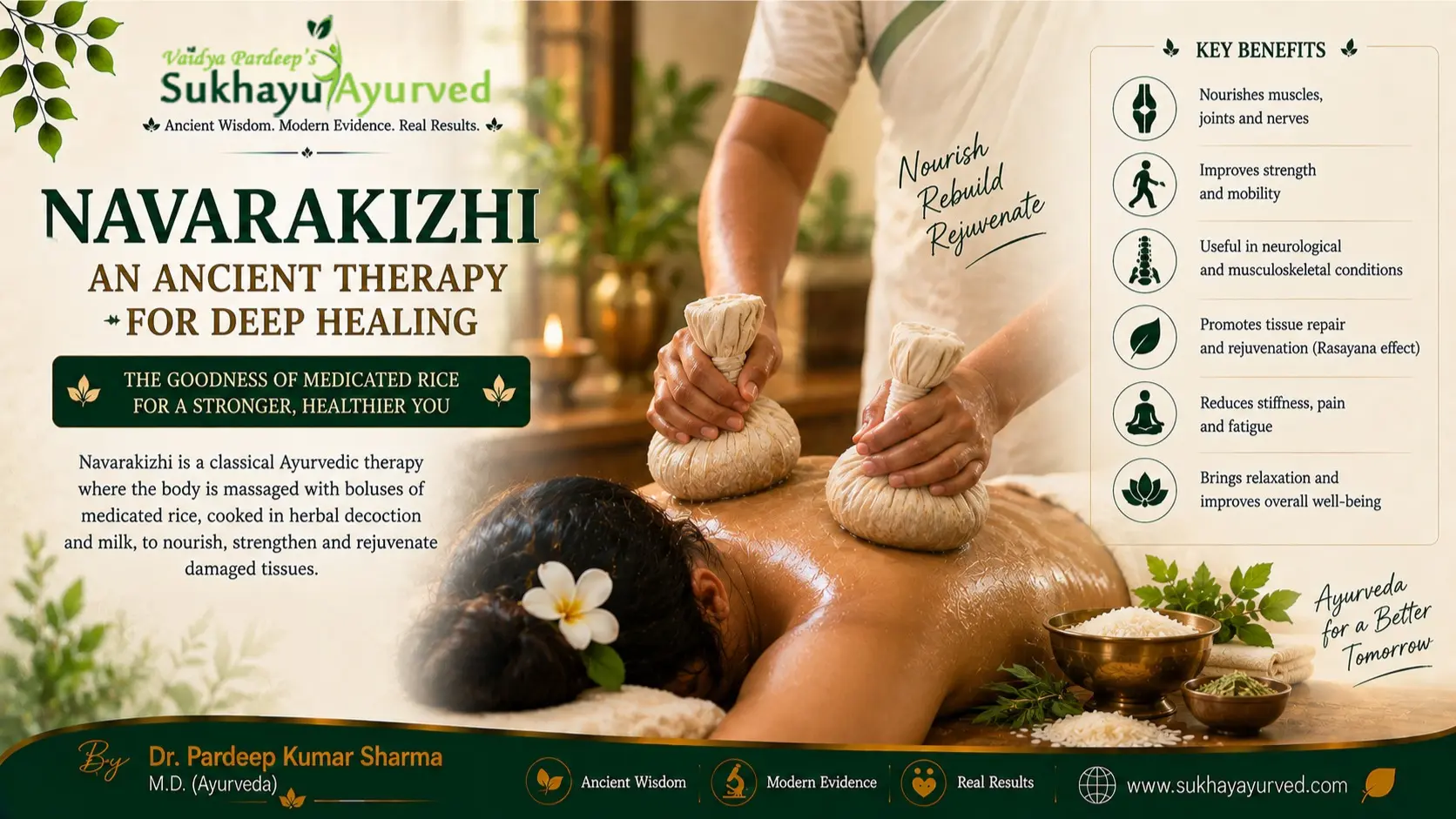
Before any Sweda is chosen — before anyone decides between a powder bundle, a leaf bundle, a sand bundle or a rice bundle — a more basic question has to be answered. It is the question that sits underneath the whole of Chikitsa, and most patients have never heard it asked.
Does this body need something taken away, or something given back?
Ayurveda divides all treatment along that single line. Apatarpana is the depleting arm — reduce, dry, lighten, clear. Santarpana is the nourishing arm — replenish, moisten, hold, build. Every therapy in the system belongs to one side or the other, and choosing the wrong side is not a small error of degree. It is the opposite of treatment.
Pinda Sweda, the bundle fomentation, exists on both sides. Choorna Pinda Sweda, Patra Pinda Sweda and Baluka Sweda are dry — Ruksha, Apatarpana. They take away. Navarakizhi and Mamsa Pinda Sweda are unctuous — Snigdha, Santarpana. They give back.
So when a patient walks into the OPD asking for "kizhi," they are asking a question that has no answer yet. Kizhi is not one treatment. It is a delivery method that can be pointed in two exactly opposite directions.
Navarakizhi is what you reach for when the answer to the first question is: this body has lost something, and needs it returned.
What Navarakizhi actually is, classically
Shashtika Shali Pinda Sweda — Navarakizhi in Kerala usage, from the Dravidian Njavara for the rice itself — sits under Snigdha Sankara Sweda: unctuous fomentation delivered by a heated bolus, applied in contact with the body.
Three materials define it, and none of them are decorative.
Shashtika Shali — the rice that matures in sixty days. Shashti is sixty; shali is rice. Charaka describes it in the Shooka Dhanya section of the Annapana Vidhi, in Sutrasthana 27/13, with a specific set of qualities: Sheeta (cold in potency), Snigdha (unctuous), Aguru (not heavy), Swadu (sweet), Tridoshaghna (pacifying to all three Doshas), and — the word that matters most here — Sthiratmaka: stabilising, holding, giving fixity. Charaka is not describing a food that adds bulk. He is describing one that steadies what is unstable. That is precisely the deficit in a wasting limb.
Balamoola — the root of Sida cordifolia, in whose decoction the rice is cooked. Bala fortifies the Vatahara action of the preparation. The rice alone is nourishing; the Bala decoction makes that nourishment specifically anti-Vata, which is what the clinical picture demands.
Ksheera — milk, added to the cooked rice and to the reserve decoction the boluses are re-dipped in. Milk adds the nourishment. Between them, Bala and Ksheera turn a starch bolus into a Vata-pacifying, Santarpana medium held at working temperature.
The oil is chosen separately, according to what the case requires. There is no single correct Taila for Navarakizhi, and any centre that runs the same oil on every patient has stopped practising medicine and started running a package.
It is worth noting, as a parallel observation rather than as proof of anything, that the sixty-day rice classical Ayurveda specified turns out to be genetically distinctive. Phylogenetic work on Njavara accessions suggests it is an extant early domesticate in the Indian rice gene pool, preserved in pure form over millennia by traditional on-farm selection for sixty-day maturity, precisely because of its medicinal applications. Farmers held one strain steady across three thousand years because physicians kept asking for it. That is not validation of the classical claim. It is an independent record of how seriously the specification was taken.
The patients this is actually for
Here the marketplace and the clinic part company.
Read most descriptions of Navarakizhi — including, honestly, older sections of our own site — and you will find the standard joint list: osteoarthritis, rheumatoid arthritis, joint pain, stiffness. That list is not wrong, but it describes the therapy by the complaints patients arrive with rather than by what the therapy is built to do.
Follow the Santarpana logic instead, and the real territory becomes clear. Navarakizhi is for loss of Mamsa — wasting, thinning, weakness. Which means, in the cases I see:
- Muscular dystrophy, including Duchenne
- Post-stroke hemiplegia and residual paralysis
- Motor neurone disease
- Poliomyelitis residual paralysis
- Cerebral palsy
- Multiple sclerosis with motor involvement
- Disuse atrophy after prolonged immobilisation — after fracture, after surgery, after months in a bed
- Vata-depleted degenerative joint disease, where the joint is dry and the surrounding muscle has thinned
Notice what these have in common. Not pain. Not swelling. Tissue that has been lost, or is being lost, and a limb that no longer holds itself.
An inflamed rheumatoid knuckle in an acute flare is not this picture. Neither is a heavy, Kapha-laden, oedematous joint. Those bodies need something taken away. Giving them Santarpana is treating the wrong arm of Chikitsa.
What happens on the table — and the story that is not true
The claim you will meet everywhere, in brochures and in patient WhatsApp forwards, is that Navarakizhi feeds the muscles through the skin. That the rice and the milk are absorbed transdermally and rebuild wasted tissue directly.
That is not what happens, and there is no need to mystify it.
What happens is a Sweda effect on a depleted substrate. Sustained moist heat combined with Sneha opens the Srotas — the body's channels — locally. Vata that has lodged in Mamsa and Asthi is dislodged. And the Ahara Rasa the patient is already producing, the nourishment their own digestion is already making every day, can finally reach tissue that had become inaccessible to it.
The nourishment comes from within. The procedure clears the road.
This is why the material of the bolus matters as a carrier of heat and unctuousness and Vatahara action — not as a nutrient being pushed through skin. And it is why the re-dipping matters more than it looks. A bolus loses temperature within a couple of minutes. Constant rotation through the heated milk-and-decoction vessel is what holds heat and Sneha steady across an hour. A single application does not do this. Neither does dry heat, which gives you the temperature without the unctuousness, in a body that has no unctuousness to spare.
It also explains why Navarakizhi is not a massage. Abhyanga precedes it and does its own work on the nervous system and the surface. Navarakizhi is fomentation — Sweda — and the two are different classical categories doing different jobs, even though a bystander watching the room would say both look like rubbing oil on a leg.
What to expect, honestly
I am asked constantly for a timeline. How many days before the arm moves. How many sessions before the calf fills out.
There is no honest general answer, and I would rather say so than invent one. What Navarakizhi does in a post-stroke hemiplegia is not what it does in a Duchenne child, and neither resembles what it does in a cerebral palsy case or in multiple sclerosis. These are different diseases with different trajectories. A patient recovering from a stroke has a nervous system that is reorganising; a child with Duchenne has a disease that is progressive. The same procedure, run identically, is doing a different job in each room.
Any centre that quotes you a fixed set of expectations is describing their package, not your case.
What I can say plainly is what it does not do. It does not restore muscle bulk in a fortnight — visible change on that timescale is not what is being asked of it. And in a progressive condition like Duchenne, the protocol is not asking to reverse the disease. It is asking to hold function, keep tissue pliable, slow the loss, and preserve what the child still has for as long as that is possible. Framing that as anything more would be a lie told to a family that deserves better.
Practically: sessions run to the better part of an hour or more, and courses typically run one to three weeks, adjusted to the case. The Pinda Swedana procedure page covers the session mechanics and the full family of bundle therapies in detail. And the assessment of whether a given day's Sweda has been adequate is made in the room — by watching the tissue, the skin and the patient — not from a schedule, and not by the patient themselves.
That is also why this is not a home therapy. It is not a matter of buying rice. We have written separately on why Pinda Swedana should not be attempted at home — wrong heat burns, wrong pressure damages, and wrong indication makes the condition worse.
When I hold it back
The most important contraindication is not on any standard list, and it is not a rule the patient can apply to themselves. It is a question of timing.
A patient with Ama, with poor Agni, or with a Kapha–Medas picture should not be given a Santarpana Sweda until that is cleared. You would be nourishing into an obstructed system. The tissue cannot receive what you are offering, the channels are already blocked, and the result of pushing Santarpana into that body is not improvement — it is more obstruction.
This is the single most common error I see in patients who arrive having had Navarakizhi elsewhere without benefit. The procedure was not wrong. The sequence was.
So in a patient who needs Navarakizhi but is not ready for it, something else runs first — the Agni is corrected, the Ama is cleared, and only then does nourishment become possible. That decision costs nothing except patience, and it is the difference between a course that works and a course that was always going to fail.
Where it sits in the treatment
In my practice Navarakizhi is used mostly as Shamana — pacificatory treatment in its own right, not as Purvakarma preparing someone for Shodhana.
And it is never the whole of the treatment. It is part of a larger prescription: internal medicines, diet, Basti where the Vata sits deep in Asthi and Majja, Abhyanga on the same table, and everything else the case demands. When a patient with multiple sclerosis or motor neurone disease improves, the improvement belongs to the protocol. Attributing it to the rice bundle would be a straightforward untruth, and it would also teach the patient to shop for procedures instead of seeking treatment.
The same is true in paralysis, where recovery so often stalls not because the nerve has finished healing but because the muscle has stopped being asked to work and has begun to waste. Navarakizhi has a real place in that picture — as one component of active rehabilitation, never as a substitute for it. And in osteoarthritis it earns its place only in the dry, depleted, Vata-dominant knee — not in the swollen one.
Cure is divine. Treatment is possible.
Milk and rice, warmed and applied to the body, reads as luxury to a global audience. It photographs well. It sells.
I look at it differently, because of who is on the table. A child whose calves are being replaced by fat and fibrous tissue. A man whose left arm has not moved properly in eleven months. A woman whose thigh has thinned to the point where standing from a chair has become a decision rather than a reflex.
For them, Navarakizhi is not indulgence. It is one of the very few things in medicine that answers depletion with nourishment rather than with another thing removed. It will not reverse a genetic disease. It will not rebuild a limb the body has stopped supplying. What it does is put the nourishment a patient is already making back within reach of tissue that had lost access to it — and in conditions that mostly move in one direction, holding ground is not a small outcome.
Cure is divine. Treatment is possible. The distance between those two sentences is where this work actually happens.
Not sure whether your case calls for Santarpana or the opposite? That question cannot be answered from a website, and it should not be. If you are managing muscle wasting, post-stroke weakness, a neuromuscular condition or a degenerative joint problem, speak to us and let the assessment come before the procedure. WhatsApp 9050802060 · [email protected]
Dr. Pardeep Sharma, M.D. (Ayurveda) is the founder of Sukhayu Ayurved, Jaipur. With over 20 years of clinical experience in Ayurvedic management of orthopedic, neurological and autoimmune conditions.
Medical Disclaimer: This article is for educational purposes and reflects classical Ayurvedic understanding and clinical experience. It is not a substitute for individual diagnosis or treatment. Muscular dystrophy, cerebral palsy, motor neurone disease, multiple sclerosis and post-stroke paralysis are serious conditions requiring qualified medical supervision, and Ayurvedic management should be undertaken alongside, not in place of, appropriate neurological care. Navarakizhi is contraindicated in several conditions and its suitability and timing must be determined by a registered Ayurvedic physician after examination.
Quick Clinical Reference: Navarakizhi (Shashtika Shali Pinda Sweda)
Classical classification: Snigdha Sankara Sweda — unctuous bolus fomentation. Belongs to the Santarpana (nourishing) arm of Chikitsa, in contrast to the Ruksha/Apatarpana bundle therapies.
The Snigdha–Ruksha divide within Pinda Sweda:
| Ruksha (Apatarpana) | Snigdha (Santarpana) |
|---|---|
| Choorna Pinda Sweda (Podi Kizhi) | Navarakizhi (Shashtika Shali Pinda Sweda) |
| Patra Pinda Sweda (Ela Kizhi) | Mamsa Pinda Sweda |
| Baluka Sweda (sand) |
Core materials: Shashtika Shali (sixty-day rice), Balamoola Kwatha (Sida cordifolia root decoction), Ksheera (milk), and a medicated Taila selected to the case.
Classical description of the rice: Sheeta (cold potency), Snigdha (unctuous), Aguru (light), Swadu (sweet), Tridoshaghna, Sthiratmaka (stabilising) — Charaka Samhita, Sutrasthana 27/13.
Principally indicated in: Muscular dystrophy · post-stroke hemiplegia and residual paralysis · motor neurone disease · poliomyelitis residual paralysis · cerebral palsy · multiple sclerosis with motor involvement · disuse atrophy following immobilisation · Vata-depleted degenerative joint disease
Held back when: Ama is present, Agni is weak, or the picture is Kapha–Medas dominant — Santarpana into an obstructed system worsens obstruction. Also in acute inflammation and other conditions determined on examination. Timing is a physician's judgment, not a self-screening checklist.
Position in protocol: Predominantly Shamana. Always one component of a larger prescription — never a standalone therapy, and never the sole explanation for an outcome.
Related reading on this site: Pinda Swedana — full procedure · Pinda Swedana and muscular health · Why Pinda Swedana should not be attempted at home · Abhyanga — the science behind Ayurvedic oil massage · Basti · Multiple Sclerosis · Motor Neurone Disease · Osteoarthritis · Why paralysis recovery plateaus · Active rehabilitation through Panchakarma for paralysis
External reference: The Prehistoric Indian Ayurvedic Rice Shashtika Is an Extant Early Domesticate With a Distinct Selection History — Frontiers in Plant Science, via PMC