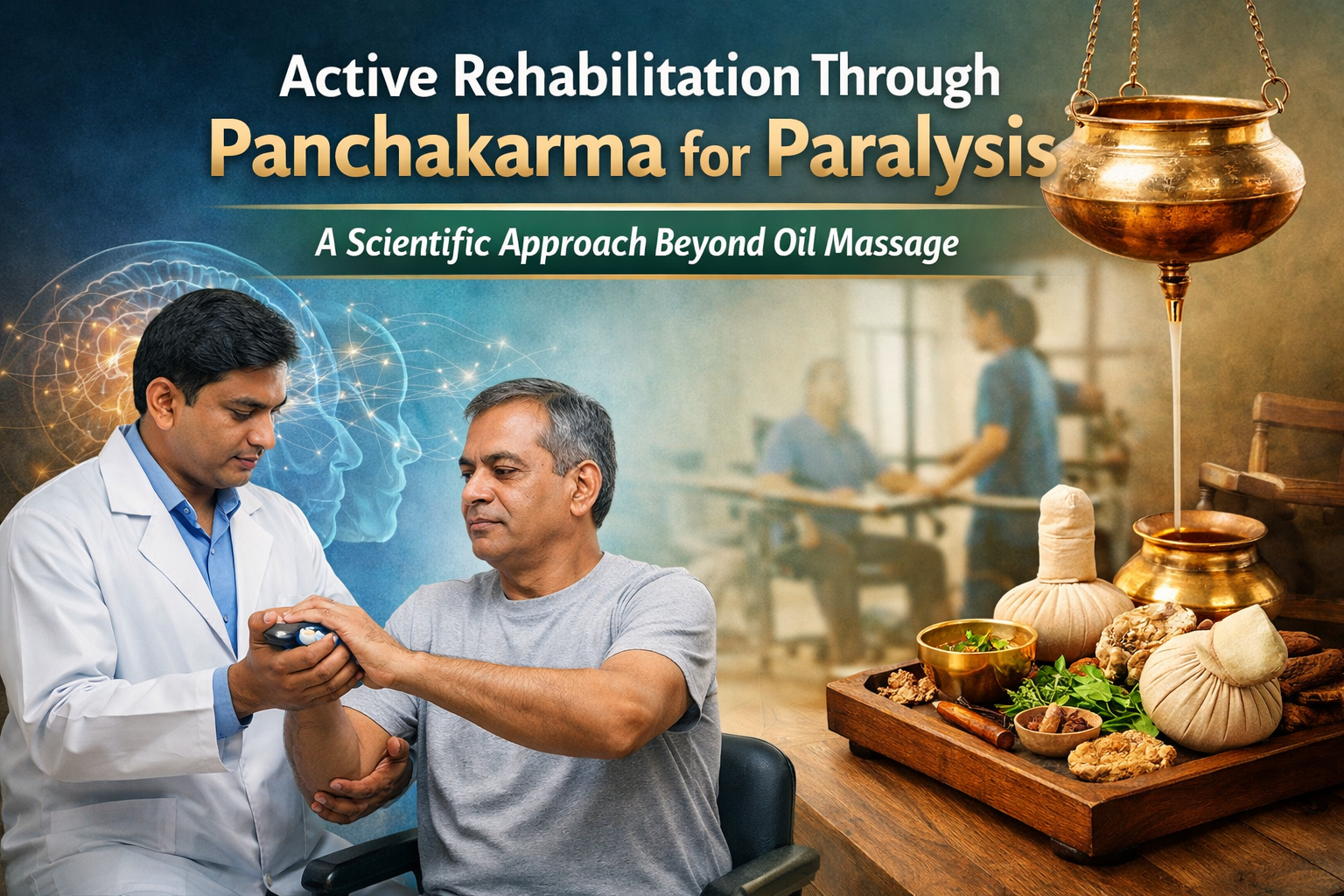
A Scientific, Structured Approach Beyond Oil Massage
Paralysis recovery often stalls — even after treatment
For many patients living with paralysis, the initial medical crisis may pass, but recovery does not always progress as expected.
After stroke, spinal injury, nerve damage, or surgery, patients are frequently advised physiotherapy, long-term medication, or time. While these are essential, a significant number of patients experience partial recovery followed by stagnation.
Movement exists, but it is weak.
Limbs respond, but coordination is poor.
Balance improves, yet confidence in movement does not return.
This phase—commonly described as a rehabilitation plateau—is where families begin searching for deeper answers.
This page explains how active rehabilitation through Panchakarma, when applied scientifically, can support functional recovery in selected paralysis patients.
Why Paralysis Recovery Plateaus After Stroke or Nerve Injury
Who should read this page (and who should not)
This page is relevant for:
- Stroke survivors (ischemic or hemorrhagic) after medical stabilisation
- Patients with hemiplegia, paraplegia, or partial paralysis
- Individuals with nerve injury or post-surgical neurological weakness
- Patients who have plateaued despite physiotherapy
- Caregivers seeking structured rehabilitation pathways
This page is not intended for:
- Medical emergencies
- Acute stroke or spinal cord trauma
- Patients requiring urgent surgery or ICU care
- Anyone seeking instant or guaranteed recovery
Clear boundaries are essential for safe, ethical care.
What paralysis actually involves — beyond nerve damage
Paralysis is often explained as a nerve problem. Clinically, it is far more complex.
Even after the primary injury stabilises, multiple systems are affected:
- Disrupted communication between brain and muscles
- Loss of coordinated motor patterns
- Muscle stiffness, weakness, or spasticity
- Reduced circulation to inactive tissues
- Impaired sensory feedback and balance
Recovery depends not only on healing, but on retraining the nervous system to move again.
This is where conventional rehabilitation may need structured support.
Why rehabilitation must be active, not passive
Passive therapies—whether massage or unspecific exercises—have limited ability to restore complex movement patterns.
Effective paralysis rehabilitation requires:
- Repeated, patterned stimulation
- Sensory-motor integration
- Gradual re-engagement of muscles and joints
- Support for circulation and tissue responsiveness
- Adaptation of therapy to recovery stage
Without this, the body may remain in a protective, low-function state despite stable medical reports.
How Ayurveda views paralysis as a functional disorder
Ayurveda does not replace modern diagnosis or emergency care.
Instead, it offers a functional framework to understand why recovery slows and how the body adapts after neurological injury.
From an Ayurvedic perspective, paralysis reflects:
- Impaired neuromuscular coordination
- Reduced tissue responsiveness
- Altered circulation and nourishment
- Loss of integrated movement intelligence
This understanding naturally leads to a rehabilitative approach, rather than symptom suppression.
Panchakarma as active neurological rehabilitation
A common misconception is that Panchakarma is limited to oil massage.
In paralysis care, Panchakarma functions as a structured rehabilitation system, not a relaxation therapy.
When applied clinically, it aims to:
- Stimulate dormant neuromuscular pathways
- Improve muscle tone adaptability
- Enhance sensory feedback
- Support circulation to affected tissues
- Reduce maladaptive stiffness and spasticity
The effectiveness depends entirely on case selection, timing, sequencing, and supervision.
Scientific mechanisms behind Panchakarma-based rehabilitation
Neuromodulation
Controlled thermal, pressure, and rhythmic stimuli influence peripheral nerves, spinal reflexes, and motor response patterns.
Circulatory support
Improved blood and lymphatic flow enhances oxygenation, nutrient delivery, and metabolic waste removal.
Muscle re-education
Targeted stimulation helps muscles relearn activation, coordination, and voluntary control.
Neuroplastic support
Recovery depends on the brain’s ability to reorganise movement patterns. Repetitive, meaningful sensory input is essential for this process.
These mechanisms are consistent with modern principles of neuro-rehabilitation.
What Panchakarma can support — and its limits
Panchakarma may help with:
- Functional mobility improvement
- Reduction of stiffness or spasticity
- Better coordination and endurance
- Rehabilitation support alongside physiotherapy
- Quality of life enhancement
Panchakarma cannot replace:
- Emergency medical care
- Surgical intervention where indicated
- Acute stroke or spinal trauma management
- Life-saving treatments
Ethical rehabilitation requires respecting these limits.
Safety, evaluation, and clinical responsibility
At Sukhayu Ayurved, paralysis rehabilitation follows strict clinical protocols:
- Comprehensive evaluation before therapy
- Medical stability confirmation
- Individualised treatment planning
- Integration with physiotherapy and medical care
- Periodic functional reassessment
Outcomes vary based on:
- Type and extent of neurological injury
- Duration since onset
- Patient participation
- Overall health status
No guaranteed timelines are promised.
When to consider Panchakarma-based rehabilitation
You may consider structured Panchakarma rehabilitation if:
- The condition is medically stable
- Recovery has plateaued
- Partial movement exists but lacks coordination or strength
- Long-term dependency is increasing
- Conventional rehabilitation alone is insufficient
Immediate medical attention is essential if new or worsening neurological symptoms appear.
A thoughtful next step
Paralysis recovery is not about choosing between systems of medicine.
It is about timing, integration, and intelligent rehabilitation.
A detailed clinical assessment helps determine whether Panchakarma-based active rehabilitation is appropriate, and how it should be safely integrated into your recovery plan.
Written by:
Dr. Pardeep Sharma
B.A.M.S., M.D. (Ayurveda)
Medical Director
Sukhayu Ayurved, Jaipur