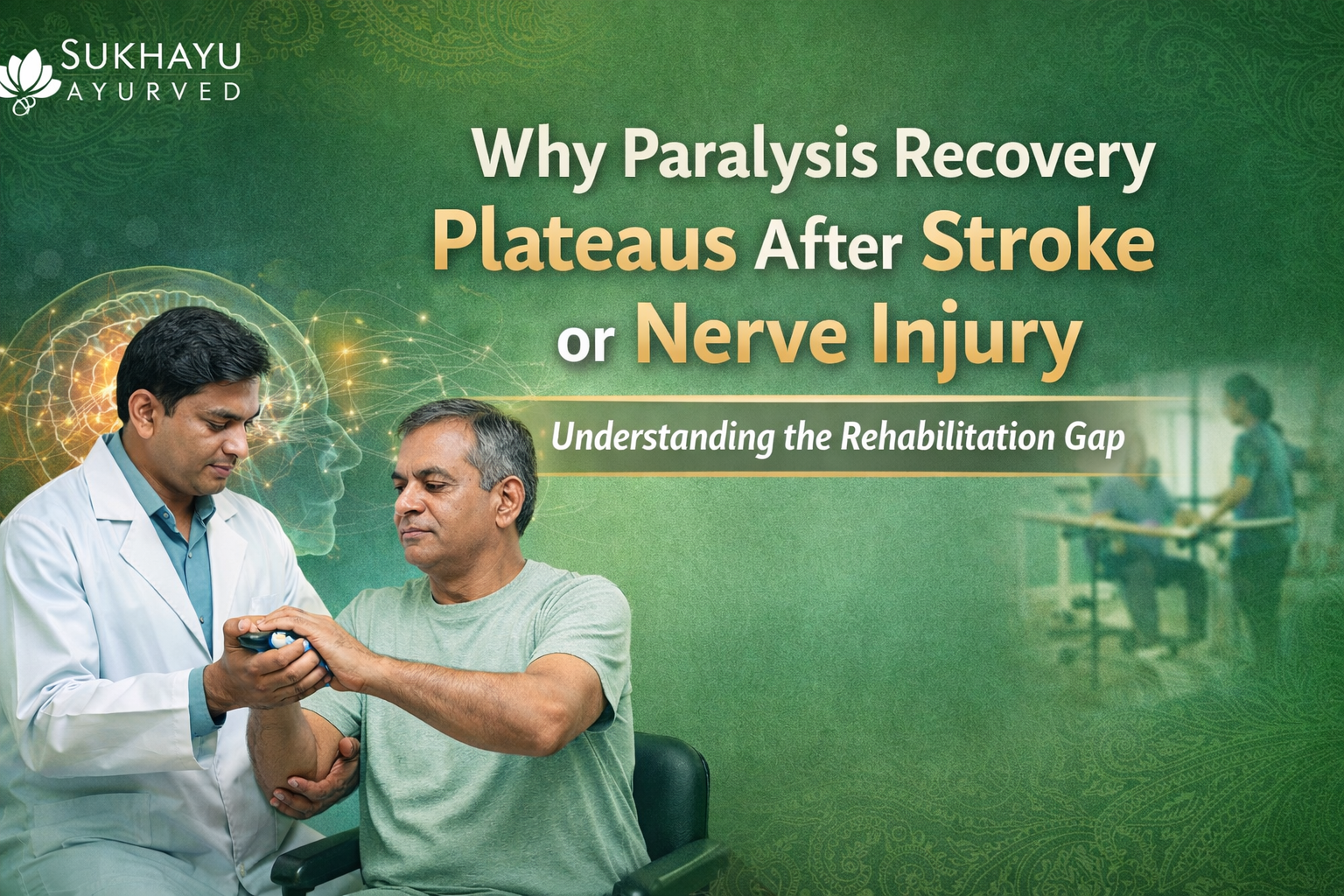
"I recovered well in starting one month, but after that the conditon is same"- this is a common statement from every Paralysis or nerve injury patient tells during consultations.
Many paralysis patients experience a similar journey. The initial crisis passes — the stroke stabilises, the surgery is completed, or the nerve injury stops progressing. Early physiotherapy begins, and some movement gradually returns.
Then something unexpected happens.
Progress slows. Exercises continue, but functional improvement becomes minimal. Families start hearing phrases like “maintenance phase,” “maximum recovery,” or “long-term adjustment.” This stage is often emotionally difficult because patients feel they are trying hard, yet visible change becomes limited.
This is known as a rehabilitation plateau - a phase where recovery appears to pause even though the body is still capable of adaptation. For a broader explanation of structured rehabilitation approaches, see:
Active Rehabilitation Through Panchakarma for Paralysis
What does a recovery plateau actually mean?
A plateau does not always indicate that recovery has ended. In many neurological conditions, it simply reflects that the body has adapted to the current level of therapy.
After stroke or nerve injury, several processes occur simultaneously:
- The brain attempts to reorganise movement pathways
- Muscles compensate for weakness
- The unaffected side of the body takes over more tasks
- Protective stiffness develops to stabilise movement
These adaptations allow survival and basic mobility, but they may also limit further progress if rehabilitation does not evolve.
A plateau is therefore not just a medical outcome — it is often a signal that the rehabilitation strategy needs to change.
Why early recovery happens faster than later recovery
In the first few weeks or months after stroke or nerve injury, improvements may appear rapid. This happens because:
- Swelling around injured nerves reduces
- Blood circulation improves
- Dormant neural connections become active
- Muscles regain partial tone
However, later recovery depends less on healing and more on relearning complex movement patterns.
This phase requires:
- Coordinated sensory input
- Repetitive, meaningful stimulation
- Progressive challenges
- Integration of multiple therapies
When rehabilitation remains unchanged, the nervous system may stop adapting, creating the impression that recovery has ended.
The hidden neurological reasons recovery slows
There are certain things which slows down the recovery. Here are few points-
1. Neuromuscular disconnection
Even when nerve signals return, the timing between muscles may remain poor. Movement becomes inefficient and tiring.
2. Sensory feedback loss
The brain relies on sensation to refine movement. Reduced sensory input makes relearning slower.
3. Compensatory patterns
The unaffected side of the body often overworks, leading to imbalance and reduced engagement of the weaker side.
4. Circulatory stagnation
Reduced movement can slow blood and lymphatic flow, affecting tissue responsiveness.
5. Psychological inhibition
Fear of falling, fatigue, or repeated failure may cause the nervous system to limit movement subconsciously.
These factors are rarely visible on imaging reports but play a major role in functional recovery.
Why physiotherapy alone may reach its limits
Physiotherapy remains essential in paralysis recovery. However, many programs focus primarily on:
- Strengthening isolated muscles
- Passive stretching
- Basic mobility training
While these are valuable, long-term recovery often requires additional layers such as:
- Sensory stimulation
- Tone modulation
- Circulatory enhancement
- Neurological priming before exercises
Without addressing these elements, the nervous system may stop progressing even though potential for improvement remains.
Neuroplasticity: recovery depends on input, not time
Modern neuroscience emphasises that recovery after neurological injury relies on neuroplasticity — the brain’s ability to reorganise itself.
Neuroplasticity is influenced by:
- Repetition with variation
- Meaningful sensory experiences
- Gradual increase in complexity
- Emotional engagement with movement
If therapy becomes repetitive without new stimulation, the brain adapts to the current level and stops changing.
This explains why many patients plateau despite consistent effort.
Understanding the rehabilitation gap
The rehabilitation gap refers to the space between:
- Medical stabilisation
- Functional independence
During this phase, patients are no longer in acute care but are not fully recovered either. Rehabilitation must shift from basic strengthening to integrated neurological re-education.
This is where integrative approaches — combining movement therapy with structured sensory stimulation — may support further progress.
How integrative rehabilitation can address the plateau
Integrative rehabilitation focuses on preparing the body to respond better to movement training.
Key goals include:
- Enhancing sensory awareness of affected limbs
- Improving muscle responsiveness
- Reducing stiffness or spasticity
- Supporting circulation to inactive tissues
- Increasing endurance during therapy sessions
Clinically applied Panchakarma, when used within a rehabilitation framework, may contribute to these goals by creating a more responsive physiological environment.
It does not replace physiotherapy or medical care. Instead, it works as a supportive layer that may help the nervous system engage more effectively.
Active Rehabilitation through Panchakarma for Paralysis
Who should reconsider their recovery strategy?
You may be experiencing a rehabilitation plateau if:
- Walking has improved but remains unstable
- Hand function is present but poorly coordinated
- Muscle stiffness limits daily activities
- Fatigue increases despite therapy
- Progress has not changed for several months
These signs suggest that recovery has not necessarily ended — only that the current approach may need adjustment.
What realistic progress looks like after a plateau
Recovery after a plateau is often gradual rather than dramatic. Improvements may appear as:
- Better balance rather than stronger muscles
- Smoother movement instead of faster movement
- Reduced fatigue during daily tasks
- Increased confidence in mobility
These subtle changes can significantly improve quality of life, even when imaging findings remain unchanged.
Safety and clinical responsibility
Rehabilitation beyond the acute phase must always be guided by proper evaluation. Integrative approaches should be considered only when:
- The patient is medically stable
- Blood pressure and cardiac risk are controlled
- Neurological status is clearly documented
- Therapy is supervised and reviewed regularly
Results vary depending on injury type, duration since onset, age, and patient participation. No rehabilitation approach should promise guaranteed outcomes.
A more realistic way to look at recovery
Paralysis recovery is rarely a straight line. Plateaus are common — but they do not always represent the end of progress.
The key question is not whether recovery is possible, but whether the nervous system is receiving the right kind of stimulation at the right time.
A structured clinical assessment helps determine whether a more integrated rehabilitation approach may support continued functional improvement.