I have never written "Guggulu" on a prescription.
Not once, in a career spent prescribing it almost daily. What leaves my consultation room is Yogaraja Guggulu, or Kaishore, or Trayodashanga, or Kanchanara, or Punarnavadi. The resin is present in every one of them. It is the reason every one of them works. But on its own, as a name on a slip of paper, it means very little — the way "flour" means very little to a baker holding a specific recipe.
This is the first thing to understand about Guggulu, and almost nothing written about it online gets there. It is not a herb you take. It is a base upon which Ayurveda builds medicines — and its clinical identity comes from what has been compounded into it and how it was processed before that compounding ever began.
The deeper principle: Guggulu is a Kalpana, not a dravya you swallow
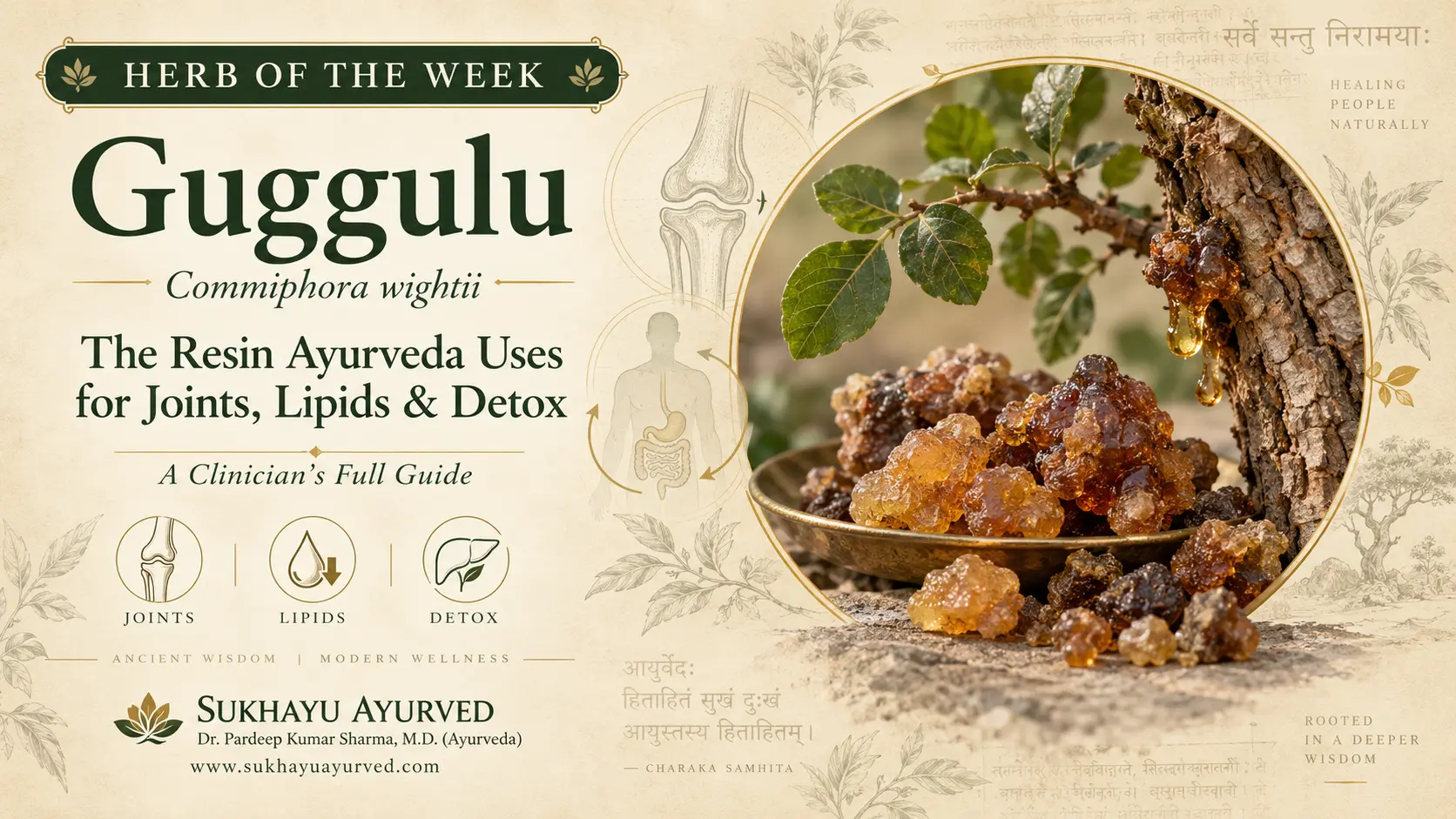
The resin comes from Commiphora wightii (syn. C. mukul), a thorny, unremarkable tree of the arid tracts of Rajasthan and Gujarat — and its first recorded use was not as a medicine at all. The Atharvaveda names it as a Dhoopana dravya, a fumigant: where a place is fumigated with Guggulu, disease does not settle there. Devadhoopa, the incense of the gods — an arc set out more fully in the Guggulu herb library entry. Internal therapeutic use came later, in the Samhita period, when Charaka and Vagbhata established it as Medohara and Vatahara — the foremost drug for Medoroga and for Vata disorders (Charaka Sutrasthana 25).
Its properties are given as Tikta-Katu Rasa (bitter and pungent, with Kashaya and Madhura also described), Laghu-Rooksha-Vishada-Sukshma Guna (light, dry, clarifying, subtle), Ushna Veerya (hot potency) and Katu Vipaka (pungent post-digestive effect).
But notice where the classical attention actually goes. Sharangadhara Samhita does not dwell on the resin's virtues in isolation; it deals with Guggulu Kalpana — the class of compound preparations built on it. That editorial choice, made centuries ago, is the whole argument.
Why build on this particular resin and not another binding agent? Because of one property that sets Guggulu apart from almost every other dravya in the pharmacopoeia: Yogavahitva.
A Yogavahi substance carries. It takes whatever it is combined with and delivers it deeper into the Dhatus than that substance could reach alone. Ghee is the other classical Yogavahi; Guggulu is the resinous counterpart. When Guduchi, Amalaki and Nimba are compounded into Kaishore Guggulu, their actions do not simply sit alongside the resin — they are carried by it into tissue planes they would otherwise skim past. This is why the same herbs, given as loose powders, do not behave the way the Guggulu preparation behaves. The formulation is not the sum of its parts. It is the parts plus a delivery mechanism.
Underneath that carrying function, Guggulu runs four actions of its own in every yoga it enters:
- Lekhana — scraping. It reduces and mobilises accumulated, pathological tissue rather than merely balancing it.
- Vata-shamana — pacification of Vata, despite being Rooksha and Laghu, which is unusual and is why it can be given in Vata-dominant joint disease without aggravating dryness.
- Srotoshodhana — clearing of the channels. Obstruction in the Srotas is the shared pathology behind conditions that look unrelated on a lab report.
- Sandhaniya — the joining, knitting action on tissue that is being repaired.
Read those four together and the multi-system reputation stops being mysterious. A substance that scrapes accumulated tissue, clears obstructed channels, pacifies Vata and supports tissue repair will inevitably appear in joint disease, in lipid disorders, in glandular growths and in wound healing — not because it is a cure-all, but because those conditions share more pathology than their diagnostic labels suggest.
The paradox I still find myself thinking about
There is something about Guggulu that has never stopped bothering me, in the productive sense.
Go back to its qualities: Tikta and Katu in Rasa. Laghu, Rooksha, Vishada, Sukshma in Guna. Katu in Vipaka. Every single one of those should aggravate Vata. Bitter, pungent, light, dry, subtle — that is a description of what makes Vata worse. Take any of those properties in isolation and a student would tell you to keep it away from a Vata patient.
And yet Guggulu is the great Vata medicine. Charaka and Vagbhata name it Vatahara. It anchors Yogaraja Guggulu, the workhorse of Vata-vyadhi. The Ushna Veerya explains part of it, but not all of it — a warming potency alone does not overturn that much drying, lightening and subtlety.
This is not a gap in the classical reasoning. It is evidence of how much reasoning went in. Whoever placed Guggulu at the centre of Vata treatment did so against the surface reading of its own properties, which means they were working from observed clinical behaviour rather than from a tidy theoretical derivation. That is what a mature pharmacology looks like.
And consider what they had available and did not choose. Bhanga and Afeem — cannabis and opium — were known, described, and unquestionably effective against pain. For a physician wanting to make joint disease stop hurting, they were right there. The classical authors did not build the standard Vata-vyadhi formulations around them. They built them around a resin that carries other medicines into the tissue and scrapes what should not be there.
That is not an accident of availability. It is a judgment about what treatment is for — relieving the sensation, or correcting the process. The same judgment runs through everything that follows in this article.
Shodhana: what it is, and what it is not
Every article on Guggulu will tell you it must be purified. Almost every one implies that this is because raw Guggulu is dangerous. That is wrong, and it is worth correcting plainly, because it frightens patients for no reason.
Guggulu Shodhana is not Rasa Shastra. It is not the detoxification of a toxic mineral where an error in processing produces a poison. If a person consumed unpurified Guggulu, they would not be harmed by it. The purification is doing two things, and neither of them is a safety procedure:
First, it removes physical impurities. Guggulu is tapped as an oleo-gum-resin and arrives carrying bark, sand, grit and vegetable debris. It is boiled in a chosen liquid, strained through cloth, and the clean resin recovered. This is straightforward and is the larger part of what Shodhana means here.
Second, the medium changes what the resin becomes. This is the part that matters clinically. Guggulu processed in Triphala Kwatha does not carry the same properties as Guggulu processed in Gomutra, Dashamoola Kwatha or Dugdha. The medium is not arbitrary and it is not interchangeable — it is selected according to the target condition of the final yoga. A Guggulu destined for a Medoroga preparation is processed differently from one destined for a Vata-vyadhi preparation, because the Shodhana medium is already the first step of the formulation's design, not a preliminary to it.
So when someone asks whether the Guggulu in a given tablet was purified, the more useful question is: purified in what, and for what.
Purana Guggulu: the specification nobody on a shelf can meet
There is a second requirement, and in practice it is the one that separates a medicine that works from one that does nothing.
Guggulu must be old. Purana Guggulu — a minimum of five years.
Sushruta records the rule plainly: new Guggulu is Vrishya — nourishing, building. Old Guggulu is Apakarshana — reducing, drawing away. These are opposite directions of action from the same substance, separated only by time. Sharangadhara lists Guggulu among the dravyas to be used Purana, and the classical five-year storage period for gums is where the number comes from.
New Guggulu adds to the body. Old Guggulu works on Medoroga. This is not a nuance — it is the difference between a prescription and its reverse.
I want to be precise about the consequence, because this is commonly overstated. Using new Guggulu where old was required does not harm the patient. It simply does not give what was being asked for. A Lekhana action is prescribed and a Brimhana substance arrives in its place; the prescription is structurally correct and clinically inert. The patient takes the tablets faithfully for three months, nothing shifts, and concludes that Ayurveda did not work. Ayurveda was never in the room. A five-year specification was.
And age is only the second problem. The first is whether the material is Guggulu at all.
Commiphora wightii is now listed as Critically Endangered. It has been over-tapped for decades, and the market has responded the way markets do: a great deal of what is sold as Guggulu today is ordinary gum, not the true oleo-gum resin. For a medicine whose entire value sits in the specific resin — and whose action then depends on correct Shodhana and correct age — sourcing is not a quality-control footnote. Sourcing is the medicine.
This is why I am unable to comment usefully on the Guggulu tablets sold over the counter in every medical store in India. Before any conversation about dose or duration can begin, there are two prior questions: is there genuine Guggulu resin in that tablet, and is it of the required age? Both are unsettled for most commercial products. It is the reason we collect Guggulu from authenticated sources and prepare our own formulations as the texts describe, rather than buying finished product in. A physician cannot reason clinically about a substance whose identity is uncertain.
The yogas are Aaptopadesha — they are not yours to reassemble
There is a habit in modern wellness practice of treating classical formulations as modular: take a little of this, drop that, add something trending. I am firmly against it, and the objection is not conservatism.
Aaptopadesha — the testimony of the reliable, verified authority — is one of the recognised means of valid knowledge in Ayurvedic epistemology, alongside direct perception and inference. The classical yogas belong to that category. Nobody today is going to compose another Sitopaladi, another Avipattikara, another Arogyavardhini. Look at Arogyavardhini's construction: Guggulu and Shilajatu together, with Katuki, Triphala, Nimba, Chitraka and Rasa dravyas, weighted in specific proportion. That architecture is not something a practitioner reasoned their way into over a weekend. It is finished science, arrived at and verified, and handed forward.
So when a joint case requires Yogaraja rather than Trayodashanga, or when Kaishore is the right answer instead of either, what is happening is selection among fixed formulations, guided by the patient's Dosha state, Agni and clinical findings. It is not customisation of the formulation itself. The physician's judgment operates at the level of which yoga, never at the level of what goes in it.
This is also the clearest reason self-mixing and self-prescription cannot be defended. A patient reading a herb list and assembling their own combination is not practising Ayurveda in a simplified form. They are doing something Ayurveda does not contain.
Medoroga and the lipid question
The vault of internet content on this herb is overwhelmingly about cholesterol, so let us take it directly.
In classical terms, Guggulu's action in Medoroga and Sthaulya is a consequence of two things already named: Lekhana acting on Medo Dhatu, and Srotoshodhana clearing the Medovaha Srotas. Excess Meda is not simply a quantity of fat; it is a Dhatu that has accumulated abnormally because the channels that should carry and process it are obstructed. Guggulu scrapes the accumulation and opens the channels. The falling number on a lipid panel is downstream evidence of that, not the mechanism itself.
This matters because it tells you what the herb is not doing. It is not behaving like a statin. It is not switching off a synthetic pathway. It is correcting a transport and metabolic obstruction — which is why it cannot work when the underlying pathology has not been assessed, and why it does not work in isolation from diet and regimen. A person eating in a way that continuously generates Medo accumulation while taking a Lekhana medicine has set two forces against each other and will see nothing move. That patient's cholesterol picture does not need a better tablet. It needs the pathology addressed.
What happened when the West extracted guggulsterone
Here the story becomes genuinely instructive, and I mention it not because Western research validates Ayurveda — it does not, and does not need to — but because a well-documented failure illustrates the argument better than any classical citation could.
In 2002, researchers published work in Science identifying the plant sterol guggulsterone as the active agent in guggul extract and showing it to be a potent antagonist of the farnesoid X receptor (FXR), a nuclear hormone receptor activated by bile acids; guggulsterone reduced hepatic cholesterol in normal mice but not in FXR-null mice, leading the authors to propose FXR inhibition as the basis of its cholesterol-lowering activity. A clean, plausible molecular mechanism. The supplement industry moved immediately, and standardized guggulsterone capsules became a mass-market "natural statin."
Then in 2003, a double-blind randomized placebo-controlled trial published in JAMA tested standardized guggulipid containing 2.5% guggulsterones in adults with hyperlipidemia on a typical Western diet. Against placebo — in whom LDL-C fell 5% — both the standard and high-dose guggulipid groups saw LDL-C rise, by 4% and 5% respectively. No significant changes were recorded in total cholesterol, HDL or triglycerides. The isolated compound, taken out of its yoga, out of its Shodhana, out of any assessment of the patient's Agni or pathology, and out of any accompanying Pathya, did not merely underperform. It moved the number the wrong way.
The obvious conclusion is the wrong one. This trial does not show that Guggulu does not work. It shows what happens when a resin whose entire clinical logic is Yogavahitva — the carrying of other substances — is stripped down to one molecule and given alone.
And here is the point I would press hardest with any colleague who thinks the extract model is simply Ayurveda modernised: Ayurveda already knew how to concentrate. Kutaja Ghana is a concentrated extract. Yavakshara is an alkaline extract. Guduchi Satva is a starch fraction separated from the whole plant. The tradition produced these deliberately, described them, and prescribed them where the pharmacology called for it. It was fully capable of doing the same with Guggulu. It chose not to.
A dravya is never a single active compound. It is a field of synergisms and antagonisms operating together, and the classical texts treated it accordingly — isolating where isolation served the clinical goal, and refusing to where it did not. That refusal was a decision, not an absence of technology.
How Guggulu preparations are actually used in practice
Some honest boundaries about what this article will and will not tell you.
Guggulu preparations are OPD medicine. They are oral, prescribed, dispensed and reviewed in consultation. They are not part of a procedure room, and this article deliberately keeps them out of that conversation.
There is no standard duration. A Guggulu yoga may run for weeks or for months. Anyone offering you a fixed course length has substituted a rule for the reasoning that should be happening. The duration follows the clinical logic of the case — the stage of the disease, the state of Agni, what else is running in the prescription, and how the patient is actually responding.
Assessment is not a lab report. What tells me a Guggulu preparation is working, or has done what it can and should be changed, is symptoms, Dosha state and clinical findings read together. In a Sandhigata Vata case that is function and the character of the pain; in Aamavata it is the behaviour of stiffness and swelling; in Medoroga it is Agni, appetite, and the quality of the tissue, of which the lipid panel is one confirmation among several. No single one of these is decisive alone.
I have not listed doses here, and that is deliberate. Dose, Anupana and timing are the three variables through which a Guggulu preparation is fitted to a particular person, and publishing them invites exactly the self-prescription that makes the medicine fail. No herb should be taken blindly — least of all one whose action reverses depending on how old it is.
On contraindications, and on Pathya
I will say something here that runs against most of what is written about this resin.
There are very few situations in which a Guggulu preparation genuinely should not be used. The circulating lists — avoid in Pitta-predominance, in Amlapitta, in bleeding tendency, in kidney disease, in pregnancy — read as caution projected onto the herb rather than caution observed in patients. Across a long practice I have not found Guggulu behaving differently in these groups when it was prescribed correctly: chosen according to Agni, given at the right time relative to food, and positioned properly among the other medicines in the prescription.
That is where safety actually lives. Not in the patient's category — in the prescribing.
What is not negotiable is Pathya. The classical restrictions accompanying Guggulu use — around excessively sour food, excessive exertion, excessive sexual activity, day sleep and alcohol — are not optional lifestyle suggestions attached to the medicine. They are part of the treatment. A Guggulu preparation taken alongside the very conduct that generates the pathology it is meant to scrape will produce nothing, and the patient will blame the tablet.
Contraindication in Ayurveda has never been a checklist a patient can run on themselves. It is a timing judgment a physician makes, and the judgment changes as the patient changes.
Closing philosophy
Hypertension has a pathology behind it. Dyslipidemia has a pathology behind it. So does every joint that has stopped moving and every gland that has enlarged. These are not conditions waiting for the right molecule; they are processes with a history, a direction and a cause.
The belief that a single herb, a single medicine, a single tablet will correct such a process is a myth — and it is a myth that has done more damage to Ayurveda's standing than any critic ever managed. Someone consumes a herb without any examination of their pathology, no measurable result appears on paper, and the conclusion drawn is that Ayurveda is pseudoscience. But nothing Ayurvedic was done. A substance was swallowed. That is a misinterpretation of Ayurveda, not a failure of it — and it applies to every herb in the pharmacopoeia, not only to this one.
Guggulu is perhaps the clearest case, because everything about it insists on context. It carries other medicines rather than acting alone. Its properties invert depending on its age. Its purification is defined by the condition it is destined for. Its formulations are received compositions, not assemblies. Strip away the context and you are left with a resin that does nothing in particular — which is precisely what the trials of the isolated extract found.
Treat the pathology. Choose the yoga. Respect the Pathya. Then the medicine has something to do.
Cure is divine. Treatment is possible.
Dr. Pardeep Sharma, M.D. (Ayurveda) is the founder of Sukhayu Ayurved, Jaipur. With over 20 years of clinical experience in Ayurvedic management of orthopedic, neurological and autoimmune conditions.
Medical Disclaimer: This article is for educational purposes and reflects clinical experience and classical Ayurvedic understanding. It is not a substitute for individualised medical diagnosis or treatment. Guggulu preparations are prescription medicines that must be selected by a qualified Ayurvedic physician according to the patient's condition, Agni and existing treatment. Dosage and Anupana have been intentionally omitted from this article. Do not self-prescribe, and do not discontinue any ongoing medical treatment without consulting your treating physician.
Herb Profile: Guggulu (Commiphora mukul) — Quick Clinical Reference
Classical description: The oleo-gum-resin (niryasa) tapped from Commiphora wightii (syn. C. mukul), a thorny tree of the arid regions of Rajasthan and Gujarat; the Mahishaksha variety is preferred for internal use. First recorded in the Atharvaveda as a Dhoopana (fumigation) dravya — Devadhoopa — before internal therapeutic use developed in the Samhita period. Charaka (Su. 25) and Vagbhata name it Medohara and Vatahara; Sharangadhara treats its compound preparations as a formulation class, Guggulu Kalpana. Commiphora wightii is IUCN Critically Endangered.
Rasa (taste): Tikta (bitter), Katu (pungent); Kashaya and Madhura also described Guna (qualities): Laghu (light), Rooksha (dry), Vishada (clarifying), Sukshma (subtle) Veerya (potency): Ushna (hot) Vipaka (post-digestive effect): Katu (pungent)
Principal Karma:
- Yogavahi — carries compounded dravyas deeper into the Dhatus; the defining property
- Lekhana — scraping of accumulated, pathological tissue
- Vata-shamana — pacifies Vata despite Rooksha-Laghu qualities
- Srotoshodhana — clears obstructed channels
- Sandhaniya — supports tissue repair and union
Nava vs Purana: Sushruta records that new (Nava) Guggulu is Vrishya — building and nourishing — while old (Purana) Guggulu is Apakarshana — reducing and drawing away. New Guggulu adds to the body; old Guggulu works on Medoroga. Sharangadhara lists Guggulu among dravyas to be used Purana; minimum five years' age (the classical gum-storage period) is required for the reducing action most therapeutic yogas depend on. New Guggulu in place of old does not harm the patient; it simply fails to deliver the intended action.
Shodhana: Removal of bark, sand and vegetable debris by boiling and straining, plus a property shift determined by the processing medium (Triphala Kwatha, Gomutra, Dashamoola Kwatha, Dugdha and others). The medium is chosen according to the target condition of the final yoga. This is not Rasa Shastra detoxification — unpurified Guggulu is not toxic.
Clinical territory: Joint and spine disorders (Sandhigata Vata, Aamavata, Vatarakta), metabolic conditions (Medoroga, Sthaulya, lipid disorders), glandular enlargement (Granthi, Gandamala), skin disease with Srotorodha, and tissue-repair contexts.
Representative classical yogas: Yogaraja Guggulu · Kaishore Guggulu · Trayodashanga Guggulu · Simhanada Guggulu · Punarnavadi Guggulu · Kanchanara Guggulu · Triphala Guggulu · Arogyavardhini (Guggulu with Shilajatu). These are Aaptopadesha — received, verified compositions. They are selected, never modified or self-assembled.
Dose, Anupana and timing: Deliberately not published. These are the variables through which the preparation is fitted to the individual patient and are determined in consultation.
Sourcing: Commiphora wightii is Critically Endangered and heavily over-tapped; much of what is sold as Guggulu is ordinary gum rather than the true oleo-gum resin. Genuine resin, correctly purified and correctly aged, is the precondition for any of the above being clinically meaningful.
Prescribing cautions: Very few absolute contraindications when the yoga is correctly selected according to Agni, timing of intake and the rest of the prescription. Pathya is mandatory — classical restrictions on excessively sour food, excessive exertion, excessive sexual activity, day sleep and alcohol are part of the treatment, not an accessory to it. Guggulu preparations do not replace ongoing medical treatment for diagnosed conditions.
Related reading on this site: Guggulu — full herb library reference · Shallaki (Boswellia) — the Ayurvedic answer to joint inflammation · Osteoarthritis — Ayurveda Treatment · Rheumatoid Arthritis — Autoimmune Ayurveda Treatment · Gout — Ayurveda Treatment · Cholesterol & Hypercholesterolemia · The concept of Agni in Ayurveda
External references: Urizar et al., "A natural product that lowers cholesterol as an antagonist ligand for FXR," Science (2002), PMID 11988537 · Szapary et al., "Guggulipid for the treatment of hypercholesterolemia: a randomized controlled trial," JAMA (2003), PMID 12915429