Every August, as Jaipur's monsoon settles into its wet, heavy rhythm, my OPD fills with a particular kind of patient. They don't come in limping from an injury. They come in stiff — stiff in a way that has nothing to do with age and everything to do with the season. A 34-year-old software engineer who can't make a fist before 10 AM. A 52-year-old woman whose knees "lock" the moment she sits for more than twenty minutes. A 29-year-old man, HLA-B27 positive, whose spine has started fusing one vertebra at a time. Different diagnoses on paper — rheumatoid arthritis, osteoarthritis, ankylosing spondylitis — but the same clinical picture standing in front of me: joints that are inflamed, not injured.
This is where Shallaki enters my prescription pad, and it has for as long as I have been prescribing anything.
The deeper principle
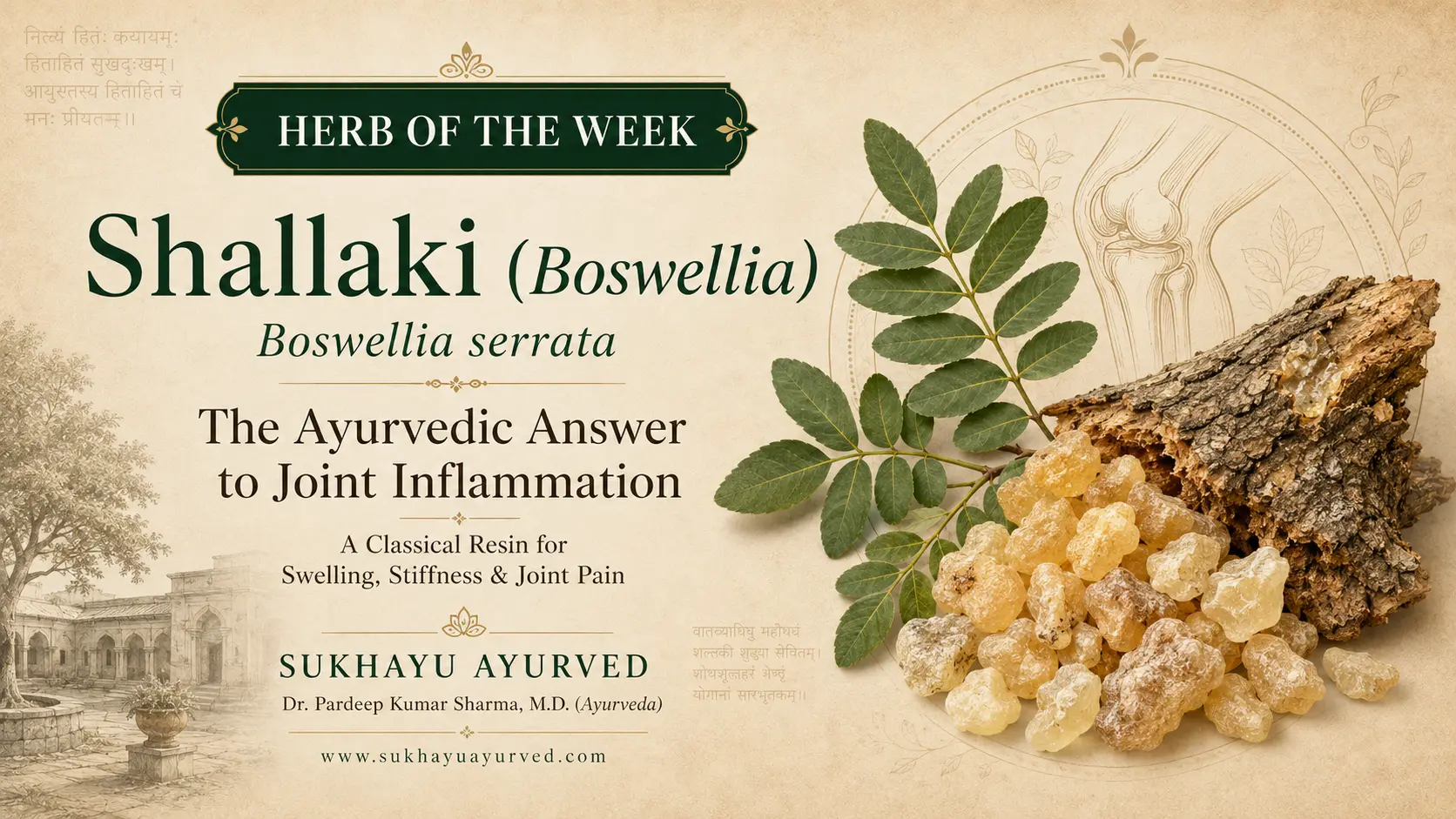
Shallaki — the resin of Boswellia serrata, known in older Nighantu literature as Sallaki or Kunduru — is not one of the herbs Charaka built a chapter around. Its classical description comes from later pharmacological texts, the Dhanvantari Nighantu and the Bhavaprakasha Nighantu, which describe it as Kashaya-Tikta Rasa (astringent-bitter in taste), Laghu-Rooksha Guna (light and drying in quality), Ushna Veerya (hot in potency) and Katu Vipaka (pungent in post-digestive effect). Put simply: it dries excess moisture, it clears heat-driven stagnation, and it moves.
That combination matters because of what Ayurveda says is actually happening inside an inflamed joint. Classical texts describe two distinct pathological pictures that modern patients present as one complaint — "joint pain." In Sandhivata (the osteoarthritic pattern), aggravated Vata lodges in the joint space, and the cartilage — the Vata-dominant tissue — degrades, leaving joints dry, cracking, and painful on movement. In Aamvata (the rheumatoid pattern), it is not dryness but toxic, undigested metabolic residue — Ama — that circulates through the Srotas (the body's channels) and lodges in joints, causing the swelling, redness, and morning stiffness that Sandhivata does not produce. Shallaki's Ushna Veerya burns through Ama; its Rooksha Guna checks the pathological Kapha that swelling represents; and by virtue of being Tikta-Kashaya, it drains excess fluid without further drying an already Vata-depleted joint the way pure heating herbs would. This is why it sits at the intersection of both patterns rather than belonging cleanly to one.
What this looks like in the OPD
I want to be specific here, because vague herb claims are exactly what this profession does not need more of.
A pattern I have watched repeat for over fifteen years now: patients with ankylosing spondylitis arrive after years of NSAID use, describing a trade they never consciously made — control of pain in exchange for a stomach that can no longer tolerate the medicine. Endoscopies showing gastritis. Some with early kidney function changes. They are not looking for an alternative to medicine; they are looking for something their body can tolerate for the years, sometimes decades, this disease will ask them to manage it.
In our monsoon OPD specifically, I see a sharp seasonal spike in Aamvata presentations — the rheumatoid pattern — because Varsha Ritu (the monsoon season) is classically described as a time of weakened Agni (digestive fire) and heightened Vata, the exact combination that produces Ama. Patients whose joints were "manageable" through summer come in July and August with knuckles they cannot close. This is not a coincidence I read about — it is a pattern I set my calendar by.
What I have observed clinically, across hundreds of joint cases, is this: Shallaki does not touch pain the way a painkiller does — it does not silence the signal. It reduces the swelling and stiffness that is generating the signal in the first place, and it does so slowly, over two to four weeks, not in two hours. Patients who expect NSAID-speed relief are often disappointed in week one and return by week four asking what changed, because morning stiffness that used to take ninety minutes to work through is now gone in twenty.
The mechanism — why, not just that
This is the part I insist on explaining to every patient, because "it's an Ayurvedic herb" is not an answer their inflamed joint deserves.
NSAIDs work by blocking the cyclooxygenase (COX) pathway — which is also the pathway responsible for maintaining the protective mucus lining of the stomach. That is precisely why long-term NSAID use in chronic joint disease produces the gastritis and renal strain I see walk into my clinic so often. Boswellic acids — specifically AKBA (acetyl-11-keto-beta-boswellic acid), the most pharmacologically active compound in Shallaki resin — work through an entirely different route: they inhibit 5-lipoxygenase (5-LOX), the enzyme responsible for converting arachidonic acid into leukotrienes, a separate class of inflammatory mediators that drive the swelling, cartilage-degrading enzyme activity, and immune cell migration seen in both osteoarthritis and rheumatoid disease. Because this pathway sits outside the COX system, it does not carry the same gastric mucosal risk.
A 2008 double-blind, placebo-controlled trial published in Arthritis Research & Therapy found that a standardized Boswellia extract produced significant improvement in pain and physical function scores in knee osteoarthritis within seven days, with the effect strengthening through 90 days of use — one of the earlier controlled confirmations of what Ayurvedic OPDs had already been observing for generations. A more recent systematic review and meta-analysis in BMC Complementary Medicine and Therapies (2020) pooled multiple randomized trials and reached the same broad conclusion: Boswellia extract measurably reduces osteoarthritis pain and stiffness compared to placebo. This is what I mean when I say the science caught up — it did not discover something new, it confirmed something old.
There is also a structural reason Shallaki matters beyond symptom control: boswellic acids appear to stabilize lysosomal membranes within joint tissue and slow the breakdown of glycosaminoglycans — the building blocks of cartilage matrix. In Ayurvedic terms, this is Shallaki acting on Asthi-Sandhi Dhatu (bone-joint tissue) rather than only on the symptom sitting on top of it.
Practical application — what I actually prescribe
In my clinic, Shallaki is prescribed in one of three forms, chosen by the clinical picture:
Shallaki Churna (powder): 3–6 grams, twice daily, with warm water as Anupana (vehicle). This is my default for early Sandhivata (osteoarthritis) where dryness, not swelling, dominates the picture.
Shallaki Guggulu (compound tablet, Shallaki combined with Guggulu resin): 500 mg–1 g, two to three times daily after meals with lukewarm water. This is what I reach for in Aamvata (rheumatoid pattern) and in ankylosing spondylitis, because Guggulu's own Vata-Kapha-clearing action compounds with Shallaki's anti-inflammatory effect, and the combination has better documented clinical outcomes in autoimmune joint disease than Shallaki alone.
Standardized extract (65% boswellic acids): 300–500 mg twice daily, used when a patient needs a more concentrated, faster-onset dose — often in the first six to eight weeks of a protocol before transitioning to classical Churna or Guggulu formulations for maintenance.
Timing matters more than patients expect. I generally prescribe Shallaki after food, not before — in Ama-dominant conditions, taking a Ushna Veerya herb on an empty, already-inflamed digestive tract can aggravate Pitta and cause acidity in sensitive patients. In pure Vata-type Sandhivata without much inflammation, I will sometimes shift to a ghee-based Anupana instead of water, since Sneha (unctuous) vehicles support Vata-depleted joint tissue better than plain water does.
For rheumatoid arthritis and ankylosing spondylitis specifically, I do not use Shallaki as a standalone protocol. It is combined with Guduchi (for its immunomodulatory action on the Ama-generating autoimmune process itself) and, where indicated, supported by Panchakarma procedures such as Basti chikitsa — medicated enemas that Charaka calls Ardha Chikitsa, "half of all treatment," specifically for their action on Vata lodged deep in Asthi-Sandhi tissue. A three-to-six-month protocol is typical before I ask a patient to evaluate outcomes against baseline markers: ESR, CRP, BASDAI score in AS, and a simple, honest measure I trust more than most lab values — minutes of morning stiffness.
Who should not take it without supervision: pregnant women (as a precaution, in the absence of adequate safety data), patients with active peptic ulcer disease who have not been evaluated for their Pitta status, and anyone on anticoagulant therapy, since Boswellia has mild antiplatelet activity in some studies. It should never replace DMARDs in confirmed rheumatoid arthritis or biologics in progressing ankylosing spondylitis without a rheumatologist and an Ayurvedic physician working in coordination — I say this to every AS patient who arrives wanting to stop their medication outright, and I will keep saying it.
Closing philosophy
I tell my patients something early in every joint disease consultation, because I think it is the only honest thing to say: cure is divine, treatment is possible. Shallaki will not un-fuse a spine that has already fused, and it will not reverse cartilage that is gone. What it offers is something more modest and, I have come to believe, more valuable — a way to keep a chronic, inflammatory disease from accelerating, without paying for that control with a stomach or a kidney. Ayurveda's oldest insight about joint disease is not mystical; it is procedural: identify whether the tissue is starved (Vata) or clogged (Ama), and treat the mechanism, not the pain. Twenty years of watching this resin work slowly, honestly, and without shortcuts has taught me that the herbs that last in a clinical practice are rarely the ones that promise the most. They are the ones that keep their promises.
Dr. Pardeep Sharma, M.D. (Ayurveda) is the founder of Sukhayu Ayurved, Jaipur. With over 20 years of clinical experience in Ayurvedic management of orthopedic, neurological and autoimmune conditions.
Medical Disclaimer: This article is for educational purposes and reflects clinical experience and classical Ayurvedic understanding. It is not a substitute for individualized medical diagnosis or treatment. Rheumatoid arthritis, ankylosing spondylitis and progressive joint disease require monitoring by qualified physicians. Please consult a registered Ayurvedic physician before starting Shallaki or any herbal protocol, particularly if you are pregnant, on anticoagulants, or currently on DMARDs or biologic therapy.
Herb Profile: Shallaki (Boswellia serrata) — Quick Clinical Reference
Classical description: Known as Sallaki/Kunduru in the Dhanvantari and Bhavaprakasha Nighantus; the oleo-gum-resin ("Salai Guggul") tapped from the Boswellia serrata tree, native to the dry, rocky regions of central and western India.
Rasa (taste): Kashaya (astringent), Tikta (bitter) Guna (qualities): Laghu (light), Rooksha (dry) Veerya (potency): Ushna (hot) Vipaka (post-digestive effect): Katu (pungent) Dosha action: Pacifies Vata and Kapha; used cautiously in Pitta-predominant states
Clinical indications: Osteoarthritis (Sandhivata), rheumatoid arthritis (Aamvata), ankylosing spondylitis, chronic low back pain, gout, post-traumatic joint stiffness
How it is prescribed:
- Churna (powder): 3–6 g twice daily with warm water
- Shallaki Guggulu: 500 mg–1 g, 2–3 times daily after meals
- Standardized extract (65% boswellic acids): 300–500 mg twice daily
Contraindications: Pregnancy (precautionary), active peptic ulcer disease without Pitta evaluation, concurrent anticoagulant therapy (mild antiplatelet effect), not a standalone replacement for DMARDs/biologics in confirmed autoimmune joint disease
Common combinations:
- With Guggulu — synergistic Vata-Kapha clearing for Aamvata and AS
- With Guduchi — addresses the immune/Ama-generating process in autoimmune joint disease
- With Ashwagandha — for Vata-dominant joint pain with tissue depletion
- With Punarnava — where oedema or fluid retention accompanies joint swelling
Related reading on this site: Rheumatoid Arthritis — Ayurvedic Treatment · Ankylosing Spondylitis — Autoimmune Ayurveda Treatment · Osteoarthritis — Ayurveda Treatment
External clinical references: Kimmatkar et al., Boswellia serrata RCT for knee osteoarthritis, Arthritis Research & Therapy (2008), via PubMed · Boswellia extract for osteoarthritis — systematic review and meta-analysis, BMC Complementary Medicine and Therapies (2020)