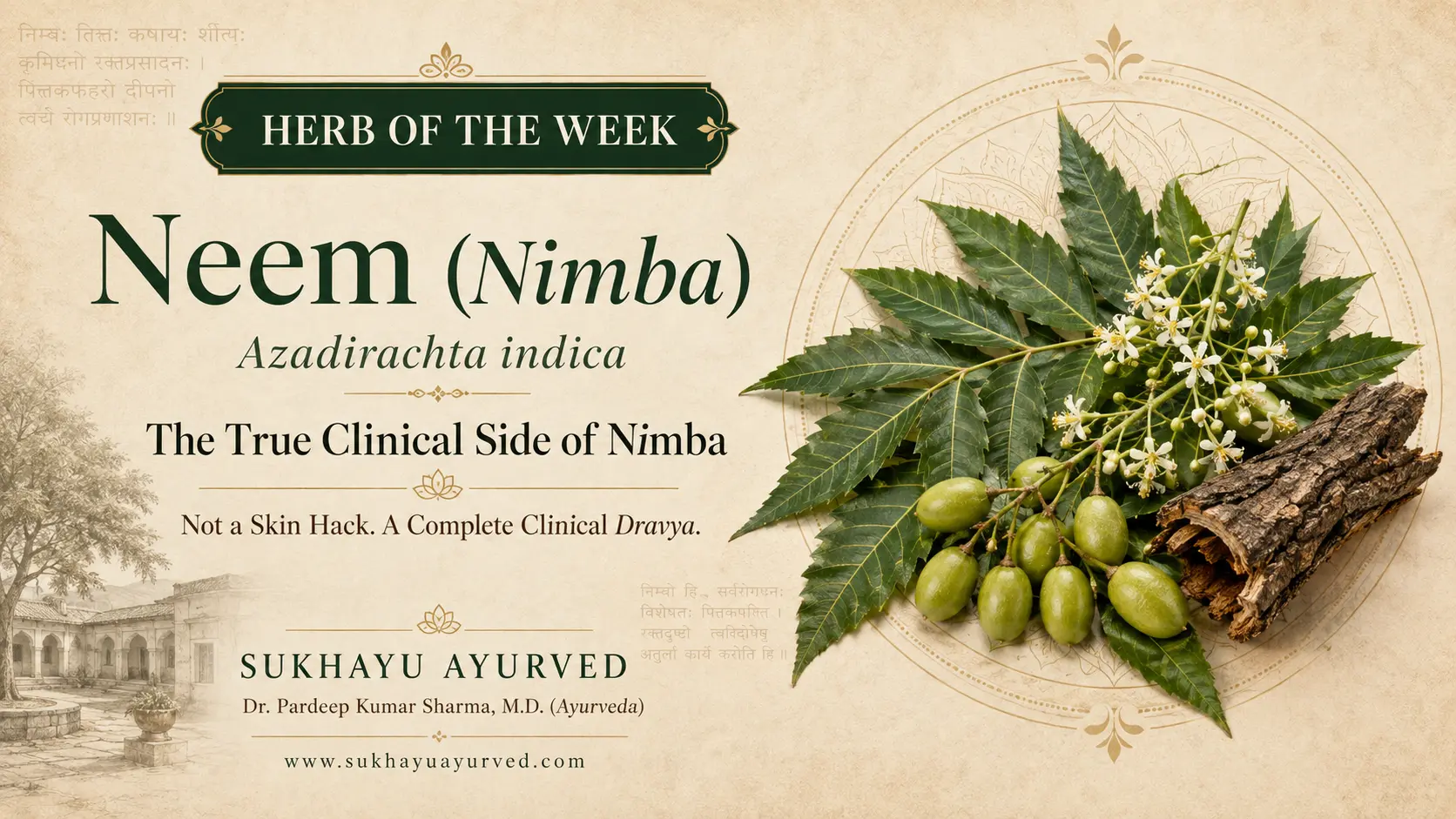
There is a tree standing in the courtyard of nearly every old Indian house. It drops its small bitter fruit onto the veranda in summer, its shade is where the afternoon is spent, and its twigs were once the toothbrush of an entire subcontinent. It is so ordinary, so woven into the walls of daily life, that most people who live beside it have stopped seeing it as medicine at all.
And yet, in the classical materia medica, this same tree carries one of the boldest names ever given to a plant. Nimba — the one that gives good health. Sarva Roga Nivarini — the reliever of all ailments. In the Bhavaprakasha Nighantu it appears as Arishta, the one that keeps sickness away, and as Pichumarda and Tiktaka. The most overlooked tree in the courtyard was given the largest claim in the pharmacy.
That gap — between how casually we treat neem and how seriously the texts do — is where this article lives. Not in the modern noise of "antimicrobial, anticancer, miracle herb," but between the lines of classical Ayurveda, where neem's real clinical identity has always been written.
What the classical texts actually say
The foundational treatises do not treat neem as a single trick. Charaka Samhita and Sushruta Samhita describe the use of its bark, leaves, flowers and fruit across skin disorders, ulcers and inflammatory conditions. The Bhavaprakasha Nighantu records its cooling potency — Sheeta Veerya — and its action on Pitta and Kapha, on wounds, and on the disturbances of digestion.
Notice what is being described here. Not a compound. A dravya — a complete medicinal substance with a full profile, understood through taste, potency, and its behaviour in the body. Neem is the archetype of Tikta rasa, the bitter taste, in its most uncompromising form. This is the axis everything else turns on.
But here is the first correction the texts force on us. Ayurveda does not reason the way modern herbalism does — it does not say "this Pitta-Kapha skin condition needs neem." That is single-agent thinking dressed up in Sanskrit. Neem is almost never prescribed as raw neem against a dosha label. It arrives already formulated. It is the bhavana, the levigation, inside Arogyavardhini Vati. It is a constituent of Panchatikta Ghrita Guggulu. It is the anchor of Brihat Panchanimbadi Churna, where the entire tree — root, bark, flower, leaf and fruit — enters the preparation.
The governing logic is Samanya-Vishesha: like increases like, and unlike decreases it. Agonism and antagonism. A substance belongs in a treatment because of how it relates to the disturbance in front of it — not because a herb has been matched to a dosha the way a key is matched to a lock.
Reading the depth of the disease
In the OPD, the question is never "which dosha, so which herb." It is: how deep has the disease gone? And the formulation is chosen to reach that depth.
For kshudra kushtha — the minor, superficial skin disorders, especially where they sit on top of digestive and liver dysfunction — I reach for Arogyavardhini, where neem enters as bhavana and the formulation works along the gut–liver–skin axis. For the wide, complex skin diseases, Brihat Panchanimbadi Churna mobilises the whole tree at once. And when the disease has penetrated all the way to asthi and majja — bone and marrow — as in psoriasis with psoriatic arthritis, the vehicle changes again to Panchatikta Ghrita Guggulu, because a ghrita-guggulu base can carry the bitter action into the deep tissues where a simple churna or vati will never reach.
This is Samanya-Vishesha made concrete. The vehicle escalates as the disease travels inward, from twak toward asthi-majja. Same herb, three depths, three medicines.
Raktaprasadana: the correction happens at the marrow
Neem's most popular banner is "blood purifier." It is also the most misunderstood word attached to it.
The modern imagination hears "blood purifier" and pictures a filter cleaning a dirty fluid — some impurity scrubbed out of circulating blood. That is not what raktaprasadana means. In Ayurveda, rakta dhatu is seated in and generated from the marrow; rakta and majja are not the sedimented picture a blood test suggests. So the correction does not happen downstream in the fluid. It happens at the source — at the marrow level, where the dhatu is formed. The skin eruptions that a patient calls "blood impurity" — the recurring boils, the chronic urticaria, the inflamed lesions — clear not because the blood was filtered, but because the terrain that keeps producing disturbed rakta has been corrected.
And here is a modern observation that sits quietly alongside this classical claim — not above it, not as proof of it, simply beside it. Modern physiology has found that bitter is not a mouth event. Taste-receptor elements are expressed across organs and tissues throughout the body, not just on the tongue; the body, in effect, reads bitter everywhere.¹ In one bone-marrow culture study, it was the bitter flavonoids — quercetin, myricetin, kaempferol, isorhamnetin — that suppressed the parathyroid-hormone-driven breakdown of bone and preserved calcium, while the neutral-tasting ones did nothing of the sort.² Bitter, doing something at the marrow. The classical claim that Tikta's raktaprasadana reaches the marrow, and an independent laboratory finding that bitterness acts in the marrow compartment, arrived near each other from opposite directions. That is worth noticing. It is not worth confusing with validation.
The whole tree, and why Ayurveda refuses to isolate
Brihat Panchanimbadi Churna uses the entire tree. Modern pharmacology would ask which fraction is "the active one" and throw the rest away. Ayurveda deliberately does the opposite, and the reason is precise.
Different parts of the tree carry different intensities and directions of the same Tikta action, distributed across different tissue depths. The root does not do what the leaf does; the bark does not reach where the flower reaches. They are not redundant copies of one compound. And the samskara — the act of processing and combining them — is itself part of the medicine, not merely a mixing step.
But underneath all of that is the simplest reason of all: the whole tree completes the profile of a medicine. An isolated fraction is a fragment of a substance pretending to be a substance. The complete dravya is a finished medicine. Isolation does not concentrate the medicine — it incompletes it. This is the same reason extract-standardised shortcuts so often disappoint: they amputate the profile and then wonder why the whole is missing.
Neem and diabetes: the distinction that decides everything
"Neem for blood sugar" is one of the most searched and most abused claims about this tree — the morning handful of neem leaves, chewed to "cure diabetes." Here the physician has to say something a content writer cannot, because the popular version isn't just incomplete. For some patients it is wrong.
Start with the obvious objection. Diabetes maps broadly to Madhumeha, classically a Vata subtype of Prameha. Neem is Ruksha, Sheeta, Tikta — dry, cooling, bitter — qualities that aggravate Vata. So how can a Vata-aggravating substance help a Vata disease? On the surface, it is a contradiction. The morning-neem-leaf crowd has no answer to this, because they never knew there was a question.
The resolution lies in a distinction the texts draw and the marketing ignores. Prameha is not one thing. It divides into Kshaya type — genuine depletion, where the dhatus are diminished (broadly aligning with what today is Type 1), and Avarana type — obstruction, where the Vata is not depleted but blocked, covered over by Kapha, Meda and Ama (broadly, the obstructive metabolic picture of Type 2).
In the Kshaya patient, further drying with Tikta-Ruksha substances is a blunt error. But in the Avarana patient, the logic inverts. The disturbance is obstruction, so the correct action is to scrape away the covering — and this is exactly what Tikta and Kashaya substances do. Remove the avarana, clear the srotas, and insulin sensitivity is restored — not because "neem lowers sugar," but because the obstruction that distorted the metabolism has been cleared.³
So neem does not treat "diabetes." It has a role in Avarana-type Prameha, as part of a formulated protocol — and the same substance would be a mistake in the depleted patient. A person with the wrong type, chewing morning leaves sold to him as a cure, is being handed the very substance that can harm him. This is also why the honest reading of the difference between blood-sugar control and genuine reversal matters: even the clinical study that showed benefit used a standardised neem preparation, dosed twice daily, in patients already on metformin.⁴ A formulated adjunct in obstructive-type disease. Not a leaf chewed at dawn as a cure.
Neem for the skin — inside and out are one treatment
"Neem for skin" conjures something entirely external: neem soap, neem face packs, boiled leaves for a bath, paste on acne. Topical neem does work well at what topical work is — genuine local relief on the skin itself.
But the modern instinct to ask "does the topical work, or is only the internal real?" is the wrong question. It assumes external and internal are two separate products doing two separate jobs. Ayurveda does not split them. Its Tailas and Ghritas — its medicated oils and ghees — are indicated for both bahya and abhyantara application, external and internal, as one dravya expressing one therapeutic logic through two routes. The oil applied and the ghrita taken are not rivals; they are the same treatment reaching the same disturbance by two doors.
This is why "neem soap will fix it" fails — not because topical is weak, but because a soap is one route amputated from an integrated, preparation-based treatment. It is the isolation error again, wearing a bar of soap instead of a capsule.
Bitterness, the rasa modern life deleted
Neem is punishingly bitter. And the bitterness is not an inconvenience to engineer around — it is the medicine. A de-bittered, flavour-masked neem is a neem that has thrown away its own therapeutic identity. The gummies, the sweetened juices, the palatable extracts: these are the marketing side, not the true side. They sell the shape of the medicine with the substance removed.
There is a larger truth folded into that bitter taste. Of the six rasas — the six tastes Ayurveda recognises — bitter is the one nobody celebrates. No one craves it. The tongue recoils from it. And yet health depends on all six rasas being present, not merely the pleasant ones. Modern diet and the wellness market have engineered bitter almost entirely out of daily life — which is precisely why the body's own bitter receptors, spread through its tissues, now go so rarely spoken to. The willingness to take something bitter is, quietly, a willingness to restore a rasa that modern life deleted.
The true side over the marketing side
So we return to the courtyard, and to the tree we stopped seeing.
Neem was never a single agent with a property to be extracted and bottled. It is a complete dravya that lives inside formulations, chosen by the depth the disease has reached. Its raktaprasadana corrects at the marrow, not in the fluid. Its role in Prameha depends entirely on whether the disturbance is depletion or obstruction. Its bitterness is not a flaw but the working edge of the medicine, and one of six tastes the body was built to receive. The tree we stopped seeing, the taste we stopped taking, the truth we stopped reading — all three have been standing in the courtyard the whole time, under a name that promised health to anyone who understood how to use it.
That understanding is the point. Not the marketing side of neem, but the true side.
Cure is divine. Treatment is possible.
Dr. Pardeep Sharma, M.D. (Ayurveda) is the founder of Sukhayu Ayurved, Jaipur. With over 20 years of clinical experience in Ayurvedic management of orthopedic, neurological and autoimmune conditions.
Medical disclaimer: This article is for educational purposes only and does not constitute medical advice, diagnosis, or a prescription. Ayurvedic medicines, including neem-based formulations, are physician-judged decisions based on individual constitution, the type and stage of disease, and clinical assessment in person. Do not self-medicate. Consult a qualified Ayurvedic physician before beginning any treatment.
References
- Extraoral Taste Receptor Discovery: New Light on Ayurvedic Pharmacology. Evidence-Based Complementary and Alternative Medicine, 2017, Article ID 5435831. https://doi.org/10.1155/2017/5435831
- Yamaguchi M, Hamamoto R, Uchiyama S, Ishiyama K. Effects of flavonoid on calcium content in femoral tissue culture and parathyroid hormone-stimulated osteoclastogenesis in bone marrow culture in vitro. Mol Cell Biochem. 2007;303(1–2):83–88. https://doi.org/10.1007/s11010-007-9458-x
- Insulin-sensitivity effects of bitter/astringent phytoconstituents. PMC6158035. https://pmc.ncbi.nlm.nih.gov/articles/PMC6158035/
- Protective effect of Azadirachta indica (neem) against metabolic syndrome — review. PMC8087850. https://pmc.ncbi.nlm.nih.gov/articles/PMC8087850/