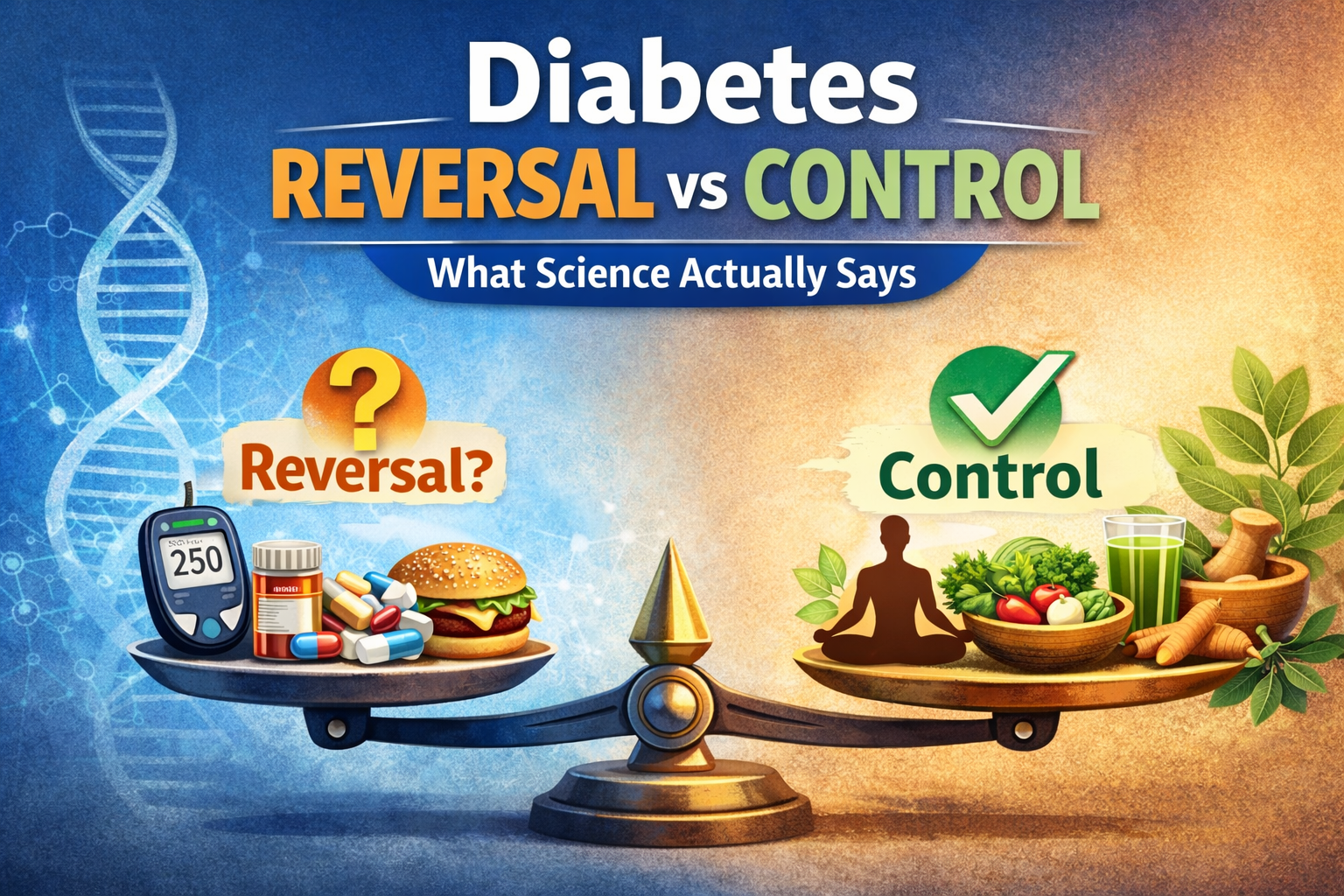
Over the last decade, diabetes has quietly become one of the most common diagnoses in Indian households. Many people are told they are “borderline,” “newly diabetic,” or “just a little high.” Almost immediately, they are exposed to a louder message outside the clinic —
“Reverse diabetes in 30 days,”
“Stop medicines forever,”
“Permanent cure without insulin.”
For a newly diagnosed person, this creates confusion and hope at the same time. Blood sugar numbers may improve quickly with strict diet changes, and HbA1c reports may even return to near-normal. The question then arises: Is this reversal — or simply control?
Understanding this distinction is critical, because it determines long-term outcomes, expectations, and safety.
Who This Article Is For / Not For
This article is for:
- People recently diagnosed with Type 2 diabetes
- Patients exploring “diabetes reversal” programs
- Families seeking clarity beyond marketing claims
- Individuals with controlled sugars but lingering risk concerns
This article is not for:
- Type 1 diabetes patients seeking cure claims
- Medical emergencies or acute complications
- Readers looking for guaranteed, permanent outcomes
- Anyone planning to stop prescribed medication without supervision
What Does “Diabetes Reversal” Actually Mean?
The term “diabetes reversal” has no formal standing in medical science.
In most programs, what is called reversal means:
- Lowering HbA1c into a near-normal range
- Achieving normal fasting and post-meal sugars
- Often while following strict dietary and lifestyle protocols
This improvement is real and beneficial — but it represents glycemic control or remission, not cure.
When these programs are carefully analyzed, they rely on:
- Calorie restriction
- Weight loss
- Improved insulin sensitivity
- Reduced liver and visceral fat
These changes lower glucose levels, but they do not eliminate the underlying metabolic susceptibility.
Why Blood Sugar Control Matters (Strong Scientific Evidence)
Landmark studies have clearly demonstrated that good glycemic control is essential.
DCCT (Type 1 Diabetes)
Tight glucose control significantly reduced:
- Retinopathy
- Nephropathy
- Neuropathy
UKPDS (Type 2 Diabetes)
Lower HbA1c reduced:
- Microvascular complications
- Eye, kidney, and nerve damage
Clinical conclusion:
👉 Blood sugar control is necessary to prevent microvascular complications.
Where Blood Sugar Control Is Not Enough
Despite excellent HbA1c values, many patients still develop serious complications.
1. Macrovascular Disease
Large trials (ACCORD, ADVANCE, VADT) showed that intensive glucose lowering:
- Did not significantly reduce heart attacks
- Did not significantly reduce strokes
- Did not reduce cardiovascular mortality
In ACCORD, very aggressive control increased mortality.
Why? Because cardiovascular damage depends on:
- Blood pressure
- Lipid abnormalities (LDL, triglycerides)
- Chronic inflammation
- Endothelial dysfunction
- Insulin resistance
- Duration of diabetes (“metabolic memory”)
2. The Concept of Metabolic Memory
Early hyperglycemia causes lasting damage through:
- Epigenetic changes
- Oxidative stress
- Advanced glycation end-products (AGEs)
Even after sugars improve, this damage may persist.
👉 This explains why “good sugars now” do not erase earlier harm.
3. Glycemic Variability Matters
Two patients with HbA1c of 7% can have very different risks:
- Large glucose swings increase oxidative stress
- Post-meal spikes damage blood vessels
- Recurrent hypoglycemia increases cardiac risk
HbA1c alone hides these fluctuations.
4. Other Independent Drivers of Complications
Even with ideal sugars, complications can arise due to:
- Hypertension
- Dyslipidemia
- Obesity and visceral fat
- Smoking
- Sleep disorders
- Chronic stress and cortisol excess
- Sedentary lifestyle
- Genetic susceptibility
Diabetes is a multifactorial metabolic disorder, not a glucose-only disease.
What Modern Medicine Now Agrees On
Optimal diabetes outcomes require multi-target management:
- HbA1c and time-in-range
- Postprandial spikes
- Blood pressure
- Lipid control (especially LDL)
- Weight and insulin resistance
- Inflammation and endothelial health
- Sleep, stress, and physical activity
This is why current guidelines focus on cardio-metabolic risk, not sugar alone.
What “Diabetes Reversal” Actually Means in Science
There is no accepted scientific cure for Type 2 diabetes.
What exists is remission.
ADA Definition of Remission:
- HbA1c < 6.5%
- Without glucose-lowering drugs
- Sustained for at least 3 months
Anything beyond this definition is misrepresentation.
What Reversal Programs Actually Do (Mechanism)
Most programs work through one core pathway:
Reducing insulin resistance, achieved by:
- Calorie restriction
- Significant weight loss
- Reduction of hepatic fat
- Improved insulin sensitivity
This is established science — not magic.
Evidence That Supports Remission
1. Weight-Loss–Driven Remission (DiRECT Trial)
- ~46% remission at 1 year
- ~36% at 2 years
- Strongly linked to >10–15 kg weight loss
- Relapse common with weight regain
2. Bariatric Surgery
- Highest remission rates
- Surgical risk and nutrient deficiencies
- Relapse possible
- Not scalable or reversible
3. Intensive Lifestyle Programs
- Very low-calorie diets
- Structured medical supervision
- Best outcomes in early diabetes
What Reversal Programs Do NOT Do
❌ They do not regenerate destroyed beta cells
❌ They do not erase genetic risk
❌ They do not permanently fix metabolism
❌ They do not work equally for all patients
Diabetes can re-emerge silently with:
- Weight gain
- Aging
- Stress and sleep deprivation
The Biggest Myth: “Once Reversed, Forever Cured”
This is biologically false.
Type 2 diabetes behaves like:
- Hypertension
- Dyslipidemia
- Gout
It has periods of remission and relapse.
No honest medical discipline claims permanent cure.
Where Reversal Programs Become Unethical
🚨 Red flags include:
- Claiming permanent cure
- Guaranteeing drug-free life
- Ignoring disease duration
- Abrupt medication stoppage
- No long-term follow-up data
These are marketing constructs — not science.
When Reversal Programs Make Sense
They may be appropriate when:
- Diabetes duration < 5–7 years
- Minimal insulin dependence
- No advanced complications
- Weight loss is achievable
- Long-term monitoring is ensured
The correct term remains remission, not cure.
How Ayurveda Interprets Diabetes (Prameha / Madhumeha)
Classical Ayurveda does not frame diabetes as a sugar disease.
Prameha is described as:
- Agni dysfunction
- Kapha–Meda predominance
- Kleda accumulation
- Progressive Dhatu involvement
- Eventual Vata dominance (Madhumeha)
The core issue is metabolic intelligence collapse, not glucose excess.
Does Ayurveda Claim “Diabetes Reversal”?
No.
Ayurveda classifies diseases by saadhyata:
- Sukha Saadhya – easily manageable (early Prameha)
- Krichchhra Saadhya – difficult but controllable
- Yapya – lifelong management required
- Asaadhya – irreversible stages
Ayurveda never promises cure in Yapya or Asaadhya stages.
What modern programs call “reversal” corresponds to:
- Early Kapha-Meda dominant Prameha
- Over-nutrition and sedentary habits
- Preserved tissue strength
This is samprapti bhanga — breaking the disease process — not erasing disease tendency.
What Ayurveda Can Help With / Cannot Help With
Ayurveda may help with:
- Improving metabolic regulation
- Reducing medicine dependency (where appropriate)
- Supporting weight and insulin sensitivity
- Delaying complications
- Improving quality of life
Ayurveda cannot:
- Guarantee permanent cure
- Reverse advanced organ damage
- Replace emergency or critical care
Safety & Clinical Boundaries
- Diabetes requires proper medical evaluation
- Results vary based on stage and adherence
- Integration with modern medicine may be necessary
- Long-term monitoring is essential
When to Seek Professional Help
Seek evaluation if:
- Sugars remain uncontrolled despite effort
- Weight loss plateaus or reverses
- Complications are present
- Medication changes are being considered
Bottom Line (Clinically Accurate)
✔ Blood sugar control is necessary
❌ Blood sugar control alone is not sufficient
Diabetes is driven by the metabolic environment, not just glucose numbers.
What is marketed as “reversal” is often temporary remission — real, valuable, but conditional.