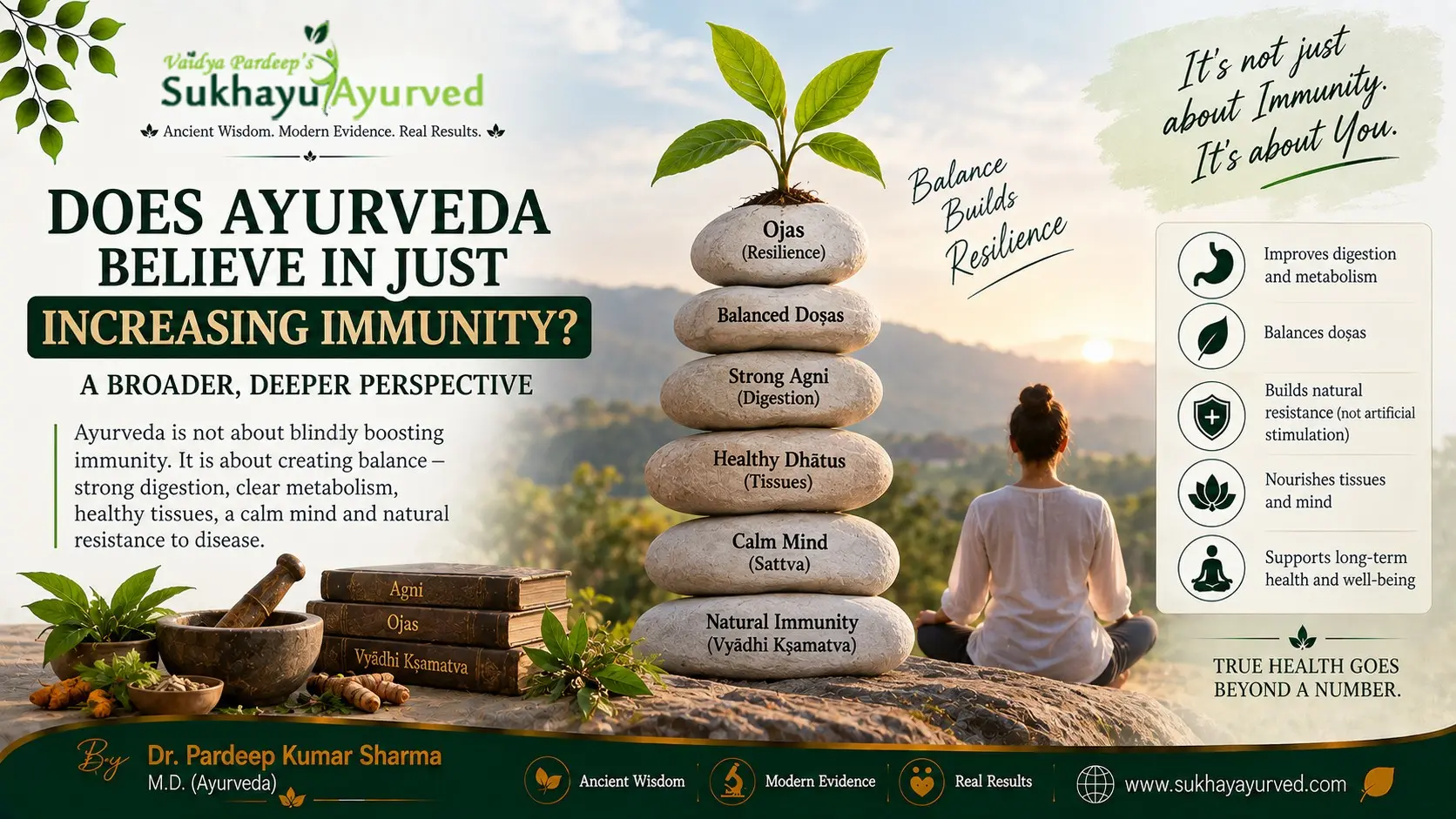
No. Ayurveda does not set out to increase immunity, and it never claimed to. What it works on is the quality of the immune response — whether your body is reading things correctly — not the size of it.
This is worth saying plainly, because almost everything written about Ayurveda and immunity says the opposite. Search for the two words together and you will be offered drinks, powders and single herbs, each promising to raise something. That promise does not come from Ayurveda. It comes from the way immunity is marketed.
The trouble starts with the word "increase"
"Increase" describes a quantity. A number goes up.
But very little in the body is healthy simply because there is more of it. More thyroid hormone is not better thyroid function. More acid in the stomach is not better digestion. More clotting is not safer blood. In every one of these, the healthy state is a range, and both ends of that range are illness.
Immunity is no different. In Ayurveda, health is balance, and "excess" is one of the two ways balance is lost — the other being "deficiency". A system that has been pushed upward is not a corrected system. It has simply been unbalanced in the more flattering direction.
Immunity is a judgement, not a supply
Your immune system does one thing all day: it decides.
Is this safe, or is this a threat? Almost everything that enters or arises in the body is safe — food, dust, pollen, your own cells replacing themselves by the billion. A very small fraction is not. The whole work of immunity is telling these apart, and then responding in proportion to what it found.
That is a judgement. You cannot improve a judgement by producing more of it. You improve it by improving the conditions under which it is made.
This is the reason a physician does not think in terms of raising immunity. Two of the commonest immune problems seen in any clinic are not problems of too little.
Problem one: allergy
In allergy, the body reads something harmless as dangerous and reacts hard.
Pollen is not dangerous. A peanut is not dangerous. Most people meet both without incident. What differs is not the pollen — it is the reading. This is why our position has always been that allergy is not about the allergen. Allergy is about us. The allergen is only the occasion; the response belongs to the person.
It follows that the treatment has to be aimed at correcting the person, not at avoiding the world. And it follows just as clearly that this is not a person who needs a stronger immune response. The response is already too quick and too large. What is missing is proportion. There is a common misreading here too — that a chest allergy must be Kapha and a dry skin allergy must be Vata — and it does not hold up at the bedside. The dosha picture in allergy is rarely that tidy.
Problem two: autoimmunity
In autoimmunity the reading fails in the other direction. The body stops recognising a part of itself as its own. A joint, a patch of skin, a gland, the covering of a nerve — something that has belonged to you your whole life is now treated as an intruder.
This is the part that matters most for anyone who has been given an autoimmune diagnosis, because the first thing many patients are told, and the first thing almost all of them come to believe, is that their immunity has become low. It has not.
An immune system capable of mounting a sustained, organised, precisely targeted attack on its own tissue is not a weak immune system. It is a capable one, pointed in the wrong direction.
So when a patient with such a diagnosis asks for something to increase their immunity, the request, however understandable, is asking for more of exactly the thing that has gone astray. Understanding what autoimmunity actually is usually changes that question — and changing the question is often the first useful step. It also explains a great deal about why these conditions flare and settle and flare again without anything obvious having changed.
Our position: every autoimmune condition is tridoshaja
Ayurveda describes three working principles in the body — Vata, which governs movement; Pitta, which governs transformation; and Kapha, which governs structure and cohesion. In most illnesses one of the three is clearly leading, and naming it is a large part of the diagnosis.
The autoimmune group is different, and this is a position we hold across all of them without exception: no autoimmune condition is a single-dosha condition. All three are involved. One may be more disturbed and another less, and that balance shapes how the illness looks in a particular person — but without all three being involved, the condition does not take this shape at all.
That has a practical consequence, and it is the reason this page exists. A disorder in which all three principles are disturbed at once cannot be answered by one herb, one powder or one drink. Whatever such a remedy does to one of the three, it is doing something to the other two as well. This is not a criticism of the herb. It is a mismatch of scale.
The two words Ayurveda actually uses
Ayurveda has no term that means "increasing immunity". It has two that get close, and both describe capacity rather than quantity.
Bala means strength — the body's working reserve, what it has available to meet a demand.
Vyadhikshamatva is the more precise one, and it is the nearest thing in the classical texts to what we now call immunity. The commentators describe it as two capacities at once: keeping a disease from taking hold in the first place, and blunting its force if it does.
Read that again and notice what is absent. Neither half is about producing more of anything. Both are about competence.
Immunomodulation is a process, not a product
The word that does fit is immunomodulation — and it is worth being exact about it, because it is now sold as though it were a category of product.
It is not a product. It is a process. To modulate is to adjust: to lift what has fallen short, restrain what has overshot, and leave alone what is already correct. It is corrective, it is directional, and it depends entirely on which way the system has drifted in the person in front of you. The same person may need one thing this month and the opposite next month.
That is precisely why it cannot be bottled and sold as a fixed formula for everyone. A bottle cannot know which way you have drifted. What "immune booster" claims actually amount to is worth reading on this, and so is the case of golden milk, which is a pleasant drink and is not doing what it is credited with. Even Guduchi, the herb with the best claim to being a true immunomodulator, works as part of a considered prescription, not as a daily supplement taken because the word appears on the label.
Where this capacity is actually built
Ayurveda's answer here is unglamorous and it is old: it is built at the dining table, every day, through digestion.
Food is the main traffic between the world outside you and the body inside you. What arrives has to be sorted — taken in, broken down, judged, and either used or discarded. That sorting capacity is Agni, the digestive and metabolic fire. What passes through it is progressively refined into the body's tissues, and the final, most refined product of that whole chain is Ojas — the fine essence in which the body's resilience is understood to reside.
There are only two places this can go wrong, and both are ordinary:
- What you put in. Food your body cannot make good use of, in quantities or combinations it cannot manage.
- What you have to work with. Digestion that is too weak, too sharp, or too irregular to do the sorting properly.
When either fails, what should have been refined into tissue is left half-processed. Ayurveda calls that residue Ama, and its slow accumulation is the closest classical account we have of what is now described as chronic inflammation.
This is the real reason Ayurveda talks about diet as relentlessly as it does. It is not moralism about food. It is where the immune system's working conditions are set.
And where Rasayana fits — and where it does not
Rasayana is usually what people are reaching for when they ask for something to increase immunity, so it deserves a straight answer.
Rasayana is not a category of immunity-boosters. It is the branch of Ayurveda concerned with the quality of nourishment — with whether what you eat genuinely reaches, rebuilds and sustains tissue. It acts on the process, not on a number. Nothing in it is measured by how high something goes.
It also has a timing. Rasayana given to a body that is still carrying an unprocessed load does not nourish; it adds to what is already sitting there. Given in the wrong condition, or at the wrong point in an illness, it can make matters worse rather than better. Which Rasayana, for whom, and at what stage, is a clinical decision made after examining a specific patient.
Which leads to the one instruction on this page: please do not combine herbs on your own. Not because the herbs are dangerous in themselves, but because a combination assembled from search results is being given for a condition nobody has examined, at a stage nobody has assessed. That is where harm comes from.
What we do not claim
We do not claim to raise anyone's immunity, because it is not a thing that is raised.
We do not claim that any autoimmune condition is cured by Ayurveda. Cure is divine. Treatment is possible — and the difference between those two sentences is the whole of honest practice.
What we do claim is narrower and more useful: that these conditions are worth understanding correctly before they are treated, that a disorder involving all three doshas needs a response built at that scale, and that the work is done through diagnosis, diet, digestion and properly chosen medicine over time. We do not sell packages. We treat diagnoses.
Where to read about specific conditions
This page is deliberately general — it is about how immunity works, not about any one illness. If you have a diagnosis, the discussion of it lives on its own page:
| Condition | |
|---|---|
| Rheumatoid arthritis | Read more |
| Psoriatic arthritis | Read more |
| Psoriasis | Read more |
| Ankylosing spondylitis | Read more |
| Systemic lupus erythematosus (SLE) | Read more |
| Sjögren's syndrome | Read more |
| Myasthenia gravis | Read more |
| Multiple sclerosis | Read more |
| Celiac disease | Read more |
| Immune thrombocytopenia (ITP) | Read more |
| Mixed connective tissue disease (MCTD) | Read more |
| Alopecia areata | Read more |
And if what you are dealing with is an allergy rather than an autoimmune condition, the Ayurvedic approach to allergy starts from the same principle: correct the person, not the pollen.
About the author Vaidya Dr. Pardeep Kumar Sharma holds an M.D. in Ayurveda and is Medical Director of Sukhayu Ayurved, an NABH-certified Ayurveda hospital in Jaipur, empanelled under CGHS and RGHS. His clinical work is in autoimmune, neurological and spinal conditions.
Medical disclaimer This article is for general education. It is not a diagnosis, a prescription, or a substitute for consulting a qualified physician. Do not start, stop or alter any medication — Ayurvedic or otherwise — on the basis of what you have read here. If you are under treatment for an autoimmune condition, continue it and discuss any change with the doctor managing your care.