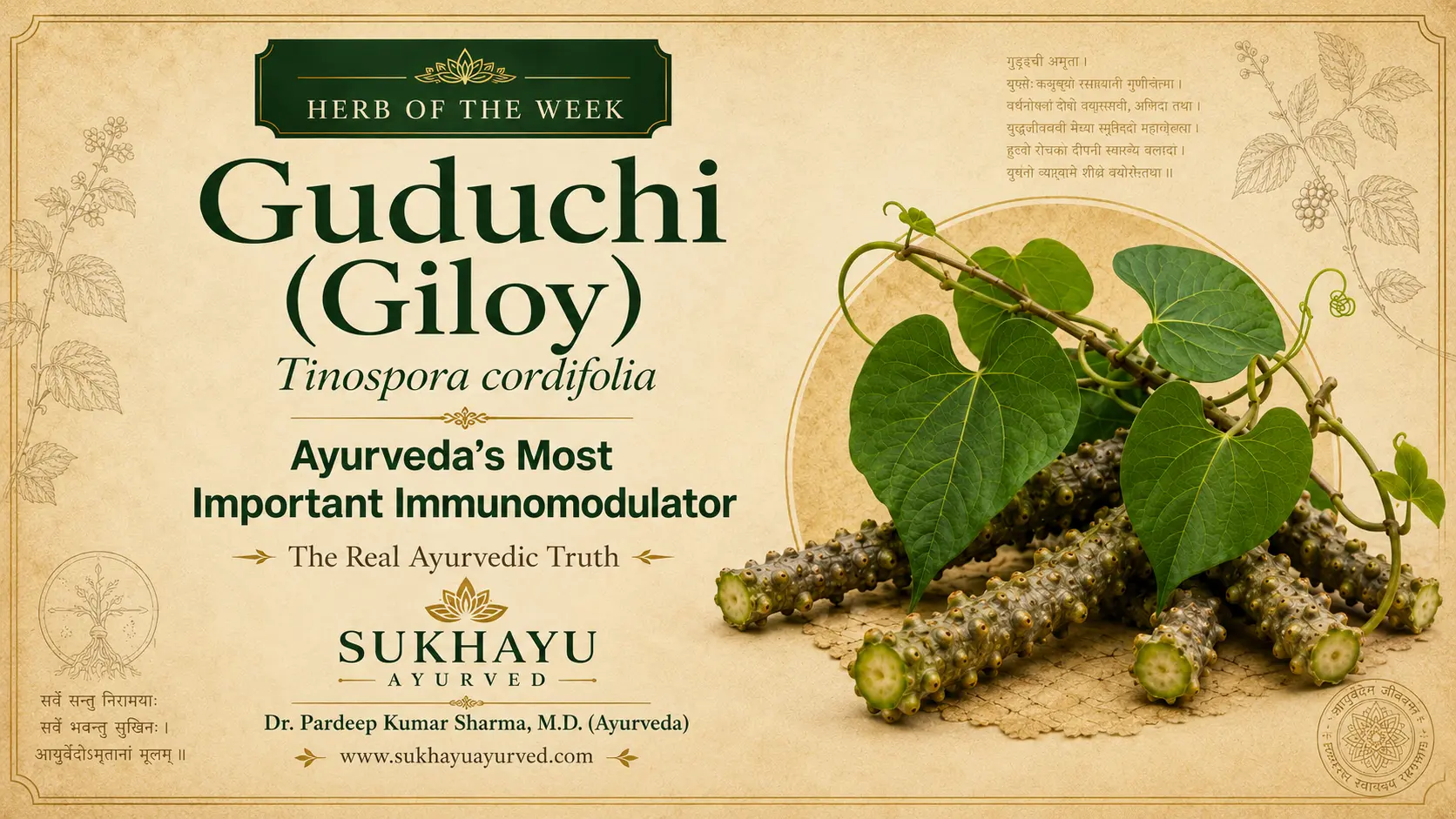
When the Devas and the Asuras churned the ocean of milk, they were not looking for a herb. They were looking for Amrita — the nectar of immortality, the one thing that would place them beyond death. The churning went on for ages. Poison rose first, then treasures, then the physician of the gods, and finally the pot of nectar itself. And as it was carried across the sky, drops of that nectar fell to the earth. Where they touched the ground, a creeper rose — heart-shaped leaves, a slender climbing stem, nothing spectacular to look at. The texts gave it the name the drops had earned: Amrita — the immortal one.
That creeper is Guduchi. Giloy, as most of India now says it.
I open with the myth not because I believe a plant fell from a churning ocean, but because the people who named it were telling us something in the only language they had. They were saying: this is not an ordinary herb. And after twenty years of watching it work in my OPD — in fevers that would not break, in autoimmune disease, in conditions modern medicine files under "irreversible" — I have come to think they were pointing at something real. Just not the thing the internet now sells.
The word everyone gets wrong
Since the pandemic, Giloy has been marketed as an immunity booster. A crash course for your defences. Drink this, and your immune system gets stronger.
I want to be very direct, because this matters more than anything else in this article: that idea is not Ayurveda. It is commerce wearing Ayurveda's clothes.
Start with the logic. In autoimmune disease — rheumatoid arthritis, lupus, Hashimoto's, ITP — the immune system is not weak. It is overactive and misdirected. It has turned on the body's own tissue. The last thing on earth such a patient needs is a "boost." Boosting a confused, self-attacking immune system is like handing petrol to someone whose house is already on fire.
What these patients need — and what Guduchi actually does — is modulation. Not more immunity, not less. Correct immunity. An immune system that can once again tell self from non-self. This is why, in my practice, when an autoimmune patient sits across from me, Giloy is very often my first consideration. Not as a booster. As an immunomodulator — a substance that restores discernment rather than volume.
And immunity, real immunity, cannot be crash-coursed. You cannot buy it back in a week of morning juice. Anyone selling you that timeline is selling you something, and it is not health.
What the classical texts placed it under
Charaka did not classify Guduchi by its supposed powers. He classified it by its taste. He placed it in the Tikta Skandha — the group of bitter herbs. This looks like a small taxonomic detail. It is in fact the whole key.
Bitterness, Tikta Rasa, is one of the most therapeutically serious tastes in Ayurveda. It scrapes. It clears. It kindles the digestive fire while it cuts through metabolic sludge. To call Guduchi bitter, in the classical framework, was to say a great deal about what it does inside the body.
And here is where an old classification and modern science quietly shake hands. We now know that the receptors which detect bitterness — the bitter-taste receptors — are not confined to the tongue at all. They line the gut. They sit in the lungs. They are present on the very immune cells that govern inflammation. In other words, bitter is a language the whole body speaks — not just a flavour on the tongue.
Think of the tongue as one telephone in a large house. When Charaka classified Guduchi by its bitterness, he was, without any instrument to see it, dialling a number that rings on every extension — the gut, the metabolism, the immune cells. He could not have drawn the receptor. He could taste where it led. I find that humbling every time I sit with it.
I will not drag you further into the biochemistry, because the point is not the machinery. The point is that a three-thousand-year-old decision to call this herb bitter was pointing at a body-wide signalling system we have only just begun to map. The ancients were not guessing. They were reading a different instrument.
What it actually does — the real meaning of Rasayana
Here is the mechanism as I hold it in my own head, after two decades of prescribing it.
Guduchi's deepest action is srotoshodhana — it clears the channels. The srotas are the body's pathways, the routes through which nourishment, waste and information move. When they are blocked with Ama — the sticky residue of incomplete digestion and metabolism — everything downstream suffers. Nutrition does not reach the tissue. Waste does not leave it. The system chokes on itself.
Most herbs do one thing: they either kindle Agni (the digestive fire) or they digest Ama (the metabolic residue). Guduchi does both — and it does both because it works upstream, at the level of the channels themselves, not merely at the fire. It opens the road and clears the debris on it at the same time.
And once the channels — particularly the Rasavaha srotas, the channels of the first and most fundamental tissue — are genuinely open, something remarkable begins. The body starts to correct itself.
This is the true meaning of Rasayana — a word the wellness world has flattened into "rejuvenation" or "anti-ageing tonic." Break it open: Rasa (the essence, the flow) + Ayana (the pathway, the movement). A Rasayana is not a nutrient you consume. It is something that restores the movement of the essence through the body. Open the pathway, and the intelligence of the body — which never left — resumes its work. The medicine does not impose healing. It removes the obstruction, and healing follows on its own.
This is where our clinic's anchor belief becomes almost mechanical rather than poetic: Cure is divine. Treatment is possible. I can open the channel — that is treatment, that is in my hands. The self-correction that follows belongs to something larger than my prescription.
What this looks like in the OPD
Let me show you why this herb fascinates me, because it reveals the same mechanism at deeper and deeper levels of the body.
In fever, Guduchi works at the level of Rasa and Rakta — the plasma and blood. This is its oldest, most classical use: Jwaraghna, the fever-breaker. It clears the channels, resolves the Ama driving the fever, and the temperature settles. Charaka knew this. Every Ayurvedic physician after him has confirmed it.
Go deeper. In ITP — immune thrombocytopenia, where the body destroys its own platelets — I have watched the right combination, with Guduchi central to it, produce correction at the level of Majja, the marrow, the deep tissue where blood is formed. The platelet failure resolves not because we suppressed anything, but because the channel at that depth was opened and the marrow resumed its proper work.
Deeper still — and this is the one that most people cannot believe Ayurveda touches — is Avascular Necrosis (AVN). In AVN, the blood supply to a section of bone dies, and the bone begins to collapse. Modern orthopaedics largely calls this irreversible; the roads offered are core decompression or, eventually, joint replacement. In my practice, AVN patients on a protocol built around Giloy Satva and Panchsoot Rasa have shown, on follow-up MRI, evidence of neovascularisation — new blood vessels forming, blood returning to bone that imaging had shown as dying.
I want to be scrupulously honest about how I frame this, because honesty is the entire foundation of trust. Giloy did not do this alone. No single herb did. It is unscientific — and frankly it is the exact bad habit I am criticising the market for — to point at a recovery and say "the Giloy fixed it." The protocol treated the patient. Giloy was central to that protocol because of its deep action on Rakta and the channels — its blood-clearing, blood-enriching capacity is precisely what a starved bone needs. But it was one instrument in a composition, playing its part.
Notice the pattern, though. Fever at the level of blood. ITP at the level of marrow. AVN at the marrow-and-bone interface. The same herb, the same mechanism — open the channels, restore the flow, let the tissue self-correct — expressed at progressively deeper tissues. ITP and AVN, in my model, are almost the same event happening at the same depth of the body. That through-line is why Guduchi is not, for me, an "immunity herb." It is a channel-clearing Rasayana whose reach happens to include the immune system.
Why you will almost never see me prescribe it alone
Ask me the dose of Giloy and you have already asked the wrong question.
In common practice I do not recall a single case where I prescribed Guduchi entirely on its own. It is not a soloist. It lives inside formulations — and that is by design, not by accident.
Both Ayurvedic and modern pharmacology rest on the principle of Samanya–Vishesha — likeness and difference, what modern language would call agonist and antagonist. In Ayurveda, like increases like, and opposite decreases. Every classical combination is engineered on this logic. This is emphatically not the modern habit of blending "a bit of this and a bit of that" because both sound healthy. The balance in the combination is the medicine. Change the composition and you change what the herb does.
So Guduchi appears woven into formulations. Shiva Gutika carries it. Panchsoot Rasa carries it at two levels at once — as Giloy Satva, the extracted essence, and triturated (given bhavana) with Giloy swarasa, the living juice. The same herb enters twice, essence and juice, each doing something the other cannot. That is pharmaceutical intelligence of a very high order. It is not a smoothie.
This is why "what dose of Giloy should I take" cannot be answered responsibly. It is like asking how many grams of a single violin make a symphony. The answer depends entirely on the composition it is written into and the condition it is written for.
Giloy is only as good as the protocol it sits in, and the hands that prescribe it.
The liver scare — and the category error underneath it
You have probably seen the headlines. During the pandemic, reports appeared of liver injury linked to Giloy, and at least one hepatologist declared, publicly and loudly, that the herb had failed a patient's liver.
Let me offer you a single clinical fact that the headline cannot account for. My AVN patients take Guduchi, inside their protocol, for eighteen months and longer — continuously, under supervision. If Guduchi were hepatotoxic as a molecule, my OPD would be a ward full of cirrhosis. It is not. Not one of them.
So what actually happened in those cases? Consider the real pattern: someone with an existing fatty liver, or an active drinker, sees a reel, and starts gulping raw, often unidentified "Giloy" for three months entirely on their own. Then they present to a hepatologist — and the herb standing nearest the damage gets arrested for the crime. That is not science. That is correlation wearing a lab coat.
The deeper error is one the classical texts warned against directly, and it reframes the whole debate. The Shastra draws a sharp line between Aahar and Aushadha — food and medicine. Food is for daily, lifelong use. Medicine is aimed at a condition: prescribed, dosed, timed, supervised, and — this is critical — discontinued when its work is done.
Guduchi is Aushadha. It is medicine, not food. The moment the market turned it into a daily kadha you sip like morning tea, it committed a category error — it fed people a medicine as though it were cumin seeds. And where harm followed, that error was the cause, not the herb.
The tragedy is that both sides then talk past each other. The hepatologist speaks the language of serum markers; the Vaidya speaks the language of srotas and dhatus. Each hears the other as babble — one speaking Japanese, the other Persian, and both concluding, "he cannot be understood, he is just blabbering." That is not a failure of the herb. It is a failure of translation.
So do not fall for the juice theory
Let me say the sharpest thing in this article plainly, the thing I would say to a room of my own colleagues.
The morning cup of Giloy juice is not Ayurveda. It is Ayurveda's costume, worn by commerce.
Nowhere in the classical framework does a physician tell a healthy person to gulp a glass of guduchi juice at sunrise like orange juice. That entire ritual — the reels, the daily "immunity kadha," the giloy-swarasa-in-the-morning trend — is commercial exploitation of Ayurveda. It is nowhere close to Ayurveda. And it collapses under every principle laid out above: it violates Aahar–Aushadha by dosing medicine like a beverage; it misunderstands Rasayana, which is channel-clearing and self-correction, not a nutrient you chug; it ignores Samanya–Vishesha, because the herb was never meant to stand alone; and it is the direct cause of the very liver scares now used to slander the plant.
Strip away the theatre and what remains is the real herb — the drop of Amrita from the churning ocean. A medicine of genuine depth, which deserves to be prescribed, not merchandised.
What to actually do
If you have a chronic or autoimmune condition — rheumatoid arthritis, an autoimmune diagnosis you have been told to simply manage for life, or even something as feared as avascular necrosis — the right step is not to buy Giloy Satva and guess at a dose. The herb is only as good as the protocol it belongs to and the assessment behind it. Come and be assessed. Let the composition be built for your channels, your Dosha picture, your condition. That is the only version of this herb worth taking.
Guduchi is called the immortal one. Treated as medicine — with respect, with a physician, with a purpose — it earns some fraction of that name. Treated as a morning juice trend, it earns only the liver scare and the ridicule. The choice was never the herb's. It is ours.
Dr. Pardeep Sharma, M.D. (Ayurveda) is the founder of Sukhayu Ayurved, Jaipur. With over 20 years of clinical experience in Ayurvedic management of orthopedic, neurological and autoimmune conditions.
Medical disclaimer: This article is for educational purposes and reflects clinical observations from Ayurvedic practice. It is not a prescription, a diagnosis, or a substitute for personalised medical care. Guduchi is a medicine, not a food supplement, and should be taken only within a protocol prescribed and supervised by a qualified physician. Outcomes described are individual and are not promises of cure. Please consult a registered practitioner before beginning any treatment.