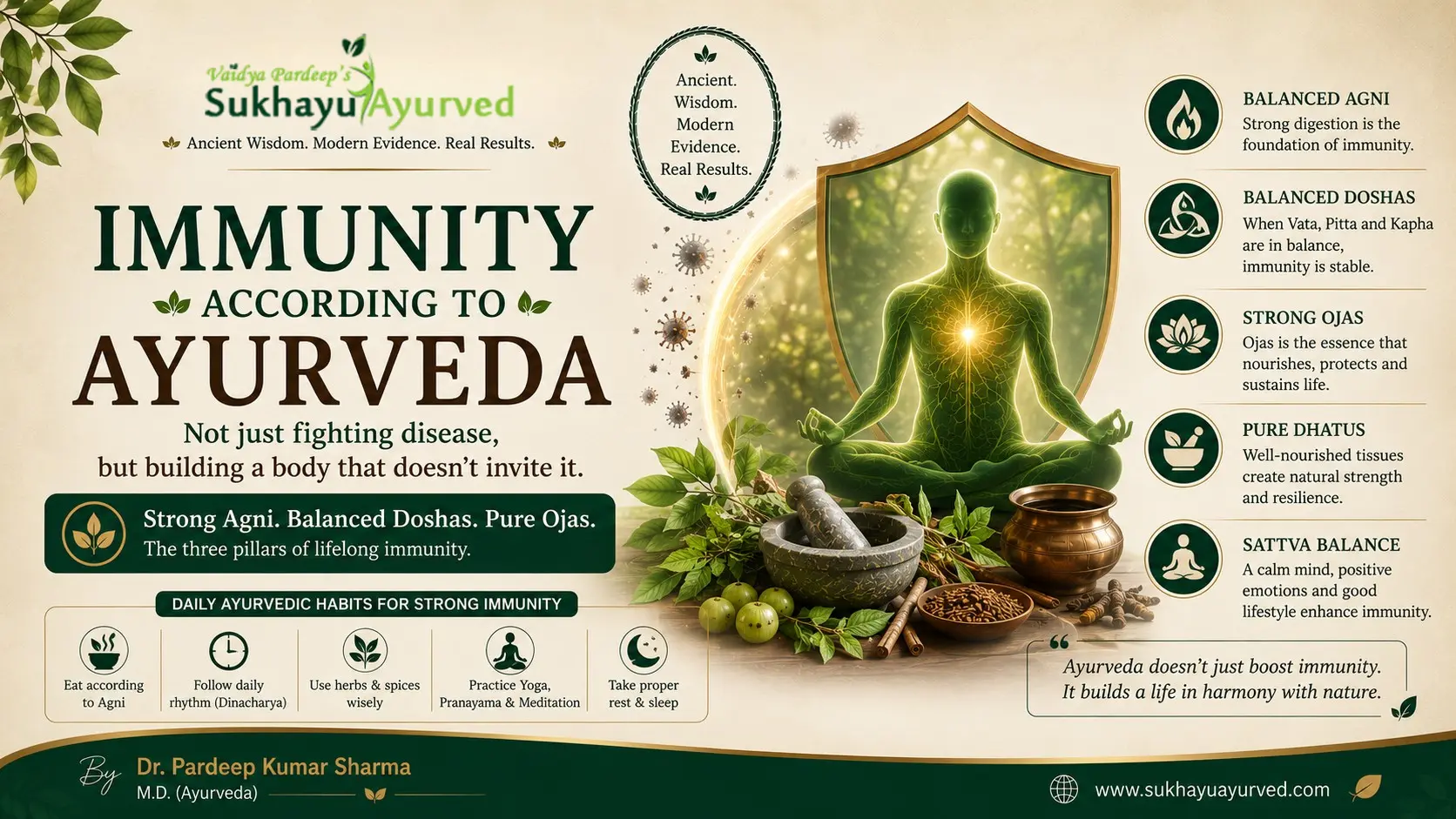
Modern immunology describes immunity as an army: scavenger cells, killer cells, a body at war with invaders. Ayurveda begins from the opposite instinct. It does not describe offence. It describes defence — the body's capacity to hold on to its own health. It calls this capacity Bala (बल), strength, and it treats immunity not as aggression against the outside world but as the body's romance with its own life.
That single shift in framing has a clinical consequence most people miss: if immunity is a quantity of strength, then both too little of it and too much of it are diseases. A weakened immune system and an overactive one are not opposites in Ayurveda. They are two failures of the same thing.
This is why, thousands of years before the word existed, Ayurveda already had a coherent account of autoimmunity — not as a mystery, but as a specific, named disorder of excess.
Bala: The Strength to Defend Health
Every cell in the body works, continuously, toward one outcome — a healthy, disease-free life. The fight against disease is therefore never the job of one specialised defender. It is the cumulative effort of trillions of cells. How strongly the body can resist disease is simply a measure of how much of this collective strength it holds.
Charaka classifies Bala into three kinds:
त्रिविधं बलमिति— सहजं, कालजं, युक्तिकृतं च। सहजं यच्छरीरसत्त्वयोः प्राकृतं, कालकृतमृतुविभागजं वयःकृतं च, युक्तिकृतं पुनस्तद्यदाहारचेष्टायोगजम्॥
- Sahaja Bala — the strength you are born with, inherited and fixed at birth. Sahaja means innate, natural.
- Kalaja Bala — strength that varies with season and with age. The resistance of youth is not the resistance of old age; the body's strength in one season is not its strength in another.
- Yuktikrita Bala — acquired strength, built deliberately through diet, specific foods, activity, and Rasayana (rejuvenative herbs).
The first you cannot change. The second changes on its own. The third is the one clinical Ayurveda works with — and the one this entire tradition of Rasayana exists to strengthen.
But strength has to come from somewhere. That source has a name.
Ojas: The Substance of Immunity
Ojas (ओजस्) is the word Ayurveda gives to the essence — the "nectar" — that the body distils from everything it eats. The digestive and metabolic systems, working together, refine food down to this final refined substance. It is Ojas that determines Bala. Immunity, in Ayurveda, is not a cell type. It is a substance, and its quantity and quality decide how well you defend your health.
Can we mark it, the way modern medicine marks immunoglobulins? Ayurveda does not work by chemical tagging. It explains Ojas by analogy: Ojas exists in the body the way fat exists in milk — dispersed, measurable, essential, but not ordinarily visible. You cannot point to it. It is everywhere it needs to be.
Ojas has recognisable qualities: it is cold, unctuous, soft, smooth, slimy and sticky to the touch; sweet in taste; white, or yellow-red, in appearance. These qualities matter clinically — because to increase or decrease Ojas, you have to know what you are trying to restore.
Golden milk does not increase immunity. The internet's favourite immunity remedy misunderstands what Ojas actually is. → Read the truth about golden milk and immunity
Two Types of Ojas
- Para Ojas — the primary, foundational Ojas. It forms during fetal development, is inherited (Sahaja), and stays essentially unchanged across life. Para Ojas sustains the process of living itself.
- Apara Ojas — the secondary Ojas, derived from food and shaped by environment. Because diet (Yuktikrita) and seasonal change (Kalaja) act directly on it, Apara Ojas is the one that participates in the process of disease.
This distinction is not academic. Almost everything clinical medicine can influence — through diet, therapy, and Rasayana — acts on Apara Ojas.
What Ojas Does
तत्र बलेन स्थिरोपचितमांसता सर्वचेष्टास्वप्रतिघातः स्वरवर्णप्रसादो बाह्यानामाभ्यन्तराणाञ्च करणानामात्मकार्यप्रतिपत्तिर्भवति।
- It provides immunity to the body.
- It governs the pace of biological ageing.
- It builds the strength and mass of the musculature.
- It lends quality to voice and complexion.
Hold on to that third and fourth function — muscle and complexion. When Ojas fails, they are exactly where the failure shows, and modern science now tells us why.
The Diseases of Ojas (Ojo Vyapada)
Ayurveda names three disorders of Ojas. Read them as a spectrum of immune failure — from an immune system that has turned against its own body, to one that has collapsed entirely.
1. Ojo Visransa — The Immune System That Overflows
Here Ojas increases and, in doing so, dislodges from its natural seat. Think of it as overflow — strength in the wrong place, doing the wrong work. Its signs:
- Sandhi Vishlesha — looseness of the skeletal muscles and laxity of the joints, leading toward dislocation.
- Gatra Sadana — bodily fatigue and weakness.
- Dosha Chyavana — displacement of all the doshas, opening the door to varied disease.
- Kriya Sannirodha — disruption of the body's normal physiological activity.
2. Ojo Vyapat — The Immune System in Distress
The second condition, an aggravation of Ojas, directly related to Visransa but with its own expressions:
- Stabdha Guru Gatrata — stiffness and rigidity of muscle; the body feels heavy.
- Vata Shopha — non-pitting, generalised edema that can appear anywhere.
- Varna Bheda — change in complexion. (In immune conditions such as HIV, altered complexion is a recognised sign.)
- Glani — a settled unhappiness with oneself.
- Tandra — drowsiness; constant yawning.
- Nidra — excessive sleep.
3. Ojo Kshaya — The Immune System That Decays
The most serious of the three, because it is a quantitative loss — an actual decay of Ojas, and therefore of the immune system itself:
- Murcha — fainting.
- Mamsa Kshaya — wasting of the skeletal muscles.
- Moha — indecisiveness, mental clouding.
- Pralapa — irrelevant, disordered speech.
- Marana — death.
Reading the Ancient Model with Modern Eyes
This is where the model stops being old and starts being astonishing.
Ayurveda listed wasting of skeletal muscle as a cardinal sign of immune decay. Modern research now shows that myokines — signalling proteins released by muscle tissue — directly regulate the immune system. Muscle is not passive scaffolding; it is an immune organ. Ayurveda made muscle central to immunity by clinical observation alone.
Ayurveda tied change in complexion to immune disorder. We now trace that link through melanocytes and the shared signalling between skin and immune function.
And the spectrum itself maps almost cleanly onto conditions we treat today:
- Ojo Visransa — the immune system in excess, overflowing, attacking joint and muscle — is the Ayurvedic description of autoimmunity. Rheumatoid arthritis, ankylosing spondylitis, lupus: an immune system so strong it turns on the body it was built to defend.
- Ojo Kshaya — the complete decay of Ojas — describes immunodeficiency, the HIV-type collapse where the defence itself is gone.
One system. Two directions of failure. This is the frame that makes autoimmune disease legible — not a hostile mystery to be suppressed, but a disorder of misplaced strength to be corrected.
What This Means If You Have an Autoimmune Disease
If immunity is Bala, and autoimmunity is Bala in excess and out of place (Ojo Visransa), then the goal of treatment is not to destroy the immune response. It is to relocate and rebalance it — to bring displaced Ojas back to its seat.
This is the clinical reasoning behind how we approach autoimmune conditions at Sukhayu Ayurved. We do not treat immunity as an enemy to be beaten down. We treat it as strength to be corrected.
Cure is divine. Treatment is possible. Ayurveda works alongside your conventional care, never as a replacement for it — and any change to prescribed medication belongs to your prescribing physician alone.
→ Ayurvedic Treatment for Autoimmune Diseases
Dr. Pardeep Sharma holds an M.D. in Ayurveda with over 20 years of clinical experience and leads Sukhayu Ayurved, a NABH-certified Ayurvedic hospital in Jaipur specialising in chronic autoimmune, spine, and neurological conditions.