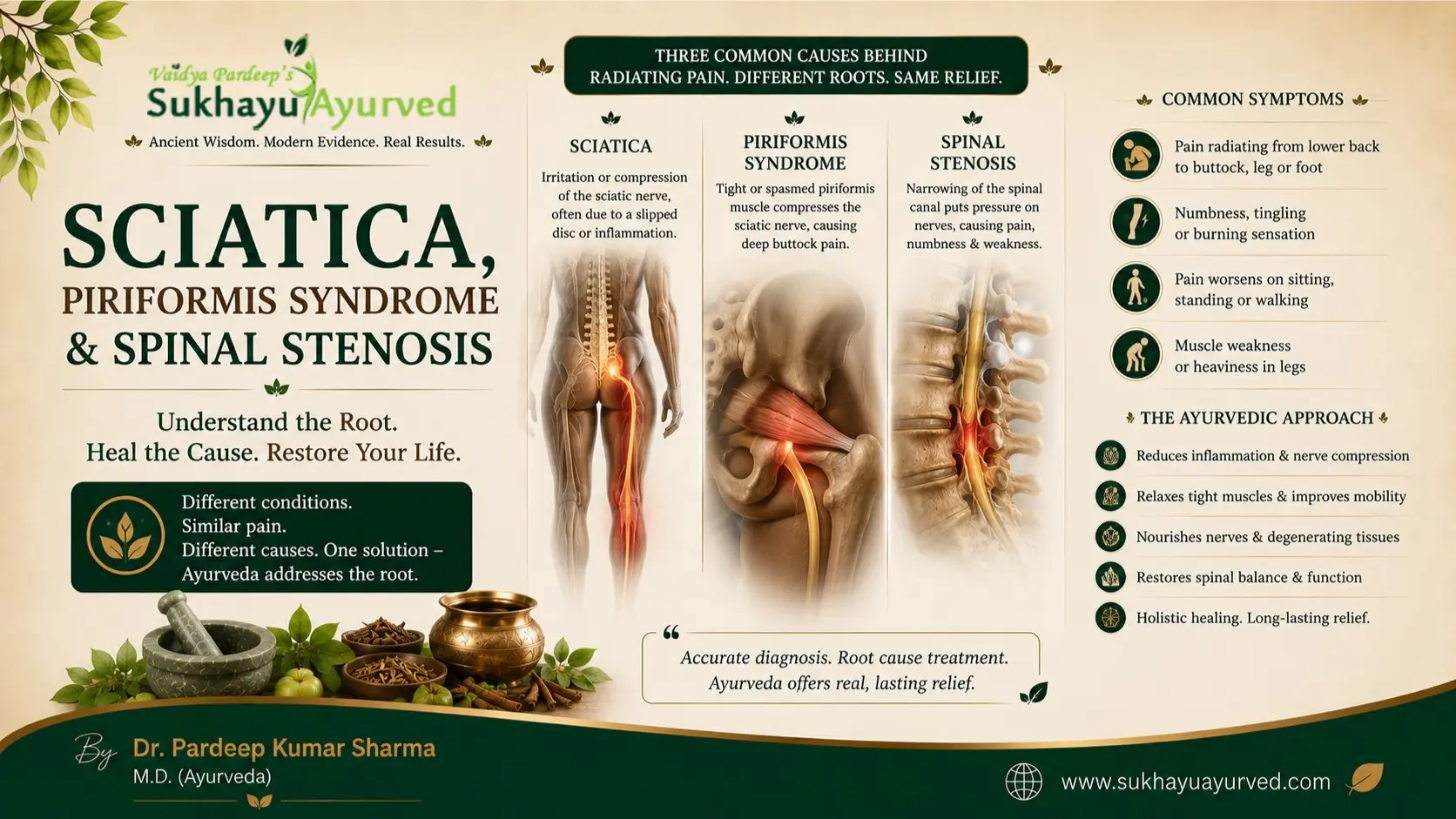
Part of our series on sciatica and the mechanical cause behind it.
Type "sciatica vs piriformis" into a search engine and you will find a thousand articles built on the same premise: that these conditions are a confusing, interchangeable tangle, and that you — the patient, at home, with a photograph of your lower body and a set of self-tests — must somehow work out which one you have.
This premise is wrong, and it is wrong in a way that costs people months.
These three conditions are not a puzzle. They are distinct problems with distinct causes, and a physician tells them apart in a single examination. The confusion you have been sold exists mostly on the internet, not in the consulting room. This article is not another self-test. It is an explanation of why the differential is more straightforward than you have been led to believe — and why chasing the wrong one wastes time you do not need to waste.
Why the "confusing trio" is largely a myth
Here is the thing almost no online article tells you: sciatica is one of the easiest conditions in spinal medicine to identify.
There is a bedside test — the straight leg raise — that a physician performs in under a minute. The patient lies flat; the leg is lifted straight; and the angle at which the radiating pain reproduces tells the examiner a great deal about whether a nerve root is being tugged over a compressing structure. It is quick, it is reproducible, and it does most of the work.
Because of this, sciatica from nerve root compression is rarely mistaken for something else once a physician has actually examined the patient. The mistakes happen when nobody examines the patient — when the diagnosis is made from a description typed into a search bar, or from an imaging report read without a corresponding clinical test.
So the honest version of "sciatica vs piriformis vs stenosis" is not a set of overlapping symptoms you must disentangle yourself. It is three different mechanisms, each with its own signature, distinguished by examination rather than by guesswork.
Let me show you the differences — not so you can self-diagnose, but so you can see how clean the distinctions actually are.
True sciatica: the problem is at the spine
In true sciatica — Gridhrasi — the trouble originates at the spine. A disc at L4-L5 or L5-S1 has bulged or herniated and is compressing a nerve root as it exits. The pain travels down the leg because the nerve travels down the leg, but the cause sits in the lumbar spine.
The signatures:
- Pain usually radiates in a defined path corresponding to the compressed root — often past the knee, sometimes into the foot
- The straight leg raise reproduces it
- It frequently comes with the back involvement you would expect from a spinal origin
- As patients often tell me, it may have begun as stiffness in the calf weeks or months before the radiating pain arrived
This is the condition the rest of this series is about, and the one whose mechanical cause the 3P Program is designed to correct.
Piriformis syndrome: the problem is in the buttock
Piriformis syndrome is genuinely different. Here the sciatic nerve is not compressed at the spine at all — it is irritated lower down, in the buttock, where it passes close to (or through) the piriformis muscle. When that muscle is tight or inflamed, it can press on the nerve and produce leg symptoms.
The signatures are distinct enough that this is not, in practice, hard to separate from spinal sciatica:
- The pain and tenderness centre on the buttock, not the back
- It is characteristically worse on sitting, and worse with movements that tense the piriformis
- There is often local tenderness deep in the buttock, near the sciatic notch
- The spinal signs of nerve root compression are absent
Notice what this means. The word "sciatica" gets used loosely for any pain along the sciatic nerve, and that looseness is where the confusion breeds. But sciatica from a compressed spinal root and sciatic nerve irritation from a buttock muscle are different problems in different locations. Even the medical literature that studies piriformis syndrome — a condition some researchers consider overdiagnosed and others underdiagnosed — agrees that specific examination findings are what distinguish it. The disagreement is about frequency, not about whether examination can tell.
Spinal stenosis: the problem is narrowing, and it has a giveaway
Spinal stenosis is different again. Here the spinal canal itself has narrowed — often with age, through degenerative change — reducing the space available to the neural structures. It can coexist with disc disease, but its clinical picture has a feature so characteristic it is often diagnosable from the history alone.
The giveaway is the pattern of walking and rest:
- Symptoms — aching, heaviness, or pain in the legs — come on with standing and walking
- They ease when the patient sits or bends forward, because flexion opens the narrowed canal slightly
- Patients describe being able to walk a certain distance before needing to stop, and often find they can walk further leaning on a trolley or uphill than on the flat
This "walk-then-rest, better-when-bent" pattern is not how a fresh disc-related sciatica behaves, and once a physician hears it, the direction of the diagnosis is usually clear before any imaging.
The point: examination separates what the internet blurs
Put the three side by side and the supposed puzzle dissolves:
- Sciatica — origin at the spine; straight leg raise positive; radiating leg pain in a root pattern
- Piriformis syndrome — origin in the buttock; worse on sitting; local buttock tenderness; spinal signs absent
- Stenosis — origin in a narrowed canal; worse walking, better bending forward; often age-related
A physician does not agonise between these. The examination — where the pain originates, what reproduces it, what relieves it, what the straight leg raise does — sorts them out efficiently. The reason patients believe it is a hopeless tangle is that they are trying to make the diagnosis without the one thing that makes it easy: an examination.
This is exactly why I am wary of the self-test culture that has grown up around these conditions. A stretch you found online cannot examine you. It can, however, convince you that you have piriformis syndrome when you have a disc problem, and send you off doing buttock stretches for months while a compressed nerve root goes unaddressed.
Why getting this right actually matters
If the distinction were academic, none of this would be worth your time. It is not academic, because the three conditions call for different treatment, and time spent on the wrong one is lost.
The danger is not usually a dramatic misdiagnosis. It is the quiet drift: a disc-related sciatica mistaken for a muscle problem, managed with stretches and massage that never reach the spinal cause, while the patient adjusts to the pain and the underlying disc problem continues. I have written elsewhere about how compression that is managed only as pain, for long enough, can produce changes that become hard to reverse.
And there is a category where none of this leisurely reasoning applies at all. Regardless of which of the three you might have, certain findings mean you stop investigating and get to a hospital: loss of bladder or bowel control, numbness in the saddle area, or rapidly progressing weakness. Those are surgical red flags, and they override every other consideration in this article.
What to do instead of self-diagnosing
The message of this article is not "here is how to work out which one you have." It is the opposite: stop trying to settle this from a search engine, because you are attempting the one part of the process that genuinely needs a physician.
A proper examination establishes where the problem originates — spine, buttock, or narrowed canal — and it does so quickly. From there, treatment can be directed at the actual cause rather than at whichever label an online quiz assigned you.
For a spinal disc problem producing true sciatica, that treatment addresses the mechanical cause through the 3P Program described in the main article of this series. For a different origin, the treatment is different. But the branch point is the diagnosis, and the diagnosis is a clinical act — not a reading exercise you were ever meant to perform on yourself.
The point of all this
The internet has turned three distinguishable conditions into a single anxious puzzle, and then offered to sell you the solution to the puzzle it invented. You do not need to solve it. You need to be examined by someone who can tell, in a few minutes, where your problem actually lives.
Sciatica is easy to diagnose. That is the good news that the "confusing trio" articles never quite let you have. The hard part was never telling these conditions apart — it is treating the real one correctly once you know which it is.
Frequently asked questions
How do I know if I have sciatica or piriformis syndrome? By examination, not self-testing. True sciatica originates at the spine, produces a positive straight leg raise, and radiates in a nerve-root pattern. Piriformis syndrome centres on the buttock, worsens on sitting, and lacks the spinal signs of nerve root compression. A physician distinguishes them quickly.
Can spinal stenosis be confused with sciatica? Less often than people fear. Stenosis has a characteristic pattern — leg symptoms that worsen with standing and walking and ease when sitting or bending forward. That "better when bent" history is usually enough to point the diagnosis before imaging.
Are the online stretches for piriformis syndrome safe to try? They may help if you actually have piriformis syndrome — but if your problem is a spinal disc, buttock stretches will not address it, and months spent on them let the real cause continue. This is precisely why the diagnosis should come first.
Isn't sciatica hard to diagnose? No. It is among the more straightforward conditions to identify on examination, largely because of the straight leg raise. The difficulty in sciatica lies in treating the mechanical cause correctly, not in making the diagnosis.
Which of these does Sukhayu treat? We treat spinal disc problems producing true sciatica, directing treatment at the mechanical cause. The first step for any of these presentations is an examination to establish where the problem originates, since the correct treatment depends entirely on that.
Related reading
- Gridhrasi: why sciatica is easy to diagnose and hard to treat — the mechanical cause, and the 3P Program
- Your MRI says L4-L5, your pain says something else — why imaging and symptoms often disagree
- When sciatica is a surgical emergency — the findings that mean hospital now
- Tired of trying Kati Basti for your L4-L5 and L5-S1 disc problem — why one therapy alone cannot resolve a disc problem
- Ayurvedic treatment for slip disc — the disc condition underlying most sciatica
This article is educational and not a substitute for examination. Ayurvedic treatment at Sukhayu works alongside conventional medical care, not in place of it. If you have loss of bladder or bowel control, saddle numbness, or progressive weakness, seek emergency care immediately.