Most of the knees I examine were treated long before they reached me. The treatment came from a television screen, a newspaper insert, a sponsored post that appeared on the phone at the hour the knee hurt most: a cream, a spray, a roll-on, a warming balm. People buy these for a reason I understand completely. Somewhere at the back of the mind sits the word replacement, and the product promises that the word never has to be spoken.
I do not hold this against the patient. But I want to describe, plainly, what the product period costs the knee.
A counter-irritant puts a second sensation on the skin (heat, cold, a tingle) that competes with the pain. The knee feels quieter. The joint beneath has been given nothing, and in most cases the product has no bearing on the disease at all. Meanwhile the knee does not wait. Every month of masking is a month of chronicity, and chronicity in a knee has a recognisable face: sclerosis of the bone beneath the cartilage (the bone hardens and thickens), further loss of cartilage, and finally a change in the shape of the leg itself.
That shape is the first thing I see. Before the history, before the X-ray, I watch the patient walk in. The legs bow outward, a varus deformity, and the gait has already rearranged itself around it: the roll of the body, the shortened step, the hand that finds the wall. The X-ray will confirm what the walk has already announced.
The age at which this happens has moved. Osteoarthritis (OA) once meant a patient past sixty. In my clinic now it is women from about forty-five and men from about fifty-five, and the two sexes are affected about equally. I offer this as an OPD observation, not a statistic.
The deeper principle: Sandhigata Vata
Charaka, in the chapter on Vata disorders (Chikitsa Sthana 28), describes Sandhigata Vata: Vata lodged in the Sandhi, the joint. The touch finds a swelling that feels like a bag filled with air, and the pain comes on bending and straightening the joint. In most of the knees I see, this is a single-Dosha condition. It is Vata alone: dry, light, mobile, and moving where it should not.
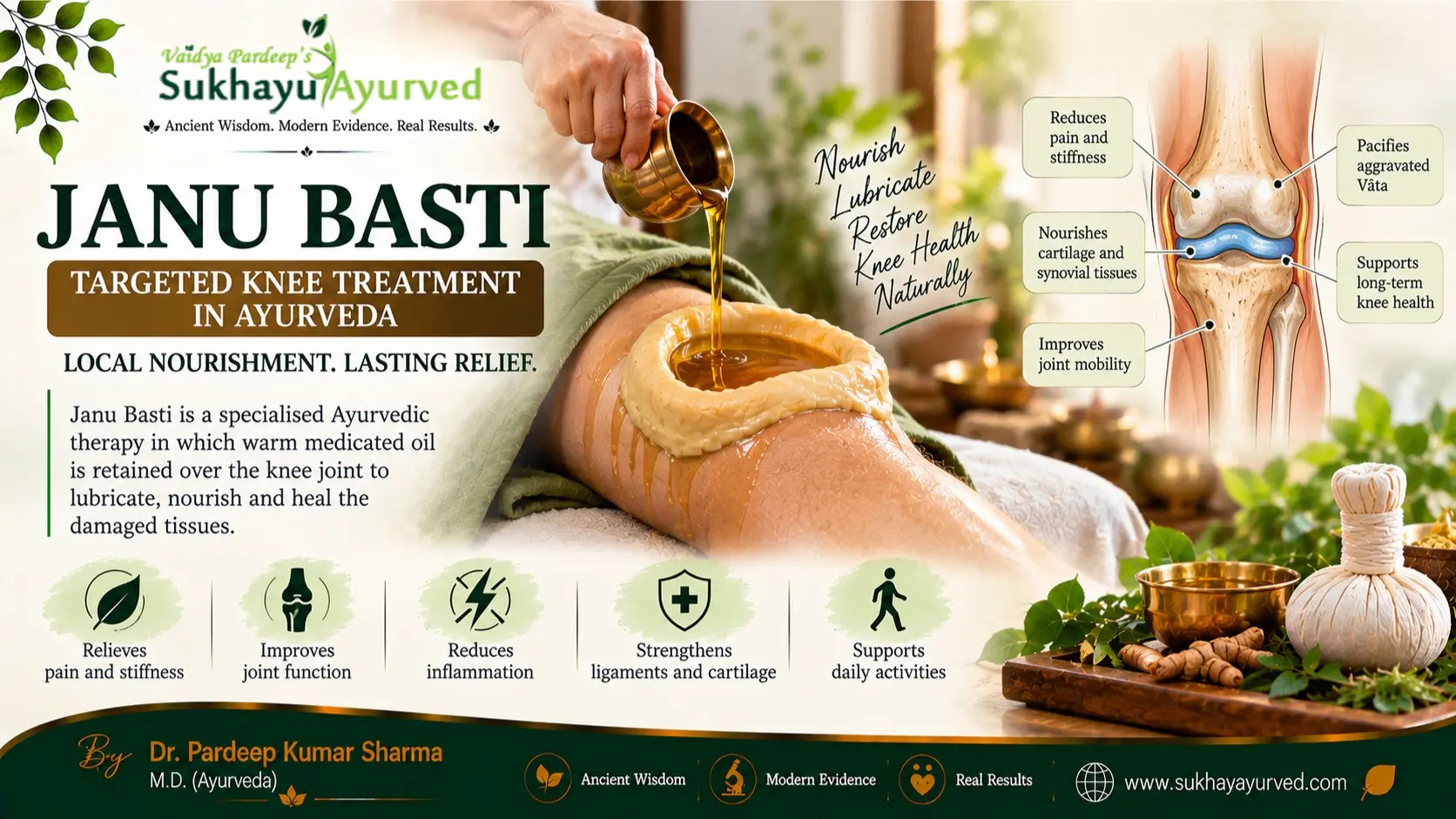
What opposes Vata is Sneha, oil: unctuous, heavy, smooth. That is the whole logic of Janu Basti. Janu means the knee. Basti, in this procedure, means a container or retaining vessel (the same word that names the medicated enema, but a different idea): a vessel is built on the body, and the oil is held inside it. Janu Basti is one of the five external Basti procedures, named for the region they sit on.
Why the oil stays for an hour
The question patients ask is the right one: how can oil sitting on the skin reach a joint? The answer in our practice is the same as for Kati Basti. Dalhana, commenting on Sushruta Samhita, Chikitsa Sthana 24.30, records how long applied oil takes to reach each tissue (Dhatu), counted in Mātrā, the classical unit of time. Skin comes first, then blood, muscle, fat, bone (Asthi), and finally the marrow layer (Majjā) at 900 Mātrā, which we reckon at about an hour. Sukhayu follows Chikitsa 24 completely, so the duration is not a preference. It is set by which tissue is diseased. A sitting of 45 to 60 minutes is how that arithmetic looks in a knee.
This is also the difference between oil and a rub. A counter-irritant masks the pain sensation. The oil in Janu Basti has nutritional as well as medicinal value, and it is given the time the classical texts say it needs to arrive. One acts on how the knee feels. The other is meant to act on what the knee is made of.
What the procedure involves
1. The X-ray comes first. Janu Basti is offered only after the degeneration has been graded on film. The grade decides everything that follows. (The standard scale is the Kellgren–Lawrence grading, grades 0 to 4.)
2. The vessel is built. A fibre mould is fitted around the knee and fixed in place with a paste of Masha, black gram flour, so that it holds the oil without leaking.
3. The oil is held. Warm medicated oil is poured into the mould and kept there for 45 to 60 minutes. The oil is chosen by the physician for the pathology of that particular knee. I do not publish the names, because the choice is the clinical judgment, and a name on a page invites a purchase.
4. The course. One sitting a day for 7 to 15 days. At the end of each sitting the mould is removed.
5. It is never alone. Up to grade III, Janu Basti is one part of a protocol that also draws on Upanaha (a warm medicated poultice bound over the joint), Janu Dhara (a stream of medicated liquid poured over the knee), Tikta Ksheera Basti (a medicated enema of bitter herbs processed in milk), and Pinda Sweda (sudation with warm herbal boluses), together with rehabilitative exercises and traction to strengthen the ligaments and muscles around the knee. I never attribute an outcome to Janu Basti alone, and I would be wary of anyone who does.
No part of this can be done with a kit. A ring of dough and a bottle of oil arrive without a diagnosis, without a grade, without the right duration and without a physician choosing the oil. That is not a smaller version of the treatment. It is a different thing.
Who it is for, and who it is not for
Whether a knee receives Janu Basti is a physician's decision, made after the film. It is not a checklist a patient can apply at home, and that is exactly why the first step is an examination and an X-ray.
In my practice Janu Basti is used for knee osteoarthritis up to grade III, for bursitis, for ligament injuries (where there is no infection), and for stiffness after injury, in knees after fracture and knees after surgery.
It is not for every knee. I do not use it in inflammatory arthritis of the knee or in Baker's cyst, because I have not found results there, and a procedure should be offered only where it has been seen to work. Where the knee has reached grade IV, I refer the patient for surgery. I say so on the first day, not after a course that could never have changed the answer.
What to expect, honestly
During a sitting the patient feels warmth and relaxation. That is all. If a knee is declared "completely better" after two or three sittings, that is placebo, the expectation of treatment, and not a change in tissue. I say this at the first consultation.
In most patients, stiffness, swelling, pain on stairs and the walk itself begin to improve around the seventh day, together with the adjuvant therapies. The timeline does not follow the X-ray grade. Sex, age, body weight and a number of other factors move it, and anyone who promises a fixed date is guessing. Only a few patients need another sitting, usually after about six months.
I measure what can be measured: pain on the VAS scale, the WOMAC index for pain, stiffness and function, walking distance, stair climbing, the time taken to rise from a chair, and the range of knee flexion and extension. The film is for deciding the grade, and I make no claim about what it will look like afterwards.
Closing philosophy
A knee that is rubbed is being asked to feel better. A knee that is treated is being given something. The first takes a few seconds and costs the joint its time. The second takes an hour a day, a diagnosis and a full protocol, and it begins with an honest answer about whether a knee is still within its reach. If your knee has been rubbed and sprayed for months, bring the X-ray and write to us. If you are weighing whether the knee really needs replacing, that is a conversation worth having with the film in hand. Cure is divine. Treatment is possible.
Dr. Pardeep Sharma, M.D. (Ayurveda) is the founder of Sukhayu Ayurved, Jaipur. With over 20 years of clinical experience in Ayurvedic management of orthopedic, neurological and autoimmune conditions.
Medical Disclaimer: This article is for educational purposes and reflects clinical experience and classical Ayurvedic understanding. It is not a substitute for individualized medical diagnosis or treatment. Knee osteoarthritis, bursitis and ligament injuries need examination and imaging by a qualified physician, and some knees need surgery. Janu Basti is a physician-administered procedure and must not be attempted at home. Please consult a registered Ayurvedic physician before starting any treatment, and do not stop prescribed medication without medical advice.
Procedure Profile: Janu Basti — Quick Clinical Reference
Classical description: An external Basti (Bahya Basti) in which warm medicated oil is retained over the knee (Janu) in a vessel built on the body. Condition framework: Sandhigata Vata, in most cases a single-Dosha (Vata) picture. Retaining vessel: Fibre mould fixed with Masha (black gram) flour. Medium: Warm medicated oil, selected by the physician for the pathology of the knee (not named in public articles). Duration of a sitting: 45 to 60 minutes, set by the Dhatu involved (Dalhana on Sushruta Chikitsa 24.30). Course: 7 to 15 days; a repeat sitting is needed in only a few patients, usually after about six months. Used for: Knee osteoarthritis up to grade III; bursitis; ligament injuries (without infection); post-injury stiffness; knees after fracture or surgery. Not offered for: Grade IV osteoarthritis (referred for surgery); knee infection; inflammatory arthritis of the knee and Baker's cyst, where results have not been found. Usually combined with: Upanaha, Janu Dhara, Tikta Ksheera Basti, Pinda Sweda, rehabilitative exercises and traction. Tracked with: VAS, WOMAC, walking distance, stair climbing, chair-rise time, knee flexion and extension.
Related reading on this site: Osteoarthritis — Ayurveda Treatment · Ayurvedic Treatment for Knee Osteoarthritis · External Basti — Kati, Greeva, Janu, Hridaya and Nabhi
External clinical references: Kellgren & Lawrence, Radiological Assessment of Osteo-Arthrosis, Annals of the Rheumatic Diseases (1957), via PubMed · Bellamy et al., Validation study of WOMAC, Journal of Rheumatology (1988), via PubMed