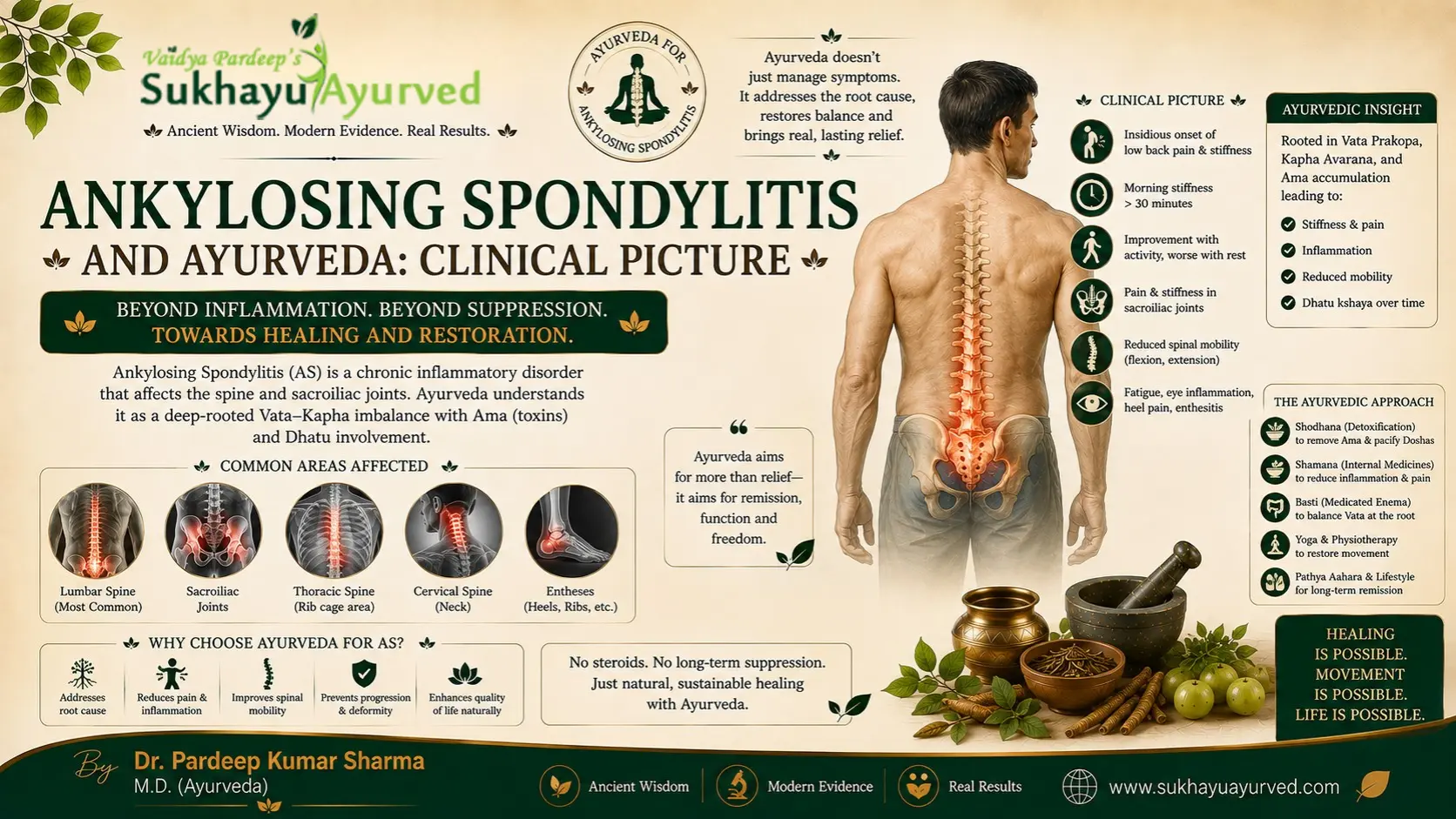
Ankylosing Spondylitis is not a back problem that grew serious. It is a disease that has reached the deepest tissue the body owns — and that single fact decides everything about how it must be treated, and who can still be helped.
Modern medicine does not offer a cure for Ankylosing Spondylitis. Neither does Ayurveda. What Ayurveda offers is something a patient can actually use: the actively destructive process can be brought under control, the march toward fusion can be stopped, and a spine that is stiffening can be kept from jamming completely. Cure is divine. Treatment is possible.
This page explains what Ankylosing Spondylitis actually is in Ayurvedic terms, why the treatment is built the way it is, what we can honestly promise, and — just as importantly — which cases we cannot take.
What Ankylosing Spondylitis Is — and Why It Reaches So Deep
In Ayurveda, Ankylosing Spondylitis is understood as Aamaja Gambheera Vatarakta with Majja Dhatu Dushti. Each word in that phrase is doing work, and together they explain why AS behaves the way it does.
Vatarakta places the disease at the level of Rakta — the blood, and specifically the capillary-level vascular changes that are, in modern terms, exactly what Ankylosing Spondylitis pathologically is. This Rakta Dushti is not idle; it is instigated by Vata, and the two act together.
Majja Dhatu Dushti tells us where the damage lands. Here a common misunderstanding needs correcting: Majja is not only the marrow sitting inside the bony cavity. In Ayurveda, whatever lies between the joints is also framed as Majja. And this matters enormously — because the smooth, frictionless movement of a joint comes from Shleshaka Kapha, and the function of Shleshaka Kapha depends on the snigdhata, the unctuousness, of Majja itself.
So the chain of the disease runs like this:
- Vata-instigated Rakta Dushti — the capillary-level vascular change — begins.
- This disturbs the snigdhata of Majja.
- With Majja's unctuousness lost, Shleshaka Kapha can no longer do its work.
- The joint loses its smooth movement.
- Stiffness sets in, then adhesion, and finally fusion.
This is why AS is a Gambheera — deep-seated — disease. It does not sit in the muscle or the surface of the joint. It sits in Majja, the deepest tissue, which is precisely why it is so difficult, and why so many treatments that work on muscle or inflammation alone never touch the real problem.
Why "Aamaja" — Why AS Never Goes Quiet
Vatarakta is classically of two kinds: Aamaja and Pakwa. This is not a distinction of severity but of state. Aamaja is the actively pathological, live phase of the disease. Pakwa is that same process once it has stabilised, or matured, and gone quiet.
Ankylosing Spondylitis is Aamaja because it never settles. It remains actively inflammatory throughout its course — this is the disease that flares, recedes, and returns, that stays perpetually in motion deep inside even when the patient feels a lull. That perpetual activity is the reason AS cannot be managed by waiting it out, and it is the reason the treatment has to keep working at the root rather than chasing symptoms.
One Disease, Not a Collection of Comorbidities
Patients with Ankylosing Spondylitis are often told they also have uveitis in the eyes, also have gut inflammation — leaky gut, ulcerative colitis — also have skin trouble. Each is handed to a different specialist, as though the body had developed several separate diseases at once.
Ayurveda sees this differently, and the difference is not cosmetic. The problem in the eye, in the gut, in the skin, and in the spine is the same problem: vascular change. It is Rakta Dushti expressing itself wherever the capillaries run. The spine is simply where it shows most loudly. The eye, the gut, the skin — these are not associated conditions travelling alongside AS. They are the one disease, arriving at different addresses through the one Rakta pathway.
This is why, at Sukhayu, extra-articular involvement is never a reason to refuse a case, and never treated as a separate problem bolted onto a spine protocol. When uveitis or gut inflammation is active, the modalities of treatment shift to meet that site — but the diagnosis does not fragment. One root, treated at the root. The therapies flex; the disease stays one.
The Treatment: Rooted in Shastra, Molded to the Patient
There is no fixed program for Ankylosing Spondylitis at Sukhayu, and this is deliberate. We do not sell packages. We treat diagnoses. For a disease that stays perpetually active and expresses itself differently in every patient, treatment must be fluidic — shaped to the condition in front of us and changed as that condition changes.
But fluidic does not mean improvised. Every component is rooted in Shastra, the classical texts. The centre of the treatment is fixed by the texts themselves.
Tikta Ksheera Basti — The Principal Treatment
The principal treatment for Ankylosing Spondylitis is Tikta Ksheera Basti, and the reason it holds that place is worth stating precisely — because it is not a matter of a clever modern rationale.
Tikta Ksheera Basti is prescribed in the classical texts in the treatment of Majja-gata Dushti, and, independently, in the treatment of Vatarakta. Ankylosing Spondylitis is both of these at once. So the Shastra points to this one treatment from two directions simultaneously — it is textually indicated for each half of exactly the pathology we are facing. That convergence, not a functional argument about ingredients, is why it is the principal treatment.
The details of how Tikta Ksheera Basti is administered — the bitter (Tikta) medicines processed with milk (Ksheera), the ghee preparations such as Guggulu Tikta and Maha Tikta, and how it works on the marrow and the microcirculation — are covered in depth in our page on the benefits of Panchakarma in the treatment of Ankylosing Spondylitis.
The Supporting Therapies
Around Tikta Ksheera Basti, therapies are selected according to what the individual patient presents:
- Kashaya Seka — Dhara, the rhythmic pouring of a medicated kashayam over the body, to move the blood and mobilise local toxins.
- Choorna Pinda Swedana — bolus fomentation, brought in particularly where there is an Aamaja and Kaphaja overlap.
- Local Lepana — medicated application over the affected regions.
- Pizhichil — introduced specifically when dryness is exceeded and the tissues need deep unctuous nourishment.
Which of these run, and in what combination, is a clinical judgment made for each patient — not a menu fixed in advance. This is what "molded to the requirement of the patient" means in practice.
For a fuller account of how these procedures work together, see the role of Panchakarma in the treatment of Ankylosing Spondylitis.
What We Can Honestly Promise
We do not use painkillers, and that shapes what recovery looks like. Because pain is treated as information about what is still wrong deep inside — not as something to be silenced — it responds on its own timeline rather than on demand.
Here is what genuinely changes with treatment:
- Stiffness and movement respond first. This is usually the earliest change a patient notices — the spine and joints beginning to move more freely.
- The joints and the spine can be saved from jamming completely. The progression toward fusion can be arrested. This is the central promise of the treatment.
- Pain settles on its own schedule. Without painkillers masking it, pain recedes as the underlying process corrects — gradually, sometimes with fluctuation, because it is tracking a real internal change rather than a drug.
- The whole disease is addressed, not just the spine. Because the eye, gut, and skin involvement share the one Rakta root, treating that root reaches them too.
What we do not claim: we do not claim to cure Ankylosing Spondylitis, to remove the HLA-B27 gene, or to alter what a patient may pass to their children. The gene cannot be undone. What can be done is to bring the active disease under control and give a patient back a normal life — and that is a great deal.
The documented experience of patients treated on this approach is set out in our case series on Ayurvedic treatment for Ankylosing Spondylitis, and in a detailed case study of AS with sciatica.
The Cases We Cannot Take
Honesty about limits is part of the treatment. Ankylosing Spondylitis is refused at Sukhayu for what has structurally happened to the joint — not for how severe the pain is, or how long the disease has run.
We cannot take:
- Complete fusion with complete loss of spinal movement — the extreme, end-stage cases.
- Cases where the joint structure has been lost completely.
The reason is straightforward and follows from everything above: the treatment works by restoring the snigdhata of Majja and the movement it enables. Where the joint is already fused, or the structure is already gone, there is nothing left for that restoration to act on. In such cases we say so plainly rather than take a case we cannot help.
If your spine is stiffening but still moving, this is precisely the window in which treatment does its most important work — arresting the process before that window closes.
HLA-B27, Genetics, and the Environment of Expression
Many patients arrive defined by a single line on a lab report: HLA-B27 positive. It is worth understanding what that does and does not mean. Our detailed discussion of the Ayurvedic treatment protocol for HLA-B27 positive patients covers this in full — including why carrying the gene is not the same as being condemned to its worst expression, and how the internal environment shapes how the disease behaves in the person who carries it.
Living With Ankylosing Spondylitis
Alongside treatment, what a patient does day to day matters — and some common habits quietly make AS worse. We have set out the most important of these in the ten things you should never do with Ankylosing Spondylitis.
Starting Treatment at Sukhayu
Ayurvedic treatment for Ankylosing Spondylitis runs in two broad ways, decided by where the disease has reached:
- Where there is no joint deformity and the disease is early, internal medicines — together with diet and lifestyle correction — can do the work.
- Where deformity has set in or the disease has progressed, deep cleansing through Panchakarma is required, and the patient is admitted for it.
Before anything, we assess whether the case can be treated at all. That assessment begins with a video consultation with Dr. Pardeep, where the stage of the disease and the right path are decided.
Sukhayu Ayurved is a NABH-certified Ayurvedic hospital in Jaipur, with a registry of more than 500+ Ankylosing Spondylitis patients treated, and cashless insurance processing. Ayurvedic treatment here is offered as complementary to your conventional care — never as a reason to stop it. Any change to prescribed medication is a decision for your prescribing physician alone.