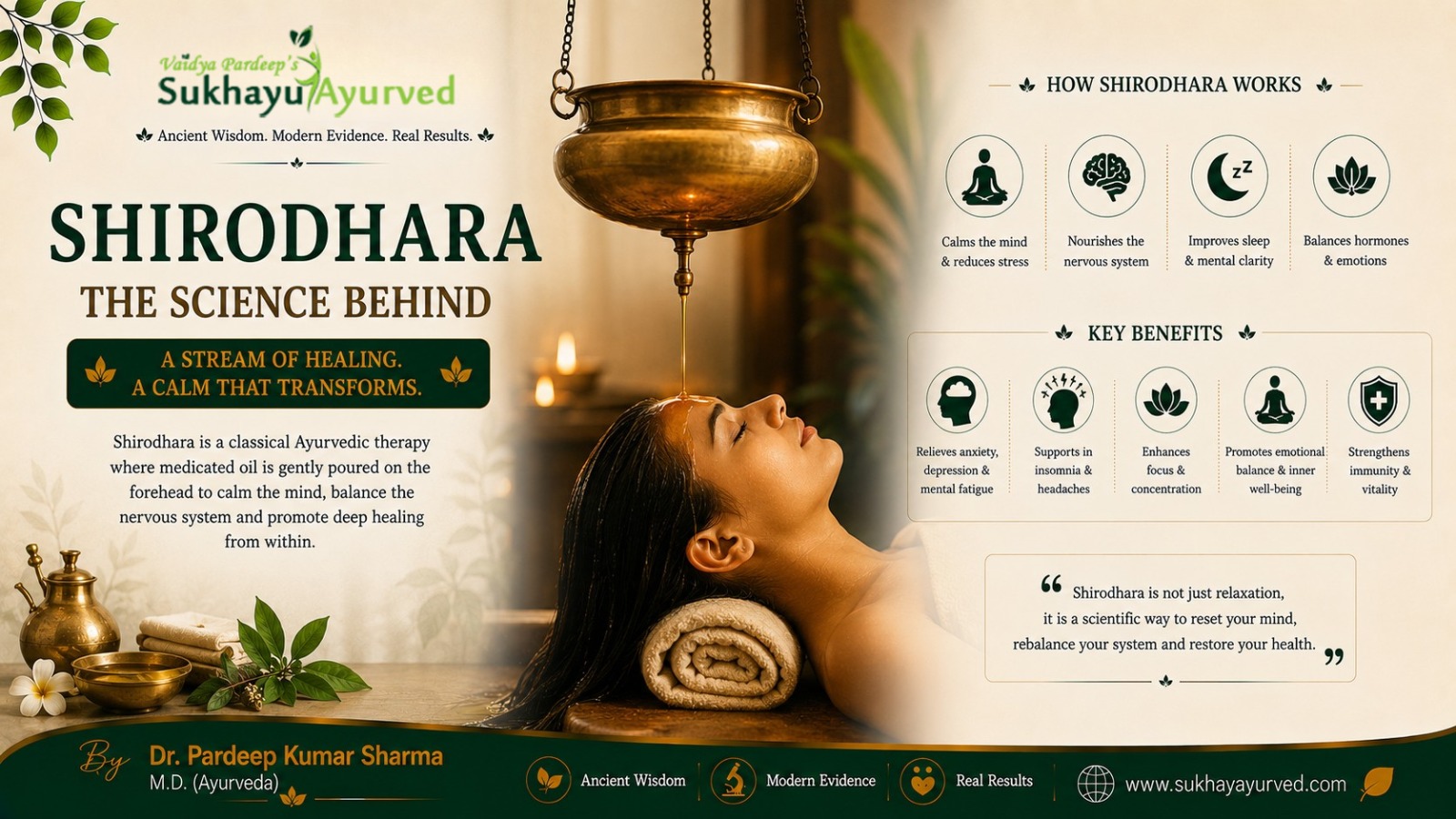
A woman walked into my consulting room a few years ago and put a printout on the desk. Two Shirodhara sessions. Bought online. Resort price.
She was tired. She had read somewhere that Shirodhara was "for stress." And she was right that it would feel wonderful — forty minutes of warm oil moving slowly across the forehead is one of the most pleasant things you can do to a human being.
I asked her one question. Not "will you enjoy it." I knew she would. I asked: is it required?
She looked at me as if I had refused her a glass of water. But that question is the whole of Shirodhara. It is the difference between a procedure and an experience, between medicine and a nice afternoon — and the answer sits in a strange little drawing that every medical student meets in their first year.
The drawing is of a man, but a badly proportioned one. His hands are huge. His lips are huge. His body is a thin strip. He is drawn that way on purpose: each part is sized by how much of the brain is devoted to feeling it, not by how big it actually is. And his forehead — a patch of skin most of us never think about — is drawn far larger than the few square centimetres it covers.
Nobody who first poured oil across a forehead had seen that drawing. They found the spot anyway. Why that spot works, why the oil has to move, why it is prescribed for cerebellar disease and psoriasis and refused for OCD — all of it starts there.
The deeper principle
Let me clear one thing first, because the market has muddied it. Shirodhara is not, strictly, Panchakarma. Panchakarma means five cleansing procedures, and this is not one of them.
Its real home in the classics is a quieter chapter. Vagbhata's Ashtanga Hridaya (Sutrasthana 22) describes four ways of applying oil to the head, together called Murdhni Taila: massaging it in (Shiro Abhyanga), holding a soaked pad on the crown (Shiro Pichu), pooling it in a reservoir on the head (Shiro Basti), and pouring it in a stream — Shiro Seka. That last one is Shirodhara. Vagbhata ranks the four by intensity, and Seka sits third.
So what is it? A supportive procedure. External oleation for the head. The classics give it clear jobs: Vata that has settled in the Shiras (the head), broken sleep, disorders of the head, and a mind that will not come to rest. Nowhere is it a tonic for being tired. Nowhere is it described as an experience.
That distinction — procedure versus experience — is the whole argument. Treatment is for treatment, not for enjoyment. Experiencing Shirodhara may be a very good experience. But is it required?
What this looks like in the OPD
Here is where Shirodhara is actually prescribed at Sukhayu, and it is not the list most people expect:
- Spinocerebellar ataxia and cerebellar atrophy — degenerative conditions where the tremor and the imbalance are only half the picture; the other half is a nervous system that has lost its stillness.
- Paralysis in active rehabilitation.
- Parkinson's disease where cognitive change has begun alongside the motor symptoms.
- Irritable bowel syndrome — a gut that flares with the mind.
- Psoriasis — a skin that flares with the mind.
- Premenstrual and perimenopausal presentations in women, where the hormonal shift arrives as a storm in the Manas (the mind) before it arrives anywhere else.
What unites gut, skin, hormones and cerebellum on one list? The psychosomatic axis. In every one of these, the disease is either driven or amplified by a mind that cannot come to rest, and Shirodhara is the procedure that reaches that trigger. It does not treat the organ. It treats the input.
And here is where it is refused:
- Obsessive-compulsive presentations. Most people assume Shirodhara is for an anxious, looping mind. It is not. OCD, in classical terms, is a Kapha-dominant Unmada — a mind held in place, stuck on a thing, with Pitta's analysis and Vata's movement both suppressed. Shirodhara is Snigdha (unctuous) and Guru (heavy) by nature; it stabilises. Applied to a mind that is already too stable, it deepens the very holding you are trying to release.
- Low blood pressure. Shirodhara lowers sympathetic tone. On a patient whose pressure is already low, that is not a benefit.
- Aggravated Kapha states generally — heaviness, congestion, dullness, undigested Ama — for the same reason: you do not add weight to a system already weighed down.
Three refusals, one principle. Shirodhara is a Vata instrument. The first clinical act is not hanging the vessel; it is deciding which Dosha is holding the mind.
The mechanism — why, not just that
Two things I will not tell you, because they are not true. The oil does not reach your brain. Nothing poured on the forehead crosses the skull. And the "third eye" story — the Ajna chakra, the pineal gland being "activated" by the stream — is a mystical exposition, not medicine. If a centre explains Shirodhara to you that way, it is explaining a mood, not a mechanism.
What actually happens is more interesting, and it begins with that distorted figure in the textbook.
The forehead has more brain than it deserves. Touch the forehead and the signal runs along a branch of the trigeminal nerve, through the brainstem and the thalamus, and lands in the strip of cortex that handles feeling — in the face area, just below the hand and just above the eyes and lips. What matters is the ratio. A small patch of forehead skin is read by a very large crowd of neurons; that is exactly what the badly proportioned man in the textbook is showing. Ackerley and colleagues, comparing touch across different parts of the body, found the forehead among the most sensitive regions for detecting and discriminating gentle touch. Ayurveda chose this patch of skin without knowing why it was special. Modern neuroanatomy observes why.
The stream moves — and the movement is the point. Shirodhara differs from Shiro Pichu and Shiro Basti in one respect: the oil is not stationary. The Dhara is swept slowly across the forehead in a continuous oscillation. Hairy skin — and the forehead is hairy skin, however fine the hair — carries a class of unmyelinated fibres called C-tactile afferents that fire most strongly to slow, gentle, moving touch at a few centimetres per second, and that project not to the sensory cortex but to the posterior insula, the region that reads the body's internal state and feeds the emotional and autonomic circuitry. Morrison, Björnsdotter and Olausson (2011) showed the posterior insula tuned precisely to this speed of touch. A warm, slow, rhythmic stream across the forehead is close to an ideal stimulus for that pathway.
And the signal does not stop at the cortex. From the somatosensory and insular cortex, the input cascades into the regulatory networks — the hypothalamus, the autonomic centres, the stress axis — where it produces measurable physiological change. This is the part the small studies have begun to record. Dhuri, Bodhe and Vaidya (2013), in healthy volunteers, found a single session lowered breathing rate, diastolic pressure and pulse, and raised alpha-wave activity on EEG — the pattern of alert relaxation. Rajan, Shamkuwar and Tanwar (2021) documented a 35-year-old woman with sleep loss, poor concentration and irritability, given sesame-oil Shirodhara for 45 minutes daily for 14 days with no internal medicine: serum cortisol fell from 14.52 to 9.45 µg/dL, DHEA from 36.50 to 21.50 ng/dL, and her total mood disturbance score moved from 49 to −21.
A note on honesty about what these studies are. They are small; one is a single case. The suggestion that the falling stream's kinetic energy generates a "voltage" that stimulates nerve conduction is a hypothesis in the literature, not an established fact. Claims about serotonin and melatonin remain inferential. Science should not be a dogma; it should have open horizons — and open horizons cut both ways. What the data consistently show is a shift in autonomic tone and stress hormones in the direction the classics describe as Vata coming down from the Shiras. That is enough to take seriously, and not so much that it needs embellishing.
So when the procedure page says "relaxation response," that phrase is accurate and it undersells. What Shirodhara produces is a period of enforced, meditative stillness — imposed from the outside on a mind with too many thoughts — through a sensory pathway that runs straight into the machinery of emotion and stress. For a patient with cerebellar atrophy whose nervous system has forgotten how to be quiet, or a psoriasis patient whose plaques bloom with every argument, that stillness is not a luxury. It is the condition under which the rest of the treatment can act.
Practical application — how it sits inside a treatment
Shirodhara alone is not the treatment. The treatment is a package, and no package shows immediate results. If someone is given an antibiotic alone — no fluids, no antipyretic, no rest — the infection is not solved, however good the antibiotic. Ayurveda is not as heavily quantified as modern medicine, but the basic system is the same: many dimensions, many layers, at the same time.
So in practice, the question is never "Shirodhara or not" but "Shirodhara with what":
- In spinocerebellar ataxia, it runs alongside Basti and Pinda Sweda; Anna Lepana is added where spasticity dominates, Pizhichil where tremor does.
- In IBS, Shirodhara with oral medicine is often sufficient.
- In psoriasis, it is specifically Takra Dhara — the buttermilk form — and it is paired with Vamana and Virechana, the cleansing procedures that address the Pitta-dominant tridoshic picture the skin is showing.
Which liquid, how many days, whether a short Abhyanga precedes it, whether Nasya joins the protocol — all of that is decided by the case, and in every patient it goes differently. The mechanics of a session, the three Dhara liquids and the full contraindication list are on the Shirodhara procedure page; read that for what is done. This article is about why, and whether.
Which brings me back to the two coupons. I did not use them. We talked instead about what was actually going on — and the answer, in her case, was a plan that included Shirodhara, but as its third component, not its first. She would have had a pleasant afternoon at the resort. She would not have been treated.
If you are considering Shirodhara for a neurological, autoimmune, gut or hormonal condition, the first step is the same one it always is: a consultation where the condition and the Dosha holding it are assessed before any procedure is chosen. You can book a consultation with Sukhayu Ayurved directly, or reach us on WhatsApp at 9050802060.
Closing philosophy
A patch of skin the size of a palm, given more brain than its size deserves, touched slowly and warmly for forty minutes — and a nervous system that has been shouting for years goes quiet. There is nothing mystical in that. There is anatomy, and there is the discipline to use it only when it is needed. The classics never promised that Shirodhara would cure anything; they described what it does and for whom, and left the choosing to the physician. That is still the job. Cure is divine. Treatment is possible.
Dr. Pardeep Sharma, M.D. (Ayurveda) is the founder of Sukhayu Ayurved, Jaipur. With over 20 years of clinical experience in Ayurvedic management of orthopedic, neurological and autoimmune conditions.
Medical Disclaimer: This article is for educational purposes and reflects clinical experience and classical Ayurvedic understanding. It is not a substitute for individualised medical diagnosis or treatment. Shirodhara is a physician-prescribed procedure with specific indications and contraindications; it should not be self-selected or purchased without a clinical assessment, and it does not replace the primary treatment of any neurological, autoimmune or psychiatric condition. Please consult a registered Ayurvedic physician before undergoing Shirodhara or any Panchakarma procedure.
Shirodhara — Quick Clinical Reference
Classical description: Shiro Seka, one of the four Murdhni Taila procedures in Ashtanga Hridaya Sutrasthana 22 (with Shiro Abhyanga, Shiro Pichu and Shiro Basti); a form of Bahya Snehana, not one of the five Shodhana Karmas. Full classical entry: Shirodhara — Charak Samhita online.
Primary Dosha action: Pacifies Vata seated in the Shiras; secondarily calms Pitta. Increases Kapha — which is why it is refused in Kapha-dominant states.
Where Sukhayu prescribes it: Spinocerebellar ataxia, cerebellar atrophy, paralysis rehabilitation, Parkinson's with cognitive change, IBS, psoriasis (as Takra Dhara), premenstrual and perimenopausal presentations.
Where Sukhayu refuses it: OCD (a Kapha-dominant Unmada), low blood pressure, aggravated Kapha states. See the procedure page for the complete contraindication list.
Always within a protocol: With Basti, Pinda Sweda, Anna Lepana or Pizhichil in cerebellar disease by symptom; with oral medicine in IBS; with Vamana and Virechana in psoriasis.
What it is not: Not Panchakarma in the strict sense; not oil "reaching the brain"; not a third-eye activation; not a stand-alone therapy; not a general remedy for tiredness.
External clinical references: Dhuri KD, Bodhe PV, Vaidya AB. Shirodhara: a psycho-physiological profile in healthy volunteers. J Ayurveda Integr Med 2013 (PMC3667433) · Rajan S, Shamkuwar MK, Tanwar AK. Impact of Shirodhara on biological markers of stress: a case study. J Ayurveda Integr Med 2021 · Ackerley R et al. Touch perceptions across skin sites. Front Behav Neurosci 2014 · Morrison I, Björnsdotter M, Olausson H. Vicarious responses to social touch in posterior insular cortex are tuned to pleasant caressing speeds. J Neurosci 2011