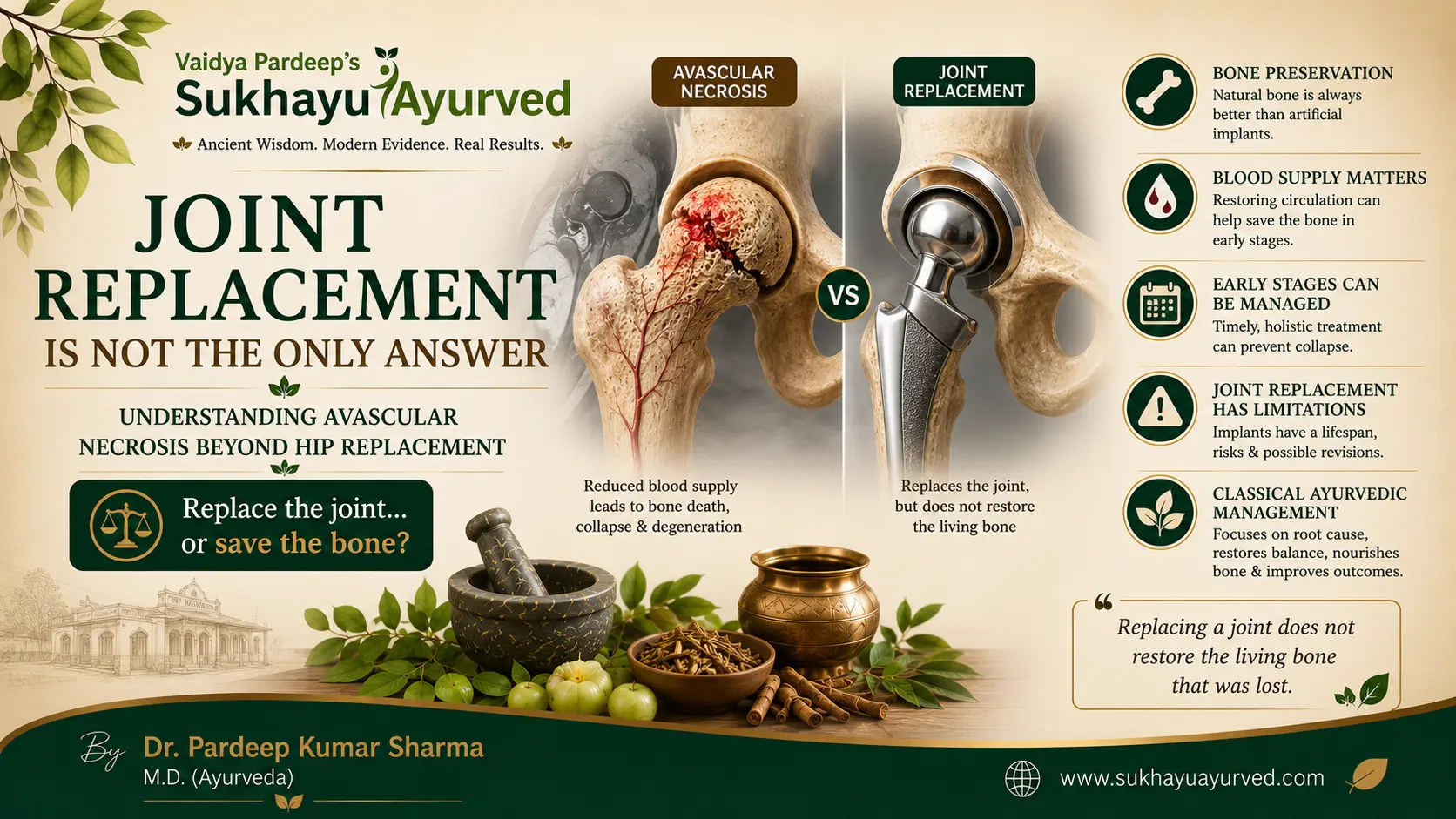
"You'll be walking normally by the second day."
That one sentence has sent thousands of avascular necrosis patients into an operating theatre. And I understand why it works. When you are in pain, when every step is a negotiation with your own hip, when you have started measuring your life in staircases you can no longer climb — any promise of "normal" feels like rescue.
I want to be clear about something before I say anything else.
I do not hate surgeons. I do not hate allopathy. I refer patients for surgery myself — the ones whose disease has progressed too far for Ayurveda to genuinely reverse. I have never felt bad about that referral, because for those patients it is the honest, ethical choice.
So this is not an anti-surgery rant. This is a disagreement with one specific, oversold idea: that joint replacement is a solution for avascular necrosis. It is not. For many patients — especially the early-stage ones being rushed to the table — it is the wrong first move. And I can tell you exactly why.
First, what avascular necrosis actually is
Avascular necrosis (AVN), also called osteonecrosis, is what happens when the blood supply to a section of bone gets cut off. Starved of blood, the bone tissue begins to die. In the hip — the most common site — the femoral head slowly loses its structural integrity and, if nothing changes, eventually collapses.
The critical thing most patients are never told plainly: AVN is staged. Doctors classify it using the Ficat and Arlet system, which runs from Stage I (the bone is dying but still intact) through to Stage IV (the femoral head has collapsed and the joint is arthritic). That distinction is everything. Early-stage AVN, before the bone collapses, behaves completely differently from late-stage AVN — and, as the orthopaedic literature itself notes, treating early AVN can postpone or avoid joint replacement altogether, which is exactly why early diagnosis and staging matter so much.
Here is the part that should make you pause: AVN strikes early. It commonly affects adults between 20 and 40 — people with decades of walking, working, and living ahead of them. And it is exactly this young, early-stage group that is most often frightened into a replacement they may not need for years, if ever.
Joint replacement removes the dead bone and the problem it caused. What it does not do is address why the blood supply failed in the first place — which is why the same underlying process can quietly threaten the other hip, and other joints, while everyone celebrates the "successful" surgery.
If you want to understand why so many of these cases are appearing now, read our piece on post-COVID avascular necrosis — the numbers have climbed sharply since the pandemic.
Reason 1: A replacement is not permanent — and everyone knows it
This is the part the "walk on day two" pitch skips.
An artificial hip is a mechanical part. Mechanical parts wear out. For AVN patients — who are frequently young, in their 30s and 40s — this is the whole problem. A prosthesis has a finite lifespan. A 38-year-old getting a hip replacement is not getting a solution; they are getting the first of what may be two or three surgeries across their lifetime.
Each revision surgery is harder than the last. There is less healthy bone to anchor into, more scar tissue, higher complication rates, and worse outcomes. The first replacement is sold as the finish line. It is closer to the starting gun. (If a knee is what's on the table, this is worth reading first: Do You Really Need Knee Replacement?)
Reason 2: It treats the joint, not the disease
Osteonecrosis is very often systemic. Steroid use, alcohol, clotting disorders, sickle cell disease, lupus, and — increasingly — the post-COVID inflammatory picture we now see regularly, these are not "hip problems." They are body problems that showed up in the hip first.
Replace the hip, and the femoral head is gone — but the biological process that killed it is untouched. This is why bilateral AVN (both hips) is common, and why a patient can go through one replacement only to watch the other side deteriorate. Surgery is a fix for the symptom that has already collapsed. It is not a fix for the mechanism.
Reason 3: The real complications are not the ones you're warned about
Every consent form mentions infection and clots. Those are real, but they are the known risks. The ones that matter more for a young AVN patient are the quiet, long-tail ones:
- Aseptic loosening — the implant working loose from the bone over years, in the absence of any infection. This is the single most common reason hip replacements fail and have to be redone, accounting for a large share of all revision surgeries across national joint registries.
- Metal wear and ion exposure — friction at the implant surfaces releases microscopic metal debris, and with some metal-on-metal designs, metal ions enter the bloodstream. This isn't a fringe worry: the US FDA warns patients directly that metal particles can cause a reaction around the joint leading to bone and tissue deterioration, implant loosening, and device failure — and that ions travelling through the bloodstream may cause problems elsewhere in the body.
- Periprosthetic fracture — the bone around the implant breaking, a serious and increasingly common problem as patients live longer with their hardware.
- Persistent pain and altered gait — a meaningful minority of patients simply never feel "normal" again, despite a technically perfect operation.
A "successful surgery" and a "happy patient" are not the same statistic, and they are not reported the same way. There's more your surgeon may not spell out — we cover it in 5 Things Your Doctor Hides From You About AVN.
Reason 4: The decision is often driven by economics, not just biology
I will say this carefully, because it is uncomfortable. Joint replacement is a high-volume, high-value procedure. There is commercial pressure in that ecosystem — implant choices influenced by "price and package" as much as by long-term biocompatibility, and a bias toward operating early rather than watching and treating.
That does not make every surgeon greedy. Most are honest people trying to relieve suffering. But it does mean the system nudges toward the operating table, and the patient — scared, in pain, and told they'll walk on day two — is in no position to push back. The thin line between an ethical recommendation and a routine sale is one the patient can't see from where they're standing.
What I am not saying
I am not telling you to refuse surgery. If your femoral head has already collapsed — late-stage, Ficat III or IV — a replacement may genuinely be your best and most honest option, and I will tell you that to your face. I refer those patients myself.
What I am saying is: do not let "you'll walk on day two" be the reason you skip the conversation about whether you needed it yet at all.
Why Ayurvedic treatment is a real alternative — for the right stage
Here is the honest version, not the marketing version.
Ayurvedic treatment for AVN does not "melt away" a collapsed joint, and anyone promising that is lying to you. What it can do — in early and moderate stages, before structural collapse — is work on the underlying pathology: improving the local circulation to the bone, addressing the systemic inflammation and dosha imbalance driving the necrosis, and giving the bone the internal environment it needs to arrest the damage and rebuild.
The advantage that surgery structurally cannot match: it protects the rest of you. Because the treatment targets the process rather than the part, it works with the other hip, the other joints, and the systemic drivers — instead of leaving them to fail next. What you eat matters here too; see our guide to the real diet for avascular necrosis.
And when it works, this is what "normal" actually looks like: patients who send me a photo from the top of a trek. Women who go on to have children. A man who messaged me a video of himself dancing at a wedding. Those are outcomes a prosthesis was never designed to give — because those are outcomes of a saved joint, not a replaced one.
The one question worth asking before you consent
Before you agree to a joint replacement for avascular necrosis, ask your surgeon one thing:
"What stage is my AVN — and if we wait and treat it, what specifically do I lose?"
If the honest answer is "your bone has already collapsed," listen to them. But if the answer is vague, or the pressure to book the surgery is stronger than the explanation of why you need it now, that is your signal to get a second opinion before you get an implant.
You can replace a joint once. You cannot un-replace it.
For a stage-appropriate assessment of your avascular necrosis, book a consultation with Sukhayu Ayurved or send your reports and imaging over WhatsApp for review.