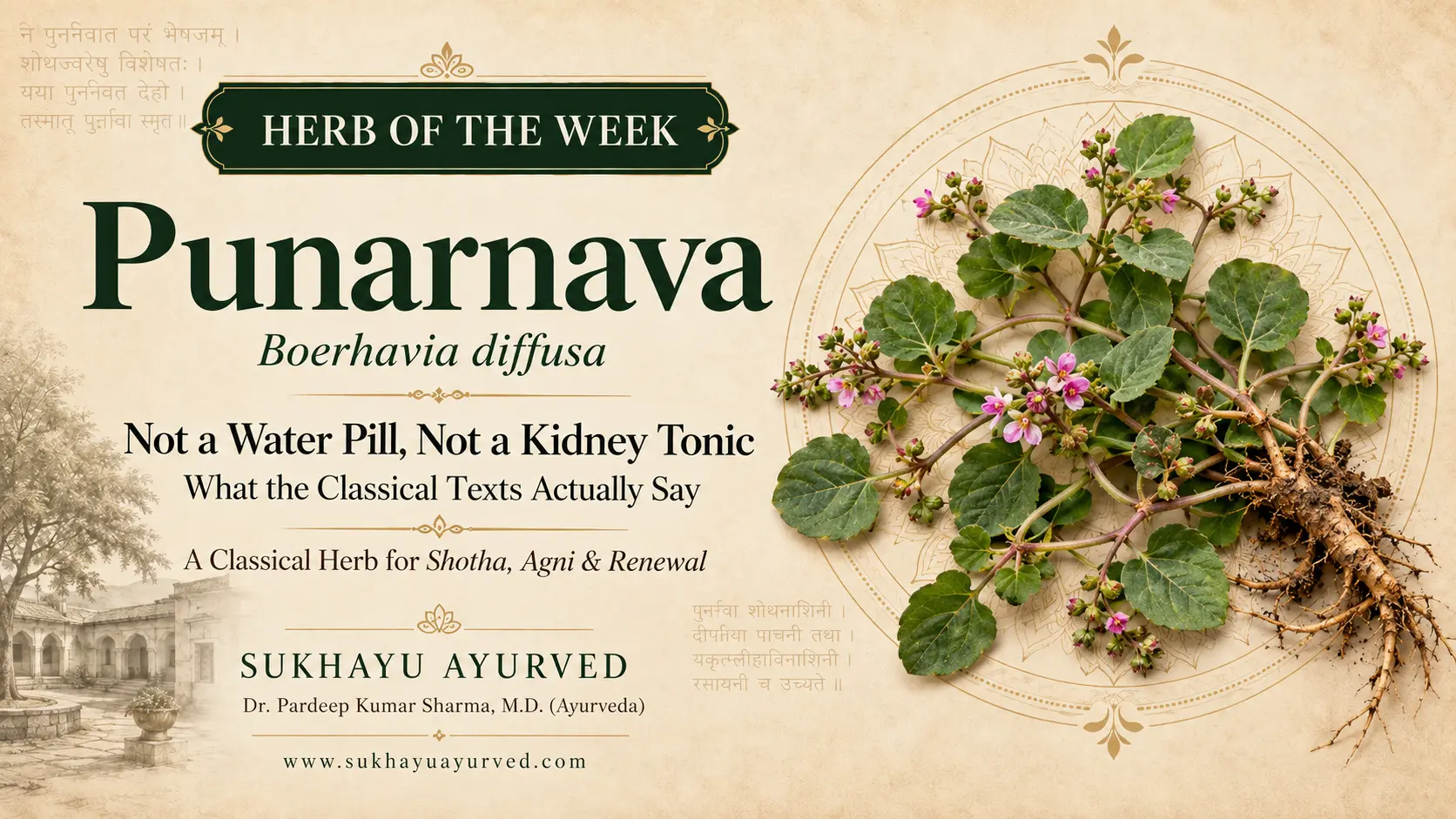
Search for Punarnava today and the name does all the selling. Punar means again; nava means new. So, the story goes, Punarnava is the herb that makes you new again. It renews the whole body, regenerates the liver, flushes the kidneys, and it arrives in a capsule, two a day, no questions asked.
Taken as a promise about a capsule, that sentence is not true. Taken as a line from the classical texts, part of it is. The difference between those two readings is the whole subject of this article, because it is also the difference between a herb and a prescription.
The deeper principle: what Shotha actually is
Punarnava's reputation rests on Shotha, or Shvayathu: swelling. The modern reading is simple. Swelling is retained fluid, so the herb that treats swelling must remove fluid, and the herb that removes fluid must be a diuretic. Every step of that reasoning sounds sensible. None of it is how Charaka describes Shotha.
Start with who develops it. In the Shvayathu Chikitsa chapter (Charaka Samhita, Chikitsa Sthana 12), the causes are laid out like this:
शुद्ध्यामयाभक्तकृशाबलानां क्षाराम्लतीक्ष्णोष्णगुरूपसेवा| दध्याममृच्छाकविरोधिदुष्टगरोपसृष्टान्ननिषेवणं च||५|| अर्शांस्यचेष्टा न च देहशुद्धिर्मर्मोपघातो विषमा प्रसूतिः| मिथ्योपचारः प्रतिकर्मणां च निजस्य हेतुः श्वयथोः प्रदिष्टः||६||
Śuddhyāmayābhaktakṛśābalānāṁ kṣārāmlatīkṣṇoṣṇagurūpasevā | dadhyāmamṛcchākavirodhiduṣṭagaropasṛṣṭānnaniṣevaṇaṁ ca || 5 || arśāṁsyaceṣṭā na ca dehaśuddhirmarmopaghāto viṣamā prasūtiḥ | mithyopacāraḥ pratikarmaṇāṁ ca nijasya hetuḥ śvayathoḥ pradiṣṭaḥ || 6 ||
In people weakened by purification therapy, by illness, by fasting, or by emaciation, Shotha follows the use of alkaline, sour, sharp, hot and heavy things. It follows curd, raw or unripe food, clay, certain vegetables, incompatible, spoiled or toxic food. It follows piles, inactivity, neglected purification, injury to a Marma (a vital point), abnormal childbirth, and treatments given wrongly.
That is not a description of a body holding too much water. It is a depleted body that has been fed and treated badly.
Then comes the mechanism, the Samprapti (the pathway by which the disease forms):
बाह्याः सिराः प्राप्य यदा कफासृक्पित्तानि सन्दूषयतीह वायुः| तैर्बद्धमार्गः स तदा विसर्पन्नुत्सेधलिङ्गं श्वयथुं करोति||८||
Bāhyāḥ sirāḥ prāpya yadā kaphāsṛkpittāni sandūṣayatīha vāyuḥ | tairbaddhamārgaḥ sa tadā visarpannutsedhaliṅgaṁ śvayathuṁ karoti || 8 ||
When Vayu reaches the Bahya Sira, the outer vessels, it vitiates Kapha, Rakta and Pitta there. Its own path is then blocked by them. Spreading while obstructed, it produces Shvayathu, whose defining sign is Utsedha: raised, elevated swelling.
Read that carefully, because it overturns the modern picture. The prime mover of Shotha is Vata, and the swelling is Vata imprisoned by the very Doshas it has disturbed. Shotha is obstructed movement, not stored water. Treating it means clearing the obstruction so that movement is restored. It does not mean draining the swelling.
Where Charaka actually placed Punarnava
If Punarnava were a diuretic, Charaka had the right place for it. In Sutra Sthana 4 he lists fifty groups of ten herbs (the Dashemani), each defined by action. One group acts on urine:
वृक्षादनीश्वदंष्ट्रावसुकवशिरपाषाणभेददर्भकुशकाशगुन्द्रेत्कटमूलानीति दशेमानि मूत्रविरेचनीयानि भवन्ति
Vṛkṣādanī-śvadaṁṣṭrā-vasuka-vaśira-pāṣāṇabheda-darbha-kuśa-kāśa-gundra-itkaṭa-mūlānīti daśemāni mūtravirecanīyāni bhavanti
These ten — the roots of Vrikshadani, Shvadamstra, Vasuka, Vashira, Pashanabheda, Darbha, Kusha, Kasha, Gundra and Itkata — are the Mutravirechaniya, the promoters of urine.
Punarnava is not among them. Charaka places it in four other groups:
- Vayasthapana — the age-sustaining group
- Kasahara — the cough-relieving group
- Svedopaga — adjuncts to sweating therapy
- Anuvasanopaga — adjuncts to the oil enema
Put those four next to the Samprapti above and the picture fits. Sveda (therapeutic sweating) liquefies and moves obstructed Kapha, which is exactly what is blocking Vata in the outer vessels. Anuvasana Basti, the oil enema, is the prime treatment for Vata itself, the imprisoned mover. Kasahara carries the same action into the channels of breath, which is why Punarnava appears in Shwasa (breathlessness) and Kasa (cough). And Vayasthapana speaks to the patient verse 5 described: depleted, weakened, emaciated. A herb for that patient must rebuild as well as clear.
So Charaka describes a herb that frees obstructed Vata, moves Kapha and restores depleted tissue. Nowhere in his classification is it a herb that acts on urine.
The verse behind the name
Now for the renewal claim, because it deserves an honest answer rather than a dismissal. It does exist in the classical literature. In the Rasayana chapter of Ashtanga Hridaya (Uttara Sthana 39), Vagbhata writes:
पुनर्नवस्यार्धपलं नवस्य पिष्टं पिबेद्यः पयसाऽर्धमासम्| मासद्वयं तत्त्रिगुणं समां वा जीर्णोऽपि भूयः स पुनर्नवः स्यात्||१५४||
Punarnavasyārdhapalaṁ navasya piṣṭaṁ pibedyaḥ payasā'rdhamāsam | māsadvayaṁ tattriguṇaṁ samāṁ vā jīrṇo'pi bhūyaḥ sa punarnavaḥ syāt || 154 ||
Whoever drinks a measured quantity of fresh Punarnava, ground to a paste, with milk, for half a month, for two months, for three times that, or for a full year, even if worn by age, becomes punarnava again: new once more.
The verse plays on the herb's name, and it does promise renewal. Look at everything it requires, though:
- Navasya — the herb must be fresh. It does not say dried, powdered, extracted or encapsulated.
- Pishtam — ground into a paste. The whole plant material is used, not an isolate.
- Payasa — taken with milk. The vehicle is part of the prescription.
- A disciplined duration — a formal course measured in weeks, months or a year.
- Rasayana Vidhi — the verse sits inside the Rasayana chapter, whose rules require a prepared body, a correct diet and correct conduct before any Rasayana is expected to act.
So the renewal is real, and it belongs to that regimen. The capsule version keeps the promise and drops every condition that made the promise possible. That is not a small edit. It turns a physician-supervised Rasayana into an over-the-counter slogan.
Clinical reality: where Punarnava earns its place
Shotha is a broad term, and Punarnava is not prescribed for "swelling" in general. In our practice it earns its place in two patterns in particular.
The first is celiac disease in which Agnimandya (a weakened digestive fire) sits alongside deranged liver function. These patients are often the depleted body of verse 5: undernourished despite eating, heavy, bloated, with liver enzymes that won't settle. Here Punarnava's Deepana action (kindling Agni) and its action on the liver work together, and it responds well. It never works alone. It is part of a full protocol of diet, oral medicines and procedures, and the outcome belongs to that protocol.
The second is Kapha-dominant presentations, where accumulated Kapha is clogging the channels, whether in the respiratory tract, the digestive tract or the tissues. Here Punarnava helps clear Kapha, which is exactly what its Svedopaga and Kasahara placements predict. The same reasoning explains its classical role in liver disorders more broadly, including fatty liver, where Kapha and Meda (fat tissue) obstruct a sluggish Agni.
"But I did lose water on it"
Yes, you probably did. Patients do lose water with Punarnava. That pharmacological effect is real, and nothing in this article denies it.
What the classical texts do not do is build the herb's use on that effect. What a patient sees on the weighing scale is not what the physician is prescribing it for. When a herb is chosen because it makes the scale drop, it is being used as a modern diuretic in an Ayurvedic costume, and that is precisely the reading Charaka's classification rules out.
Why I do not prescribe Punarnava in CKD
This is the most searched claim about Punarnava, so it deserves a plain answer. I do not use Punarnava in chronic kidney disease, and I am not a supporter of the practice.
The reason is the classification itself. Ayurveda has a named group of urine-acting herbs, the Mutravirechaniya, and Punarnava is not in it. The chain of reasoning behind "Punarnava for kidneys" runs like this: it is a diuretic, so it is a kidney herb, so it can support or stand in for diuretics in renal disease. That chain is built on a label the classical texts never gave it. Moving Punarnava into a kidney protocol on the strength of that label, or treating it as a herbal replacement for diuretics, is simply not relevant to how Ayurveda classifies the herb.
Kidney disease needs its own diagnosis and its own reasoning. How we approach it is described on our chronic kidney disease page.
The mechanism: why the classical reading holds
The Rasa-Guna-Veerya-Vipaka profile explains the action better than any label. Punarnava is Tikta (bitter), Madhura (sweet) and Kashaya (astringent) in taste. It is Laghu (light) and Rooksha (dry) in quality, and Ushna (hot) in potency. The heat and lightness kindle Agni and cut through Kapha and Ama. The bitterness clears obstruction in the channels. The sweetness links to its Vayasthapana role, since a purely scraping herb could not rebuild a depleted patient.
That profile does exactly what the Samprapti of Shotha asks for. It lightens and moves the Kapha that has blocked Vata's path, restores Agni so that fresh Ama stops forming, and supports the tissue that depletion has weakened. The swelling settles because the obstruction behind it clears.
Modern laboratory work offers a parallel observation, not a validation. Animal studies of aqueous Punarnava preparations, including Swarasa (fresh juice) and Hima (cold infusion) made by the classical methods, have reported protective effects on the liver under experimental injury (Kaushik et al., Pharmacognosy Magazine, 2017). A broad review of the plant's pharmacology catalogues anti-inflammatory and hepatoprotective activity alongside its better-known effect on urine (Mishra et al., BioMed Research International, 2014). These findings sit beside the classical account. The classical account does not need them to stand.
Practical application: forms, and whose decision the rest is
Punarnava reaches patients in several classical forms. Each exists for a reason.
- Swarasa — the fresh juice, the most potent classical preparation, closest to the navasya of the Rasayana verse.
- Kwatha — a decoction, suited to conditions where a lighter, warmer, channel-clearing preparation is wanted.
- Churna — the dried powder, the most convenient form and the one furthest from the fresh plant.
- Punarnavadi Mandura — a classical iron-based formulation, used in Pandu (anaemia) with Shotha and liver involvement.
- Punarnavashtaka Kwatha — a classical eight-ingredient decoction for Shotha.
Formulations like the last two are Aaptopadesha: received, verified compositions. They are not recipes for patients or practitioners to reassemble or modify.
The dose, the Anupana (the vehicle it is taken with), the timing and the duration are the physician's decisions. This article gives no quantities deliberately. They depend on the diagnosis, the state of Agni, the Dosha picture and the other medicines a patient is taking. A dose copied from the internet carries none of that information. The broader case against self-prescribing is laid out in why no herb should ever be taken blindly.
Closing philosophy
There is a quiet lesson in this herb's name. The word that sells Punarnava online is the same word Vagbhata used. The internet kept the word and dropped the conditions. The fresh plant, the paste, the milk, the months of discipline and the prepared body were all quietly removed. What was left was a promise without a method. Ayurveda has never worked like that. A herb does not heal because of what it is called. It acts through what it is and on the body it meets, and only when it meets the right body at the right time. Punarnava can clear swelling, kindle a failing Agni and support a burdened liver, but only inside a diagnosis and inside a protocol. Outside them, it is just a plant in a capsule with a beautiful name.
Cure is divine. Treatment is possible.
Dr. Pardeep Sharma, M.D. (Ayurveda) is the founder of Sukhayu Ayurved, Jaipur. With over 20 years of clinical experience in Ayurvedic management of orthopedic, neurological and autoimmune conditions.
Medical Disclaimer: This article is for educational purposes and reflects classical Ayurvedic understanding and clinical experience. It is not a prescription and not a substitute for individual diagnosis or treatment. Swelling of any kind needs a proper diagnosis before any treatment. Kidney disease, liver disease, heart disease and respiratory disease all require supervision by qualified physicians. Please consult a registered Ayurvedic physician before starting Punarnava or any herbal preparation, and do not stop or replace prescribed medicines on your own.
Herb Profile: Punarnava (Boerhavia diffusa) — Quick Clinical Reference
Classical placement: Charaka Samhita, Sutra Sthana 4 — Vayasthapana, Kasahara, Svedopaga and Anuvasanopaga groups. Not in Mutravirechaniya (the urine-acting group). Rasayana use: Ashtanga Hridaya, Uttara Sthana 39.154 (fresh herb, as a paste, with milk, under Rasayana Vidhi). Shweta (white) and Rakta (red) varieties are described in the Nighantus.
Rasa (taste): Tikta (bitter), Madhura (sweet), Kashaya (astringent) Guna (qualities): Laghu (light), Rooksha (dry) Veerya (potency): Ushna (hot) Vipaka (post-digestive effect): Madhura (sweet) Dosha action: Clears Kapha and frees obstructed Vata
Classical actions: Shothahara (resolves Shotha by clearing obstruction, not by diuresis), Deepana (kindles Agni), Kasahara–Shwasahara, beneficial in liver disorders, Vayasthapana
Where it earns its place clinically: Shotha of an obstructive, Kapha–Vata pattern; celiac disease with Agnimandya and deranged liver function; Kapha-dominant conditions of the respiratory and digestive tracts; liver disorders; Rasayana use under Rasayana Vidhi
Where it does not belong: as a kidney tonic in CKD, as a herbal substitute for diuretics, or as a self-selected "renewal" or "detox" capsule
Classical forms: Swarasa, Kwatha, Churna, Punarnavadi Mandura, Punarnavashtaka Kwatha. Dose, Anupana, timing and duration are set by the physician.
Physician's cautions: Unexplained swelling must be diagnosed before it is treated. Punarnava can mask a cause that has not yet been identified. Its Ushna and Rooksha qualities call for care in Pitta-predominant states and in dry, depleted Vata presentations. Use in pregnancy, and alongside diuretics, antihypertensives or other prescribed medicines, is a decision for the treating physician.
Related on this site: Punarnava in the Sukhayu Herb Library · Guggulu: a clinical overview
External references (parallel observations): Kaushik et al., Swaras and Hima extracts of B. diffusa, Pharmacognosy Magazine (2017) · Mishra et al., Boerhavia diffusa pharmacological overview, BioMed Research International (2014)
Consult: Contact Sukhayu Ayurved · WhatsApp 9050802060 · [email protected]