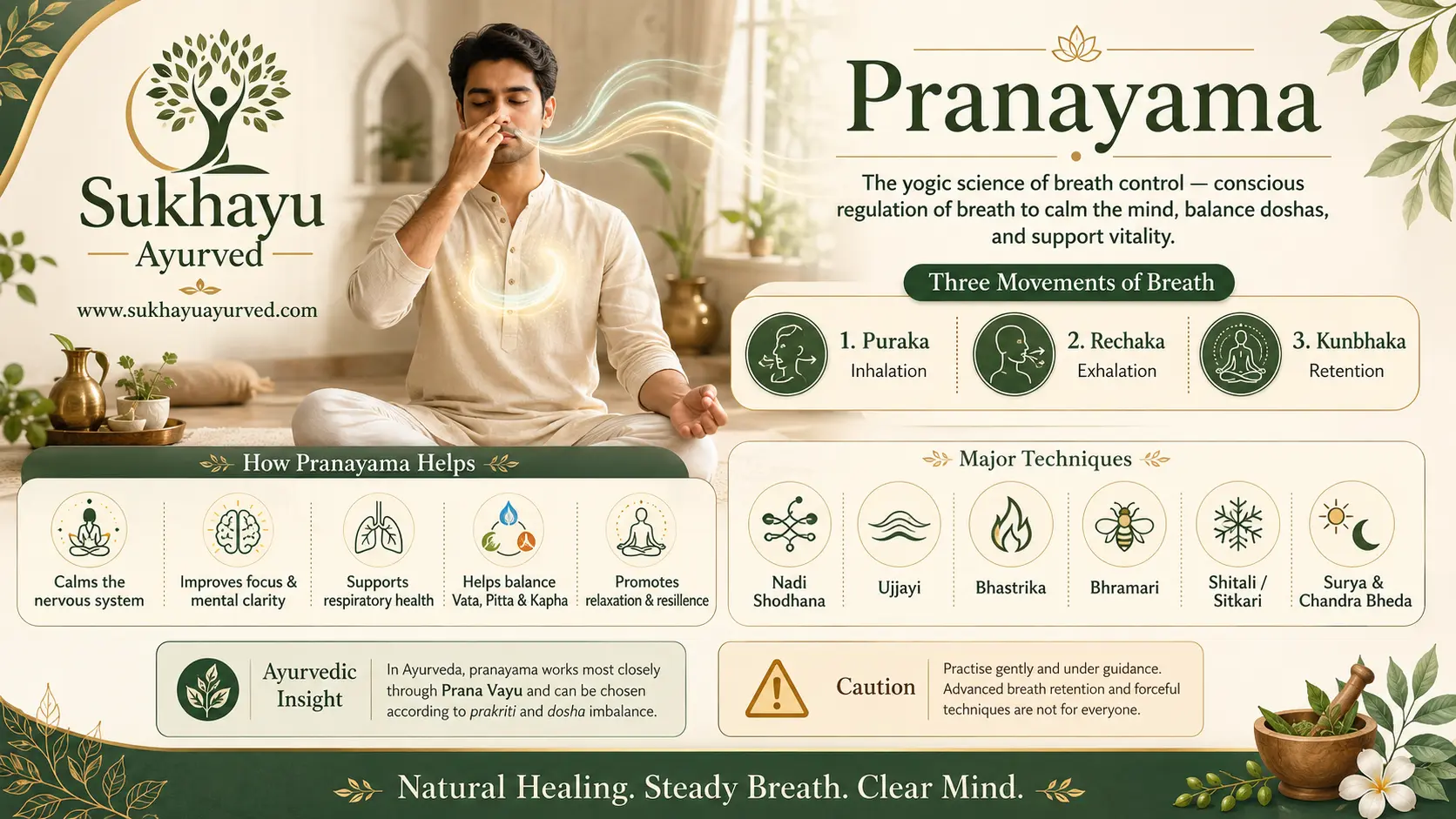
Most people breathe twenty-thousand times a day and never once do it on purpose. Pranayama is what happens when you take that one automatic act — the one thing your body will not let you skip for more than a couple of minutes — and put it under conscious command. In the Ayurvedic and Yogic tradition, that is not a wellness accessory. It is one of the most direct levers a human being has over the mind, the nervous system, and the flow of vitality itself.
At Sukhayu Ayurved, we treat breath the way the classical texts do: as prana — the life force — made visible. This page explains what pranayama actually is, the mechanics the old masters described, how it fits within Ayurveda, which techniques do what, and the one warning every serious text repeats but most modern classes leave out.
What "Pranayama" Really Means
The word is usually translated too loosely. It is made of two parts, and both matter.
Prana is the life force or energy that exists everywhere in the universe and is expressed in each of us through the breath. It is not simply "air" and not simply "oxygen." It is the animating current that food, water, and rest all feed, but that breath carries most directly.
Ayama means "to stretch, extend, restrain, or regulate." Note that it does not mean "stop" or "hold." Pranayama is the extension and conscious direction of prana — learning to draw it in, distribute it, and govern its flow for physical and mental benefit.
Put together, pranayama is the science of breath: the deliberate regulation of the life force through the medium of respiration. And the reason the tradition places such weight on it is simple biology dressed in older language — breathing is the one autonomic function you can also run manually. It is the door between the voluntary and the involuntary self. Master the breath, and you gain a handle on states of mind and body you otherwise cannot touch.
The Three Movements of Breath
All breathing, however elaborate the technique, is built from three actions. Classical yoga names each one:
- Puraka — inhalation, the filling up. Drawing prana in.
- Rechaka — exhalation, the emptying of the lungs. Releasing what is spent.
- Kumbhaka — retention, the interval in which there is neither inhalation nor exhalation. The breath is held and restrained.
Kumbhaka is the heart of advanced pranayama, and it comes in two forms. Think of a kumbha — a water pot. A pot can be filled completely with water and sealed, or emptied completely and sealed. Breath retention works the same way:
- Antara kumbhaka — retention after a full inhalation, when the lungs are completely filled, held before exhalation begins.
- Bahya kumbhaka — retention after a full exhalation, when the lungs are completely emptied, held before the next inhalation begins.
Antara means inner; bahya means outer. In both, the breath is suspended and restrained — and in both, that suspension is where the tradition says the real work of pranayama takes place. In many Hatha Yoga texts, "kumbhaka" is even used loosely to stand for the whole practice, because the capacity to retain the breath calmly is treated as the measure of a practitioner's control.
Prana as the Hub of Life
The Hatha Yoga tradition does not describe breath as one function among many. It describes it as the axis. Pranayama is the hub around which the wheel of life revolves — every other faculty, physical and mental, turns on it. Breathing shapes not only the body's actions but its thoughts: agitated breath, agitated mind; steady breath, steady mind. This is why the practice sits so close to meditation in the classical sequence — regulated breath is the gateway that makes a settled mind possible, which is also why pranayama is counted among the eight limbs of Ashtanga Yoga.
There is also a larger frame. The prana in the body of the individual (jivatma) is understood as a part of the cosmic breath of the universal spirit (paramatma). The practice of pranayama is, in this view, an attempt to harmonise the individual breath (pinda-prana) with the cosmic breath (brahmanda-prana) — to bring the small rhythm into tune with the large one. Whether one reads that spiritually or simply as a beautiful description of coming into coherence with one's environment, the practical instruction is the same: breathe with attention, and something in you organises.
How Pranayama Fits Within Ayurveda
Yoga and Ayurveda are sister disciplines, and pranayama is one of the clearest places they meet. Ayurveda organises the body's functions around three doshas — Vata, Pitta, and Kapha — and of the three, breath belongs most intimately to Vata, the principle of movement, and specifically to Prana Vayu, the sub-type governing inhalation, the senses, and the mind.
This is why pranayama is such a precise instrument in Ayurvedic terms. Different breathing patterns move the doshas differently:
- Cooling, slow, retention-based practices settle aggravated Vata and quiet an overactive mind.
- Cooling breaths such as Shitali and Sitkari pacify heat and excess Pitta.
- Heating, vigorous practices such as Bhastrika and Kapalbhati-style breathing mobilise stagnant Kapha and kindle agni, the digestive fire.
Because of this, pranayama is not a single generic exercise but a toolkit — and the right tool depends on your constitution (prakriti) and your current imbalance. That is the same individualising logic that runs through all of Ayurveda: what balances one person can aggravate another.
The Major Pranayama Techniques
The tradition preserves a family of distinct practices, each with its own rhythm, effect, and appropriate use. Below is an orientation to the principal ones. Each links to a dedicated guide.
Balancing and Foundational
- Nadi Shodhana — alternate-nostril breathing, the great equaliser. It is said to purify the nadis (subtle channels) and balance the two sides of the breath, and it is the classical starting point for calming Vata and steadying the mind.
- Ujjayi Pranayama — the "victorious" or ocean breath, made with a gentle constriction at the throat. Warming and grounding, it lengthens the breath and builds focus.
Energising and Heating
- Bhastrika Pranayama — the "bellows breath," a forceful, rhythmic practice that generates heat, invigorates the system, and clears Kapha-type stagnation from the chest.
- Surya Bheda Pranayama — the "sun-piercing" breath, drawing in through the right (solar) nostril to build warmth and vitality.
Cooling and Calming
- Shitali Pranayama — the "cooling breath," inhaled through a curled tongue, used to reduce internal heat and pacify Pitta.
- Sitkari Pranayama — a related cooling breath drawn through the teeth, calming and heat-reducing.
- Chandra Bheda Pranayama — the "moon-piercing" breath, the cooling counterpart to Surya Bheda, drawing in through the left (lunar) nostril to quiet and cool.
- Bhramari Pranayama — the "humming bee" breath, whose soft internal vibration is prized for settling an anxious, racing mind.
Refining Breath Control
- Viloma Pranayama — interrupted breathing, in which inhalation or exhalation is taken in stages with brief pauses, training finer control and lung capacity.
- Pratiloma Pranayama — an "against the grain" alternate-nostril variation that builds on the discipline of Nadi Shodhana.
For the ground these practices grow from, it helps to understand yoga as a whole and the difference between yoga asanas and ordinary physical exercise — pranayama is not calisthenics for the lungs, and treating it that way misses the point.
Breath and the Respiratory System
There is a natural, honest overlap between a discipline built on breath and the health of the organs that breathe. Steady, well-directed breathing supports the lungs and the diaphragm, and in the Ayurvedic reading it addresses the Kapha and Vata patterns that sit behind much respiratory discomfort. This is one reason breath work is often part of the supportive picture in conditions such as asthma and other respiratory conditions Ayurveda addresses.
A word of clinical honesty, since we are a hospital and not a lifestyle brand: pranayama is a support and a discipline, not a substitute for treatment. In an acute asthma attack or any breathing emergency, breath exercises are not the answer — medical care is. Where pranayama earns its place is in the long, patient work between flares, as part of a properly diagnosed plan. If you are managing a respiratory condition, learn the appropriate techniques under guidance rather than from a video, and keep your treating physician in the loop.
Why Pranayama Is Worth the Discipline
Approached seriously and consistently, the reported and traditionally described benefits of pranayama are considerable:
- A calmer nervous system. Slow, extended breathing with gentle retention shifts the body toward its rest-and-recover state, which is why the practice is so closely tied to relief from tension and to managing the effects of stress.
- A steadier mind. Because breath and thought move together, governing one helps govern the other — the foundation for concentration and meditation.
- Better breathing capacity and awareness, and support for the respiratory system.
- Support for digestion and metabolic fire. Heating practices are traditionally used to kindle agni, and healthy digestion is central to Ayurvedic wellbeing.
- A contribution to resilience. Within Ayurveda's broader, non-gimmicky view of immunity, a calm, well-regulated system is a more resilient one.
A Warning the Old Texts Never Left Out
Modern pranayama is often taught as though it were harmless by definition. The classical tradition knew better, and said so plainly. The Hatha Yoga Pradipika compares prana to a wild animal:
As lions, elephants and tigers are tamed slowly and cautiously, so should prana be brought under control gradually — measured according to one's capacity and physical limitations. Otherwise, it may harm the practitioner.
That is not mysticism. It is a straightforward caution about a powerful practice. Forced retention, over-vigorous bellows breathing, or pushing past your capacity can leave a beginner dizzy, anxious, or worse — and certain techniques are inappropriate for people with particular cardiac, respiratory, blood-pressure, or pregnancy considerations. The remedy is the one the tradition always prescribed: begin gently, progress slowly, and learn kumbhaka in particular under a knowledgeable teacher rather than from memory or a screen.
This is exactly how we approach it at Sukhayu. Breath work, where it is indicated, is prescribed as part of an individualised plan — matched to your constitution, your condition, and your capacity — not handed out as a one-size-fits-all routine.
Where to Go From Here
If you are new to all of this, start by understanding yoga and the basics of the practice, then explore the tri-dosha framework so the choice of technique makes sense for your constitution rather than someone else's. From there, the individual technique guides above will take you into the specifics.
And if breath is something you are working on because of a genuine health concern — respiratory, neurological, or otherwise — talk to a physician who can see the whole picture. Pranayama is at its most powerful not as a standalone trick, but as one disciplined thread woven into a plan built for you.
This page is for education. It is not a diagnosis or a prescription, and it does not replace consultation with a qualified physician. If you have a medical condition, learn and practise pranayama under professional guidance.