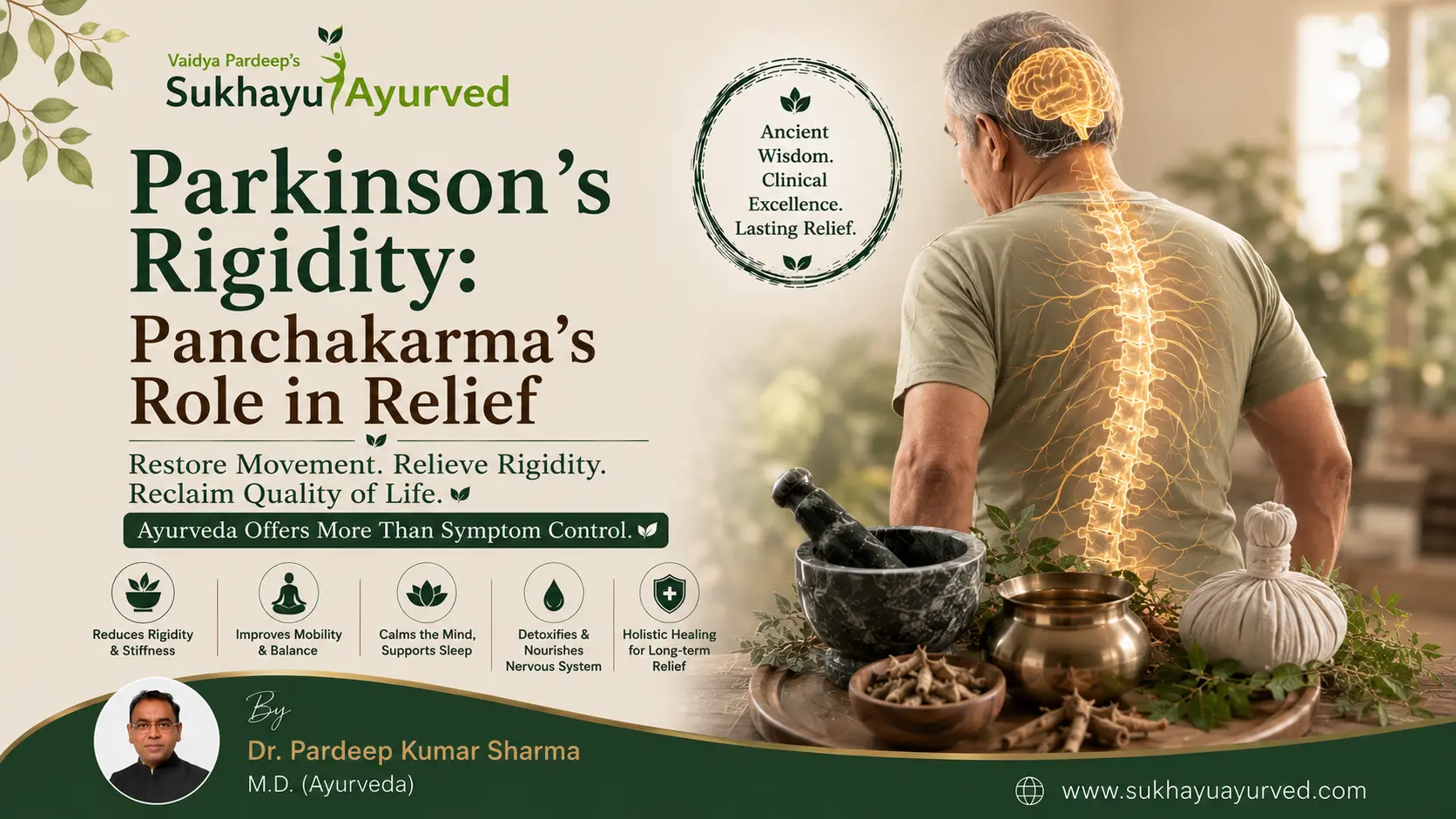
When most people picture Parkinson's disease, they picture a tremor — a hand that will not stay still. But in my consulting room in Jaipur, that is not the patient I most often meet. The patient I meet is the one whose body has grown quiet in the wrong way. An arm that no longer swings when he walks. A foot that drags at the doorway. Fingers that can no longer find a shirt button. Slowness where there should be flow.
In more than two decades of clinical practice, I have come to see Parkinson's patients as falling into three broad presentations: those in whom tremor dominates, those in whom stiffness and slowness — bradykinesia — dominate, and those in whom both are present together. This article is written for the second group and the families who love them. Because for the rigidity-dominant patient, there is a specific and often misunderstood pathology at work — and Panchakarma has a specific role to play in it.
What "rigidity" really is, seen through the doshas
In Ayurveda, all movement in the body is governed by Vata. When movement fails, it is Vata that has gone wrong. But Vata does not go wrong in only one way. There are two very different pathologies hiding under the same word "aggravation," and confusing them is where most treatment — Ayurvedic and otherwise — loses its way.
The first is Kshaya — depletion. Here the problem is at the source. In the language of neurology, this is the loss of dopamine-producing cells in the substantia nigra: the factory itself is failing.
The second is Avarana — obstruction. Here the dopamine may well be present, but something covers the pathway, and the signal cannot attach where it needs to attach. The factory is running; the road is blocked.
In the rigidity-dominant patient, the picture I most often find clinically is Avarana. Specifically, it is Kapha obstructing Vyan Vayu — the Vata responsible for movement distributed throughout the whole body. Kapha, heavy and static by nature, settles over the very channels through which movement should flow. The result is not the shaking of an unrestrained system, but the heaviness of a covered one. This is why the rigidity patient feels slowed, not shaken.
It is worth naming the more advanced picture too, so families understand the map. When the voice weakens and swallowing falters — dysarthria and dysphagia, the bulbar signs — the disorder has moved into Udan Vayu, and the condition is considerably more advanced. Rigidity and bradykinesia, by contrast, live in the territory of Kapha and Vyan Vayu. Knowing which territory a patient is in changes everything about how we treat.
Why "natural dopamine" is the wrong tool for this patient
There is a great deal of Ayurveda content online promising relief for Parkinson's through natural dopamine sources — Kaunch beej (Mucuna) chief among them. I do not build my rigidity protocols around these, and the reason goes to the heart of the distinction above.
Adding an external dopamine source is, in essence, a treatment for Kshaya — for depletion. It tries to solve a shortage by pouring more in. But if the patient's real problem is Avarana — obstruction — then pouring more dopamine at a blocked receptor does not address the actual pathology. You are adding supply to a road that is closed. The obstruction remains untouched.
Our focus, therefore, is not to add dopamine and not merely to chase symptoms. It is to remove the Avarana — to clear the Kapha covering so that the body's own Vyan Vayu can move as it was meant to. Treat the obstruction, and you have treated the thing that the "add more dopamine" approach never reaches.
How do I know which patient is which? The honest answer is that the symptoms tell everything. There is no shortcut around clinical judgment here — reading the whole presentation carefully is what reveals whether obstruction or depletion is the dominant story. That reading is the physician's work, and it cannot be Googled.
The Panchakarma protocol for rigidity — and the logic behind each step
Once we have understood a patient as an Avarana-dominant, Kapha-over-Vyan-Vayu presentation, the protocol follows from the pathology. For these patients, the principal procedures are Basti (both Kashaya and Taila), Udvartana, Pizhichil, and Nasya. Each has a specific job.
Basti — Kashaya and Taila together, never apart. This is the cornerstone, and the "together" matters enormously. Any sound Basti protocol uses both types. Kashaya Basti reduces Kapha; Taila Basti nourishes and pacifies Vata. If one were to reduce Kapha with Kashaya alone, Vata would be aggravated further — and in a disease that is fundamentally a Vata disorder, that can create serious problems. The two work as one system precisely so that we can clear the obstruction without worsening the underlying Vata.
☞ Basti For Neurological Diseases
Udvartana. This is the therapeutic clearing of the channels — Srotoshodhana. Its particular value here is that it reduces Kapha without aggravating Vata in the process, which is exactly the tightrope this disease demands.
Pizhichil. Where Udvartana clears, Pizhichil restores flow. Rigidity is, in part, a Vata that has spread grossly and unevenly across the body. The warm, continuous stream of medicated oil in Pizhichil, with oils chosen for the case, helps rebalance that spread-out Vata and re-establish smooth movement — doing what dry clearing alone cannot.
Nasya. Kapha's seat is the Shiras — the head. Nasya is the classical route to that seat. For a disorder rooted in Kapha covering the movement pathways, treating the head directly through the nasal route is not incidental; it addresses Kapha where it resides.
And a point I want families to hold onto: the in-patient Panchakarma and the oral medicines that follow are not two separate treatments. They are one continuous system aimed at the same target — the Avarana. Panchakarma itself works over long periods; the medicines are not there merely to prop up a fading effect, but to continue treating the underlying obstruction.
One patient's course
Let me tell you about a man of 54. He had been diagnosed four years before he came to us. The first thing he had noticed, long before the diagnosis, was subtle: while walking, his left arm simply did not join the movement — it hung, unswinging — and his left foot began to drag, catching often. By the time he reached us, the condition had progressed somewhat. Walking had become difficult. He could no longer tuck his own buttons — a fine-motor loss more than pure bradykinesia — and the slowness was concentrated on his left side.
He was, by his own firm choice, never on conventional Parkinson's medication. He did not wish to start it, and he never did. I record this simply as his decision and his individual course — not as advice to anyone else, and not as a statement about conventional care, which for many patients is the right and necessary path.
We followed the protocol: Kashaya and Taila Basti, Udvartana, Pizhichil, and Nasya. During his in-patient stay there were symptomatic changes — he moved with more confidence, and he felt it. He was discharged with medicines to continue the work. Two months after finishing that course, the improvement was markable. He returned four months later for a further ten-day admission to consolidate the gains.
The number that captures it honestly: on the bradykinesia items of the MDS-UPDRS, his score moved from 4 to 2 over six months, following that first follow-up treatment. I offer this as one documented individual case — not a cure, not a promise, but a record of what changed for this particular man and his particular body.
Where I draw the honest lines
I would be failing you as a physician if I let this read as though Panchakarma rescues everyone. It does not.
What it can honestly offer the rigidity-dominant patient is this: it removes the Avarana without aggravating Vata dosha. That is a real and specific thing, and for the right patient it can meaningfully change how they move through their day.
What it cannot do is undo every stage of the disease. I have treated patients past 80, immobile, unable to walk, confined to bed. For a patient that advanced, honesty requires me to set expectations very differently, and to say plainly that this will not restore what a family may be hoping for.
There is also a fair thing to say about conventional treatment — said without any hostility toward neurology, which does essential work. Because conventional medication addresses the symptoms rather than the underlying dosha pathology, dosages tend to climb over time as the disease progresses, alongside the symptoms and their complications. Ayurveda's argument is not that this is wrong; it is that treating the doshas — the underlying pathology — reaches for something the symptomatic approach does not. And in advanced cases, I have seen integrated treatment, Ayurveda alongside conventional care, help stabilize a patient more quickly than either alone. We treat the root; they treat the symptom; and the patient, always, decides.
Which is why my anchor holds even here: Cure is divine. Treatment is possible. Parkinson's is a progressive condition, and I will not pretend otherwise. But treatment — real, root-directed, dosha-level treatment — is possible, and it is worth pursuing.
A closing reflection
We tend to notice movement only when it fails. A swinging arm, a foot that clears a doorway, a finger that finds a button — these are so ordinary that no one celebrates them, until one day the body grows quiet and they are gone. Parkinson's teaches, in the hardest way, that movement was never the small thing we assumed it to be. It was the body speaking. To help a person move again is not merely to loosen a stiff limb; it is to return to them a small, daily fluency of being alive.
If this is you, or someone you love
This article is written above all for the rigidity- and bradykinesia-dominant patient — the one who is slowing, dragging, stiffening — and for the families of more advanced patients trying to understand what is truly possible.
The honest first step is a proper clinical assessment, so that we can determine whether your pathology is one of obstruction or depletion — because that single distinction shapes everything that follows.
You can read more about our approach to Parkinson's disease here: Ayurvedic Treatment for Parkinson's Disease — Sukhayu Ayurved
We do not sell packages. We treat diagnoses.