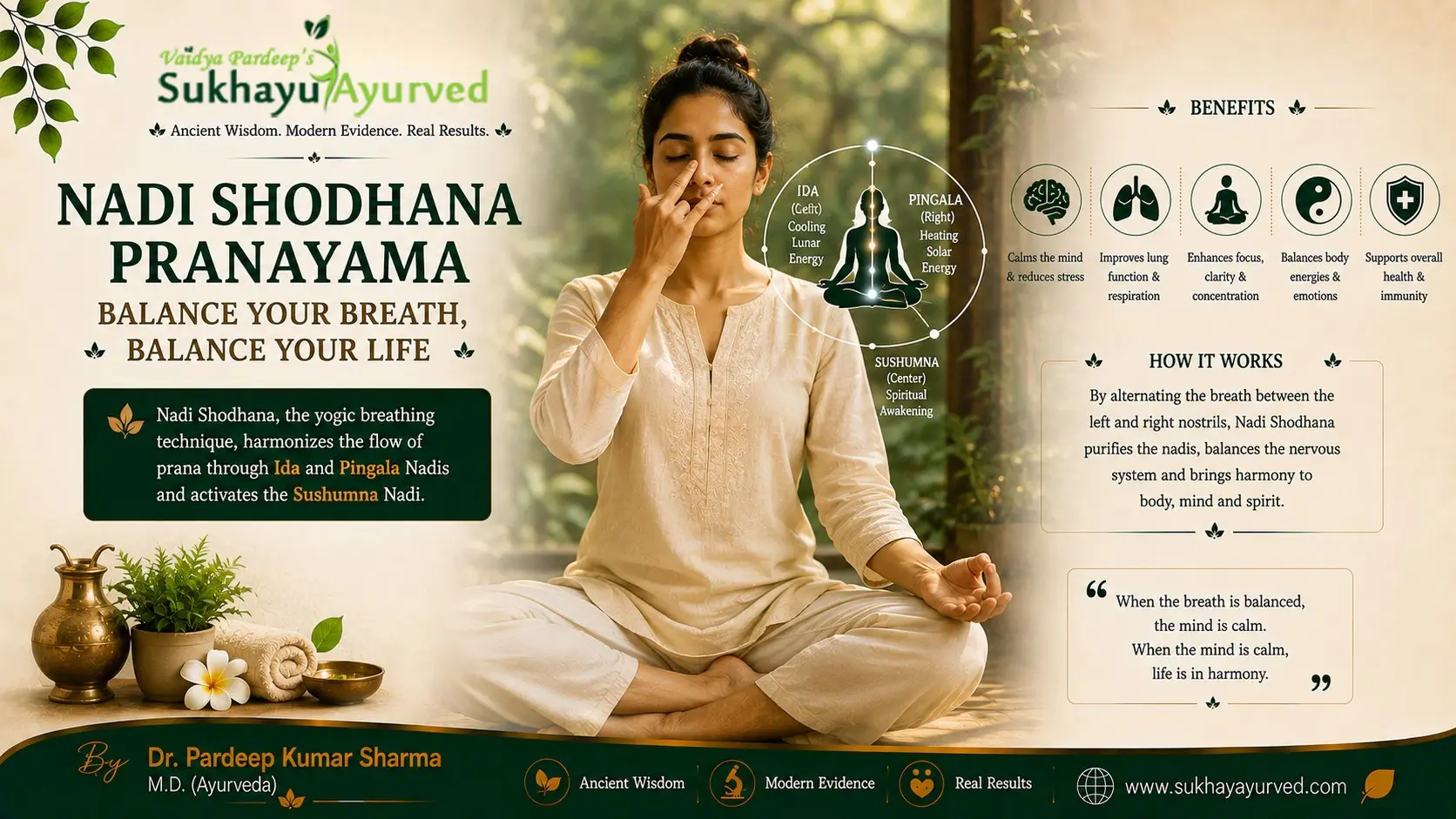
Nadi means channel. Shodhana means purification. Together they name exactly what this breath sets out to do — clear the channels through which prana moves, so that everything downstream of the breath has a steadier road to travel on.
What it is
Nadi Shodhana is alternate-nostril breathing: you breathe in through one nostril, out through the other, and keep swapping. Classically it works the two great nadis that flank the spine — Ida, the left or lunar channel, cooling and receptive; and Pingala, the right or solar channel, heating and active. By feeding the breath alternately into each, the practice stops either side from running the show for too long.
That alternation is the whole point. Almost every other pranayama pushes the system in one direction — Bhastrika heats, Shitali cools. Nadi Shodhana pushes in neither. It is the balancing breath, and it is the one we teach first.
The Ayurvedic view
Dosha. Nadi Shodhana is primarily Vata-pacifying, and specifically it works on Prana Vata — the sub-dosha seated in the head and chest that governs the breath, the senses, and the movement of thought itself. When Prana Vata is disturbed, breathing becomes shallow and irregular, sleep breaks up, and the mind moves faster than it can be followed. A regulated, rhythmic breath is the most direct instrument we have for settling it.
Virya. Unlike its siblings, Nadi Shodhana has no strong virya of its own. It is neither ushna (heating) nor shita (cooling) in the way Surya Bhedana and Chandra Bhedana are — those two deliberately favour one nadi and take on its temperature. Nadi Shodhana alternates, and so comes out sama: balanced. This is precisely why it is the safest starting point, and why it can be practised when a strongly heating or cooling breath would be the wrong medicine.
Season and constitution. Because it carries no strong virya, it suits every ritu and every prakriti. It is particularly useful at ritu-sandhi — the seam between two seasons, when the body is renegotiating its balance and Vata rises. Vata constitutions get the rhythm they lack. Pitta constitutions get the cooling weight of the left nostril without being pushed further into heat. Kapha constitutions benefit too, though the practice must be kept crisp and upright rather than drowsy, or it will settle a system that was already too settled.
Sattvavajaya. In the framework we set out on Understanding Yoga, Sattvavajaya is the deliberate work of steadying the mind — and Nadi Shodhana is its most practical handle. You cannot argue an agitated mind into stillness. You can, however, lengthen an exhale. Rajas settles first, in the space of a few minutes; only once the restlessness quietens does the heaviness of tamas begin to lift. This is why alternate-nostril breathing sits at the front of almost every protocol we build: it is the lever that the rest of the treatment can be pulled with.
There is a physiological reading of the same idea that we find honest. Airflow through the right nostril is associated with sympathetic activation, and through the left with parasympathetic tone. Alternating between them appears to nudge the autonomic nervous system towards equilibrium rather than towards either pole — which is a modern description of what the classical texts were pointing at when they spoke of balancing Ida and Pingala. We offer it as a plausible mechanism, not as proof.
A note on names: Anuloma, Pratiloma, Anulom Vilom
The naming here is genuinely confusing, so it is worth setting straight.
Classically, Anuloma means "with the grain" — inhale through both nostrils, exhale alternately through one at a time. Pratiloma means "against the grain" — inhale alternately, exhale through both. Nadi Shodhana is the full alternate-nostril cycle: in through one, out through the other, both directions.
In common Indian usage, "Anulom Vilom" has come to mean alternate-nostril breathing generally — which is to say, it has come to mean Nadi Shodhana. If that is the practice you were taught under that name, this is your page. The distinct classical variant with its own ratio work is covered separately at Pratiloma Pranayama.
How to do it
Stage 1 — without retention (the clinical default)
This is the version we teach in the hospital, and the version used in most of the published clinical work. It carries no kumbhaka.
- Sit. Sukhasana, Padmasana, Vajrasana, or an upright chair with both feet flat. Spine erect, shoulders loose, eyes closed. Comfort matters more than the classical posture — a knee that hurts will pull the mind straight back out.
- Settle first. Before touching the nostrils, spend one to two minutes on quiet abdominal breathing. Let the belly move; let the breath find its own pace. Beginning the alternation on an already-agitated breath makes the whole practice a struggle.
- Set the hand. Rest the left hand on the left knee. With the right hand, fold the index and middle fingers in, or rest them lightly at the centre of the eyebrows. The thumb closes the right nostril; the ring finger closes the left. Pressure should be light — you are directing air, not blocking it.
- Rechaka (left). Close the right nostril with the thumb. Exhale slowly and completely through the left.
- Puraka (left). Inhale through the left nostril — smooth, unhurried, filling from the abdomen upward.
- Rechaka (right). Release the thumb, close the left nostril with the ring finger. Exhale through the right.
- Puraka (right). Inhale through the right nostril.
- Close the round. Close the right, exhale through the left. That completes one full round — you have returned to where you started.
- Continue for five to ten minutes. Begin with an equal ratio (inhale and exhale of the same length). Over weeks, let the exhale lengthen toward twice the inhale. Never force the count; if you find yourself gasping at the turn, the ratio has run ahead of the lungs.
- Finish. Release the hand. Sit for a minute breathing normally before opening the eyes. The settling that happens in that minute is part of the practice, not an epilogue to it.
Kumbhaka: none at this stage. There is no breath-holding in Stage 1, and most people never need to go beyond it to get what they came for.
Stage 2 — with retention (supervised practice only)
The classical form adds antara kumbhaka — retention after the inhalation — often in a 1:4:2 ratio (inhale 4 counts, retain 16, exhale 8). This is real practice with real demands, and it belongs to a later stage of training.
Approach it only after several months of comfortable Stage 1 practice, and only under the direct guidance of a teacher or physician who can watch you do it. Retention work is not something to build from a written page, and the ratio should never be reached for before the breath itself is long and easy. If any of the cautions below apply to you, Stage 2 is not for you at all.
Benefits
Framed as supportive effects — what regular practice tends to help with, alongside whatever else your care requires.
- Steadies the breath itself. Breathing becomes slower, deeper, and more even — often the first thing patients notice, usually within the first fortnight.
- Supports a calmer autonomic state. Slow alternate-nostril breathing is associated with a shift toward parasympathetic tone: lower heart rate, longer intervals between beats.
- Helps settle mental restlessness. Useful where the mind races, particularly in the evening or before sleep.
- Supports cardiovascular measures as an adjunct to medical management — see the research note below for what has and has not been shown.
- Improves attention and reaction time in the period immediately following practice.
- Prepares the system for the stronger pranayamas. It is the groundwork on which retention work and the heating and cooling breaths are safely built.
- Requires nothing. No equipment, no floor space, no particular time of day. This matters more than it sounds — it is the reason patients actually keep doing it.
What the research shows
Two clinical trials are worth naming, and worth being precise about.
An exploratory randomised trial from AIIMS Rishikesh (Mittal et al., Annals of Neurosciences, 2025) studied ten minutes of Nadi Shodhana — preceded by two minutes of abdominal breathing, with no retention — in patients with hypertension who were already on antihypertensive medication. Immediately after practice, systolic and diastolic pressure both fell significantly, alongside a lower mean heart rate and improved heart-rate-variability measures. After six weeks of daily practice, systolic pressure and several autonomic measures were significantly better than in the control group. Sleep and anxiety scores also improved, but those improvements did not reach statistical significance — we mention them as a direction of travel, not a finding.
Two features of that study are the reason we cite it. It was designed as an adjunct to conventional treatment, not a substitute for it — which is exactly how we use this breath. And the protocol used no breath retention, which supports our Stage 1 default.
A second trial (Upadhyay et al., Journal of Ayurveda and Integrative Medicine, 2023) compared Nadi Shodhana with Bhramari in hypertensive patients and found a significant improvement in auditory reaction time after Nadi Shodhana. In that study, however, the heart-rate-variability changes did not reach significance in either group. The authors concluded that both practices can help balance sympathovagal tone. We report it here with its null result intact, because a benefit list that only carries the wins is not worth trusting.
Who should be cautious
Nadi Shodhana is the gentlest of the pranayamas, and Stage 1 is safe for most people. These cautions are real nonetheless.
- Blocked nose, cold, sinusitis, or active allergic rhinitis. Do not practise while a nostril is congested. Forcing air through a blocked passage achieves nothing and irritates the mucosa.
- Deviated nasal septum or structural nasal obstruction. If one nostril never clears, discuss the practice with a physician before starting; a mechanical block will not respond to breathing technique.
- Fever or acute illness. Wait until you have recovered.
- Hypertension and heart conditions. Stage 1 without retention is generally appropriate and has been studied in exactly this population — but as an adjunct, alongside your prescribed treatment and with your cardiologist informed. Stage 2 retention work is not appropriate.
- Pregnancy. Stage 1 only, with no retention and no breath lengthening beyond what is comfortable. Discuss with your obstetrician.
- Glaucoma and raised intracranial pressure. Avoid all retention.
- Panic disorder and acute anxiety. Breath-focused practice occasionally intensifies symptoms at first. Start very short — two or three minutes — and stop if the anxiety sharpens rather than eases.
- Recent abdominal, chest, or nasal surgery. Wait for clearance.
- Never force anything. Not the count, not the ratio, not the airflow. Forced practice is the single most common way a beneficial breath is turned into a harmful one. Build it gradually, under guidance.
How Sukhayu uses it clinically
Nadi Shodhana is the first breath we teach almost every patient, whatever they came in for — because so much of what we treat sits downstream of a disturbed Prana Vata and an unsettled mind. In practice it appears most often in three places. In stress-driven headache, where patients report that the days beginning with ten quiet minutes of alternate-nostril breathing are the days the attacks stay away — it forms part of the supportive routine alongside our Ayurvedic treatment for migraine. In disturbed sleep, practised in the evening rather than the morning, as part of the wider approach we describe for sleep disorders and insomnia. And as preparation before Panchakarma — particularly before Shirodhara, where a patient who arrives already breathing slowly gets considerably more from the therapy than one who arrives braced.
None of this replaces the medicine you have been prescribed. Where a patient is on antihypertensives, antidepressants, or anti-epileptics, the breath is added to that treatment and the treating physician is kept informed — it is never a reason to reduce or stop anything on your own. This is complementary care, working alongside conventional treatment rather than in place of it.
Cure is divine. Treatment is possible.
Last reviewed by Dr. Pardeep Sharma, September 3, 2026
Related practices: Pranayama — the complete guide · Pratiloma Pranayama · Surya Bhedana Pranayama · Chandra Bhedana Pranayama · Bhramari Pranayama
References
- Mittal G, Pathania M, Bhardwaj P, Dhar M, Khapre M, Mittal S. An exploratory randomised trial to assess the effect of Nadi Shodhan Pranayama as an adjunct versus standard non-pharmacological management in hypertensives. Annals of Neurosciences. 2025. doi:10.1177/09727531251318810. CTRI/2023/11/059625.
- Upadhyay J, Nandish NS, Shetty S, Saoji AA, Yadav SS. Effects of Nadishodhana and Bhramari Pranayama on heart rate variability, auditory reaction time, and blood pressure: a randomized clinical trial in hypertensive patients. Journal of Ayurveda and Integrative Medicine. 2023;14(4):100774. doi:10.1016/j.jaim.2023.100774.