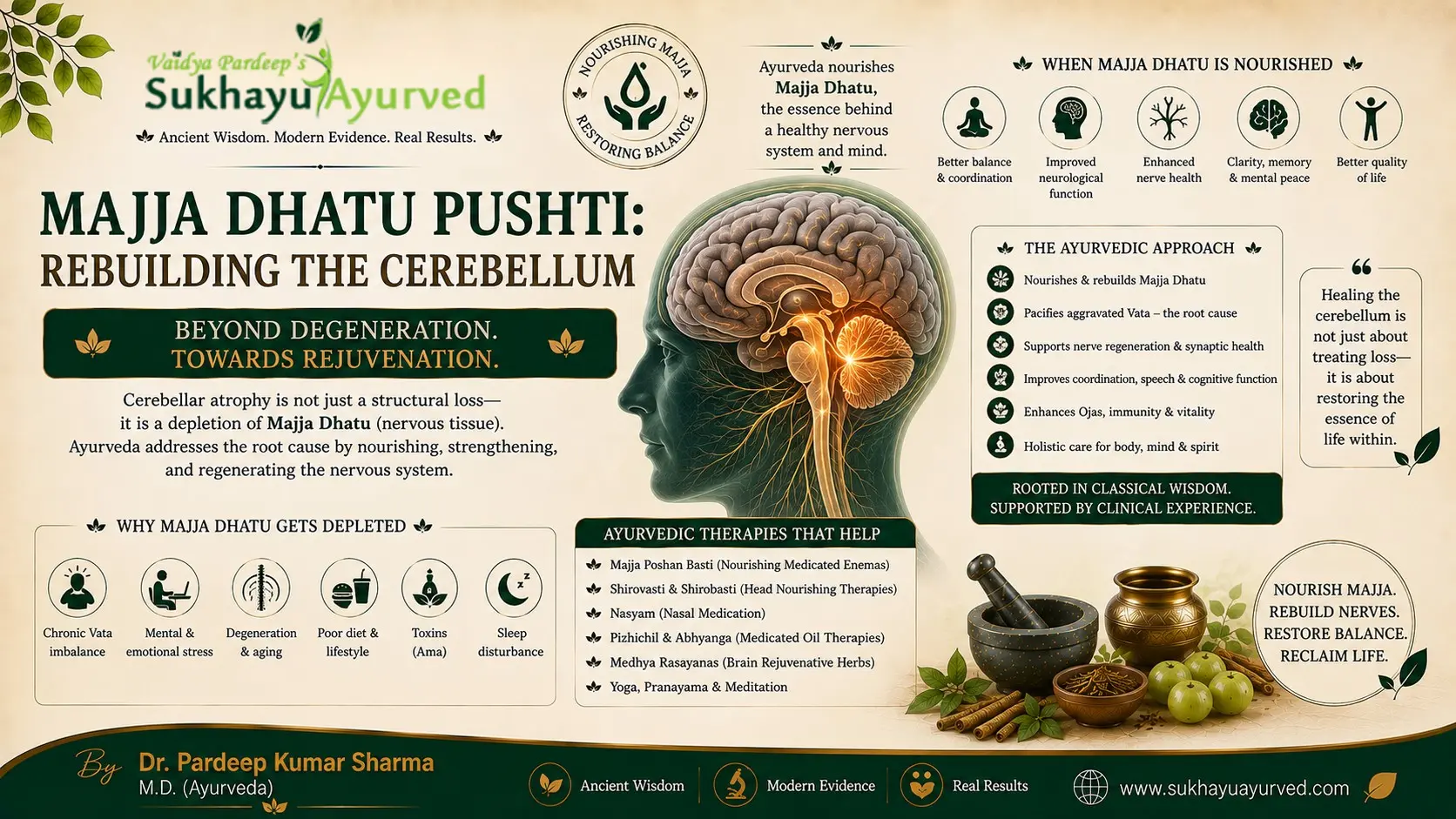
Modern neurology looks at a shrinking cerebellum and asks a management question: how do we control the tremor, the imbalance, the slurred speech? It is a fair question. But it is not the question that changes anything.
Ayurveda asks a different one, and it is the whole difference: what has this tissue been starved of, and how do we feed it back? That question has an answer — a specific, sequenced, physical answer that has been refined over centuries. It is called Majja Dhatu Pushti, the nourishment and rebuilding of the neural tissue itself. This is the logic beneath our entire cerebellar atrophy treatment, and in this article I want to open it up completely — not the promise, but the mechanism.
The Cerebellum, in Ayurvedic Terms: Shirogat Sneha
To understand the treatment, you have to understand how Ayurveda sees the organ. Classical Ayurveda does not describe the cerebellum by name — but it describes something remarkably precise in its place.
The great commentator Acharya Chakrapani identifies the brain and its tissue as Shirogat Sneha — the unctuous, oily, nourishing substance seated in the head. Hold that image, because it is not loose metaphor. The brain is, quite literally, one of the most fat-rich tissues in the body; its myelin, its membranes, its very capacity to conduct signal, are built from lipids. Ancient observation and modern histology are pointing at the same thing.
Now the diagnosis follows directly. Atrophy, in this framework, is Mastulungakshaya — the Kshaya, the depletion, of that Shirogat Sneha. The cerebellum is not merely "damaged." It is dried out, thinned, depleted of the very unctuousness that is its substance. Once you see the problem that way, the treatment is not a mystery. You do not manage a depletion. You replenish it.
Why It Dries: Cerebellar Atrophy as a Vata Vyadhi
What drives that depletion? In Ayurveda, the nervous system is the domain of Vata Dosha — Vata governs all movement, all signal, all coordination. And Vata has a defining quality: it is Ruksha, dry. When Vata aggravates, it desiccates. It draws moisture and unctuousness out of the tissues it touches, and they shrink.
This is why cerebellar atrophy is treated as a Vata Vyadhi, a disorder of aggravated Vata, and why it becomes more common with age — because ageing itself is the Vata-predominant phase of life, the season of drying. A lifetime of Vata-aggravating diet and lifestyle accelerates it. The wide-based unsteady gait, the tremor, the faltering speech — these are the visible signature of a nervous system that has been dried past the point where it can coordinate itself.
Name the problem correctly and the entire strategy writes itself: if Vata dries the tissue, treatment must pacify Vata and re-introduce Sneha — oiliness, fat, unctuous nourishment — directly to the depleted neural tissue. Everything that follows is in service of that single corrective.
The Protocol: How Each Therapy Feeds the Cerebellum
This is where logic becomes procedure. At Sukhayu, the cerebellar atrophy programme runs as an indoor Panchakarma course of roughly 21 to 28 days, and each therapy in it has a specific job in the Majja-nourishing sequence. The order is not decorative — you cannot nourish a channel you have not first prepared.
Basti — the primary instrument. In all neural disorders, Basti is the principal treatment, because it is Ayurveda's most direct tool for pacifying Vata at its seat. Our Ful Basti protocol uses both Kashaya (decoction) and Taila (medicated oil), alternated over the course so that the drying Vata is calmed and the lost unctuousness is systematically restored. Basti is not a side-therapy here; it is the spine of the treatment.
Shirobasti and Shirodhara — feeding the head directly. This is Majja Dhatu Pushti at its most literal. In Shirobasti, warm medicated ghee or oil is held against the scalp within a fitted cap for a sustained period — and classical Ayurveda calls this food for the brain, Sneha delivered to the very seat of the Shirogat Sneha that has been depleted. Shirodhara, the steady stream of warm medicated oil across the forehead, calms the aggravated Vata governing the nervous system and settles the agitation that rides alongside degeneration. Together they address the head-seated depletion the diagnosis identified.
Pizhichil — whole-system saturation. A continuous, warm flow of medicated oil over the entire body, Pizhichil floods the system with the unctuousness Vata has stripped away. It is deep, sustained Snehana — the counter-force to drying, applied everywhere at once.
Pinda Swedana — nourishing warmth to the tissue. Using medicated boluses (Choorna, Navar rice, or Pathra — herbal powders, medicated rice, or leaves, chosen to the case), this therapy delivers gentle fomentation that carries nourishment into the tissues and mobilizes what the oleation has loosened. Warmth is itself anti-Vata; warmth carrying Sneha is the point.
Read as a sequence, the logic is clean: calm the drying force (Vata), flood the system with what it has lost (Sneha), and drive that nourishment specifically to the head (Shirobasti) and into the tissue (Swedana) — all of it aimed at reversing the Kshaya, the depletion, that is the atrophy. This same Vata-pacifying, tissue-nourishing architecture is what we bring to the neural degeneration behind Parkinson's disease and the tissue damage of multiple sclerosis; cerebellar atrophy is the same premise, precisely targeted.
Alongside the Panchakarma, internal Rasayana medicines continue the rebuilding at home over many months, and specific Mudras and Pranayama are added to retrain coordination — because rebuilt tissue still has to relearn its work.
What This Does — Said Honestly
I will not describe results I cannot stand behind, because the credibility of everything above depends on it. Majja Dhatu Pushti is slow, patient rebuilding, not a switch. The aim is threefold: halt the progression, rejuvenate the neural tissue, and restore function — steadier balance, clearer speech, a return of independence.
And the improvements arrive in a characteristic order, which is itself a sign the mechanism is real. In our experience the first changes appear in the quality of voice and in mental clarity, often within the first two to three weeks. Gait and coordination follow more gradually, with meaningful functional gains typically over 6 to 12 months of dedicated treatment. Anyone promising a faster miracle is selling one; this is honest, sequential tissue repair, and it moves at the pace tissue actually heals.
If you want to know whether your own cerebellar atrophy is the kind this protocol is built for — and not an incidental, age-related finding that needs no such treatment at all — start with how to read your MRI report, then let us assess you properly.
The Bottom Line
Ayurveda's answer to a shrinking cerebellum is neither vague nor mystical. It is a precise chain of reasoning: the brain is Shirogat Sneha; atrophy is the depletion of that Sneha; the depletion is driven by drying Vata; therefore the treatment pacifies Vata and restores Sneha, therapy by therapy, in sequence. That is Majja Dhatu Pushti — not a hope, but a method.
📞 To find out whether this protocol fits your case, consult Vaidya Dr. Pardeep Sharma for a full assessment.
🔗 Related Reads: