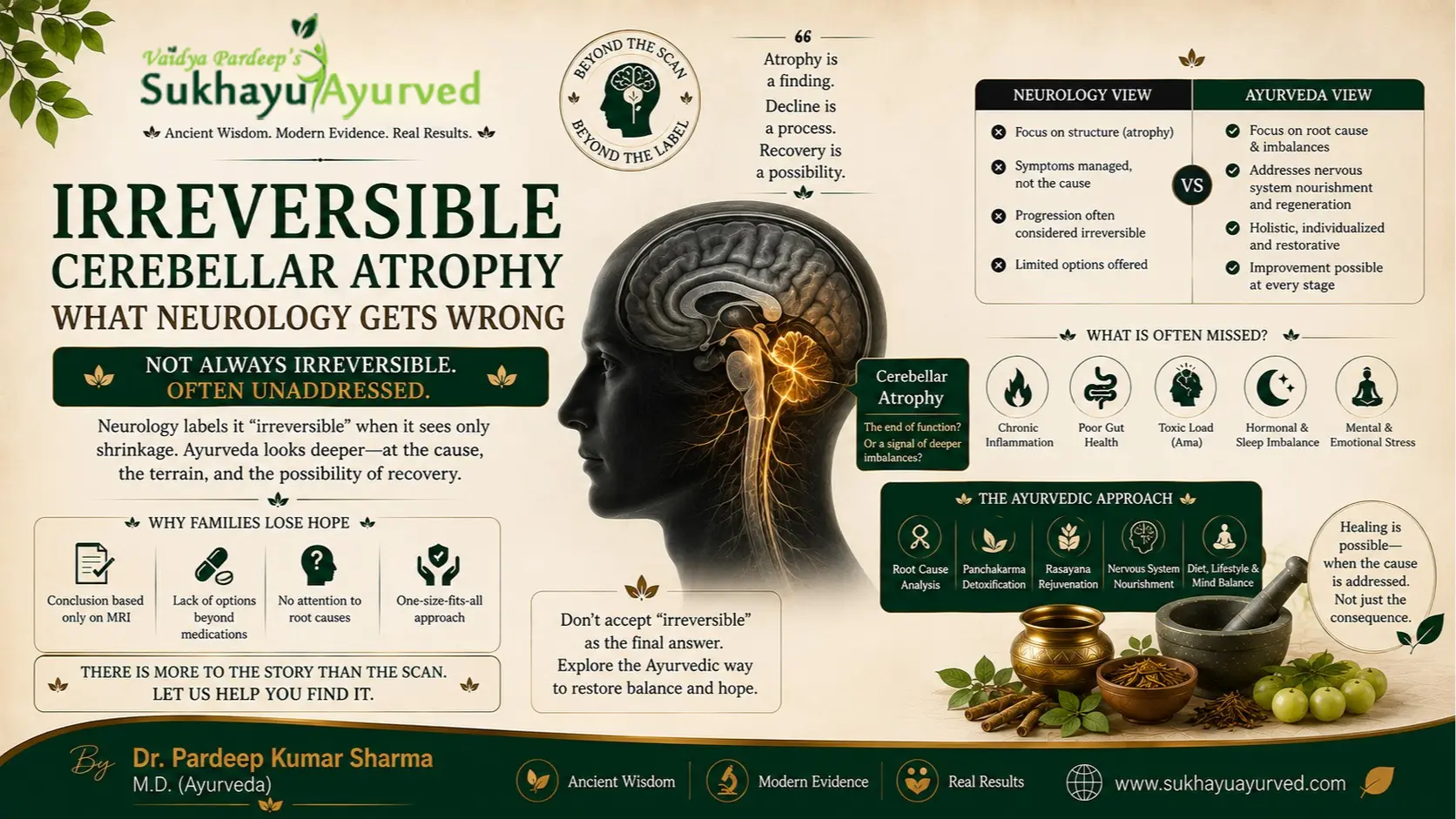
Almost every cerebellar atrophy report I have read in twenty years ends with the same word. Progressive. Sometimes irreversible. And I have watched what that single word does to a person the moment they read it — the shoulders drop, the future contracts, the fight goes out of them before the treatment ever begins.
I want to say something carefully, because it matters and because I do not say it lightly. That word is not a lie. But it is not the whole truth either. It describes what a particular tool — imaging, and a particular model of the nervous system — is able to see and offer. It is not a description of what your body is capable of. And confusing the two has cost too many of my patients months they could not spare.
Let me explain the difference between a diagnosis and a verdict.
What "Irreversible" Actually Means — and What It Doesn't
When conventional neurology calls cerebellar degeneration irreversible, it is being honest about its own toolkit. Within that framework, there is no medication that regrows a shrinking cerebellum, so the goal becomes symptom management, and "irreversible" is the accurate summary of that approach.
But notice what has quietly happened. A statement about one system's options has been handed to you as a statement about your prognosis. Those are not the same thing. "We have nothing that reverses this" is a fact about a pharmacy. "Nothing can improve" is a claim about a human being — and it is a much bigger claim, one that the reports rarely have the right to make.
I have sat across from patients told exactly this, who six and nine months later were walking steadier, speaking clearer, and living with a confidence the report said they had lost for good. Not cured — I will come back to that word, because honesty is the whole point of this article — but genuinely, measurably better. Enough that the verdict simply did not hold.
The Ayurvedic Premise: The Body Is Built to Rebuild
Ayurveda begins from a different assumption about the human body, and that assumption changes everything downstream.
There is a line from the classical texts I return to constantly — शीर्येते इति शरीरम् — that which decays every moment is the body. Read quickly, it sounds bleak. Read properly, it is the opposite. If the body is decaying every moment and yet you are still here, still whole, still walking — then something in you is rebuilding every moment too, fast enough to keep pace. Decay is not the exception in a living body. It is one half of a constant exchange. The other half is regeneration.
This is not poetry standing in for medicine. It is a working clinical premise. Ayurveda holds that the tissues of the body, given the right conditions, are oriented toward repair — and that includes the neural tissue, the Majja Dhatu, that a degenerating cerebellum has lost. The question Ayurveda asks is not "how do we manage the decline?" It is "what has starved this tissue of its ability to renew, and how do we feed that ability back?"
It is the same premise we bring to conditions that conventional medicine also files under irreversible — the demyelination of multiple sclerosis, or the neural degeneration that makes many consider Parkinson's incurable. Different conditions, same underlying wager: the body is built to rebuild, and treatment's job is to restore the conditions that let it.
What This Looks Like as Treatment, Not Philosophy
A premise is worth nothing if it does not translate into something you can actually do. In cerebellar atrophy, it translates into a structured programme with three honest aims:
- Halt the progression — slow and stabilize the active degeneration so the ground stops shifting under you.
- Nourish and rebuild the neural tissue — Majja Dhatu Pushti, the targeted nourishment of the very tissue the atrophy has thinned, through Rasayana therapy.
- Restore function to daily life — because the goal was never a better scan. It is a steadier walk, clearer speech, a spoon held without spilling, a stair climbed without fear.
The tools are specific, not vague: a Panchakarma programme built around therapies like Ful Basti, Shirobasti and Shirodhara, Pizhichil, and Pinda Swedana, sequenced deliberately over a course of treatment. How each of those actually feeds the cerebellum, and why the order matters as much as the therapies themselves, is laid out on our main treatment page: Cerebellar Atrophy Ayurvedic Treatment.
Now the Honest Part — Because Hope Without Honesty Is Cruelty
I will not tell you Ayurveda "cures" cerebellar atrophy, and you should be wary of anyone who does. Cerebellar degeneration is a slow, chronic process, and treating it is serious, patient work — measured in months, not weeks, and dependent on how early you begin and what is driving it.
What I will tell you, because I have watched it happen too many times to call it anything else, is that "irreversible" is far too small a word for what is actually possible. Between "cured" and "hopeless" lies an enormous, real territory — stability, functional recovery, restored independence, a life that looks and feels dramatically different from the one the report seemed to promise. That territory is where my patients live. And most of them were told it did not exist.
There is also a flip side I owe you, the same one I give every patient: not every MRI that says "atrophy" is even a disease. If your scan mentions cerebellar atrophy but you have no real symptoms — no gait trouble, no slurred speech, no loss of coordination — you may be worrying over an incidental, age-related finding that needs reassurance, not treatment. I have written separately on exactly how to tell the difference, because getting that wrong causes its own harm: Diffuse vs. Pathological Cerebellar Atrophy — the one word that changes everything.
The Bottom Line
A diagnosis tells you what is happening. A verdict tells you it cannot change. Your report is allowed to give you the first. It has no authority to give you the second — that authority belongs to your own body, and your body has been quietly rebuilding itself every moment you have been alive.
So before you accept the last word on that page as the last word on your life, get a second reading from a framework that starts by asking what can be restored, rather than what has been lost.
📞 To understand what is genuinely possible in your case, consult Vaidya Dr. Pardeep Sharma for a proper assessment.
🔗 Related Reads: