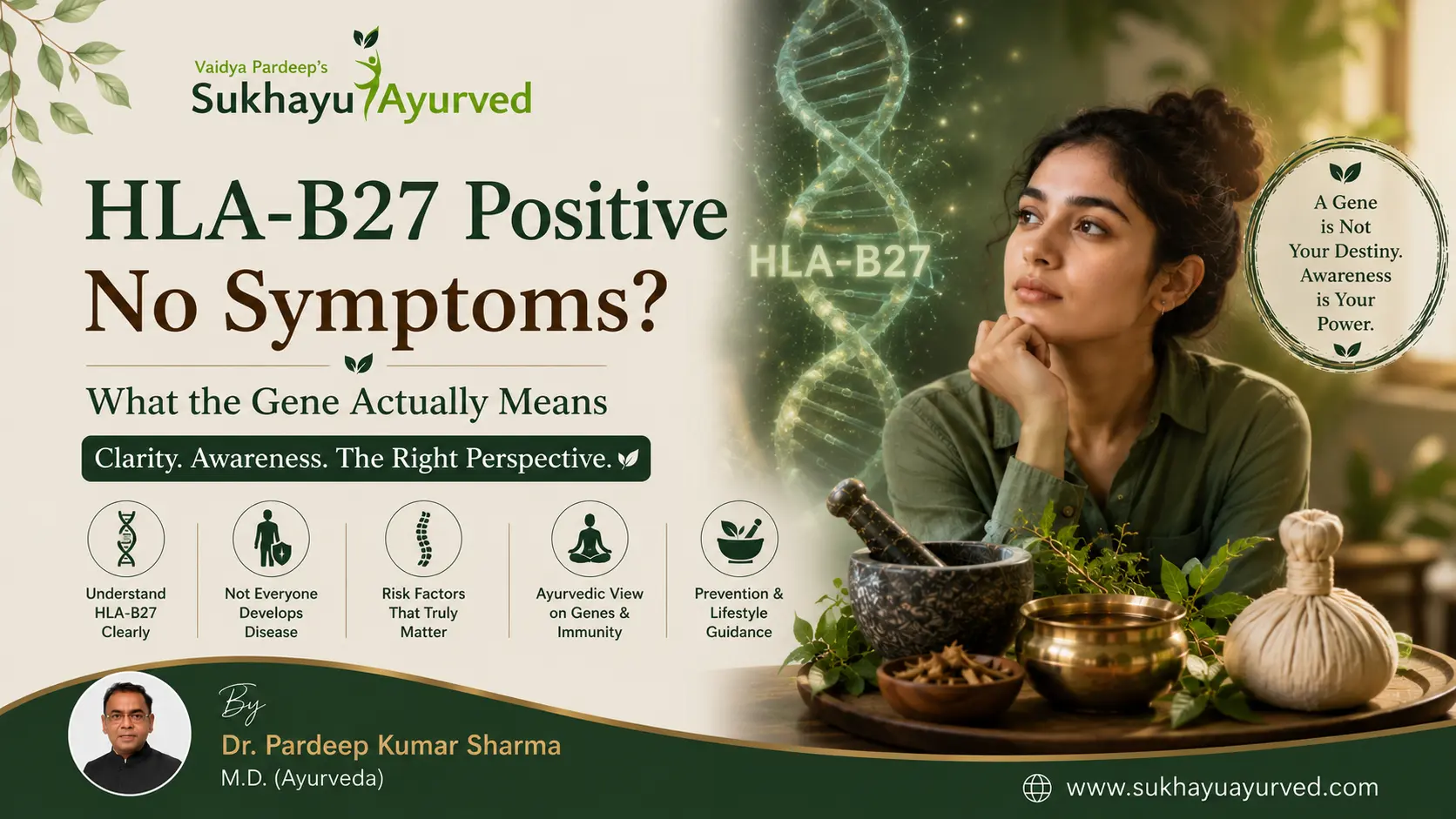
A blood report comes back HLA-B27 positive, and by evening the patient has already read enough on the internet to be convinced their spine will fuse by forty. This is one of the more unnecessary anxieties I encounter in OPD — not because the gene is irrelevant, but because it is almost always explained to patients as a verdict rather than what it actually is: a probability, and a fairly weak one at that.
Only about 6 to 8% of people who carry the HLA-B27 gene ever go on to develop a disease associated with it — Ankylosing Spondylitis or uveitis being the two most discussed. A gene, on its own, does not cause disease. What it does is create a susceptibility that requires something else to switch it on: diet, environmental exposure, gut microbiota, lifestyle. I tell patients this plainly — carrying the gene is closer to owning a matchbox than lighting a fire.
Why your grandparents didn't have this problem
I hear a version of this sentence often: "Doctor, nobody in my grandfather's generation had spine problems like this." The patients who say it are usually right, and the reason is not mysterious. It is diet.
Diets heavy in refined sugar, trans fats, and processed food are well documented to drive cytokine responses that sustain systemic, low-grade inflammation. Add to that the near-total abandonment of eating according to season, region, and constitution — what I call the loss of the three commandments — and you have a population eating in a way that provokes exactly the genetic susceptibility it happens to be carrying. The gene hasn't changed across generations. The provocation has.
The five signs an asymptomatic HLA-B27-positive person should actually watch for
This is the part I want patients to carry away from this article, because "just monitor it" is not useful advice without knowing what you're monitoring for.
- Morning stiffness that takes more than 15 minutes to ease, and improves with movement rather than rest. This is the single most important differentiator. Mechanical stiffness — from a bad mattress, poor posture, ordinary wear — settles within a few minutes and often gets worse with activity. Inflammatory stiffness does the opposite: it lingers, and movement is what relieves it.
- Back pain located over the sacroiliac joints — the bony points on either side of the lower spine — that wakes you at night and restricts how far you can bend or twist the lower back the next morning.
- A neck that suddenly feels "jammed," with stiffness that doesn't correspond to any obvious strain or injury.
- Pain in large joints — particularly the knees — where stiffness accompanies the pain rather than following an injury.
- Signs outside the joints entirely: skin rashes consistent with psoriasis, eye redness or blurred vision (uveitis), or unexplained gut symptoms resembling IBS. These extra-articular signs frequently appear before the joint disease itself becomes obvious, and patients rarely connect them back to the spine until much later.
If any of these are present, this is no longer a "positive report, no symptoms" situation — it warrants a proper clinical assessment, not continued self-monitoring.
Where this sits in Ayurvedic classification, and why the distinction matters
Ayurveda does not have a category for genetic disease as such. Classical texts divide disease broadly into Nija (arising from internal physiological imbalance) and Aagantuja (arising from external causes) — though in practice, most disease is a mixture of both. There is also an older, less-cited reference to disease caused by the Beeja, the seed itself — Beeja Dosha Janaya. Carrying HLA-B27 is the Nija component, the seed; diet and environment supply the Aagantuja trigger.
Most Ayurvedic writing places Ankylosing Spondylitis under Asthi-Majjagata Vata — vitiated Vata affecting bone and marrow tissue — and there's a reasonable case for that. But when I look specifically at what HLA-B27 does pathologically — sustained, body-wide inflammation that damages small blood vessels through endothelial injury, microvascular dysfunction, and in some cases outright vasculitis — the closer classical correlate is Vatarakta, not Asthi-Majjagata Vata alone. The distinction isn't academic. Asthi-Majjagata Vata centers the disease on bone and joint tissue; Vatarakta centers it on the blood and vascular pathology driving the inflammation. Given what we now understand about HLA-B27's mechanism, tracking the actual pathological process rather than only the eventual site of damage is the more accurate framework — and it changes how a physician thinks about management, not just how it's labeled.
MUST READ: Ankylosing Spondylitis & Ayurveda: A scientific Perspective
What actually helps — before there's a disease to treat
Here I want to be direct with patients, because it disappoints some of them: medicines are for disease. Prevention does not need a prescription.
What prevention needs is discipline around three things — Traditional, Regional, and Seasonal eating. These aren't abstract principles; they're specific, testable rules that function, in modern language, as epigenetic management:
- Avoiding grain from a freshly harvested crop before it has matured in storage
- Avoiding curd and buttermilk during Chaturmas (the monsoon-through-early-winter months)
- Waking and sleeping on a consistent schedule to protect the body's circadian rhythm
These rules sound almost too simple to matter next to a herbal formulation with an impressive name, but they are, if followed with any consistency, doing more real epigenetic work than most bottles on a pharmacy shelf.
If HLA-B27-related disease already runs in the family — a parent or sibling with confirmed Ankylosing Spondylitis, for instance — I do think seasonal Panchakarma is worth considering, provided it is authentic and administered by a physician who understands both the underlying pathology and the procedure itself. A massage and a shirodhara session at a wellness resort will not accomplish this. Panchakarma done without diagnostic understanding is relaxation, not medicine.
The larger point
A positive HLA-B27 report is information, not a sentence. The gene sets the susceptibility; nearly everything else that determines whether it ever becomes disease is within a patient's daily control — diet, sleep, and season. That is, if anything, a more empowering way to understand a genetic report than the internet usually presents it.
Must Read Articles on Ankylosing Spondylitis:
Can Ayurveda Really Cure Ankylosing Spondylitis?
Ankylosing Spondylitis treatment in Ayurveda
Is there any treatment for HLA B27 positive cases in Ayurveda?
This article is for educational purposes and reflects clinical experience in Ayurvedic practice. It is not a substitute for individualized medical evaluation. Please consult a qualified physician for assessment specific to your case.