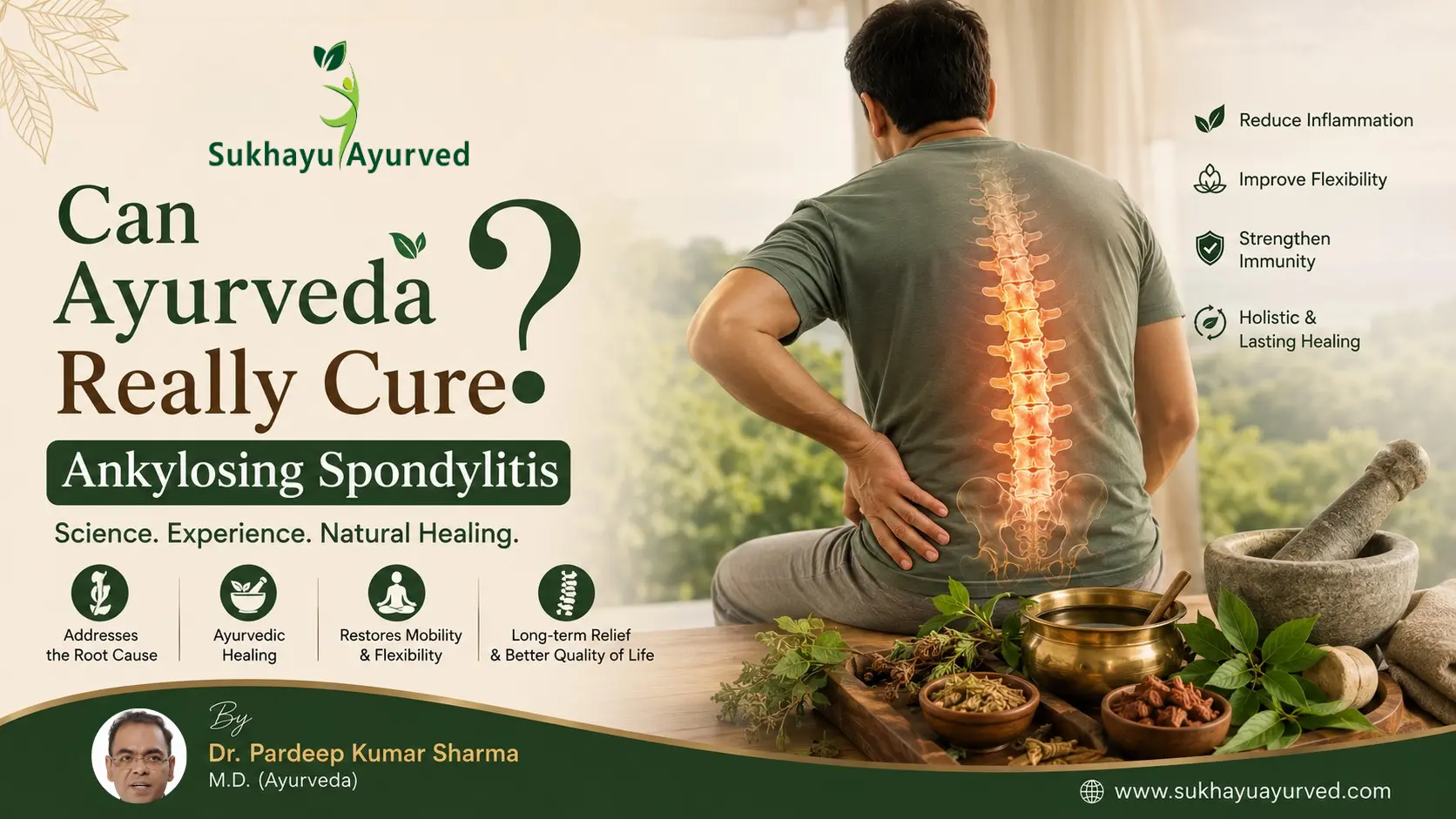
If you've typed this question into Google at 2 AM, lying awake because your spine is too stiff to find a comfortable position, I want to give you an honest answer before anything else: cure is divine. Treatment is possible.
That's not a marketing line - it's something I tell every patient who walks into my clinic asking, "Doctor, will I be cured?" After 20+ years of practicing Ayurveda and personally treating more than 500 registered patients with Ankylosing Spondylitis (AS) at Sukhayu Ayurved, I've learned that the honest answer is more useful than the comforting one. So let's get into it properly.
What Modern Medicine Says Is Happening
Ankylosing Spondylitis is an autoimmune condition strongly linked to a gene called HLA-B27. In AS, the immune system mistakenly attacks the spine — specifically the points where tendons and ligaments attach to bone (called entheses). This causes chronic inflammation, which over years can lead to stiffness and eventually fusion of the spinal joints, the hallmark "bamboo spine" appearance seen in advanced cases.
What most patients aren't told, and what research is increasingly confirming, is that HLA-B27 doesn't just affect the spine. It's also associated with higher rates of psychological symptoms — depression, anxiety, and in some studies, psychosis-like features. I bring this up not as a side note, but because in my clinical experience, it's one of the two biggest things standing between an AS patient and recovery.
How Ayurveda Understands Ankylosing Spondylitis
In Ayurveda, we don't have a one-to-one translation for "autoimmune disease attacking spinal entheses." But the clinical picture of AS — deep-seated joint pain, progressive stiffness, destruction of bone and joint architecture, eventual fusion — closely resembles a condition we call Gambheer Vatarakta (a deep, advanced stage of Vatarakta).
Here's how I explain it to patients: in this condition, Aama (a toxic, undigested metabolic byproduct, roughly comparable to inflammatory residue) combines with vitiated Vata dosha and lodges deep into the Asthi (bone) and Majja (bone marrow/deep tissue) dhatus. This isn't a surface-level inflammation — it's something that has penetrated into the deepest tissue layers of the body. That's exactly why it behaves the way modern medicine describes: progressive, structural, and capable of fusing joints permanently if left unaddressed.
This framework matters practically, not just philosophically. It tells us treatment has to work at the level of the Asthi and Majja dhatus, not just suppress surface inflammation — which is part of why Panchakarma (deep cleansing therapies) becomes central to treatment in progressed cases.
So — Can It Actually Be Cured?
This is where I'll be more precise than most articles you'll find on this topic, because vague promises help no one.
In my clinical experience, the answer depends entirely on the stage at which a patient comes to us:
Early-stage cases (no joint deformity yet): Full reversal is genuinely possible. At this stage, the disease hasn't yet caused structural damage, so Ayurvedic medicines combined with diet and lifestyle correction can often bring the disease process to a halt and reverse symptoms substantially.
Moderately progressed cases (joint changes present, but not fused): Here, "cure" in the absolute sense isn't the honest promise to make. What is achievable, and what we see consistently, is long-term control of inflammation and symptoms, preservation of remaining joint mobility, and a genuinely good quality of life — often without dependence on conventional medication.
Advanced cases with complete spinal fusion or major postural changes: I'll be direct here, because I think patients deserve direct answers: once complete fusion has occurred, that damage cannot be undone. We don't take on these cases with promises we can't keep. Integration with conventional/biological treatment may still be appropriate for pain management, but bone that has fused will not un-fuse — through Ayurveda or otherwise.
This is also why I caution patients against jumping straight to biologicals purely for "magical pain relief" in earlier stages, before lifestyle and Ayurvedic management have even been tried. Biologicals have their place, particularly once fusion has set in or in genuinely severe disease — but using them as a first-line shortcut, before addressing the root cause, often means missing the window where real reversal was still possible.
A Real Case: 19-Year-Old Female, Diagnosed AS, On Conventional Medication
Let me walk you through an actual patient, because numbers and theory only go so far.
A 19-year-old female came to Sukhayu Ayurved with:
- Persistent lower back pain and stiffness
- Morning stiffness in the spine and joints
- Difficulty with prolonged sitting and bending
- General fatigue and weakness
- Reduced physical endurance
She had already been diagnosed with Ankylosing Spondylitis and was on conventional treatment before she came to us — specifically Sulfasalazine (SAZ), Hydroxychloroquine (HCQ), and supportive anti-inflammatory medication. Despite taking these regularly, her symptoms hadn't resolved, and her inflammatory markers remained significantly elevated.
We treated her with a combination of Panchakarma protocols:
- Kashaya Basti (medicated decoction enema)
- Taila Basti (medicated oil enema)
- Choorna Pinda Swedana (herbal powder bolus fomentation)
- Kashaya Seka (medicated decoction pouring/streaming therapy)
Over the course of treatment, she showed both symptomatic and laboratory improvement — a significant reduction in spinal stiffness, improved functional activity, better energy levels, improved digestion and appetite, and overall better well-being.
Today, she is not taking any conventional medications and remains under continued Ayurvedic follow-up for long-term management and stabilization. This case is documented on our website as part of our case studies, precisely because we believe in showing real outcomes rather than just claims.
I want to be clear about something important: this doesn't mean every patient should stop their conventional medication on their own. Her transition off SAZ and HCQ happened under continued medical observation as her condition stabilized — this is not a "throw away your medicines" message. It's a "this is what becomes possible with consistent, supervised treatment" message.
What Treatment Actually Looks Like
One thing I find missing from most articles on this topic is an honest description of what the treatment process actually involves — not just the philosophy, but the logistics. At Sukhayu Ayurved, we follow two distinct treatment pathways depending on the patient's stage:
1. Treatment with medicines alone For early-stage cases with no joint deformity, oral Ayurvedic medicines combined with strict diet restrictions and lifestyle modification are often sufficient. Patients can typically begin this after an initial consultation, including a video consultation for primary assessment.
2. Panchakarma combined with medicines For cases where joint deformity has already developed, medicines alone aren't enough — the system needs deeper cleansing, which only Panchakarma provides. These patients are admitted for intensive Panchakarma care for Ankylosing spondylitis treatment, typically for 16 to 21 days for the first sitting, with subsequent follow-up sittings of 8 days each, repeated as required based on progress.
Before any of this begins, though, we do a proper assessment. If complete fusion has already occurred, we don't take on the case — not because we don't want to help, but because promising reversal of fused bone would be dishonest, and patients deserve clarity, not false hope.
Diet: What We Actually Restrict
In Ayurveda, certain foods are classified as Vidahi — broadly, foods that generate inflammatory or toxic byproducts in the body when digested. For AS patients, we specifically restrict:
- Wheat and barley (largely due to gluten-related inflammatory effects)
- Milk and milk products
- Guru Aahar (heavy-to-digest foods), such as urad dal, rajma (kidney beans), and chickpeas
These aren't arbitrary restrictions — they're chosen because they tend to aggravate Aama formation and Vata vitiation, the exact combination driving the disease process in Gambheer Vatarakta. Diet isn't a side suggestion in our protocol; it runs parallel to medicine and Panchakarma throughout treatment.
The Two Mindsets That Sabotage Recovery
After two decades of treating AS patients, I've noticed something that has nothing to do with medicine and everything to do with psychology — and it shapes outcomes more than people realize.
The first type of patient keeps "wandering" — moving from one treatment to another, hoping that their HLA-B27 marker will simply turn negative with some treatment, somewhere. They don't fully commit to lifestyle modification because they're holding out for a different kind of answer — one where the underlying genetic marker disappears and the disease "goes away" on its own terms. This mindset often delays consistent treatment long enough for the disease to progress further.
The second type of patient has the opposite problem: they've read enough, suffered enough, and become depressed and anxious — partly, the research suggests, because HLA-B27 itself is associated with higher rates of depression, anxiety, and even psychotic symptoms. These patients often give up on treatment altogether, convinced nothing will work.
Both groups need the same thing before medicine can fully work: realistic expectations and consistent follow-through. This is why, at every stage of treatment, we spend as much time managing expectations and explaining the "why" behind the disease as we do prescribing therapies.
So, Can Ayurveda Cure Ankylosing Spondylitis?
Here's the honest summary I'd want every reader to walk away with:
Cure, in the absolute sense — a return to a spine and immune system that behave as if AS never existed — is realistically possible only in early-stage cases, before structural damage has set in. Treatment, however, is possible at almost every stage short of complete fusion, and a genuinely good quality of life is well within reach for most patients. Ayurveda's real strength in AS isn't a miracle reversal story; it's saving joints from fusion and helping patients live full, functional lives — often without lifelong dependence on conventional medication, when caught early enough and managed consistently.
In more progressed cases, integration with conventional or biological treatment can absolutely help, and we don't discourage that. What we do discourage is reaching for biologicals as an immediate first step purely for fast pain relief, without first exploring whether the root cause can be addressed — because that's often the window where the most meaningful, lasting recovery is still possible.
If you're newly diagnosed, or even years into managing AS, the question isn't really "can Ayurveda cure this?" The more useful question is: "How early am I catching this, and am I willing to commit to consistent treatment and lifestyle change?" That answer matters more than any single therapy.
This article reflects 20+ years of clinical experience treating Ankylosing Spondylitis at Sukhayu Ayurved, including outcomes from 500+ registered patients. Individual results vary based on disease stage, duration, and patient compliance. If you're managing AS, please don't stop or alter conventional medication without consulting your treating physician.