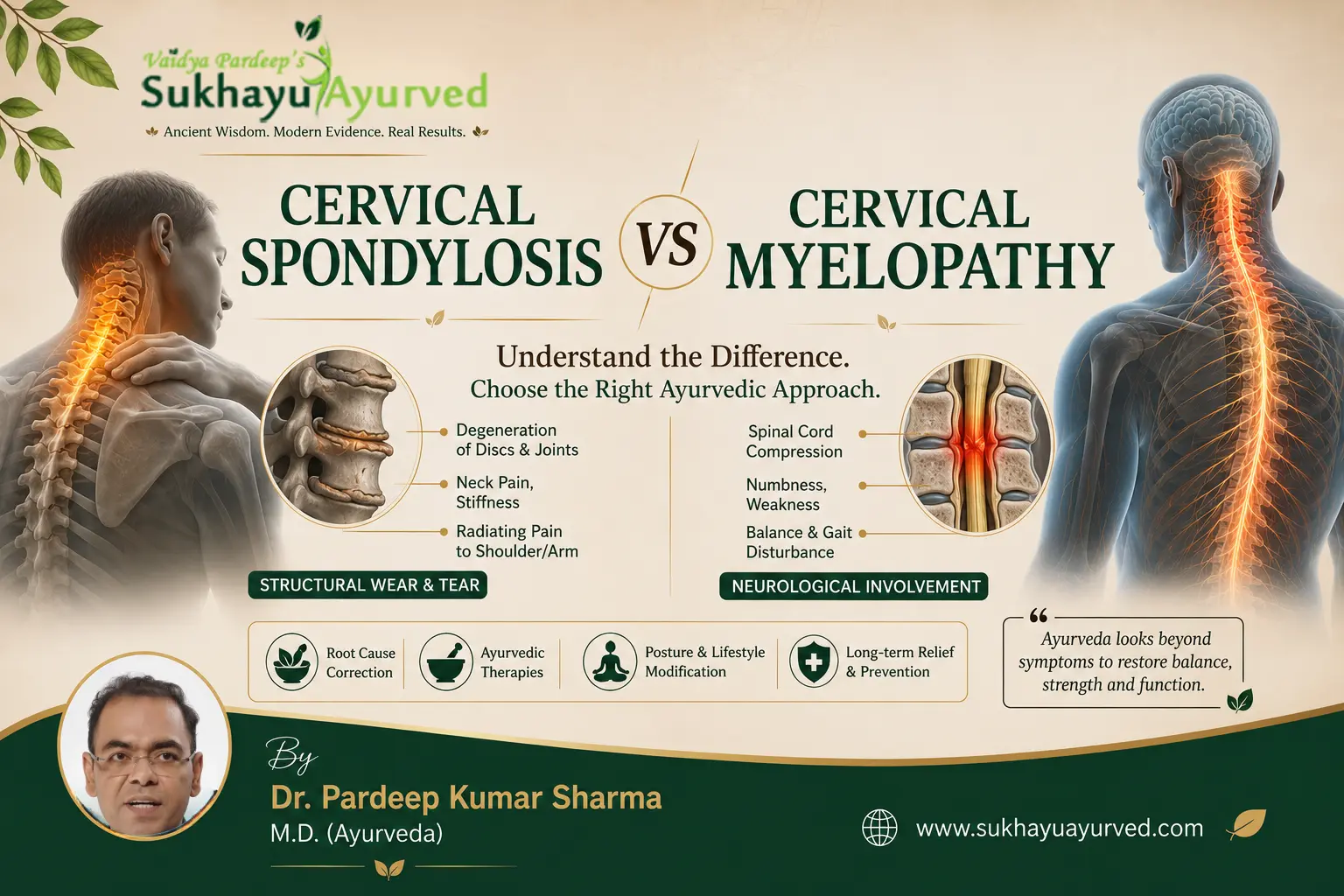
Patients often walk into my clinic using these two words as if they mean the same thing. They do not. Cervical spondylosis and cervical myelopathy are separated by a very deep gap — in what they are, in what they feel like, and in how urgently they need to be addressed. Confusing one for the other is not a small mistake. In some cases, it is the difference between a condition you can manage patiently and a condition that needs a surgical opinion this week.
So let me draw the line clearly.
Spondylosis is wear. Myelopathy is the cord.
Cervical spondylosis is degenerative change in the neck — the discs, the ligaments, the vertebrae aging and wearing down. It is common. Most people past a certain age will show some spondylotic change on an MRI, and many of them feel very little.
Cervical myelopathy is a different animal altogether. It is not a common thing. Here the pathology — a bulged disc, a thickened ligament, a slipped vertebra (listhesis) — has stopped being a local wear-and-tear problem and has begun to press on the spinal cord itself. The cord is the central line. Once that central line is under pressure, the problem is no longer confined to the neck. It announces itself all over the body.
That is the single most important thing to understand: spondylosis is about the neck; myelopathy is about the whole nervous system downstream of the neck.
The symptoms that should make you stop and pay attention
When someone describes ordinary neck degeneration, they describe the neck: stiffness, local ache, pain that moves into a shoulder or an arm.
Myelopathy speaks in a completely different language. The complaints I take seriously as cord-level warning signs are:
- Numbness spreading through the body, not just the neck or one arm — a pattern that must be distinguished from peripheral neuropathy
- Numb soles of the feet — with no lower back problem to explain it. This is a telling sign. If the feet are numb and the lumbar spine is clean, the problem may be sitting much higher, in the neck.
- Weakness of grip — things slipping out of the hand, buttons and jars becoming difficult
- A "belt-like" sensation around the abdomen — a band of tightness circling the trunk
- Imbalance while walking — the feeling of being unsteady, of the body not being fully under command
These are not neck symptoms. These are cord symptoms. And when a patient lists them, my attention shifts immediately.
Why a problem in the neck is felt in the feet and the belly
Patients always ask me the same question: if the problem is in my neck, why are my feet numb? Why do I feel a band around my stomach?
Here is how I explain it.
Your brain is the powerhouse. Every nerve in the body travels through the neck to reach it. If there is a pathology deep inside the neck that impacts the central line — the cord — then it disturbs signals travelling to and from the entire body below. That is why the symptoms are so widespread. The compression is in one small place, but the wiring that passes through that place serves everything downstream.
The belt-like sensation confuses people the most, so I use a simple picture. Think of the abdomen like a football. The abdominal wall is the outer leather layer, and the intestines and organs inside are like the bladder of the football. When the muscles of that wall are not getting an adequate nerve supply — because the signal is being choked off in the neck — the outer layer loses its proper tone and bulges, and that is what creates the strange band-like sensation around the middle.
Once you see it this way, the far-flung symptoms stop being mysterious. They are all the same story: a signal interrupted at the neck, felt wherever that signal was supposed to arrive.
When Ayurveda is not the answer — and surgery is
I want to be very direct here, because honesty about limits is not a weakness in medicine. It is a duty.
There is a threshold at which I stop discussing conservative management and tell the patient to go for surgery as soon as possible. That threshold is complete incontinence of stool and urine. When the cord compression has progressed to the point of losing bowel and bladder control, this is not the time to try therapies and wait. At Sukhayu Ayurved, we tell such patients plainly: opt for surgical decompression without delay.
I would rather send a patient to the right surgeon at the right time than hold on to a case that has crossed the line. That is what a treating physician owes you.
The truth about surgery that patients are rarely told
Here is something important, and it is true whether you choose surgery or not.
Surgery can remove the bulged disc. It can fix the listhesis. It can take the pressure off the cord. What surgery cannot do is regenerate the nerves. There is no point in the operation where nerves that have been damaged are made new again simply by removing the disc or stabilising the vertebra. Decompression relieves the pressure. It does not, by itself, restore the lost signal.
This is why so many patients are surprised after a technically successful surgery: the pressure is gone, but the numbness, the weakness, the imbalance are still there. The structural problem was solved. The signalling problem was not.
That signalling problem needs something else. It needs active rehabilitation of the nervous system — the brain and cord being taught, through structured effort and repetition, to re-establish the connection rather than passively waiting for it to return. This is required in essentially every case, surgical or not. I have written separately about why active re-learning of movement matters so much more than passive care, and why the nervous system has to be trained, not just treated: The Secret to Paralysis Recovery They Don't Tell You.
How Ayurveda understands cervical myelopathy
In classical terms, cervical myelopathy is a Majja dhatu involvement with a specific pattern: Kaphavritta Vata — Vata that has been enveloped and taken over by Kapha. To explain why this classification fits, and why it is different from ordinary spondylosis, I need to place the neck correctly.
The neck belongs to the Urdhva Jatrugata region — everything above the clavicle. This is a Kapha region of the body. Now consider what happens in myelopathy. The disc, the ligament, the vertebra erode and inflame the myelin sheath around the cord and its nerves — the wear and tear, the inflammation, sit here in this Kapha territory. As the sheath is compromised, Kapha takes over the movement of Vata, which is otherwise meant to be contained and conducted cleanly within the nerves.
There is a very close modern parallel that makes this easy to understand. Think of an electrical wire with a rubber coating. As long as the rubber coating is intact, the current runs cleanly to its destination and does not leak. Strip that coating away, and place the bare wire in a wet surrounding, and the current diffuses — it dissipates into the surroundings instead of reaching where it was meant to go. The myelin sheath is that rubber coating. When it erodes, the command — the electrical signal — no longer makes it to its destination. It leaks into a wet, Kapha-dominated environment. That is Kaphavritta Vata described in the language of physiology.
This is precisely why myelopathy is not the same as spondylosis in Ayurvedic reasoning. Spondylosis is degenerative Vata wear. Myelopathy is a Kapha obstruction seizing control of Vata's conduction at the level of Majja dhatu — a deeper, more serious involvement.
What rehabilitation actually looks like
For the myelopathy patient who has not crossed the surgical threshold, here is the honest shape of treatment.
The core therapies are Basti (the primary Vata-managing intervention), Nasya (working on the Urdhva Jatrugata region directly through the appropriate route), and a local neck procedure — but here I must add a firm caution that reflects how I treat these patients.
I do not use Greeva Basti for cervical myelopathy. This matters. Greeva Basti, the pooling of medicated oil over the neck, is a standard therapy many centres apply routinely for neck complaints. But in myelopathy the spinal cord is a delicate and vulnerable structure. A procedure that strains the neck can do harm rather than good. The delicacy and vulnerability of the spinal cord must be kept in mind at all times. So the local neck work is chosen carefully — never Greeva Basti — and the treatment always keeps the safety of the cord first.
Alongside these targeted therapies, the patient receives general Vata-pacifying treatment for the whole body, following our protocol-based treatment approach at Sukhayu Ayurved. The aim here is deliberately twofold: to pacify Vata overall, and to serve the active rehabilitation of the nervous system. The therapies are not there only to relieve symptoms — they are there to prepare and support the nervous system to re-learn its own signalling.
The realistic timeline
I set expectations honestly, because false hope helps no one.
The intensive, in-clinic phase is a 21 to 28 day IPD (in-patient) admission. This is the concentrated period of therapies under supervision.
But recovery of the nervous system is not a matter of a few weeks. The medicines continue for a much longer period — typically 8 to 10 months. Re-establishing signalling, retraining the cord and brain to conduct properly, is slow biological work. Anyone who promises you a quick reversal of cord-level damage is not being straight with you. The in-patient phase opens the door; the long months of continued medicine and active rehabilitation are what carry you through it.
The bottom line
If your neck aches and stiffens, you likely have spondylosis, and there is time and there are options. But if you notice numb soles with no back problem, a belt around your middle, a grip that fails you, or a walk that has lost its balance — do not file these under "neck pain." These are the cord asking for attention. Get imaged, get assessed, and understand which of the two conditions you are actually dealing with. If you would like your MRI and symptoms reviewed by our team, you can reach us for a consultation. The name you give it decides everything that follows.
This article is for educational purposes and reflects clinical experience in Ayurvedic practice. It is not a substitute for individualized medical evaluation. Ayurvedic management is intended to complement, not replace, conventional diagnosis and care — particularly for cervical myelopathy, where delayed treatment of cord compression can have serious and sometimes irreversible consequences. If you have signs of cord involvement, especially loss of bowel or bladder control, seek urgent medical assessment. Please consult a qualified physician for evaluation specific to your case.