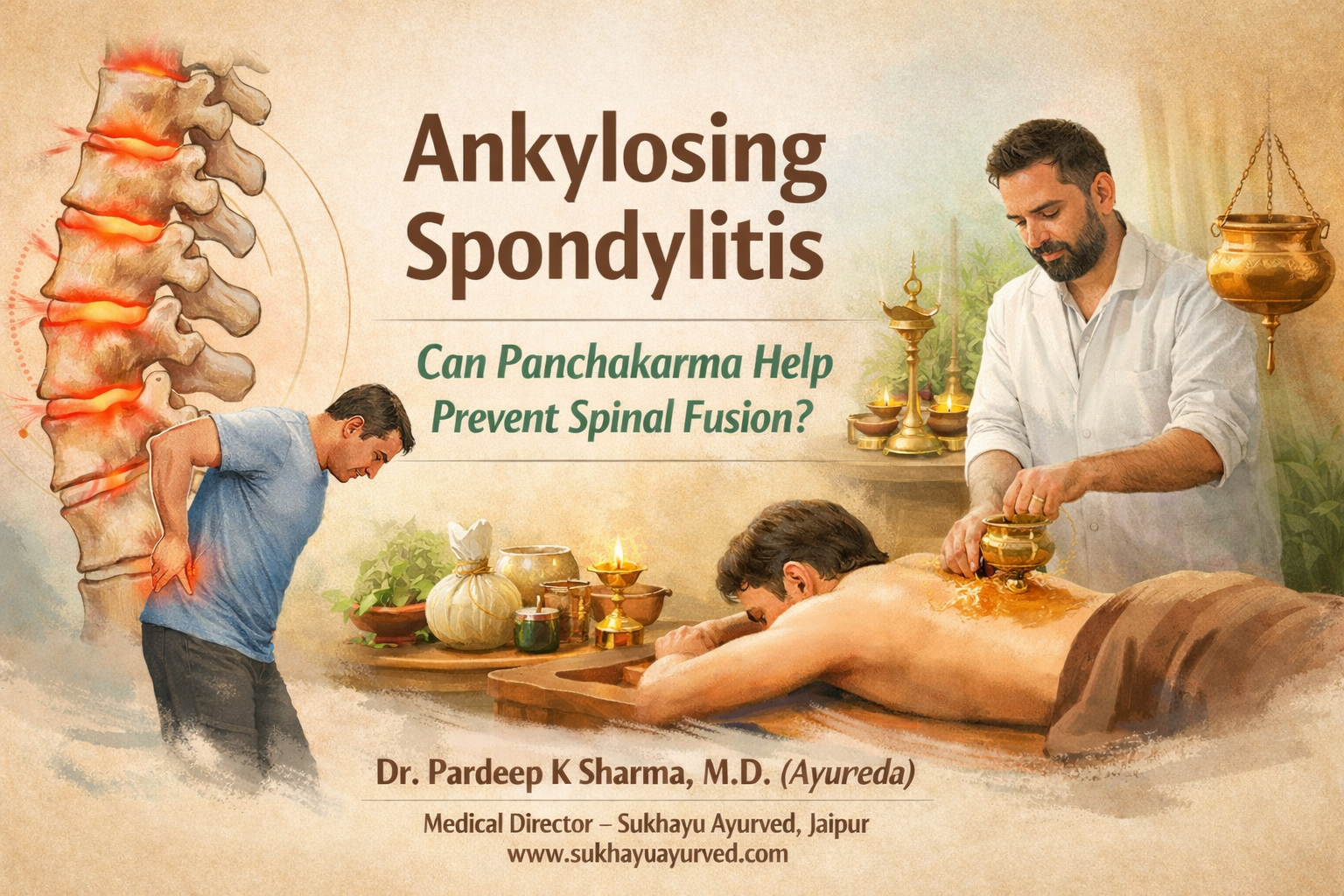
Many people living with Ankylosing Spondylitis (AS) eventually reach a stage where stiffness in the spine begins to limit everyday movement. At that point, patients often start searching intensely for alternatives.
A very common question that appears in consultations and online searches is:
“Can Panchakarma, particularly Tikta Ksheera Basti, reverse spinal fusion in Ankylosing Spondylitis?”
The interest around this therapy is understandable. In Ayurveda, Tikta Ksheera Basti has traditionally been described as one of the most important interventions for deep-seated Vata disorders affecting bones and joints. But to understand its role honestly, we must look at the bigger picture.
Understanding Ankylosing Spondylitis from an Ayurvedic Perspective
In Ayurveda, conditions resembling Ankylosing Spondylitis are understood through the interplay of:
- Aggravated Vata
- Inflammatory processes resembling Ama involvement
- Weakness or depletion of Asthi (bone) and Majja (marrow) tissues
Over time, this imbalance may lead to:
- persistent inflammation around spinal joints
- stiffness and reduced flexibility
- progressive restriction of movement
If the disease progresses unchecked for years, the spine may gradually become rigid — sometimes described in modern medicine as spinal fusion.
Ayurveda therefore focuses not only on pain relief but also on correcting the deeper imbalance affecting tissues and systemic inflammation.
Why Tikta Ksheera Basti Is Often Highlighted
Among Panchakarma therapies, Basti (medicated enema therapy) is considered the most important treatment for disorders dominated by Vata.
Tikta Ksheera Basti is a specialized form of this therapy that combines:
- Tikta (bitter) herbs such as Guduchi, Nimba, or Patola
- Medicated milk preparations
- Herbal decoctions and oils
Traditionally, this combination is believed to work in two ways:
1. Pacifying aggravated Vata
Since the colon is considered the main seat of Vata, therapies administered through this route are believed to influence systemic Vata imbalance. When Vata stabilizes, symptoms like:
- stiffness
- deep joint pain
- restricted movement
may begin to reduce.
CASE STUDY OF PATIENT TREATED WITH PANCHAKARMA
2. Supporting Asthi and Majja Dhatus
Tikta herbs are traditionally used in inflammatory conditions, while medicated milk preparations are considered nourishing for deeper tissues such as bone and marrow.
This combination is why classical Ayurvedic physicians have often regarded Tikta Ksheera Basti as a key therapy for disorders involving bones and joints.
Important Clarification: It Is Never a Stand-Alone Cure
One of the biggest misconceptions circulating online is the idea that a single therapy alone can cure complex diseases like Ankylosing Spondylitis.
This is not how authentic Ayurvedic treatment works.
While Tikta Ksheera Basti may be the central therapy in many treatment plans, it is usually only one component of a broader therapeutic approach.
A comprehensive Ayurvedic treatment program may also include:
- Preparatory therapies to improve digestion and metabolic balance (Agni correction)
- External therapies such as oil treatments or sweating procedures to reduce stiffness
- Sequential Panchakarma therapies, where different Bastis are administered in a planned schedule
- Internal herbal medicines selected according to the patient’s constitution and disease stage
- Dietary guidance to reduce inflammatory triggers
- Lifestyle and movement practices to maintain spinal flexibility
In other words, Tikta Ksheera Basti may be a cornerstone therapy, but it is rarely the entire treatment.
Thinking of it as a single “magic procedure” oversimplifies a very thoughtful and individualized system of care.
What Clinical Observations Suggest
Clinical observations from Panchakarma-based treatment protocols in Ankylosing Spondylitis have reported encouraging outcomes in many patients.
After structured treatment cycles that include Basti therapies along with supportive interventions, patients have shown:
- improvement in BASDAI (Bath Ankylosing Spondylitis Disease Activity Index) scores
- reduced morning stiffness
- improved spinal mobility
- reduction in inflammatory markers such as ESR and CRP
Many patients also describe improvements in:
- sleep quality
- overall energy levels
- reduced reliance on frequent pain medication
These outcomes suggest that systemic inflammation and disease activity may be meaningfully reduced in some patients under supervised Ayurvedic care.
HOW AYURVEDA HELPED AN ANKYLOSING SPONDYLITIS PATIENT
But Can It Reverse Spinal Fusion?
This question deserves a very honest answer.
If complete structural fusion of the spine has already occurred, no therapy — whether modern or traditional — can simply restore the original anatomy.
Bone that has already fused cannot easily separate again.
However, Ayurvedic treatment may still offer meaningful benefits such as:
- slowing further progression of the disease
- reducing ongoing inflammation
- preserving remaining spinal mobility
- improving flexibility and daily functioning
- enhancing overall quality of life
When intervention begins before advanced fusion develops, improvements in symptoms and mobility may be significantly better.
Why Timing Matters
Many patients seek alternative approaches only after several years of disease progression.
However, the most favorable responses to integrative therapies often occur when intervention begins during:
- persistent inflammatory back pain
- prolonged morning stiffness
- early radiological changes in sacroiliac joints or spine
At these stages, the goal becomes controlling inflammation and preserving joint function.
Lifestyle and Diet: The Often-Ignored Foundation
In chronic inflammatory conditions, therapies alone rarely bring long-term results without changes in daily habits.
Ayurveda traditionally emphasizes:
- improving digestive efficiency (Agni)
- avoiding foods that are difficult to digest or promote inflammation
- maintaining regular sleep and activity rhythms
- gentle stretching or movement practices that support spinal mobility
These supportive steps are essential for sustaining the benefits of any treatment.
Precautions
- Panchakarma procedures such as Tikta Ksheera Basti should always be performed under the supervision of qualified Ayurvedic physicians.
- These therapies must be individualized according to the patient’s condition, digestive capacity, and disease stage.
- Patients taking biologics, steroids, or other immunosuppressive medications should not discontinue them without consulting their treating physician.
- Self-administration or unsupervised Panchakarma practices can lead to complications.
The Real Takeaway
The idea that a single therapy can reverse spinal fusion is a misunderstanding.
However, when used as part of a comprehensive Ayurvedic treatment approach, Panchakarma — including Tikta Ksheera Basti — may help reduce inflammation, improve mobility, and slow disease progression in Ankylosing Spondylitis.
The real strength of Ayurveda lies not in one isolated procedure, but in a carefully designed combination of therapies, medicines, and lifestyle corrections tailored to each patient.
Disclaimer:
This article is for educational purposes only. Ayurvedic therapies such as Panchakarma should always be undertaken under the guidance of a qualified practitioner. Patients with Ankylosing Spondylitis should consult their healthcare provider before making changes to their current treatment plan.