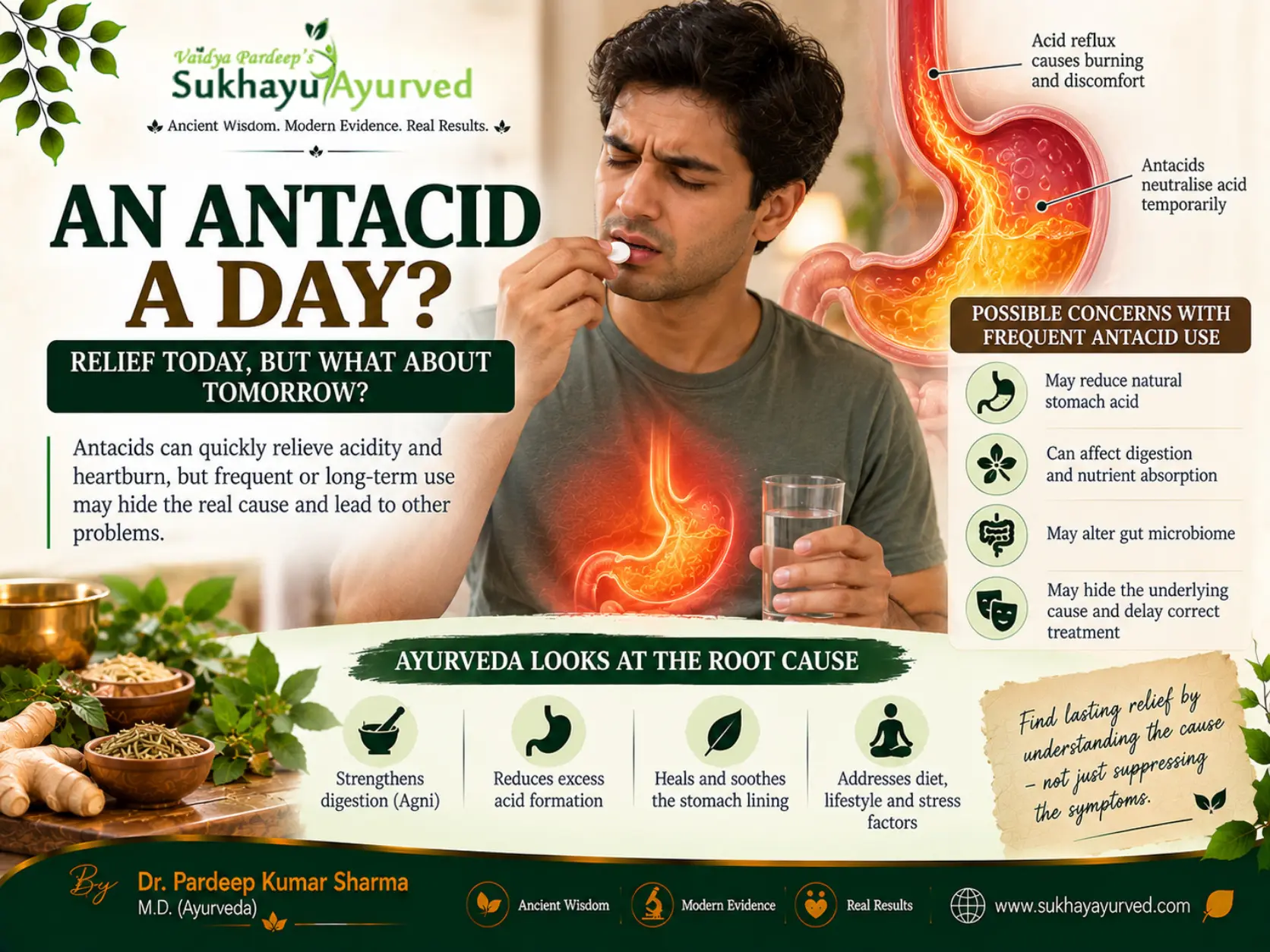
By Vaidya Pardeep Sharma, M.D. (Ayurveda), Chief Physician, Sukhayu Ayurved, Jaipur · Updated October 2026
The short answer: No. Antacids are made for occasional, short-term relief. No guideline recommends them as a daily habit, and over-the-counter packs carry a 14-day limit for a reason. Long-term use of acid-suppressing capsules is linked to vitamin B12 deficiency, low magnesium, fractures and rebound acidity. If you need one every day, the need itself is the finding: something in the stomach is not right, and the pill is hiding it.
Anti-acid. The name carries the whole theory: the acid is the enemy, so neutralise it. It is a neat theory. It is also mostly wrong.
The stomach is supposed to be acidic. It makes acid to break down protein, to activate its digestive enzymes and to kill microbes in food. A healthy stomach lives with a pH of 1.5 to 3 every day without burning itself. When it starts to burn, the more useful question is not "how do I remove the acid?" but "why can my stomach no longer tolerate its own acid?"
The pills people take every day are not all the same pill
In our OPD, patients rarely name their medicine. They describe it: the gas ki goli, the khali pet ka capsule taken before breakfast, the bajne wala capsule that rattles when you shake it. These fall into two groups.
- Antacids (tablets, chewables, gels and syrups) neutralise acid already in the stomach. Relief is fast and short.
- Acid-suppressing capsules (proton pump inhibitors and similar medicines) switch down the stomach's acid production itself. Most of the empty-stomach and rattling capsules belong here.
Both were designed to relieve symptoms. Neither treats the reason the symptoms appeared.
Daily use has documented costs
The risks below come from controlled trials, large population studies and regulator warnings, not from opinion.
- Rebound acidity. In a randomised trial, 120 healthy volunteers with no acid problems took an acid-suppressing capsule daily for 8 weeks. After stopping, 44% developed heartburn, acid regurgitation or indigestion, against 15% on placebo (Reimer et al., Gastroenterology, 2009). The pill can create the symptom it is taken for. This is why so many people feel they "cannot stop".
- Vitamin B12 deficiency. Among about 26,000 patients with B12 deficiency and 184,000 controls, two or more years of acid-suppressing capsules was linked to a 65% higher risk, rising with dose (Lam et al., JAMA, 2013).
- Fractures, low magnesium and gut infection. The US FDA has warned of a higher risk of hip, wrist and spine fractures (2010), low blood magnesium after more than a year of use (2011), and a serious infectious diarrhoea, C. difficile (2012) (FDA safety communications).
- Plain antacids are not harmless either. Large amounts of calcium-based antacids can disturb the body's calcium and acid balance and strain the kidneys, and can stimulate fresh acid after the first relief. Aluminium-based antacids can build up in people with weak kidneys (MedicineNet; Poison Control).
One balancing fact belongs here. The American Gastroenterological Association notes that many long-term risks come from observational studies, and that when a diagnosed condition needs these medicines, the prescribing doctor weighs benefit against risk (Freedberg et al., Gastroenterology, 2017). That is precisely the point. These are prescription decisions. A self-bought pill taken every morning for years has no doctor weighing anything.
Your stomach was built to live with acid
The stomach protects itself with a mucus gel about 200 microns deep and with bicarbonate secreted by its own lining. Together they keep the surface of the stomach close to neutral while the inside sits at pH 1.5 to 3 (Flemström & Turnberg; Flemström).
Two findings from this research change how acidity should be seen. When this defence is impaired, the result is ulceration. And acid itself switches the defence on: acid in the stomach can raise bicarbonate secretion up to tenfold (Flemström, Knutson & Kivilaakso). Damage comes from a defence that has failed, not from acid alone. Neutralising the acid every day does nothing to rebuild that defence.
The acid is rarely the real problem
Antacids are never a solution because they do not address the cause. In practice, the burning usually traces back to one of these:
- H. pylori infection, a bacterium that lives in the stomach lining.
- Weak mucosal protection, where the lining can no longer shield itself.
- Medicine-induced acidity, from painkillers and other regular medicines.
- Irregular meals, wrong food, stress, tobacco and alcohol, which keep the problem going.
In Ayurvedic terms, the picture usually reads as Vidagdha Ajeerna (indigestion where food sours and burns) or Amajeerna (indigestion with ama, undigested residue). Both are disorders of Agni, the digestive fire. Neither is a disorder of too much acid.
The stomach is a seat of Kapha, not of Pitta
Classical Ayurveda places the Amashaya, the stomach, as a seat of Kapha. Acidity is usually blamed on Pitta alone. In my reading, the problem begins earlier.
This is my clinical hypothesis, drawn from practice: hyperacidity begins with depletion of Kledaka Kapha, the moistening, protective Kapha of the stomach. As it weakens, Agni turns irregular (Mandagni), and Pitta moves into a seat that is not its own. The burning is Pitta out of place, because the Kapha that should hold that place has thinned.
Modern physiology describes a remarkably similar protective layer: the mucus gel and bicarbonate described above. The research does not prove an Ayurvedic idea. But it points in the same direction: the problem is a failing defence, so treatment must restore the defence, not just remove the acid.
Warning signs that need a doctor, not another pill
Stop self-treating and see a doctor promptly if you have any of these:
- Difficulty or pain in swallowing
- Vomiting blood or coffee-ground-like material
- Black, tarry stools
- Unexplained weight loss
- Persistent vomiting
- Chest pain, especially on exertion
- Heartburn starting for the first time after about age 55
At Sukhayu, patients with these signs are sent for endoscopy first. We treat only if the findings fall within our treatment criteria. A bleeding or deep ulcer, a suspicious growth, a narrowed food pipe or Barrett's changes are referred for conventional care. Ayurveda is complementary care here, not a replacement for investigation.
How we treat people who need an antacid every day
Treatment has three aims, worked on together rather than one after another: restoring Kapha, correcting Agni and pacifying Pitta. Both internal medicines and diet carry the treatment. Panchakarma is generally not needed. Where there is a long, chronic history of hyperacidity, Vamana (therapeutic emesis) is indicated.
- H. pylori is not an exclusion. It is treated within the protocol. Symptoms usually begin to respond within two to three weeks.
- Progress is confirmed by medical investigation, not by how the stomach feels on a good day.
- The antacid is reduced gradually, and in most cases stopped within the first month. The medicines usually conclude in two to three months. Every patient's course is individual.
- Self-bought pills: the first step is understanding what daily use does. Once patients understand it, most show remarkable will-power in stopping. Reducing gradually, rather than overnight, keeps rebound acidity manageable.
- Diagnosed GERD on prescribed treatment: reduction is planned gradually around the previous treatment, and the decision belongs to your prescribing doctor.
Read more on our approach to heartburn, GERD and acid reflux and our wider Ayurvedic gastroenterology care.
What you can change from tomorrow
In most cases, two things keep acidity going: eating at irregular times and eating the wrong food. Get control of these two and the stomach often settles noticeably. Stress, and the tobacco and alcohol that come with it, is the next driver; escaping it does not solve it. Our diet for hyperacidity guide sets out what to eat and avoid. For short-term soothing while you get evaluated, see our home remedies for hyperacidity.
Talk to us
If you have been taking an antacid every day and want to understand why, share your symptoms, history and reports with our team on WhatsApp at 9050802060. We do not sell packages. We treat diagnoses. Cure is divine. Treatment is possible.
This article is for education and does not replace a consultation. Do not stop a prescribed medicine without speaking to your prescribing doctor.
References
- Reimer C, et al. Proton-pump inhibitor therapy induces acid-related symptoms in healthy volunteers after withdrawal of therapy. Gastroenterology. 2009. Summary
- Lam JR, et al. Proton pump inhibitor and histamine 2 receptor antagonist use and vitamin B12 deficiency. JAMA. 2013;310:2435–42. Summary
- US FDA drug safety communications on proton pump inhibitors, 2010–2012. List
- Freedberg DE, Kim LS, Yang YX. The risks and benefits of long-term use of proton pump inhibitors. Gastroenterology. 2017;152(4):706–715. PubMed
- Flemström G, Turnberg LA. Gastroduodenal defence mechanisms. PubMed 6378442
- Flemström G. Gastroduodenal mucosal secretion of bicarbonate and mucus: physiologic control and stimulation by prostaglandins. Am J Med. 1986. PubMed 3463207
- Flemström G, Knutson L, Kivilaakso E. Gastroduodenal mucosal secretion of bicarbonate and mucus: physiological control and role in protection. PubMed 3560771
- MedicineNet. Can you overdose on antacids? Link
- Poison Control. Are over-the-counter antacids safe? Link