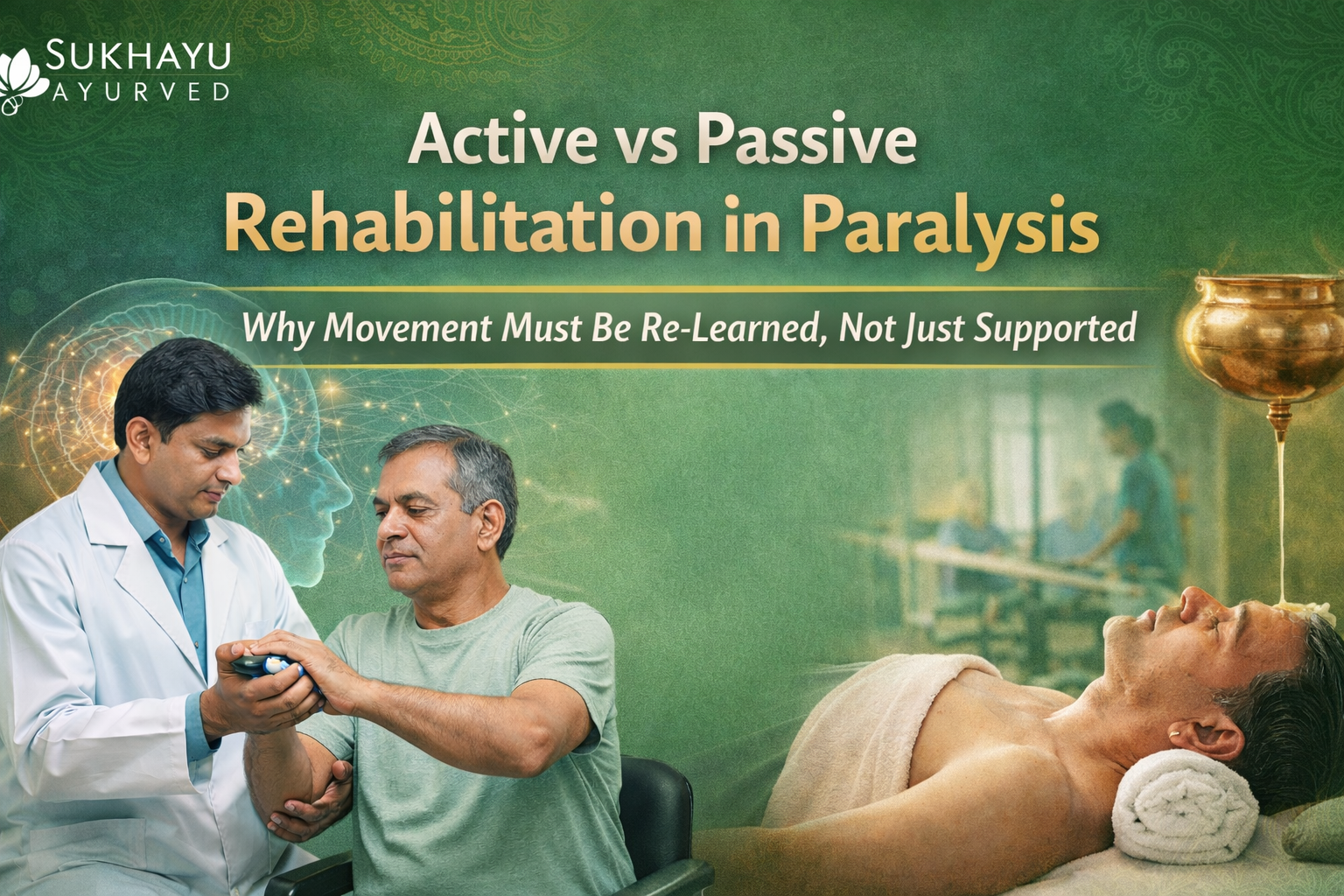
If your loved one is navigating the world of paralysis recovery—after a stroke, a spinal cord injury, or nerve damage—you are likely living in a whirlwind of hospital visits, therapy schedules, and hope.
You watch as therapists move their limbs, apply hot packs, or perform massages. It feels like something is being done, and that feels productive. It’s easy to assume that any therapy is good therapy, and that time and effort alone will eventually lead to walking out of the clinic.
But after months of this, a quiet, terrifying question often creeps in: Why isn’t he walking yet? Why can’t she use that hand?
The answer often lies not in the amount of therapy, but in the type. There is a fundamental difference between having something done to you and actively learning to do it yourself. Understanding this distinction is the most important step you can take in a recovery journey.
👉 For a broader explanation of structured rehabilitation models, see:
Active Rehabilitation Through Panchakarma for Paralysis
The Two Faces of Rehab: Comfort vs. Connection
Let’s look at two different scenarios.
Scenario A (The Passenger):
You arrive at the clinic. You lie on a table. A therapist gently bends your stiff knee back and forth. Then, someone massages warm oil into your arm. You feel relaxed, looser, and cared for. You go home.
Scenario B (The Pilot):
You arrive at the clinic. The therapist asks you to try and lift your arm yourself. It barely moves an inch. She supports the weight, but insists you try to initiate the movement. You repeat a frustrating motion ten times. You are exhausted, but you focused intensely.
Both are valid forms of care. But only one teaches the brain to reconnect with the body.
What is Passive Rehabilitation?
This is when the patient is a passenger. The work is done to them. Think of massage, passive stretching, or a therapist moving a limp limb.
It’s valuable for:
- Keeping joints from freezing up.
- Reducing swelling and improving blood flow.
- Providing comfort and preventing bedsores.
But there is a hard truth we need to face: Passive therapy alone cannot rebuild a broken connection between the brain and the muscles. It keeps the body in good condition, but it doesn't teach it how to move.
Why Passive Care Hits a Wall
Imagine your phone’s Wi-Fi is broken. You can polish the screen and charge the battery (that’s passive care), but if you don’t fix the signal, you can’t send a message.
Paralysis is a "signal" problem. It’s a disruption in the communication line between the brain's command center and the muscles. If the brain never has to try to send the signal, it learns to give up. It rewires itself to accept silence. This is why a patient might have strong muscles that simply won't fire when they need them to.
The Brain’s Secret Power: Neuroplasticity
Here is the hope that changes everything: Your brain can rewire itself. It’s called neuroplasticity.
Think of your brain after an injury as a city with a major bridge collapsed. Traffic (nerve signals) is stuck. Passive therapy is like repaving the roads on the other side of the bridge—it looks nice, but it doesn’t solve the core problem.
Active rehabilitation is about building a new bridge.
What is Active Rehabilitation?
Active rehabilitation is when the patient becomes the pilot. It requires effort, concentration, and repetition. It isn't always gentle.
It looks like:
- Reaching for a cone, even if the hand shakes.
- Trying to grip a sponge, even if it drops.
- Shifting weight while sitting, even if it feels impossible.
This process is hard work. It can be frustrating. But it sends a loud and clear message to the brain: "Hey! We still need to use this arm! Fix the connection!"
Through repetition, the brain starts to carve new pathways around the damaged area. It learns new ways to talk to the muscles. This is how movement is truly re-learned.
The Missing Link: The "Sixth Sense" of Movement
There’s another reason why you can’t just sit back and let someone else move your limbs. Your body has a "sixth sense" called proprioception. It’s the ability to know where your arm is, even with your eyes closed.
When a therapist moves your arm for you, your brain doesn’t have to work. It doesn't feel the position or the pressure. But when you struggle to lift the arm yourself, even a tiny bit, your muscles and joints fire sensory signals back up to the brain saying, "We tried!"
Active rehab creates this vital feedback loop. The brain sends a signal down, and the limb sends a report back up. This conversation is what builds coordination.
Where Ancient Wisdom Meets Modern Science (The Role of Panchakarma)
This brings us to a common point of confusion: Is traditional therapy like Panchakarma just passive pampering?
It doesn't have to be. In fact, when done right, it’s the ultimate warm-up for active rehab.
Think of a stiff, frozen garden hose. You can’t just turn the water on full blast; the kinks will stop the flow. You need to gently warm the hose to make it pliable first.
Panchakarma, when used clinically for paralysis, can act as that "warming" agent. It can:
- Melt away the rigidity and stiffness that makes active movement impossible.
- Wake up the sensory nerves in the skin and muscles, turning on the "feedback loop" before exercise.
- Improve blood flow to bring oxygen to a hungry, healing brain.
The magic happens when the patient, now loose and sensorially "awake," immediately begins active movement therapy. The oil and massage prepare the instrument, but the active exercise plays the music.
Is Your Current Rehab Working? A Checklist for Families
It’s time to be honest about the therapy your loved one is receiving. Ask yourself:
- Does the session have a goal? (e.g., "Today we will try to hold the spoon for 5 seconds," vs. just "We will do the usual routine.")
- Who is doing the work? Is the patient sitting quietly while being manipulated, or are they sweating, concentrating, and trying?
- Has progress stalled? If mobility isn't improving, the brain might need a new challenge, not just more of the same comfort care.
- Is stiffness the main enemy? If you fight the same stiffness every morning, passive care is just a temporary fix. Active movement is the only way to train the muscles to stay relaxed on their own.
A Message of Honest Hope
Recovery is rarely a straight line. It is a series of small, almost invisible victories that suddenly add up to a breakthrough.
Passive care holds your hand and keeps you comfortable on the journey.
Active rehabilitation takes you where you need to go.
Don't settle for just being comfortable. Demand to be challenged. Ask your therapists: "What are we actively training today?"
Because the goal isn't just to survive paralysis. It's to live again. And that requires rolling up your sleeves, engaging your brain, and fighting for every single inch of movement.