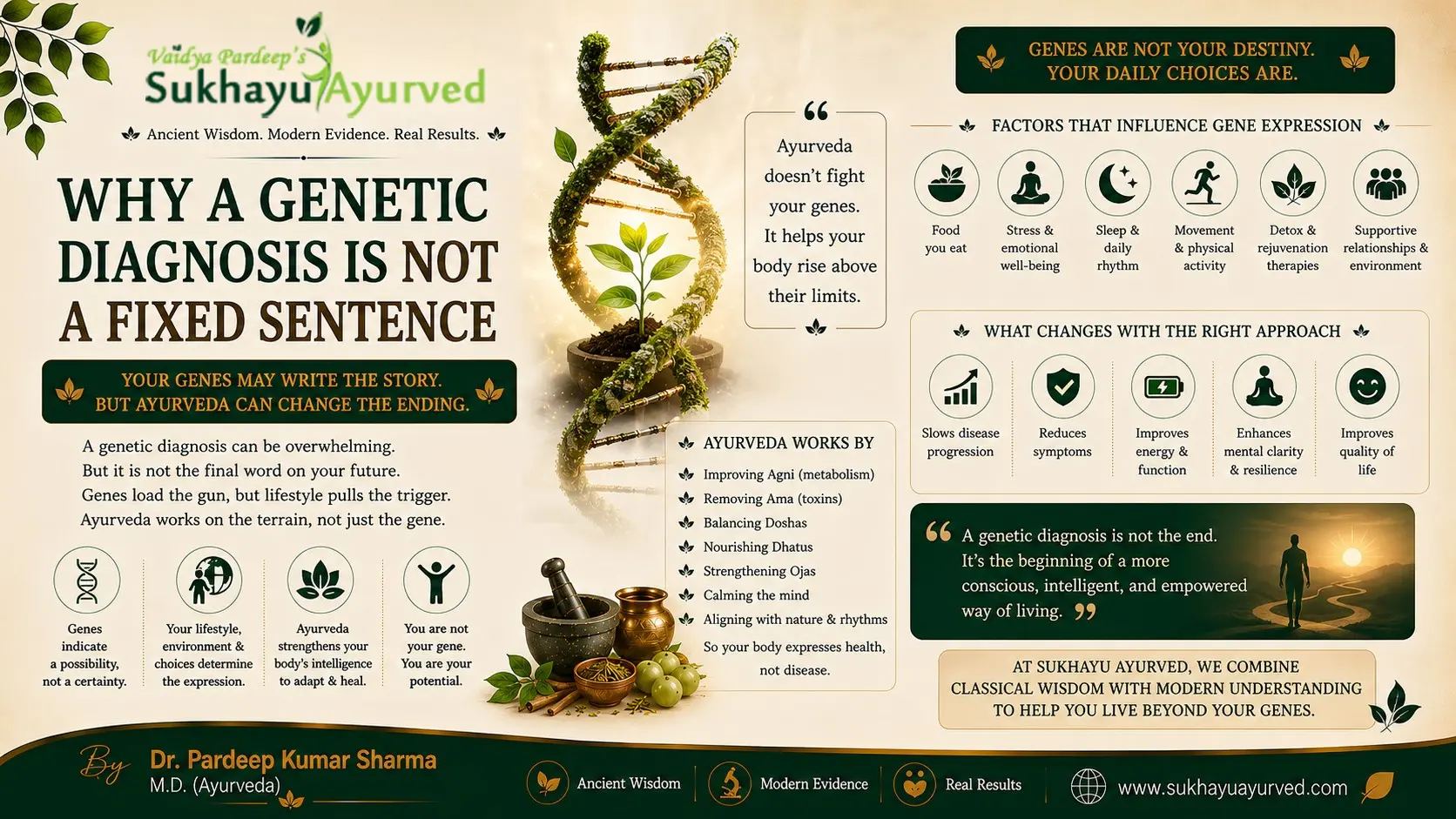
There is a specific silence that falls over a consultation room the moment a patient reads a genetic result they believe has already decided their life.
I have watched it happen for over twenty years. It looks the same whether the report says HLA-B27 positive or names a repeat expansion in Spinocerebellar Ataxia. The shoulders drop. The eyes go somewhere far away. And then, almost always, the same sentence: "So it's in my genes. There's nothing I can do."
I want to take that sentence apart. Not with reassurance — reassurance is cheap, and patients can smell it. I want to take it apart with biology, and with a concept Ayurveda has held for two thousand years that modern science has only recently caught up to.
Because the belief that a gene is a sentence is not just emotionally corrosive. It is scientifically incomplete — and how incomplete depends entirely on which gene we are talking about.
Two genetic reports, two different truths
I am deliberately putting two very different conditions in the same room, because most writing on genetics blurs a distinction that decides everything.
HLA-B27 and Ankylosing Spondylitis sit at one end. HLA-B27 is a susceptibility marker. Carrying it raises your risk of AS — but here is the fact almost no one hands the patient with their report: the majority of people who carry HLA-B27 never develop Ankylosing Spondylitis. The gene loads a possibility. It does not pull a trigger.
Spinocerebellar Ataxia sits nearer the other end. In many SCA subtypes the genetic change is not merely a risk factor — it is causative. Here I will not perform the same trick, because it would be dishonest, and dishonesty in a clinic is the one thing I will not do. If the mutation is present, the question is not usually whether.
So do these two conditions belong in the same essay? They do — and understanding why is the whole point.
Because between "the gene is only a risk" and "the gene is causative" there is a vast territory that genetics alone does not govern: how the disease expresses — how fast it moves, how severely it burdens the body, how much function is kept along the way. That territory is not fixed by the report. And it is the territory a physician actually works in.
What epigenetics actually says
Epigenetics is the study of how gene expression is turned up or down — without changing the underlying genetic code itself.
The metaphor I use with patients is deliberately simple, because it is also accurate. Your genome is the piano. Every key is present at birth and cannot be added or removed. Epigenetics is which keys get played, how hard, and how often. The same instrument can produce a lullaby or a scream.
Diet, inflammation, gut ecology, stress, sleep, metabolic state, physical loading of the tissues — these are not vague "lifestyle" abstractions. They are inputs that biochemically influence which genes are amplified and which are dampened, and how the body copes with the proteins those genes produce.
For a susceptibility gene like HLA-B27, this reaches all the way back to onset — the internal environment is part of what decides whether a carrier ever crosses into disease at all. For a causative condition, epigenetics and the wider bodily terrain do not un-write the gene, but they still shape the terms: the rate of decline, the load of inflammation and toxicity the tissue carries, how much reserve the body brings to the fight.
The gene set the stage. The internal environment decides which performance gets played on it — and, in the harder cases, how gracefully.
Prakriti: the older name for the same idea
Here is where I have to tell you that Ayurveda is not offering an "alternative" to this. It is offering an earlier, and in some ways more clinically usable, framework for it.
Ayurveda begins every diagnosis with Prakriti — your fundamental constitution, the specific ratio of Vata, Pitta and Kapha established at conception. Prakriti is the closest classical analogue to the genome: it is given, it is individual, and it does not change across your life.
But Ayurveda never stopped at Prakriti. It introduced a second, decisive concept: Vikriti — your current state of imbalance. The deviation, right now, from your baseline.
And this is the pivot the entire tradition turns on:
Prakriti is what you were born with. Vikriti is what is happening to you now. Treatment does not touch the first. It works entirely on the second.
A classical physician was never trying to change your constitution — that would be as absurd as trying to change your genome. The physician's entire work was on the terrain: the accumulated Ama (metabolic toxicity), the disturbed Agni (digestive-metabolic fire), the srotas (channels) clogged or inflamed. The soil, not the seed.
Place the two frameworks side by side and the correspondence is almost uncomfortable:
| Modern biology | Ayurveda | Nature |
|---|---|---|
| Genome | Prakriti | Fixed, inherited, individual, untouchable |
| Epigenetic terrain | Vikriti | Dynamic, environmental — the actual site of intervention |
Modern medicine spent a century believing the genome was destiny, then discovered the terrain governs expression. Ayurveda structured its entire diagnostic method around the terrain from the beginning. It simply never made the error of confusing the seed with the harvest.
HLA-B27: where the gene is only a beginning
This is the more forgiving case, so let me be exact about the good news and its limit.
Being HLA-B27 positive does not mean Ayurveda will remove your gene. It cannot. No system on earth can, and any clinic that implies otherwise is lying to you. The gene stays. Your Prakriti stays.
What our clinical work at Sukhayu Ayurved addresses is the Vikriti — the active, inflamed, deranged internal state that determines whether that predisposition drives progressive disease or is held in a quieter equilibrium. In our framework, Ankylosing Spondylitis presents as Aamaja Gambheera Vatarakta — a deep, actively inflammatory vascular-level disturbance reaching the Majja Dhatu. That is a description of terrain. And terrain is workable.
This is why the same treatment can help two patients with the identical HLA-B27 report to very different degrees. They do not have the same disease. They have the same marker and two entirely different Vikriti states. Genetics gave them a shared headline. Their internal environment wrote different stories underneath it.
The full clinical reasoning — why treatment converges on Tikta Ksheera Basti, how stiffness and movement respond before pain does, and where we draw our exclusion lines — sits on our dedicated HLA-B27 treatment protocol page.
SCA: where the honest claim is different — and still not "nothing"
Now the harder case, and the one that matters most, because it is where the phrase "there's nothing I can do" feels most true to the patient — and where a careless clinic does the most damage by over-promising.
Let me draw the line first, in plain words: Ayurveda does not correct the genetic change that underlies Spinocerebellar Ataxia, does not reverse neurodegeneration, and does not alter the inherited condition itself. Anyone telling a family otherwise is selling something. I will not.
What remains true — and it is not a small thing — is that the terrain through which this condition unfolds is not fixed by the report. {{SCA_CLINICAL_LINE — Pardeep's positioning goes here. Placeholder written to ceiling below:}} In our framework the presentation is understood as [a Vata-predominant disturbance reaching the deeper dhatus governing coordination and neural tissue], and the clinical work is directed at the Vikriti that surrounds and burdens that process — the Ama, the Agni, the quality of the tissues doing the coping. The aim is bounded and stated honestly: [to support function and quality of life, and to work on the modifiable terrain within which progression occurs] — never a claim of halting, reversing, or curing the underlying disease.
That is the whole difference between the two conditions expressed in one principle. For HLA-B27, terrain can influence whether the disease appears at all. For SCA, terrain cannot decide whether — but it still has a hand in how. In both, the gene is the seed and the terrain is the soil. In neither is the harvest fully written on the day of the report.
What this means when you are the one holding the report
Whether your report reads HLA-B27 or names an SCA subtype, the structure of the honest answer is the same:
The one thing your genetics has already decided is over and not up for debate. It is fixed, and no treatment I offer touches it. But the internal environment that reads that genetic script — the inflammation, the toxicity, the metabolic terrain, the reserve your tissues bring to the fight — is not fixed. It is where you live every day. And it is where the medicine has always been aimed.
That is not hope offered in place of medicine. It is the correct location of the work.
A necessary boundary
I will not end this without the sentences I say to every patient, because a post that promised more than a consultation room would be dishonest.
Ayurvedic treatment works alongside your conventional medical and neurological care, not as a replacement for it. Decisions about your existing medication belong to the physician who prescribed it. And I make no cure claim — I have never made one, and I never will.
Cure is divine. Treatment is possible.
The gene is not the sentence. The terrain is the story. And the terrain is where we work.
Dr. Pardeep Sharma, M.D. (Ayurveda), is the founder and chief physician of Sukhayu Ayurved, a NABH-certified Ayurvedic hospital in Jaipur. Sukhayu maintains a registry of over 500 Ankylosing Spondylitis patients.
Related reading: